
 Afiya Jafar
Fitness & Wellness Writer
Afiya Jafar is a fitness and wellness writer who focuses on making health, exercise, and healthy lifestyle information simple and practical.
Read Full Bio of Author →
Afiya Jafar
Fitness & Wellness Writer
Afiya Jafar is a fitness and wellness writer who focuses on making health, exercise, and healthy lifestyle information simple and practical.
Read Full Bio of Author →
 Sameena Begum
Health, Fitness & Digital Content Reviewer
Sameena reviews selected health, wellness, fitness, and digital content for clarity, factual presentation, and reader usefulness.
Read Full Bio of Reviewer →
Sameena Begum
Health, Fitness & Digital Content Reviewer
Sameena reviews selected health, wellness, fitness, and digital content for clarity, factual presentation, and reader usefulness.
Read Full Bio of Reviewer →
 Dr. Khizrana Begum
General Physician & Dermatologist
Dr. Khizrana Begum is a General Physician and Dermatologist with MBBS and MD qualifications and 5+ years of experience in the medical field.
Read Full Bio of Medical Reviewer →
Dr. Khizrana Begum
General Physician & Dermatologist
Dr. Khizrana Begum is a General Physician and Dermatologist with MBBS and MD qualifications and 5+ years of experience in the medical field.
Read Full Bio of Medical Reviewer →
At home exercise challenges have also boomed in 2026 as the more desire an inexpensive, informal, and convenient way to get fit. You can even achieve results equal to the gym at home by working with family, friends or an online group on group at home exercises if performed correctly.
If you’re just starting your fitness journey, these beginner-friendly group exercises at home can help you build confidence, improve coordination, and establish a consistent workout routine.
This guide is intended to align with informational + commercial search intent, helping you not only learn effective group exercises but also choose the correct setup, equipment, and strategies to exploit results.
❝
This article is a part of
Exercises At Home Hub
Benefits of Group Workouts at Home
Group at home workouts are popular because it incorporates the elements of convenience, motivation, and public involvement into one setting. People who exercise at home through group settings with family members, friends, and/or online fitness circles will be able to restore physical health and mental well-being, as well as make exercise fun.
If you’re looking for activities that everyone can enjoy together, these family and kids group exercises provide fun ways to stay active while strengthening family bonds.
Increased Inspiration and Accountability
One of the advantages to exercising with others on line is that you receive motivation from doing so. When you are exercising by yourself on line it can become monotonous or tiring and then there are days where you want to skip exercising altogether. However, when exercising with other people on line they spur you on to ensure that you finish working out.
Group workouts also create accountability. Members are more likely to follow a regular fitness monotonous when others expect them to join. This kind of support network will help individuals with their health and fitness regimes.
Improved Mental Health and Stress Relief
Stress, nervousness and all kinds of negative feelings go away when you workout. And if you do so together with other people, collections are an optimal way of mental recovery. In a positive and motivating atmosphere of a group you recover mood and find confidence.
Home groups are a good option for individuals who have prolonged exposure indoors or work at home. Feelings of isolation can be reduced and emotions can be fulfilled via exercising together.
Cost-Effective Fitness Explanation
Group fitness in home is a low-cost alternative to gym membership and training with a personal trainer. People can workout together without need to pay costly monthly fees, or travelling to and fro.
Many exercises require little or no equipment, making them nearby for people with different budgets. Free online training videos, fitness apps, and virtual training sessions also allow collections to stay active without spending large amounts of money.
Suitability and Time Saving
Group fitness workouts at home removed the aspect of travel to and from gym/ fitness centres. This saves time. It enables members to do their workout at a time which fits them best. Professionals or students who do not have enough time and parents can make use of home based group fitness training. As meeting is quicker for anyone to insert into their day’s activities.
Members are more likely to workout with fitness eras that benefit all, which can keep constancy higher.
Stronger Social Connections
Working out together also helps build relationships. It is good for relationships between family members, friends and relationships between husband and wife. Group fitness doings encourage teamwork, communication, and mutual support. This social connection makes bodybuilding more enjoyable and less stressful.
Group sessions for families are also another factor for kids to learn good health habits, and have a more animated life style at home.
Better Fitness Performance
People work out well when they exercise in a group. The group exercises will inspire people and create competition to make one feel that they should push hard for the training. This will help them gain much more endurance, power, elasticity and other forms of strength.
Yoga, aerobic dancing, dance, strength training and HIIT sessions will be much more fun and informative in a group session.
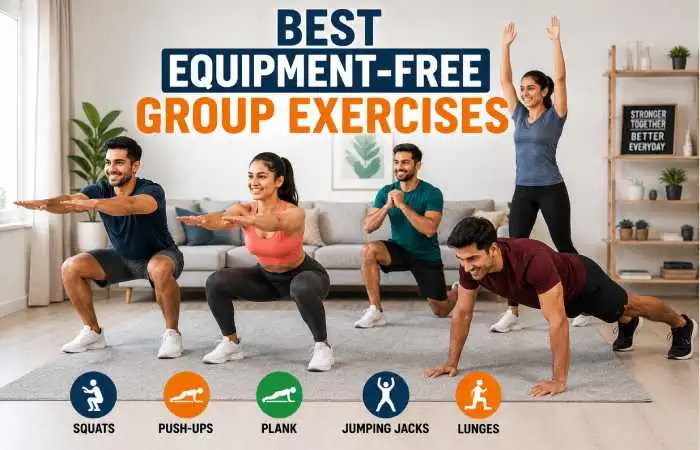
Best Equipment-Free Group Exercises
Equipment-free group aerobics are a cost effective, portable, and effective way for participants of all ages and fitness levels to become healthier. These body weight movements do not require expensive gym machines or weight, and enhance flexibility, stamina, strength and coordination. Equipment-free gathering exercises are carried out in many places such as homes, schools, offices and parks to stimulate communication.
Perhaps the best advantage of bodyweight group exercises is their accessibility. Without the use of exercise machines or weights, individuals can focus their attention to coordination, movements and constancy. These group exercises will enable members to work out regardless of their past experiences and fitness levels.
Benefits of Equipment-Free Group Exercises
Bodyweight workouts provide physical and mental benefits by improving cardiorespiratory fitness, stability, muscular strength and elasticity, and decrease expenditure for fitness.
Group workouts also growth motivation because participants encourage each other to stay active and whole the exercises together.
Key Benefits of Equipment-Free Workouts
| Benefit | Description |
| Cost-Effective | You don’t need any equipment or gym memberships |
| Easy Accessibility | Can be performed anywhere |
| Improved Fitness | Enhances strength and endurance |
| Group Motivation | Encourages teamwork and consistency |
| Flexibility | Suitable for all fitness levels |
| Time-Saving | Quick and efficient workouts |
Jumping Jacks
Another classic no equipment group fitness routine, jumping jacks are simple, energetic, and are a perfect workout warm-up routine.
This exercise improves:
- Heart health
- Coordination
- Stamina
- Full-body movement
Another classic no equipment group fitness routine, jumping jacks are simple, energetic, and are a perfect workout warm-up routine.
Jumping Jack Benefits
| Feature | Advantage |
| Full-Body Exercise | Engages arms, legs, and core |
| Cardio Workout | Increases heart rate |
| Beginner-Friendly | Easy for most participants |
| Warm-Up Exercise | Prepares muscles for activity |
Squats
Squats are an excellent bodyweight exercise and strengthen the muscles of the lower body. The areas that they work include the thighs, hip, glutes and calves.
A group workout could involve incorporating something like a challenge, e.g. Squat challenges, timed sets of squats, and turn the exercise into a competitive thing.
Muscles Targeted by Squats
| Muscle Group | Function |
| Quadriceps | Strengthens thighs |
| Glutes | Improves lower-body power |
| Hamstrings | Supports leg movement |
| Core Muscles | Improves stability |
Squats also help improve posture, balance, and mobility.
Push-Ups
Classic bodyweight exercise, building upper body strength. They can be adjusted to suit all fitness levels, perfect for use in group exercise.
Benefits include:
- Stronger chest muscles
- Improved arm strength
- Better core stability
- Enhanced endurance
If people want, the could even hold a push-up competition or a push-up routine between two people.
Push-Up Variations
| Variation | Difficulty Level |
| Wall Push-Ups | Beginner |
| Knee Push-Ups | Moderate |
| Standard Push-Ups | Intermediate |
| Decline Push-Ups | Advanced |
Plank Exercises
Planks are great for building up core strength and improving your posture; there is no movement involved but the action works multiple muscle groups simultaneously.
A challenge for a group plank exercise is also frequent since there will be people motivating others to hold out longer.
Benefits of Plank Exercises
| Benefit | Description |
| Core Strength | Strengthens abdominal muscles |
| Better Balance | Improves body stability |
| Posture Support | Reduces back strain |
| Full-Body Activation | Engages multiple muscle groups |
Lunges
This build strength and flexibility in the legs as well as developing coordination. They’re a great addition to group circuits as you can do them in lines or rotating through stations.
This exercise mainly targets:
- Glutes
- Thighs
- Hamstrings
- Calves
Lunges also improve balance and joint mobility.
Burpees
High intense exercise that incorporate cardio and strength in one workout called burpees. Even though these exercises are tough, they are great calorie burning and endurance building exercises.
When in group burpee classes it gives a lot of enthusiasm and encouragement because everyone pulls each other to keep the energy going.
Burpee Workout Advantages
| Feature | Benefit |
| High-Calorie Burn | Supports weight management |
| Full-Body Workout | Engages multiple muscle groups |
| Cardio and Strength | Combines both training styles |
| Improves Endurance | Boosts stamina |
Mountain Climbers
Mountain climbers – They are quick exercises that work your abs, and also help you get fit.
This exercise helps improve:
- Agility
- Coordination
- Core stability
- Fat burning
In group workouts, mountain climber intervals add intensity and energy to the session.
Don’t have access to fitness gear? Try these no-equipment group exercises at home that rely on bodyweight movements to deliver an effective workout.
Beginner Group Exercises
Scheming beginner group exercises at home requires a different approach than generic fitness plans. The neutral is not intensity—it is movement value, confidence-building, and steadiness. A well-structured learner program reduces injury risk while ensuring all members feel included and talented.
What Defines a Beginner in Group Workouts?
A beginner is not just someone new to exercise. In group settings, beginners may include:
- People returning after a long break.
- Persons with low stamina
- Aged adults or mixed-age participants
- Those unacquainted with exercise form
Core Principles of Beginner Group Training
- Low Impact Over High Intensity
Avoid:
- Jumping movements
- Fast transitions
- Complex coordination drills
Focus on:
- Controlled, steady movements
- Joint-friendly movements
- Ease and Repeatability
Beginners perform better when:
- Exercises are easy to understand
- Movements are repeated across sessions.
Rule: Limit each session to 5–6 core exercises.
- Group Synchronization
In beginner groups, synchronization improves:
- Engagement
- Rhythm
- Confidence
Example:
- Everyone performs squats together for 10 reps.
- Count aloud as a group.
- Emphasis on Form and Posture
Incorrect form is the biggest risk factor for beginners.
Focus Areas:
- Neutral spine
- Controlled living
- Joint alignment
Best Beginner Group Exercises
- Bodyweight Squats
The legs and glutes are the muscles
In what way: Stand and place hands on thighs to guide hips down to sitting, keeping chest tall.
Learner Tip: This is where a chair can be beneficial as a target.
- Wall Push-Ups
Chest and Arms are the muscles
In what way: Push against a wall instead of floor
Why: The risk is diminished when the pressure on the wrists and shoulders are reduced.
- Marching in Place
Muscles: Full body (light cardio)
In what way: Lift knees alternately
Benefit: The risk of coordination and improving heart rate are two main points.
- Standing Side Leg Raises
The legs and hips are the muscles
In what way: Lift one leg sideways deliberately
Suggestion: Hold onto a wall for extra stability.
- Seated Knee Extension
Quadriceps are the Muscles.
In what way: Extend leg while seated
Best for: Seniors or low-mobility participants
- Basic Plank (Modified)
Muscles: Core
In what way: Hold position on knees
Duration: 10–20 seconds
Structured Beginner Group Workout Plan (30 Minutes)
| Activity | Phase | Duration |
| Marching, arm circles | Warm-up | 5 mins |
| Squats, wall push-ups | Round 1 | 8 mins |
| Leg raises, marching | Round 2 | 8 mins |
| Modified plank | Core | 4 mins |
| Stretching | Cool-down | 5 mins |
Beginner-Friendly Group Workout Formats
- Follow-the-Leader
- One person demonstrates
- Others follow
- At the end of each set switch leaders.
- Circle Workout
- Stand in a circle
- Perform the same exercise together.
- Partner Support Training
- Work in pairs
- Provide feedback on form.
Progression Strategy
Gradually advance the difficulty level.
Weekly Progression Model
| Week | Change |
| Week 1 | Learn movements |
| Week 2 | Increase the reps during the second week |
| Week 3 | Add additional exercises during the third week |
| Week 4 | Add low intensity to the fourth week |
Common Beginner Mistakes
| Mistake | Problem | Solution |
| Going too fast | Poor form | Slow down reps |
| Skipping warm-up | Injury risk | Always warm up |
| Comparing with others | Demotivation | Focus on personal pace |
| Overtraining | Fatigue | Rest days required |
Equipment Recommendations for Beginners
Though all this can be done using just body weight. It is highly beneficial to include some pieces of equipment into the routine to make it more exciting.
| Equipment | Purpose | Priority |
| Yoga mat | Comfort | High |
| Resistance bands | Light strength | Medium |
| Chair | Support | High |
Fun Group Cardio Workouts
Cardio becomes more sustainable when it’s enjoyable. (sciencealert)
Engaging Cardio Ideas
- Dance workouts (Zumba-style)
- Fitness games
- Shadow boxing rotations
- Step challenges
Cardio Group Circuit
| Exercise | Time |
| High knees | 30 sec |
| Jump squats | 30 sec |
| Skipping (imaginary rope) | 30 sec |
| Rest | 30 sec |
Repeat 4–6 rounds.
2026 Insight
Gamified workouts increase participation by 50%+, based on fitness app engagement trends.
Group Strength Training Ideas
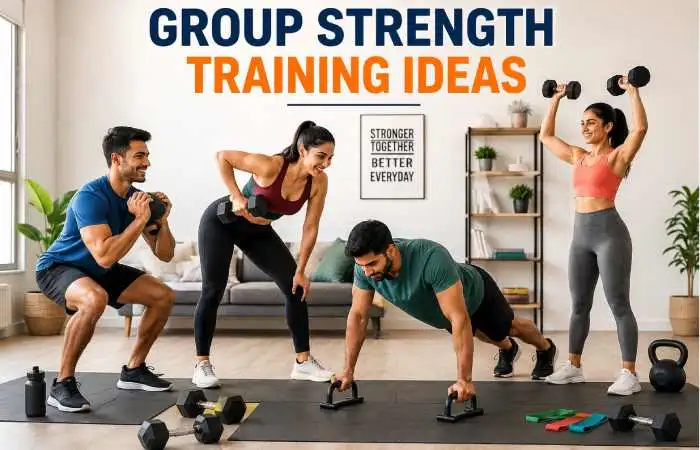
Strength training is essential for:
- Muscle growth
- Fat loss
- Metabolic health
Best Equipment for Groups (2026 Comparison)
| Equipment | Best For | Price Range (India) | Recommendation |
| Resistance Bands | Beginners | ₹300–₹1200 | Highly recommended |
| Dumbbells | Intermediate | ₹800–₹5000 | Versatile |
| Kettlebells | Advanced | ₹1500–₹6000 | Space-dependent |
| Yoga Mats | Comfort | ₹500–₹2000 | Essential |
Example Strength Circuit
- Squats – 12 reps
- Push-ups – 10 reps
- Resistance band rows – 12 reps
- Shoulder press – 10 reps
Repeat 3–4 rounds.
Group HIIT Exercises
Group HIIT exercise is one of the best exercise to improve fitness, keep high energy, high motivation. High-intensity interval training(HIIT) is exercise using short intense bursts of physical activity followed by brief rest periods. Group HIIT exercise makes your workout funnier, more competitive, and engaging. You can do this at home, outdoors or in fitness studio. No matter what level of fitness you are, there is a suitable group HIIT exercise.
What Are Group HIIT Exercises?
Group HIIT exercise is an exercise done together by a group of people using structured pattern at a higher intensity. Group HIIT typically combines cardio, body weight, strength training, endurance and so on.
A typical HIIT workout includes:
- 20–45 seconds of intense exercise
- 10–30 seconds of rest or recovery
- Multiple rounds of different exercises
The primary focus is the elevation of heart rate rapidly so as to reduce the time required for the body to burn calories effectively.
Common Features of Group HIIT Workouts
| Feature | Description |
| Short Workout Duration | Usually takes about 20-45 minutes of time. |
| Intensity of Training | Exercises in rapid sequence without longer break times. |
| Variety of Exercises | Cardiovascular, strength and core training combined in sessions. |
| Motivation | Provided by other people of a similar group. |
| Location Flexibility | Training is possible at home, in fitness clubs or in the open. |
For those who want to improve endurance and burn calories, these group cardio workouts offer an effective way to boost cardiovascular fitness at home.
Benefits of Group HIIT Workouts
Group HIIT has a host of advantages on both physical and mental health. A main benefit of group HIIT is calorie expenditure. It’s an effective method of calorie burning which continues long after the actual workout thanks to the “afterburn” effect, also known asEPOC (excess post-exercise oxygen consumption).
Other major benefits include:
- Cardiovascular health will improve.
- Stamina and endurance increase.
- The metabolism will increase at a faster rate.
- Muscle strength will increase.
- Flexibility and range of motion will increase.
A group setting will also increase motivation. People in the group can encourage each other through difficult exercises making them continue with fitness training.
Major Benefits of Group HIIT Exercises
| Benefit | How It Helps |
| Fat Burning | Burns calories quickly during and after workouts |
| Muscle Strength | Builds full-body strength |
| Better Endurance | Improves stamina and energy levels |
| Mental Wellness | Reduces stress and boosts mood |
| Time Efficiency | Effective workouts in shorter durations |
| Social Interaction | Encourages teamwork and accountability |
Many group exercise activities can also be adapted as women’s fitness exercises to support strength, flexibility, and overall wellness goals.
Why Group HIIT Is More Effective
Working out in a group setting usually has some benefits to how your workout performs. The feeling that others are working out next to you, their motivation to keep you going at it really pushes you further than you would normally go. The group setting also provides an environment of accountability to where if you don’t go to the gym for it you can’t just decide to blow it off.
A lot of people enjoy group HIIT over working out alone because working out alone is not an interactive experience but the group setting provides just that. It allows interaction, uses a music backdrop, promotes working together to reach a goal in addition to making people have fun.
Working out in a group may have great benefits for an individual in reducing stress, and improving mood. In addition to exercising and producing endorphins, you also create social interaction and eliminate the isolation and boredom that some people feel when they are working out.
If your group enjoys fast-paced routines that improve endurance and burn calories efficiently, consider adding HIIT training workouts to your home fitness sessions.
Group HIIT vs Solo HIIT
| Factor | Group HIIT | Solo HIIT |
| Motivation | High due to group support | Depends on self-discipline |
| Accountability | Strong | Limited |
| Enjoyment Level | More interactive | Can become repetitive |
| Social Benefits | Excellent | Minimal |
| Workout Consistency | Higher | Lower for many individuals |
Best Group HIIT Exercises to Try
The objectives and target muscle groups will change according to the type of HIIT exercise you opt for. A group HIIT exercise could include both cardio and strength and core exercise.
Building muscle and increasing overall strength is easier with structured group strength training exercises that can be performed with friends or family members.
Cardio-Based HIIT Exercises
These exercise primarily aim to increase cardiovascular health and fitness.
| Exercise | Main Benefit |
| Jumping Jacks | Whole body cardiovascular exercise |
| High Knees | Enhances endurance |
| Jump Rope | Fast calorie burn |
| Sprint Intervals | Increases cardiovascular fitness |
| Skaters | Improves agility and balance |
All these activities raise the heart rate very fast and boost up burning calories.
For those looking to burn calories and improve overall fitness, our collection of group exercises for weight loss offers effective workouts that can be done with friends or family at home.
Strength-Focused HIIT Exercises
The strength based HIIt workout aims at developing muscles and boosting the overall fitness.
| Exercise | Target Area |
| Push-Ups | Chest and arms |
| Squats | Legs and glutes |
| Lunges | Lower body |
| Dumbbell Presses | Upper body |
| Plank Holds | Core stability |
These moves tone up your upper body, lower body and your core.
Core HIIT Exercises
It helps in improving posture, balance and stability.
| Exercise | Core Benefit |
| Bicycle Crunches | Strengthens abs |
| Russian Twists | Improves oblique strength |
| Leg Raises | Targets lower abs |
| Mountain Climbers | Core and cardio training |
| Plank Shoulder Taps | Enhances stability |
Theses moves target abdominal and lower back muscles greatly.
Safety Tips for Group HIIT Workouts
Though it is an effective workout but one must follow safety measures:
Participants should:
- Warm-Up before working out
- Stay Hydrated
- Use comfortable workout clothes
- Proper Form of exercise
- Take breaks if necessary
Beginners should always begin with simple to difficult moves.
Important Safety Guidelines
| Safety Tip | Purpose |
| Warm-Up Exercises | Prepares muscles and joints |
| Hydration | Prevents dehydration |
| Proper Footwear | Reduces injury risk |
| Correct Form | Prevents muscle strain |
| Rest Periods | Allows recovery between sets |
Safety Tips for Group Workouts
While groups training are still as efficient they bring more risks because training space is shared, members of the group have different physical standards and people can be competitive within their group. Below there is some particular rules and tips that I can show and that I have been used and found them helpful to reduce risks of injuries and make your training more effective:
-
Appropriate Spacing and Organization Control
Minimum spacing guideline:
- 1.5 to 2 meters per person
Why it matters:
- Avoid collision between exercises like lunges, burpees, and all jumping exercises
- Enables unhindered movement in each exercise
Best Practice Setup:
- Assign fixed workout zones per person.
- Use mats or floor markers.
- Place equipment together in one space so as not to have anything in the way.
-
Warm-Up is Essential!
Skipping warm ups is a leading cause of injuries that happen in the gym.
Ideal warm up process (5-8 minutes):
- Cardio Warm Up(marching in place/ jogging) – 2 minutes
- Dynamic Warm Up( leg swings/arm circles) – 3 minutes
- Muscle activation(glute bridges, shoulder taps) – 2 minutes
Outcome:
- Increases blood flow
- Improves joint mobility
- Reduces muscle strain risk
Older adults looking for safe and effective routines can benefit from senior fitness workouts that focus on mobility, balance, and maintaining an active lifestyle.
-
Prioritize Form Over Speed or Competition
Group environments often trigger over-competition, leading to poor form.
High-Risk Exercises:
- Burpees
- Jump squats
- Push-ups (fatigue-related collapse)
Correction Strategy:
- Introduce a “form-first rule”.
- Pause rounds for posture correction.
- Use a designated “form checker” role.
-
Scale Exercises for Mixed Fitness Levels
In most group settings, participants vary in:
- Strength
- Endurance
- Mobility
Solution: Provide Tiered Variations
| Exercise | Beginner | Intermediate | Advanced |
| Squats | Chair squats | Bodyweight squats | Jump squats |
| Push-ups | Wall push-ups | Standard | Decline push-ups |
| Plank | Knee plank | Full plank | Plank with shoulder taps |
Result:
Everyone trains safely without overexertion.
-
Manage Fatigue and Rest Intervals
Fatigue significantly increases injury probability.
Recommended Structure:
- Work: 30–45 seconds
- Rest: 30–60 seconds
Group Tip:
- Use a shared timer
- Synchronize rest periods
-
Hydration and Temperature Control
Overheating and Dehydration are possible even when indoors.
Guidelines:
- Drink water every 10–15 minutes.
- Make sure that there is sufficient ventilation (fans/windows).
- Don’t be in crowded room.
Warning Signs:
- Dizziness
- Excessive sweating
- Rapid fatigue
-
Safe Use of Equipment (If Applicable)
Improper equipment use is a major injury trigger.
Checklist:
- Inspect resistance bands for tears.
- Secure dumbbell grip
- Use non-slip mats
Group Rule:
- One person uses the equipment at a time (if limited)
-
Clear Communication and Role Assignment
Confusion during workouts leads to:
- Timing errors
- Movement clashes
Assign Roles:
- Leader → Calls exercises
- Timer → Tracks intervals
- Observer → Monitors safety/form
-
Injury Awareness and Immediate Response
Ignoring minor discomfort can escalate into serious injury.
Stop Immediately If:
- Sharp pain occurs
- Joint instability is felt.
- Breathing becomes irregular
Basic Response Protocol:
- Rest
- Ice (if swelling)
- Avoid pressure on affected area.
-
Cool-Down and Recovery Protocol
This phase is easily forgotten but is also the most crucial part of any workout.
Cool down sequence (5 minutes):
- Breathing awareness, or slow walking
- Stretching (static hamstrings, calves, shoulders).
Benefits:
- Reduces muscle soreness
- Prevents stiffness
- Promotes recovery
FAQ Section for Best Group Exercises at Home
What are the best group exercises at home?
Good ones are squats, push ups, planks, jumping jacks and HIIT.
How many people can work out together at home?
2–6 people, depending on available space.
Do group workouts help in weight loss?
Yes, they improve consistency and calorie burn.
Is equipment necessary?
No, but resistance bands and mats enhance results.
To keep participants motivated and engaged, try incorporating group workout challenges that encourage consistency, teamwork, and healthy competition.
Final Thoughts
Top home group fitness includes balance, simplicity, structure, and entertainment. When training at home, either as a beginner or as a fitness professional, working out in a group increases motivation, compliance, and results. The effective use of a range of bodyweight exercises, cardio, strength, and interval training, and most importantly, taking care and time on technique, can help you develop real home workout habits.
Ultimately, long-term success is due to neither strength nor the training method but consistency and adaptability. Start at a level that challenges you and is attainable, increase the difficulty gradually, and remember to make your workouts fun – because if you don’t look forward to it, you won’t do it.
Afiya Jafar is a fitness and wellness writer who focuses on making health, exercise, and healthy lifestyle information simple and practical. Her work covers workouts, fitness motivation, strength training, nutrition, weight management, stress management, mindfulness, and everyday wellness.
Read Full Bio of Afiya Jafar →
Sameena Begum reviews selected health, wellness, fitness, and digital content for clarity, factual presentation, consistency, and reader usefulness. Her review work helps maintain clear and responsible editorial standards across PhysicalFitt content.
Read Full Bio of Sameena Begum →
Dr. Khizrana Begum is a qualified medical professional with MBBS and MD qualifications and 5+ years of experience in the medical field. She works as a General Physician and Dermatologist, with expertise in general medicine, dermatology, preventive healthcare, and skin health.
Read Full Bio of Dr. Khizrana Begum →