
Last Updated: July 24, 2026
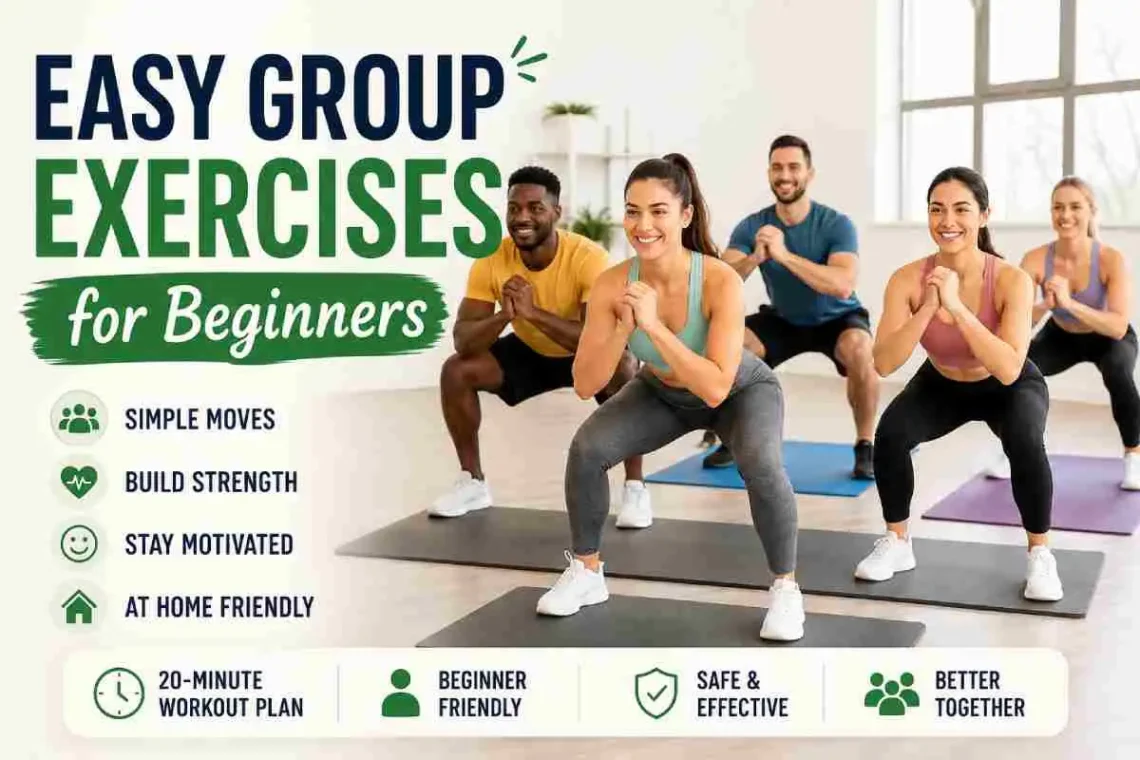
Taking on your first fitness routine can be daunting, especially if you’re trying to make changes on your own. Easy Group Exercises for beginners are one of the biggest fitness trends in 2026 for this exact reason. Group exercises offer motivation, accountability, social support and an environment of support that makes it easy for beginners to stay on track.
Why Beginner Group Training Works
When working in groups the team helps each other to stay motivated.
Key Benefits
| Benefit | How It Helps Beginners |
| Accountability | Reduces skipped workouts |
| Motivation | Encourages consistency |
| Social Support | Makes exercise enjoyable |
| Better Adherence | Higher long-term success |
| Confidence Building | Easier learning environment |
| Lower Stress | Makes fitness less intimidating |
For the average beginner it is more enjoyable and easier to work out with others rather than on their own.
Best Easy Group Exercises for Beginners
The exercises that are suitable for the beginner are as follows- Simple, low impact, easily adaptable.
- Chair Squats
The chair squat introduces a perfect squating movement while strengthening glutes and legs.
How To Perform
- Stand in front of a chair.
- Lower yourself slowly.
- Lightly touch the chair.
- Return to standing.
Recommended:
- 10–12 reps
- 2 rounds
- Wall Push-Ups
The wall push up is the perfect exercise for an exercise beginner who cannot do regular pushups yet.
Benefits
- Strengthens chest
- Improves shoulder stability
- Low joint stress
Recommended:
- 10 reps
- 2 rounds
- Marching in Place
A simple cardio exercise suitable for all fitness levels.
Benefits
- Raises heart rate safely
- Improves coordination
- Great warm-up movement
Recommended:
- 60 seconds
- Bird Dogs
Excellent for core stability and posture improvement.
Benefits
- Core activation
- Balance training
- Lower back support
Recommended:
- 8 reps per side
- Group Plank Hold
Participants hold a plank together for a shared challenge.
Beginner Version
- Wall plank
- Incline plank
- Knee plank
Recommended:
- 20–30 seconds
- Step-Ups
Step-ups mimic daily movement patterns and improve leg strength.
Benefits
- Functional fitness
- Balance improvement
- Beginner-friendly progression
Recommended:
- 10 reps per leg
Comparison Table: Beginner Group Exercises
| Exercise | Calories Burned* | Difficulty | Equipment |
| Marching in Place | 40-60 | Very Easy | None |
| Chair Squats | 50-70 | Easy | Chair |
| Wall Push-Ups | 30-50 | Easy | Wall |
| Bird Dogs | 25-40 | Easy | None |
| Step-Ups | 60-90 | Easy | Step/Platform |
| Group Planks | 40-60 | Moderate | None |
How to Start Group Workouts Safely at Home
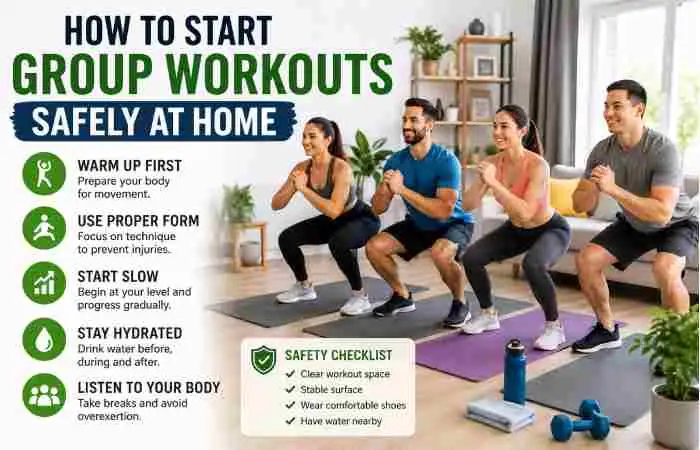
Safety should always be the first priority.
Beginner Safety Checklist
Warm Up First
Spend 3–5 minutes performing:
- Marching in place
- Arm circles
- Shoulder rolls
- Gentle stretching
Maintain Proper Form
Focus on:
- Controlled movements
- Neutral spine
- Comfortable range of motion
Progress Gradually
A health and fitness expert would tell you to start with lower volume and increase sets/reps over time.
Stay Hydrated
Sample 20-Minute Beginner Group Workout Plan
Warm-Up (3 Minutes)
| Exercise | Time |
| Marching in Place | 1 min |
| Arm Circles | 1 min |
| Shoulder Rolls | 1 min |
Main Workout (15 Minutes)
Perform 2 rounds.
| Exercise | Reps |
| Chair Squats | 12 |
| Wall Push-Ups | 10 |
| Bird Dogs | 8/side |
| Step-Ups | 10/leg |
| Plank Hold | 20 sec |
Rest 60 seconds between rounds.
Cool Down (2 Minutes)
- Deep breathing
- Light stretching
- Shoulder mobility exercises
Benefits of Beginner-Friendly Group Training
The group fitness sessions being aimed at the beginners provide you with more than just a workout: they support you on a new level, teaching new exercisers the correct movements, offering motivation and encouraging the establishment of good, habits without the stress.
Whether it is the friends or family you meet at a gym, the colleagues at the office, or members of an online fitness community, exercise in the company of others will be a great addition to your long term fitness routine.
Increased Motivation and Accountability
Exercise is dropped quickly and easily by most beginners. The group training aspect provides the commitment that makes this more difficult.
Benefits include:
- Greater workout consistency
- Reduced likelihood of skipping sessions
- Positive encouragement from group members
- Stronger commitment to fitness goals
Builds Confidence for New Exercisers
The group workouts for beginners offer a non-threatening and friendly environment for those new to the workout programs. They fear the possibility of working out incorrectly and being looked at and analyzed.
There are various benefits to the build-up of confidence; for example:
- Learning new techniques
- Gaining support from others
- Reaching mini-milestones in the program
- Encouraging a positive outlook to exercise.
The increase in confidence levels helps the people participating in the program to attempt new exercises and be more active.
Makes Exercise More Enjoyable
People are also more motivated to exercise with other people around. It can be a lot more entertaining and enjoyable to work out with others, and this will motivate someone new to actually want to do their workout as opposed to feeling like it is another chore they need to do.
Popular group workout activities include:
- Circuit training
- Walking groups
- Partner exercises
- Fitness challenges
- Team-based workout games
Encourages Proper Form and Safety
A lot of beginner group programs focus on safety, with instructor or trainer or the more experienced group member guiding proper movement.
Safety benefits include:
- Reduced injury risk
- Better posture and technique
- Appropriate exercise modifications
- Gradual progression based on fitness level
Creates Long-Term Healthy Habits
The healthy habits that can be built through group exercise are:
- scheduling times to exercise,
- developing sensible goals,
- constantly checking your results,
- accountability and living an active life
Over time, these are not things you have to make an effort to do. They are life habits.
Suitable for All Fitness Levels
Examples include:
- Wall push-ups instead of floor push-ups
- Chair squats instead of deep squats
- Walking instead of jogging
- Shorter exercise intervals for new participants
This flexibility makes group training inclusive and accessible to a wide range of beginners.
Why Group Training Is Ideal for Beginners
Beginners may find that a group training environment is highly beneficial as it is comprised of all the elements of personal training without the extra financial commitment. Beginners will have a support system and be provided with accountability in a group setting that they may not get while working alone.
This group training for beginners, along with simple movements and attainable objectives, might perhaps be a perfect method to achieve greater fitness, improve confidence and build healthy habits.
Common Mistakes New Exercisers Should Avoid
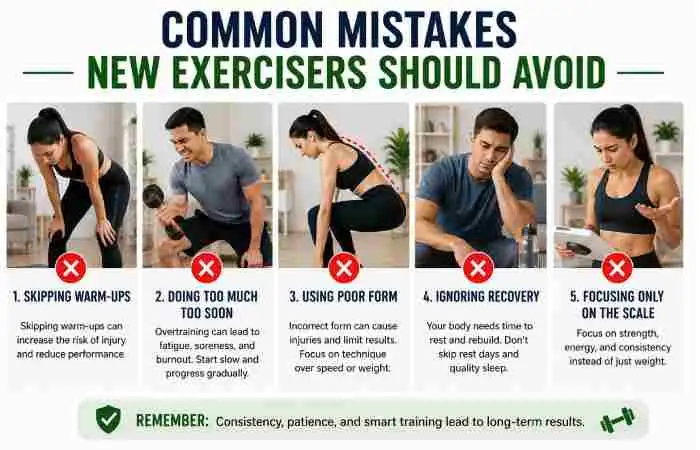
- Skipping Warm-Ups
Increases injury risk and reduces workout performance.
- Exercising Too Hard Too Soon
Many beginners stopped because they start with progressed routines rather than building a footing first.
- Comparing Yourself to Others
Progress should be measured against your own starting point.
- Ignoring Recovery
Rest days are necessary for muscle recovery and long-term stability.
- Using Poor Form
Always prioritize technique over speed.
Recommended Beginner Group Workout Setups
| Group Size | Recommended Format |
| 2-3 People | Circuit Training |
| 4-6 People | Partner Stations |
| 6-10 People | Relay Challenges |
| Remote Teams | Video Workout Sessions |
Conclusion
Your 2026 workouts can begin with the gentlest of easing-ins; the easiest and safest way to begin exercise, of course, would be enjoyable group exercises for beginners. Practicing simple movements while learning new techniques at your own pace and practicing frequently will increase your strength and cardiorespiratory fitness, increase your flexibility and improve your confidence while eliminating any costs related to equipment or gym memberships.
Group workouts with friends, family, and colleagues, or online will work best if practicing moderately at your own pace, practicing consistently and when practicing learned techniques.