
Last Updated: June 24, 2026
Consistent exercise, is for many, harder than commencing any form of fitness in the first place. Too many undertake their fitness journey with immense vigour but then after a few short weeks; motivation tends to falter and then what? In order to find sustained success, daily workout motivation strategies are fundamental.
Studies and personal training experts confirm time and time again, that, ‘super’ exercisers do not have some magical amount of motivation; in reality their fitness success hinges upon systems, habits, and accountability. Rather than waiting for ‘feelings of motivation’, they develop an environment where exercise is simple and almost an automaton.
Why Daily Workout Motivation Is Important
Benefits of maintaining workout motivation include:
- Better physical health
- Improved mental wellbeing
- Reduced stress levels
- Increased energy
- Better sleep quality
- Greater confidence
- Long-term weight management
They are saying that regular workouts will not only improve both the performance of the body and the mind but will also make you much less likely to abandon your fitness journey altogether.
Motivation vs Discipline
| Motivation | Discipline |
| Emotional | Behavioral |
| Temporary | Long-lasting |
| Depends on feelings | Depends on routine |
| Unpredictable | Reliable |
Simple Ways to Stay Motivated Every Day
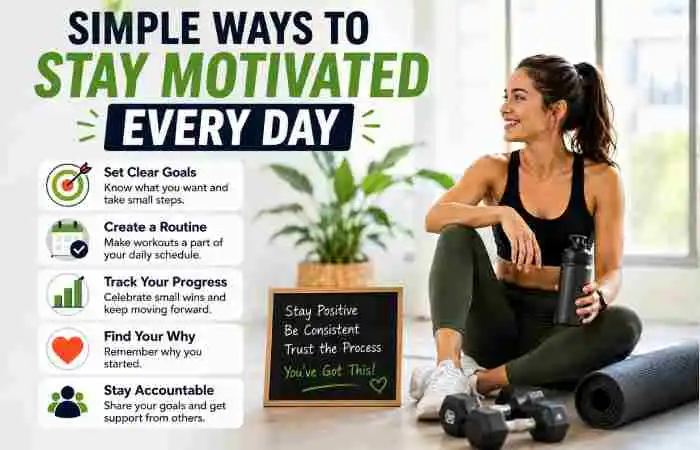
- Define Your Personal “Why”
Ask yourself:
- Do you want more energy?
- Better health?
- Weight loss?
- Improved confidence?
- Greater athletic performance?
People who connect exercise to personal values tend to stay committed longer.
- Start Small
It’s one of the biggest mistakes many beginners make to try to do too much, too soon.
Instead of:
❌ 90-minute workouts daily
Try:
✅ 15-20 minutes per day
Small wins build momentum.
- Schedule Your Workouts
Treat exercise like an important appointment.
Example:
| Time | Activity |
| 6:30 AM | Walk |
| 7:00 AM | Breakfast |
| 6:00 PM | Strength Training |
Research shows scheduled workouts significantly improve adherence rates.
- Track Progress
Tracking creates visible evidence that your efforts are working.
Track:
- Steps
- Workouts completed
- Weight lifted
- Body measurements
- Consistency streaks
Progress tracking is one of the strongest psychological motivators identified in fitness research.
- Find Activities You Enjoy
You don’t have to force yourself into workouts you hate.
Popular options include:
- Walking
- Cycling
- Swimming
- Yoga
- Dancing
- Strength training
- Sports
Enjoyment significantly increases long-term exercise adherence.
Creating a Personal Fitness Motivation Plan
A motivation plan creates structure.
Step 1: Set SMART Goals
These smart goals just naturally boost the chances of success by providing clarity.
Step 2: Create Weekly Milestones
Example:
| Week | Goal |
| 1 | Complete 3 workouts |
| 2 | Complete 4 workouts |
| 3 | Reach 8,000 daily steps |
| 4 | Increase workout duration |
Small milestones create regular feelings of achievement.
Step 3: Build Accountability
Accountability options:
- Workout partner
- Fitness coach
- Online community
- Habit-tracking app
- Family support
Community support consistently improves adherence rates.
Best Fitness Motivation Tools in 2026
| Tool Type | Benefits | Best For |
| Habit Tracker Apps | Streak tracking | Beginners |
| Smartwatches | Activity monitoring | Data lovers |
| Fitness Apps | Guided workouts | Home workouts |
| Online Communities | Accountability | Social motivation |
| AI Fitness Coaches | Personalized plans | Advanced users |
In recent years, many modern fitness platforms incorporate a game-like approach or progress tracking to help their users to stay on the right track.
Common Motivation Killers and How to Avoid Them
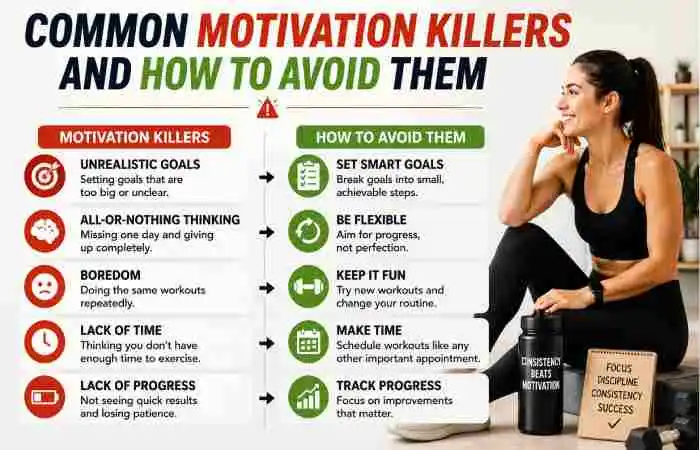
#1: Unrealistic Goals
Problem: Trying to lose 20 kg in a month.
Solution: Focus on gradual progress.
#2: All-or-Nothing Thinking
Many people believe:
“If I can’t do a full workout, I won’t exercise at all.”
Instead:
- Do 10 minutes.
- Take a walk.
- Complete one exercise.
Short workouts still count.
#3: Boredom
Fix boredom by:
- Changing workout styles
- Trying new exercises
- Joining classes
- Creating challenges
Variety improves consistency.
#4: Lack of Time
Use:
- 10-minute workouts
- Walking breaks
- Lunch workouts
- Home exercise sessions
Micro-workouts remain highly effective for busy schedules.
Long-Term Strategies for Exercise Success
Success is not born of finding daily inspiration; rather it comes from creating habits and systems which see you performing exercise for months and years on end. When you start an exercise routine you usually do it with a lot of energy and you really want to do it.. After a while a lot of people stop because it is not new anymore and they do not see big changes right away.
Focus on Consistency Over Perfection
Many people stop exercising because they think every time they exercise it has to be really great or that it should always be the time they ever had. Consistency trumps the intensity of your workout, though, because missing one workout won’t necessarily sabotage all your progress like totally quitting will. A casual twenty-minute walk, ten minutes of calisthenics in the living room, or just twenty minutes of stretching is perfect. You just need to build the habit of being there-even when you are swamped.
Create an Identity Around Fitness
I should stop thinking I need to work out and start thinking I am a person who looks after my health. This change in the way I think can make a difference. When taking care of my health becomes part of who I’m making good choices about my health feels easier and does not seem like a task. I am someone who takes care of my health. That is what health is all about, for me.
Examples include:
- Choosing to walk up the stairs of taking the elevator
- Taking a walk sometimes during the day
- Making time to exercise and treating it like an important meeting
- Trying to stay active when you are traveling
If you keep doing these small things they will help you keep wanting to live a healthy lifestyle. You will see that exercise is a part of living. It is good, for you. Exercise is something that you should do all the time like exercise is a part of your routine so exercise becomes a habit.
Set New Goals Regularly
When people get what they want they often stop trying. This is because they do not have a goal to work for. To keep going people need to make things to do. They need to make these new things a little hard so they can stay interested in what they’re doing.
People need to keep making goals for themselves. This is the way for people to stay motivated and keep trying. Making goals is, like making a new challenge for the person to complete. This challenge will help the person to stay focused and keep going.
Examples of new fitness goals:
| Example | Goal Type |
| Increase squat weight by 10% | Strength |
| Complete a 5K run | Endurance |
| Lose 5 kg gradually | Weight Loss |
| Improve flexibility through yoga | Mobility |
| Exercise 4 times per week for 3 months | Habit-Based |
Track Progress Beyond the Scale
Track metrics such as:
- Strength improvements
- Workout consistency
- Energy levels
- Sleep quality
- Daily step count
- Body measurements
- Athletic performance
Build a Support System
Accountability is considered a huge predictor of long-term exercise habits. Build a supportive network to support you to remain committed.
Adapt Your Routine as Life Changes
Adapt to life circumstances and routine flexibility A training program will naturally need to adjust over the time due to changes in your schedule, level of fitness, health, and other life events.
- An example: For the busy professional that is going to focus on shorter, more frequent workout sessions;
- A parent will probably have to opt for some home workout exercises;
- For more advanced fitness people will usually decide for some structure of fitness plans;
- For older adults with a less active lifestyle may try some more simple exercises for mobility and recovery etc.
Having said all this, the main purpose here of making such accommodations is not to excuse inactivity but to create long-lasting and sustainable habits in exercise.
Embrace the Long-Term Mindset
Fitness isn’t just a one-month program, it is a lifetime thing. You may only be seeing a slight progression, and that’s fine, in the long term, those small changes will add up and lead you to your desired fitness goal. Long term successful results in exercise are achieved through years of hard, disciplined work and lifestyle changes.
Troubleshooting: When Motivation Suddenly Disappears
| Problem | Solution |
| Feeling tired | Prioritize sleep and recovery |
| Bored workouts | Try a new activity |
| No progress | Reassess goals |
| Busy schedule | Use shorter workouts |
| Burnout | Take active recovery days |
Remember: motivation naturally fluctuates. Systems and habits carry you through low-motivation periods.
Conclusion
Top Daily Workout Motivation Strategies will not help you get a constant source of inspiration; they’ll create a structure that does the exercise work for you. It will involve defining your ‘why’ of exercise, setting attainable goals, tracking your progress, removing any barriers you face in terms of your routine, and not perfection.
People who can sustain fitness for the long haul aren’t motivated on a daily basis; they build habits that keep them moving. If you follow the above strategies you will build a successful fitness habit that will give you the desired results throughout 2026 and beyond.