

 Afiya Jafar
Fitness & Wellness Writer
Afiya Jafar is a fitness and wellness writer who focuses on making health, exercise, and healthy lifestyle information simple and practical.
Read Full Bio of Author →
Afiya Jafar
Fitness & Wellness Writer
Afiya Jafar is a fitness and wellness writer who focuses on making health, exercise, and healthy lifestyle information simple and practical.
Read Full Bio of Author →
 Sameena Begum
Health, Fitness & Digital Content Reviewer
Sameena reviews selected health, wellness, fitness, and digital content for clarity, factual presentation, and reader usefulness.
Read Full Bio of Reviewer →
Sameena Begum
Health, Fitness & Digital Content Reviewer
Sameena reviews selected health, wellness, fitness, and digital content for clarity, factual presentation, and reader usefulness.
Read Full Bio of Reviewer →
This makes sense if you’ve ever joined a gym full of motivation only to fizzle out within a few weeks – the same issue millions of people face. But it doesn’t have to be that way. With some strategic and tactical shifts based on the latest psychology, fitness science, and personal development tools, you too can find and harness sustainable gym motivation.
❝
This article is a part of
Gym Hub
What Is Gym Motivation?
Gym motivation is the driving psychological power which encourages you to begin working out, carry on working out and consistently get back into the gym. It’s not static and permanent, depending on your energy levels, moods, environment and clear goals. While it is very common to believe that gym motivation is what is necessary in order to successfully achieve results, it truly is simply a starting point.
The Three Stages of Gym Motivation
Gym motivation occurs through three main stages. Initiation – the power to begin training when you have no desire to do so and continue persistence – the drive to carry on working out and to be in a flow state and persistence – the drive to consistently be present at the gym over weeks and months (this is where the actual transformation happens).
Intrinsic vs Extrinsic Motivation
Most people fall into two kinds of motivated behavior when hitting the gym. First, we have intrinsic motivation: the one for which there is no reward other than satisfying oneself, getting some relaxation or making progress feel rewarding. And second, we have extrinsic motivation, for which we exercise for reasons that outside the experience itself – say, to get rid of some fat, build muscles or look better.
In many cases, beginners will mainly focus on extrinsic motivation because it’s very rewarding and can produce great results initially. It’s not until we manage to reach the inner rewarding power of the whole experience and turn it into intrinsic motivation that we truly succeed with consistency.
How Gym Motivation Works (Behavioral Science)
If we look from a behavioral standpoint, the cycle of motivation plays out as: Trigger -> Behavior -> Reward. Over and over, you’re wired to perform the behavior and become motivated. If you lay out clothes for the gym each night: the trigger is the routine; the behavior is the actual workout; the reward is feeling accomplished or having the endorphin rush after exercise. As you continue this loop you notice that at times you’re even less reliant on the idea of motivation because it starts to happen automatically.
Why Motivation Alone Is Not Enough
Huge misconceptions exist that we need motivation all the time. It’s often fickle anyway; it ebbs and flows and inevitably takes a hike when work and life gets busy, or you see less impressive results from your exercise regime. Anyone who relies solely on feeling motivated will quit within weeks.
The secret to stick-ability is converting motivation to a structured fitness plan.
It can be as simple as fixed workout days, easy to follow programmes, or low barrier behaviours. So in real-world terms: that is the difference between working out because you would like to and the reason you are going to as a result of that was your intention .
Why People Lose Motivation to Exercise
When motivation to exercise dwindles, it’s hardly out of the blue. It often unfolds according to familiar patterns of behavior concerning expectation, perceived progression and habit structuring. If these fundamentals don’t sync, individuals with the strongest initial drive may falter within weeks.
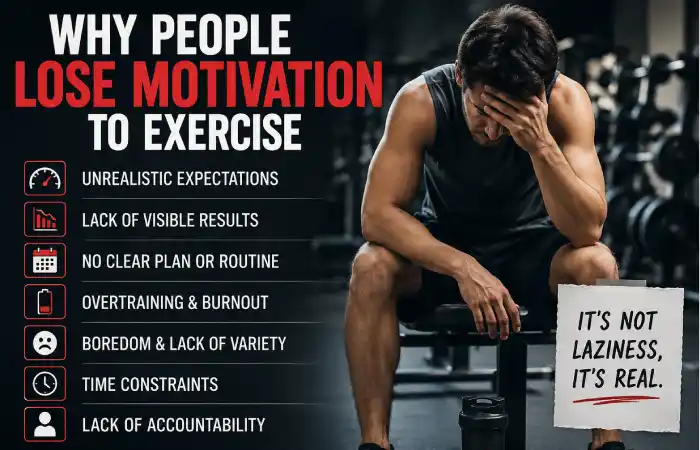
What Research Shows About Motivation Drop-Off (2026 Data)
Contemporary fitness adherence research (health behavioral outcomes and health club memberships) reveals the highest rates of dropping out appear within the initial eight to 12-week window of time and they aren’t tied solely to physical limitations – but largely psychologically and programmatically.
| Primary Reason for Losing Motivation | Percentage of Individuals | Core Issue |
| Lack of visible results | 40–45% | Unrealistic expectations |
| Time constraints | 25–30% | Poor scheduling systems |
| Low mental motivation | 15–20% | No habit formation |
| Physical fatigue / burnout | 10–15% | Overtraining |
| Boredom / lack of variety | 8–12% | Repetitive routines |
The evidence is overwhelming: loss of motivation isn’t driven by willpower.
Unrealistic Expectations and the “Quick Results” Trap
Beginner goals Many beginner exercisers anticipate seeing a significant difference within 2–3 weeks, but biological processes such as fat loss and muscle gain take time to develop. If you don’t get the results you anticipate, this creates a sense of failure and may cause you to give up.
| Fitness Goal | Expected Beginner Timeline (Realistic) |
| Fat loss | 0.5–1 kg per week |
| Muscle gain | 0.25–0.5 kg per month |
| Strength increase | Noticeable in 3–6 weeks |
| Visible body change | 6–12 weeks |
When individuals expect faster results than these benchmarks, motivation declines despite normal progress.
If you’re just starting your fitness journey, read our gym motivation for beginners guide to build confidence and create a sustainable workout habit.
Lack of Visible Progress (Measurement Problem)
Weight focus Relying on just one metric, like the number on your scale, is another pitfall, as many factors affect weight-including water balance, foods, and hormones.
This gives a false impression of a lack of progress.
| Tracking Method | Impact on Consistency |
| Weight only | Low adherence |
| Weight + measurements | Moderate adherence |
| Full tracking (strength, photos, logs) | High adherence (+30–35%) |
Scientific study finds that when individuals monitor several progress measures, they’re more likely to stick with a plan. When you don’t keep tabs on progress, it seems-even if it exists-to disappear and saps motivation.
Lack of Structure and Decision Fatigue
Unstructured exercises mentally drains us The act of having to determine what exercises will be done on the spot, what weight/intensity to be used on the same will automatically create variability between workouts.
| Workout Approach | Consistency Rate |
| Random workouts | Low |
| Basic weekly plan | Moderate |
| Structured program | High (+40%) |
Being consistent can be hard, especially when we are using a brain and this effort goes towards decision fatigue on a regular workout day as it requires thought. No “default mode” for you to automatically walk into the gym and crush a workout as mentally taxing as the last one 3 days prior.
Overtraining and Burnout
We’ve all heard stories of workout program writers advising to start high/intensity, that that’s the “key to progress.
Whilst the first session felt “product of physical labour” it more likely will be followed by more muscle soreness, and more mental drain. The brain will then subconsciously tie workout in with a feeling of pain and soreness, making motivation to even start go to zero.
| Training Style | Short-Term Effect | Long-Term Outcome |
| High intensity daily | Rapid fatigue | Dropout risk high |
| Moderate structured | Sustainable | High adherence |
| Progressive overload | Gradual growth | Best results |
When workouts consistently feel exhausting, the brain begins to associate exercise with discomfort, reducing motivation.
Lack of Routine and Habit Formation
When it’s not plugged into a schedule, you won’t feel motivated to do it. According to the science of behavior, consistency of any activity increases when the action is attached to a specific time, place. When habits build-up the less you’ll have to depend on the motivation.
| Workout Pattern | Adherence Level |
| “Whenever I feel like it” | Very low |
| Flexible schedule | Moderate |
| Fixed routine (same days/time) | High (+50%) |
The more it depends on a habit, the less depends on motivation.
Absence of Accountability
The influence of the environment accountability for consistency Accountability has a verifiable relationship to consistency. Regardless of how it’s done through external social interaction systems or data collection, the process generates commitment.
| Accountability Type | Success Rate |
| None | Low |
| Self-tracking | Moderate |
| Workout partner | High |
| Coach/trainer | Very high (+60%) |
Without accountability, skipping workouts has no immediate consequence, making it easier to quit.
Boredom and Repetitive Training
Repetition without progression leads to disengagement. Even effective routines can fail if they lack variation or challenge.
| Training Style | Engagement Level |
| Repetitive routine | Low |
| Progressive overload | Moderate |
| Varied structured plan | High |
Mental engagement is as important as physical effort for long-term adherence.
Lifestyle Constraints and Time Pressure
Time is one of the most cited barriers. However, research suggests the issue is often prioritization rather than actual lack of time.
| Workout Duration | Adherence Rate |
| 60+ minutes | Low |
| 30–45 minutes | High |
| 15–20 minutes | Moderate |
Short, consistent workouts are more sustainable than long, irregular sessions.
Benefits of Staying Motivated in the Gym
Maintaining gym motivation is the key to the quality of consistency and long-term results you experience in the gym. Consistency and sustained motivation creates a positive upward cycle where small actions compound over time into radical physical and mental change. When motivation is present and established habits accompany it, progress builds exponentially.
Consistency Leads to Measurable Physical Results
The immediate perk of gym motivation is consistency – without it, you can’t expect any progress at all in your workouts.
| Fitness Outcome | Low Consistency | High Consistency |
| Fat loss | Minimal | Steady (0.5–1 kg/week) |
| Muscle gain | Negligible | Progressive growth |
| Strength levels | Stagnant | +20–40% increase (8–12 weeks) |
Training on a consistent basis boosts strength, endurance, and body composition consistently.
Improved Mental Health and Stress Regulation
Without regular workouts due to lacking motivation, progress can cease or plateau. Mental Health boost Exercise causes an increase of endorphins, dopamine, and serotonin in the brain to help improve our mood, reduce stress.
| Mental Health Factor | Effect of Regular Exercise |
| Stress levels | Reduced significantly |
| Anxiety | Decreases over time |
| Mood stability | Improves consistently |
| Focus & productivity | Enhanced |
Individuals who stay motivated to exercise report better emotional resilience and improved daily performance.
Development of Discipline and Self-Control
Maintaining motivation in the gym slowly builds into a form of self-discipline. This builds control over yourself in the gym which gradually moves to work, studying, and other parts of your life.
| Behavior Area | Impact of Gym Consistency |
| Time management | Improved |
| Goal setting | More structured |
| Daily habits | More consistent |
Over time, the gym becomes a training ground not just for the body, but for mental discipline.
Higher Energy Levels and Daily Performance
Exercising regularly not only improves health but energy levels as well because your cardiovascular system works more effectively and delivers oxygen better throughout your body.
| Energy Indicator | Before Consistency | After Consistency |
| Daily fatigue | High | Reduced |
| Stamina | Low | Improved |
| Productivity | Fluctuating | Stable |
This makes it easier to stay active and productive throughout the day.
Reduced Risk of Lifestyle Diseases
People know exercise takes energy but consistent training will leave you with an overall more energized feeling. The longer you workout on a consistent schedule the higher your chances are of having an improved lifespan.
| Health Condition | Risk Reduction with Regular Exercise |
| Heart disease | 30–40% lower risk |
| Type 2 diabetes | 25–35% lower risk |
| Obesity | Significantly reduced |
| High blood pressure | Improved control |
These benefits are only achieved when motivation leads to consistent action.
Better Body Image and Confidence
Sticking to exercising month and month year on year is where this benefit lies. With the improvements in your physique from working out combined with consistency builds self confidence and this goes way beyond the way your clothes fit or how you look in the mirror.
| Confidence Factor | Impact |
| Body image | Improves gradually |
| Self-esteem | Increases |
| Social confidence | Enhanced |
People who stay consistent with their workouts tend to feel more in control of their lives.
Long-Term Habit Formation
One of the most underrated benefit to remaining motivated is to move from trying and action to habit and automaticity. Working out becomes you and not something you need to push yourself for each session.
| Stage | Description |
| Motivation phase | Requires effort and reminders |
| Habit phase | Becomes routine |
| Lifestyle phase | Fully integrated into daily life |
Research indicates that it takes approximately 6–10 weeks of consistent behavior for gym routines to start becoming automatic.
How to Build Long-Term Workout Motivation
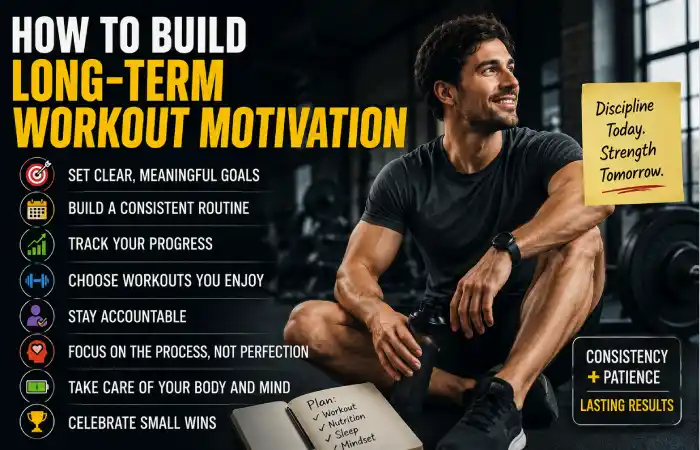
Motivation should not be relied upon—it should be engineered.
- Set Process-Based Goals
Instead of “lose 10 kg,” aim for:
- “Workout 4 times per week”
- Use Habit Stacking
Attach workouts to existing habits:
- After brushing teeth → 10-minute warm-up
- Track Progress Visually
Apps and logs increase adherence by up to 33% (2026 data)
- Reduce Friction
- Prepare gym clothes in advance
- Choose a nearby gym
Motivation vs Discipline
What’s the distinction between drive and self-control- is most important for lifetime wellness: A large number of individuals begin by drawing ondriveor drive. BUTthose folks that truly obtain long term success must rely ondiscipline. If you recognize how the two work and connect with each other it’s often a match-maker orbreaker-whether it is possible to consist of OR start/stop with regard to ever before.
Understanding the difference between motivation vs discipline can help you stay consistent even when you don’t feel like exercising.
What Is Motivation?
When we think about motivation we are thinking about the psychological and emotional stimulus that you feel to move to action. Inspiration can provide it, but sometimes just sheer feeling of enthusiasm for improvement or the need to change like trying to get fit or gain muscle. Unfortunately, it’s motivation’s temporary and unreliable nature, that becomes the downfall of your workouts.
Motivation levels are always high when we first begin any fitness programs, however, it all dies down as soon as you start losing steam.
This occurs anytime training becomes the norm, the workout seems to repeat itself a million times or you have so much on yourplate–that is the sole reason you might start enthusiastically and then your motivation seems to start slipping.
What Is Discipline?
Discipline refers to the action you take despite how you feel. It is formed from repetition, discipline, and routines, not feelings. Discipline does not ebb and flow like motivation.
It’s dependable and consistent.
For instance, discipline means you do not opt out of a workout, just because you feel less motivated to exercise on any given day.
Key Differences Between Motivation and Discipline
| Factor | Motivation | Discipline |
| Nature | Emotion-driven | Habit-driven |
| Reliability | Inconsistent | Consistent |
| Duration | Short-term | Long-term |
| Trigger | Inspiration, goals | Routine, systems |
| Impact | Helps you start | Helps you continue |
This distinction explains why motivation alone is not enough for sustained fitness progress.
What Research Indicates (2026 Behavioral Data)
Recent habit and fitness adherence studies show a clear pattern:
| Approach Used | 3-Month Consistency Rate |
| Motivation only | Low (20–30%) |
| Motivation + basic routine | Moderate (40–50%) |
| Discipline-based systems | High (65–80%) |
Why Motivation Fails Without Discipline
Motivation is such a temperamental beast. You can feel unmotivated in an instant if you didn’t get enough sleep, you’re stressed out, nothing seem to be showing, you had an argument and everything can affect your motivation and make you unmotivated and people without systems just stop working out. Motivation falls, routine breaks down. This is where discipline comes in – it gets rid of the need to “feel” like doing work, that feeling of being “able” or “ready” to do it. Discipline means precommitedness.
How to Shift from Motivation to Discipline
We’re not looking for an end to motivation, we want a way to employ it wisely. Motivation comes handy when you want to begin with your workout schedule. But as for the continuous effort, discipline comes into the picture.
A practical approach is to:
- Fix specific workout days and times
- Follow a simple, repeatable routine
- Reduce decision-making before workouts
- Track consistency instead of relying on feelings
Over time, repeated behavior reduces resistance, and workouts become automatic.
The second approach produces consistent results because it does not depend on emotional state.
Best Gym Motivation Tips
What to do when you lack motivation in the gym Gym motivation isn’t born in a bolt of inspiration; it occurs as a set of internal systems, designed to remove hurdles for working out, create habits, and lock in engagement of your mind. The recommendations here are informed by scientific data on behavior change, exercise adherence, and real-life.
Focus on Process, Not Just Results
The key to sticking with motivation? Learn to reframe from outcome goals to process goals. Rather than focus your attention on what the final results might be, like whether you’re building muscle or losing weight, take into consideration and have power over what can get you there each day, like getting to the gym for every intended session or reaching your daily step goal.
These practical gym motivation tips will help you overcome excuses and make fitness part of your daily routine.
| Goal Type | Example | Sustainability |
| Outcome-based | Lose 10 kg | Low |
| Process-based | Train 4 times per week | High |
Process goals create quick wins, which reinforce consistency and reduce frustration.
Build a Fixed Workout Schedule
Be consistent Work out at the same time each week, such as M W F 9am, T R 4pm and W F afternoon in time for dinner. Think of your workouts as non-negotiable.
| Schedule Type | Adherence Rate |
| Random timing | Low |
| Flexible schedule | Moderate |
| Fixed weekly routine | High (+40–50%) |
A fixed schedule reduces decision fatigue and makes workouts automatic over time.
Use Progress Tracking Systems
Monitoring progress makes the results more apparent which means motivation goes up; those who log exercises, are far more apt to stick with it.
| Tracking Method | Effectiveness |
| No tracking | Low |
| Basic logs (weights/reps) | Moderate |
| Full tracking (photos, strength, metrics) | High (+30%) |
Tracking also shifts your focus from short-term results to long-term progression.
Reduce Friction Before Workouts
| Friction Level | Example | Impact on Consistency |
| High | Long commute, unclear routine | Low |
| Moderate | Some preparation needed | متوسط |
| Low | Ready-to-go setup | High |
Lower friction increases the probability of action.
Train with Accountability
That accountability either through a gym buddy, trainer, and/or tracking tool enhances commitment and lessens your chances to flake.
| Accountability Type | Consistency Improvement |
| None | Baseline |
| Self-tracking | Moderate |
| Workout partner | High |
| Coach/trainer | Very high (+60%) |
External accountability adds a layer of responsibility beyond personal motivation.
Follow a Structured Program
The workout plan itself has to be there – when you don’t have to wonder about what’s for dinner (or workout) it will boost your activity.
| Workout Approach | Motivation Level |
| Random exercises | Low |
| Basic routine | Moderate |
| Structured program | High |
Structured training also allows you to measure progress more effectively, which reinforces motivation.
Introduce Variety Without Losing Structure
If routine is all well and good but doing the same old thing over and over is what will bore you out, bring some of controlled variations; switch exercises, workout type, intensity etc.
| Training Style | Engagement Level |
| Repetitive routine | Low |
| Structured + variation | High |
The goal is to keep workouts mentally stimulating without sacrificing consistency.
Reward Progress Strategically
Reward systems reinforce behavior. Small rewards after completing weekly goals can strengthen motivation.
| Reward Type | Example | Effectiveness |
| Immediate | Post-workout treat | Moderate |
| Short-term | Weekly reward | High |
| Long-term | Fitness milestone reward | Very high |
Rewards should support your goals rather than undermine them.
Setting realistic fitness goals and motivation strategies makes it easier to measure progress and stay committed.
Common Motivation Killers
Definitely do not let yourself do any of the above:
- don’t ignore the recovery days (burnout is real)
- don’t compare your progress to anyone
- never set your expectations too high
- don’t skip the sleep (your willpower can actually decrease)
Creating a Fitness Routine You Can Follow
Fitness routines will only be effective if you’ll able to stick to them long-term. The biggest mistake fitness enthusiasts commit is creating an “ideal routine,” which appears productive in theory, but actually too intimidating or time-consuming to continue as an everyday practice. Followability is the only criterion of an efficient fitness routine – ease, simplicity, and ease of integration into one’s day, not complexity or novelty.

Start With Your Real Schedule, Not an Ideal One
Realistic time sets the framework for a Sustainable Practice. Don’t ask me “how often do you workout” ask me “how often can I realistically workout”. My time Realism is driven by work, personal obligations, sleep, etc.
| Weekly Availability | Recommended Frequency | Sustainability |
| 2–3 days | Full-body workouts | High |
| 4 days | Upper/Lower split | High |
| 5–6 days | Split routine | Moderate |
Your adherence is considerably higher if it’s based on your true availabilities rather than some imaginary idealized scenario.
Keep the Structure Simple and Repeatable
If you have less need to decision, the routine is more likely to be followed by a successful performance.
A beginner-friendly structure typically includes:
- A warm-up to prepare the body
- A few compound exercises (covering major muscle groups)
- Optional accessory work
- A short cooldown
| Routine Complexity | Adherence Rate |
| Complex (10+ exercises) | Low |
| Moderate (5–7 exercises) | High |
| Simple (3–5 exercises) | Very high |
Simplicity reduces mental resistance, making it easier to stay consistent.
Choose Exercises You Can Perform Confidently
Many people lose motivation because they feel unsure about exercise technique or equipment usage. Confidence in execution plays a direct role in consistency.
Focus on basic, effective movements such as:
- Squats or leg presses
- Push movements (push-ups, bench press)
- Pull movements (rows, lat pulldown)
Mastering a small set of exercises is more effective than frequently switching routines without progression.
Balance Intensity With Recovery
Best program isn’t to do more but just enough and this gives body to recover. Over-training leads to burnout.
| Training Intensity | Short-Term Feeling | Long-Term Outcome |
| Very high | Exhaustion | Low adherence |
| Moderate | Manageable | High adherence |
| Progressive | Challenging | Best results |
A sustainable routine should leave you feeling energized, not drained.
Fix Your Workout Timing
Consistently working out at similar times (per day or per week) produces a reliable cue, further lowering your dependence on your motivational level.
| Timing Strategy | Consistency Level |
| Random timing | Low |
| Flexible time window | Moderate |
| Fixed time slot | High |
Whether it’s early morning, afternoon, or evening, the best time is the one you can repeat consistently.
Whenever you need an extra push, these motivational gym quotes can inspire you to complete your workout.
Track and Adjust, Don’t Constantly Change
It is really surprising what some people do with changing regimens constantly instead of following it for a few weeks and track it first.
Then after seeing that it doesn’t bring to results, apply minor adjustments.
| Approach | Result |
| Frequent changes | Confusion, low progress |
| Consistent routine | Measurable improvement |
| Gradual adjustments | Optimal progression |
Tracking helps you see improvement, which reinforces motivation.
Example of a Simple Weekly Routine
| Day | Workout Focus |
| Mon | Full Body |
| Tue | Rest/Cardio |
| Wed | Full Body |
| Thu | Rest |
| Fri | Full Body |
| Sat | Active Recovery |
| Sun | Rest |
This type of structure is effective for beginners because it balances frequency, recovery, and simplicity.
Design for Low-Motivation Days
A routine should include a “minimum version” for days when motivation is low. This ensures you maintain the habit even if you reduce intensity.
| Scenario | Action |
| High motivation | Full workout |
| Low motivation | Shortened session |
| Very low energy | Light activity (walk/stretch) |
Maintaining the habit is more important than maximizing every session.
How to Stay Motivated After Results Slow Down
The slowing of results is not a failure, it’s the nature of things when it comes to fitness. Generally, the beginner gets some pretty quick results within the first few weeks, then gets “stuck” between week 6-12. This occurs because the body has gotten used to the training stimulus you’ve been applying, and your quick early adaptations (water loss, neuromuscular) have leveled out. The main mistake that people make when it comes to a plateau, however, is seeing the slowing of results as a failure rather than the cue to do soemthing about it.
Learn how to stay motivated to go to the gym with practical habits that keep your workouts consistent all year long.
Why Progress Slows Down
Early results are often driven by rapid physiological responses. Over time, improvements become incremental and harder to notice. This shift requires a different mindset.
| Phase of Training | Typical Duration | Type of Progress |
| Initial phase | 0–4 weeks | Rapid, visible changes |
| Adaptation phase | 4–12 weeks | Slower, steady progress |
| Plateau phase | 6–12+ weeks | Minimal visible change |
Understanding this progression reduces frustration and prevents premature quitting.
Shift Focus From Outcome to Performance
Physical adaptations slow down the pace but a better way of determining and continuing a progression can be through performance. In such instance increased performance in strength, endurance, and technique has much larger effect than the changes in the scale or in the mirror.
| Metric Type | Visibility | Reliability |
| Body weight | High | Low |
| Strength levels | Moderate | High |
| Endurance | Moderate | High |
| Workout consistency | Low | Very high |
Tracking performance keeps motivation intact because it provides continuous feedback.
Introduce Progressive Overload
Plateaus often occur because the body has adapted to the current workload. To continue progressing, the training stimulus must increase gradually.
This can be done by:
- Increasing weights
- Adding repetitions or sets
- Improving exercise control and technique
| Adjustment Type | Effect on Progress |
| No change | Stagnation |
| Gradual overload | Continued progress |
| Excessive increase | Risk of burnout |
Small, consistent increases are more effective than sudden jumps in intensity.
Use Deload and Recovery Strategically
Sometimes your body has accumulated too much fatigue to react to training effectively which can be effectively treated by temporarily lowering training intensity through de-loading.
| Recovery Strategy | Purpose |
| Deload week | Reduce fatigue |
| Extra rest days | Improve recovery |
| Sleep optimization | Restore energy |
After recovery, performance often improves, which helps rebuild motivation.
Track Non-Scale Victories
Focusing only on weight or appearance can be misleading. Non-scale victories provide additional proof of progress.
Examples include:
- Lifting heavier weights than before
- Improved stamina during workouts
- Better posture and movement quality
- Increased daily energy levels
| Progress Indicator | Motivation Impact |
| Scale only | Low |
| Multiple indicators | High |
Recognizing these improvements prevents the false perception of stagnation.
Adjust Your Routine Without Overhauling It
When results slow down, minor adjustments are often enough. Completely changing your routine too frequently can disrupt progress tracking.
| Approach | Outcome |
| No changes | Plateau continues |
| Small adjustments | Progress resumes |
| Constant overhaul | Inconsistent results |
Effective changes include modifying intensity, exercise variation, or workout frequency.
Reset Expectations and Timeframes
As you progress, improvements naturally take longer. This is a normal part of adaptation, not a setback.
| Experience Level | Rate of Progress |
| Beginner | Fast |
| Intermediate | Moderate |
| Advanced | Slow |
Adjusting expectations helps maintain motivation because progress is evaluated more realistically.
Maintain Routine Over Motivation
During plateaus, motivation tends to drop because visible rewards are delayed. This is where discipline and routine become critical.
Instead of relying on how you feel, continue following your scheduled workouts. Consistency during slow phases is what leads to the next breakthrough.
| Approach | Result |
| Skip workouts | Regression |
| Maintain routine | Break plateau |
| Increase consistency | Long-term progress |
Frequently Asked Questions
- How do I stay motivated every day?
You don’t. Build discipline and systems instead.
- What is the best time to work out?
The best time is the one you can stay consistent with.
- How long does it take to build a habit?
On average, 66 days (behavioral science data).
- Are fitness apps worth it?
Yes, especially for beginners needing structure.
Final Thoughts
The secret is that gym motivation isn’t going to happen to you – it’s going to happen because you; systems, habits, and environmental designs. You shift from transient emotion to consistent actions, and you create a fitness lifestyle for life.
Afiya Jafar is a fitness and wellness writer who focuses on making health, exercise, and healthy lifestyle information simple and practical. Her work covers workouts, fitness motivation, strength training, nutrition, weight management, stress management, mindfulness, and everyday wellness.
Read full bio of Afiya Jafar
Sameena reviews selected health, wellness, fitness, and digital content for clarity, factual presentation, and reader usefulness.
Read full bio of Sameena Begum