
Last Updated: July 13, 2026
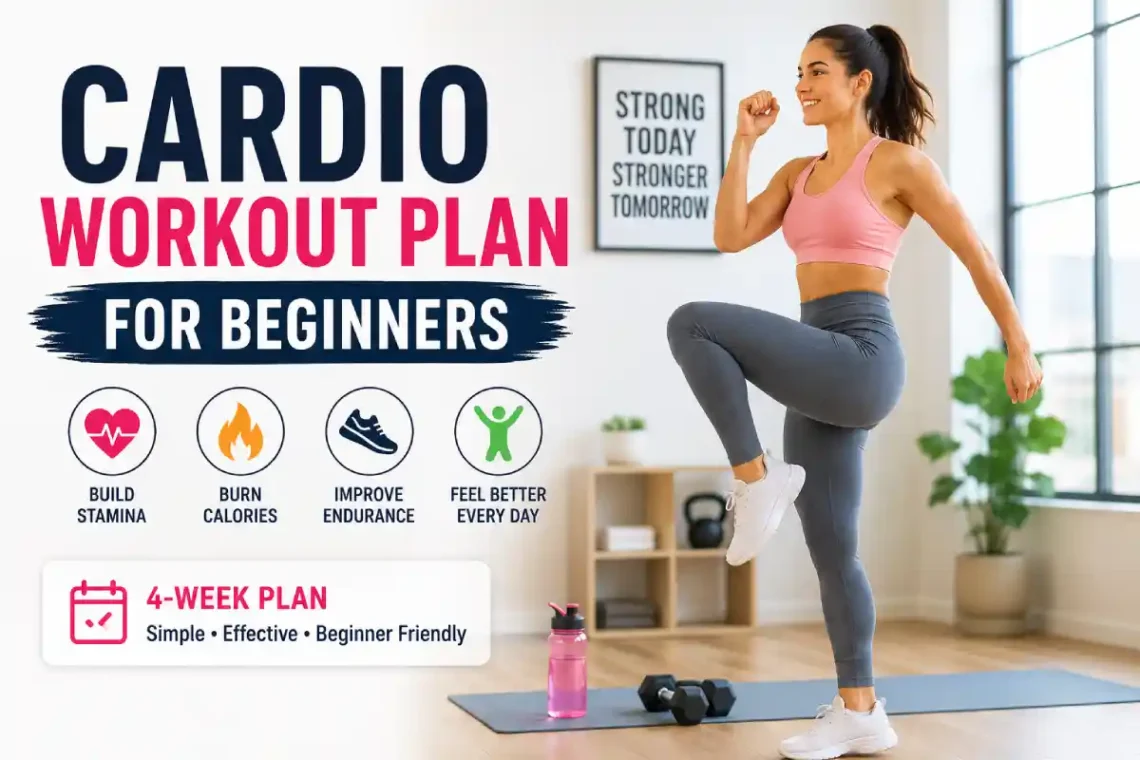
The overwhelming aspect of beginning any fitness regimen is easily eliminated with Cardio Work Plan for Beginners. This workout plan prevents the initial struggle of forcing yourself too hard, instead allowing for gradual and continuous improvement in heart health, cardiovascular fitness, fat burning, and self-assurance. It works in conjunction with calorie and fat burn in your overall goal of either losing weight, increasing stamina or maintaining good health for the duration of 4 weeks.
Once you’ve developed consistency, learn how cardio for fat loss can help reduce body fat while supporting lean muscle retention.
❝
This article is a part of
Cardio Hub
Why Beginners Should Start with Cardio
This type of exercise is brilliant for your heart and blood flow, boosts the size of your lungs and helps you burn up a great amount of calories.
Cardiovascular workout guidelines set by the world, through 2026 are as follows:
- 150–300 minutes of moderate-intensity aerobic exercise per week.
- 75–150 minutes of high-intensity cardio per week
- Include movement throughout the day
- Increase duration before increasing intensity
Benefits include:
- Better cardiovascular health
- Increased daily energy
- Improved sleep quality
- Lower stress levels
- Healthy weight management
- Reduced risk of chronic diseases
If your goal is to lose excess body weight, our guide to cardio for weight loss explains the most effective routines and training frequency.
Beginner Fitness Assessment
The first and most essential thing to do before choosing any beginner workout plan for your cardio is to establish your fitness level. Performing a quick check helps you adjust the workout’s intensity, minimize injury risk and check your improvement over a period. You’re not supposed to be compared to any other; just begin.
Evaluate Your Current Activity Level
Ask yourself these questions before beginning your cardio routine:
1) are you exercising 2-3 times a week already?
2) are you able to power walk for 20-30 minutes with no problems?
3) are you out of breath after walking up only a flight or two of stairs?
4) have you suffered an injury recently or do you have joint pain?
5) do you have any health condition for which you’d need clearance from your doctor?
If most of these questions made you say “no,” then start with short and light-effort workouts and work your way up in intensity.
Perform a Simple 10-Minute Walking Test
Here is one of the most simple forms of assessing cardiovascular fitness you can take by a brisk walk.
Do it:
- At a brisk yet relaxed pace walk for 10 minutes
- Take note of how it felt with reference to your breathing, and your level of fatigue
- After walking, consider how challenging it was
| How You Feel After 10 Minutes | Suggested Starting Point |
| Very easy, could continue longer | Begin with 30-minute cardio sessions |
| Comfortable but slightly challenged | Start with 20–25-minute sessions |
| Tired or out of breath | Begin with 10–15-minute sessions and progress gradually |
As you begin combining cardio with resistance training, discover whether cardio before or after weights is the best approach for your goals.
Use the Talk Test
The Talk Test is a simple way to monitor exercise intensity without special equipment.
- Easy : you are comfortable chatting and are out of breath to some extent.
- Moderate : You can easily carry on a conversation with your friends.
- Intense : you cannot utter more than two or three words at a time.
It is best to remain in the moderate range because you will get benefit while exercising and not get overly tired, even with conversation with your friends or other exercisers.
Check Your Resting Heart Rate
Resting heart rate is generally a fair indicator of cardiovascular fitness.
To measure it:
- Rest in a chair with back supported for five minutes.
- Press your thumb, middle and two fingers of your index finger to the inside of your wrist, a bit 1-2 inches higher than the base of your thumb, or press both sides of your windpipe.
- Count your pulse for 30 seconds. Multiply that number by two.
| Resting Heart Rate (BPM) | General Fitness Indicator |
| 60–70 | Excellent cardiovascular fitness |
| 71–80 | Good fitness level |
| 81–90 | Average fitness |
| Above 90 | Beginner level; focus on gradual improvement |
Set a Realistic Starting Goal
Now that you’ve got an idea of where you stand, create a realistic and attainable goal for your first month. This could be anything like:
- Do 3 cardio sessions each week.
- Walk for 30 consecutive minutes at a time without stopping.
- Add an extra 10-15 minutes to your weekly cardio time.
- Increase your pace while walking without giving up comfortability while you are talking.
Beginning with such simple, realistic goals provides a confidence boost and keeps you motivated. Over the next few weeks, as your stamina and endurance increase, you’ll be able to steadily increase your workouts over time, whether it be in duration, intensity, or variety without the chance of pushing yourself too far.
Week 1 Cardio Schedule
Goal: Build consistency.
| Workout | Day | Duration |
| Brisk Walk | Monday | 20 min |
| Rest or Stretching | Tuesday | 20 min |
| Walking + Light Cycling | Wednesday | 25 min |
| Rest | Thursday | |
| Brisk Walk | Friday | 25 min |
| Leisure Walk | Saturday | 20 min |
| Rest | Sunday |
Focus on:
- Comfortable pace
- Good posture
- Proper breathing
- Consistency
Week 2 Progression Plan
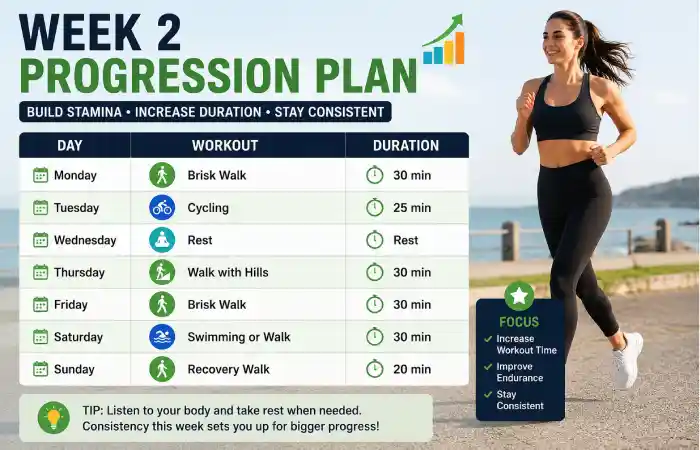
Aim to add about 10% total weekly volume.
| Day | Workout | Duration |
| Monday | Brisk Walk | 30 min |
| Tuesday | Cycling | 25 min |
| Wednesday | Rest | |
| Thursday | Walk with hills | 30 min |
| Friday | Walking | 30 min |
| Saturday | Swimming or Walking | 30 min |
| Sunday | Recovery Walk | 20 min |
New additions:
- Slight incline walking
- Gentle cycling
- Longer sessions
Week 3 Endurance Building
Now your cardiovascular system adapts to longer exercise sessions.
| Workout | Duration |
| Brisk Walk | 35 min |
| Cycling | 35 min |
| Elliptical | 25 min |
| Walking Intervals | 30 min |
| Recovery Walk | 20 min |
Introduce intervals:
- 2 minutes brisk walking
- 1 minute faster pace
Repeat 8–10 rounds.
Benefits:
- Improved endurance
- More calorie burn
- Increased aerobic capacity
Week 4 Advanced Beginner Routine
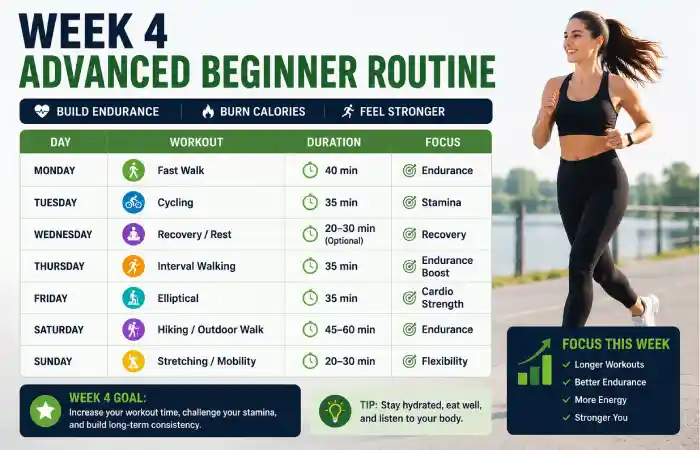
Your body is ready for moderate cardio.
Example week:
| Day | Workout |
| Monday | Fast Walk 40 min |
| Tuesday | Cycling 35 min |
| Wednesday | Recovery |
| Thursday | Interval Walking |
| Friday | Elliptical |
| Saturday | Hiking or Outdoor Walk |
| Sunday | Stretching |
Intensity:
60–75% maximum heart rate.
Best Beginner Cardio Exercises
| Exercise | Calories/30 min* | Joint Impact | Difficulty |
| Walking | 120–170 | Low | Very Easy |
| Cycling | 180–260 | Very Low | Easy |
| Swimming | 200–300 | Very Low | Moderate |
| Elliptical | 220–320 | Low | Easy |
| Rowing | 220–350 | Medium | Moderate |
| Dancing | 180–280 | Medium | Easy |
*Calories vary by body weight and workout intensity.
As your fitness improves, explore our complete guide to cardio exercises in the gym to learn about different machines and workout styles.
Product Comparison for Home Cardio
| Equipment | Best For | Pros | Cons |
| Treadmill | Walking & Running | Indoor convenience | Expensive |
| Exercise Bike | Joint-friendly workouts | Comfortable | Lower muscle engagement |
| Elliptical | Full-body cardio | Low impact | Higher cost |
| Jump Rope | HIIT workouts | Affordable | Higher impact |
| Walking Pad | Small spaces | Compact | Lower top speed |
Commercial intent users often compare these options before purchasing.
After building a solid fitness foundation, you can progress to HIIT cardio workouts for greater calorie burn and improved cardiovascular endurance.
If you enjoy indoor workouts, our treadmill cardio workout guide includes walking, incline, and interval routines suitable for every fitness level.
Tracking Progress
Don’t rely only on the scale.
Instead monitor:
- Weekly workout completion
- Resting heart rate
- Walking distance
- Average pace
- Energy levels
- Waist measurement
- Recovery time
Monthly Progress Example
| Week | Workout Minutes | Energy | Endurance |
| Week 1 | 90 | Fair | Beginner |
| Week 2 | 130 | Better | Improving |
| Week 3 | 170 | Good | Moderate |
| Week 4 | 210 | Excellent | Strong Beginner |
Common Beginner Mistakes
Avoid these common errors:
Exercising too hard
Skipping warm-up
Wearing poor footwear
Ignoring recovery
Comparing yourself with others
Doing cardio every single day
Consistency always beats intensity.
Troubleshooting
| Problem | Cause | Solution |
| Shin pain | Too much too soon | Reduce intensity |
| Excess fatigue | Lack of recovery | Add rest day |
| No motivation | Unrealistic goals | Shorten workouts |
| Knee discomfort | Poor shoes | Replace footwear |
| Plateau | Same routine | Add intervals |
Conclusion
The foundation of any good Beginner Cardio Workout Plan is not about results you get fast, but the habits you stick with. Following a steady 4-week plan, gauging your level, measuring real progress, and steering clear of all pitfalls you’ll build improved cardiorespiratory endurance, build self-confidence and feel more motivated. Ensure a balanced diet and good rest along with regular strength training to reap the most of these benefits. Stick with consistency and not a strict regime for optimum benefits.