
 Afiya Jafar
Fitness & Wellness Writer
Afiya Jafar is a fitness and wellness writer who focuses on making health, exercise, and healthy lifestyle information simple and practical.
Read Full Bio of Author →
Afiya Jafar
Fitness & Wellness Writer
Afiya Jafar is a fitness and wellness writer who focuses on making health, exercise, and healthy lifestyle information simple and practical.
Read Full Bio of Author →
 Sameena Begum
Health, Fitness & Digital Content Reviewer
Sameena reviews selected health, wellness, fitness, and digital content for clarity, factual presentation, and reader usefulness.
Read Full Bio of Reviewer →
Sameena Begum
Health, Fitness & Digital Content Reviewer
Sameena reviews selected health, wellness, fitness, and digital content for clarity, factual presentation, and reader usefulness.
Read Full Bio of Reviewer →
 Dr. Khizrana Begum
General Physician & Dermatologist
Dr. Khizrana Begum is a General Physician and Dermatologist with MBBS and MD qualifications and 5+ years of experience in the medical field.
Read Full Bio of Medical Reviewer →
Dr. Khizrana Begum
General Physician & Dermatologist
Dr. Khizrana Begum is a General Physician and Dermatologist with MBBS and MD qualifications and 5+ years of experience in the medical field.
Read Full Bio of Medical Reviewer →
We’ve all embarked on the dieting journey full of motivation and abandoned it a few weeks later, and we are not alone! More often than not, failure to reach your weight goals stems from a lack of motivation – or not! Most of us fail to hit weight loss targets by setting expectations too high, and that’s the key.
Discover how to set goals and expectations that actually help you to lose weight, improve motivation, establish a healthier lifestyle and attain real, long term results, instead of trying to get quick fixes.
Health specialists still recommend steady weight loss which provides higher long-term success while minimising the loss of muscles, or potential to regain weight. Read this guideline on how to set goals which are realistic and tailor them to your life!
❝
This article is a part of
Weight Loss Motivation Hub
Why Goal Setting Matters
Most of us focus on the number on the scale only.
Creating a plan:
- Stay motivated
- Measure improvement
- Build healthy habits
- Celebrate milestones
- Stay consistent after setbacks
Studies published during the past few years are consistently showing that individuals who write out certain health goals are more likely to stay the course with diet and exercise plans compared to those with general ideas, like “I need to lose weight.”
Before setting goals, explore our complete weight loss motivation guide to learn strategies for staying committed throughout your fitness journey.
Benefits of Realistic Goals
| Unrealistic Goals | Realistic Goals |
| Lose 10 kg in 2 weeks | Lose 0.5–1 kg per week |
| Skip meals | Balanced calorie deficit |
| Exercise every day immediately | Start with 3 workouts weekly |
| Perfect diet forever | Follow the 80/20 rule |
| Scale only | Track multiple health markers |
SMART Goals
Achieving your goals becomes much easier when you develop a positive weight loss mindset that keeps you focused despite challenges.
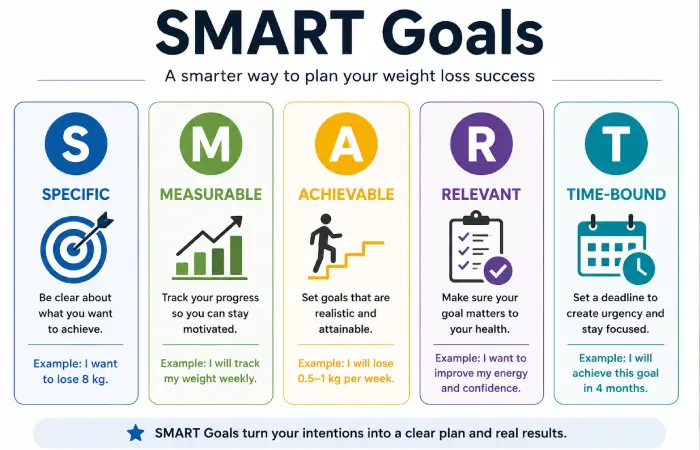
There’s arguably no greater goal-setting framework than SMART Goal Setting.
SMART stands for:
| SMART Element | Example |
| Specific | Lose 8 kg |
| Measurable | Track weight weekly |
| Achievable | 0.5–1 kg weekly |
| Relevant | Improve health and energy |
| Time-Bound | Within 5 months |
This goal is clear, measurable, and realistic.
Weekly vs Long-Term Goals
Weight loss is a marathon—not a sprint.
Breaking large goals into smaller milestones makes them less overwhelming.
Weekly Goals
Examples include:
Here’s the to-do list that should help you maintain the healthiest version of yourself:
– Aim to walk 35k plus every day
– Drink 2.5+L of water per day
– Set yourself a goal of 4 workouts per week
– Try to eat a serving of vegetables in your lunch, breakfast and dinner
– Have at least 7hrs of sleep a night
Monthly Goals
Sustainable goals are supported by healthy habits for weight loss that you can follow every day.
Examples:
- Lose 2–4 kg
- Reduce waist circumference
- Improve workout performance
- Meal prep every Sunday
Long-Term Goals
Examples:
- Lose 15 kg
- Reduce body fat percentage
- Reach a healthy BMI
- Build sustainable eating habits
Goal Timeline Comparison
| Timeline | Focus | Success Indicator |
| Daily | Habits | Water, food, exercise |
| Weekly | Consistency | Workout completion |
| Monthly | Progress | Measurements |
| 3–6 Months | Fat loss | Body composition |
| 1 Year | Lifestyle | Weight maintenance |
Measuring Progress
The scale tells only part of the story.
A healthy loss is all this and other health improvements (like better sleep) besides lose.
Track:
- Body weight
- Waist measurement
- Hip measurement
- Progress photos
- Strength improvements
- Energy levels
- Sleep quality
- Clothing fit
Even with realistic goals, you may need to learn how to overcome a weight loss plateau to continue making progress.
Best Progress Tracking Methods
| Method | Frequency | Why It Matters |
| Body Weight | Weekly | Monitor trend |
| Waist Measurement | Every 2 weeks | Fat loss indicator |
| Photos | Monthly | Visual comparison |
| Workout Log | Every session | Performance gains |
| Food Journal | Daily | Accountability |
| Sleep Tracker | Daily | Recovery support |
2026 Research Snapshot
Recent evidence continues to support habit-based approaches over crash dieting.
| Better Long-Term Success | Habit |
| Higher adherence | Weekly weigh-ins |
| Preserves lean muscle | Strength training |
| Improves satiety | High-protein diet |
| Reduces overeating | Meal planning |
| Supports appetite regulation | Sleep (7–9 hrs) |
Adjusting Goals
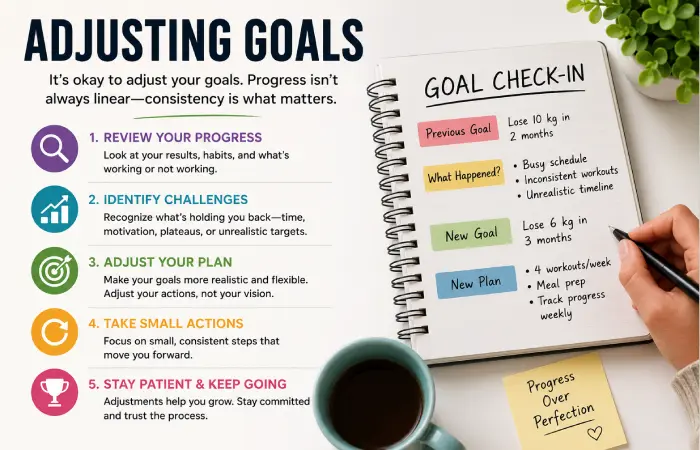
Progress isn’t always linear.
Factors that affect weight loss include:
- Hormonal changes
- Water retention
- Stress
- Sleep quality
- Exercise recovery
- Medication
- Muscle gain
Recording your weekly progress in a weight loss journal helps you stay accountable and measure your success.
If progress slows for several weeks:
Review your nutrition
Small portions can gradually become larger.
Increase activity
Add:
- 2,000–3,000 extra daily steps
- One additional strength workout
- Short cardio sessions
Improve recovery
Poor sleep and chronic stress can make consistency harder.
Focus on habits
Instead of chasing rapid scale changes, aim to consistently complete your healthy routines.
Plateau Troubleshooting
| Problem | Possible Cause | Solution |
| Weight unchanged | Water retention | Wait another week |
| Hungry constantly | Low protein | Increase protein intake |
| Low motivation | Goals too big | Break into smaller milestones |
| No energy | Poor sleep | Improve bedtime routine |
| Frequent cravings | Restrictive diet | Allow balanced treats |
Staying Focused
Motivation comes and goes.
Persistence provides long-term gains.
Try these strategies to maintain your focus:
Enjoy small successes
Whether it’s a nourishing meal, a sweat session, or a healthier routine, your accomplishments matter.
Routines Help
Establish patterns For workouts and healthy meals, set time aside as you would for any important commitment.
Identify accountability
Accountability If a friend works out with you or family members know your progress goals, you may be more inclined to stick with them.
Prepare for relapses
Have a buddy. If you workout together or your friends and family can keep an eye on your training regimen, you will likely to be able to adhere to it. Get ready to fall off of course. It may seem counterintuitive to allow yourself a slip-up, but having a failed exercise shouldn’t set back the entire thing.
Recall your motivation
You’ll get back on course just soon enough. Focus on why you are motivated. When you are unable to muster any drive to get a workout completed, be aware of what benefits are driving the desire you wish to get.
Reading inspiring weight loss success stories can motivate you to stick with your goals even during difficult weeks.
Healthy Habits That Support Long-Term Success
| Habit | Impact |
| Strength training | Maintains muscle |
| Walking daily | Increases calorie burn |
| Protein-rich meals | Keeps you full |
| Meal planning | Improves consistency |
| Hydration | Supports overall health |
| Sleep | Enhances recovery |
| Stress management | Reduces emotional eating |
Product Comparison (Commercial Intent)
| Tool | Best For | Pros | Cons |
| Fitness Tracker | Activity monitoring | Step counting, heart rate | Requires charging |
| Smart Scale | Body composition | Tracks trends | Estimates body fat |
| Food Tracking App | Calorie awareness | Large food database | Daily logging required |
| Meal Prep Containers | Portion control | Convenient | Requires planning |
Frequently Asked Questions
How much weight should I lose each week realistically?
Ideally for most adults, between 0.5kg-1kg (1lb-2lbs) per week is a good safe target. I should not weigh in everyday!
Weight gain or loss due to the time of day can really mislead you.
We recommend using a morning weekly weigh in under the same circumstances every time.
What do I do when my weight loss stalls?
Weight loss plateaus are completely normal! Take a step back and look at your diet, your activity levels, sleep quality, stress levels before drastic changes.
Is it alright to change my goals?
Absolutely! As your schedule, fitness level and health changes, so do your weight and health goals should too.
So, is a fitness tracker a requirement?
No, you do not need one. You can just simply write down all your exercises and meals into your diary or note section of your mobile.
Conclusion
The easiest method for to create your self more success during weight reduction would be to be sure to can do all of that to become capable of shed weight. Don’t concentrate entirely for the range when you really do build these sorts of SMART ambitions and therefore are continuously searching at more signals besides your range, this may alter and modify your plan since you get progress or shift through health demands. That has become a long lasting lifestyle alteration requires a great deal less than ideal behavior as perfection in the beginning does not usually transpire, but since you consider things at a measured rate using the details available, you can significantly increase your health!
Afiya Jafar is a fitness and wellness writer who focuses on making health, exercise, and healthy lifestyle information simple and practical. Her work covers workouts, fitness motivation, strength training, nutrition, weight management, stress management, mindfulness, and everyday wellness.
Read Full Bio of Afiya Jafar →
Sameena Begum reviews selected health, wellness, fitness, and digital content for clarity, factual presentation, consistency, and reader usefulness. Her review work helps maintain clear and responsible editorial standards across PhysicalFitt content.
Read Full Bio of Sameena Begum →
Dr. Khizrana Begum is a qualified medical professional with MBBS and MD qualifications and 5+ years of experience in the medical field. She works as a General Physician and Dermatologist, with expertise in general medicine, dermatology, preventive healthcare, and skin health.
Read Full Bio of Dr. Khizrana Begum →