
 Afiya Jafar
Fitness & Wellness Writer
Afiya Jafar is a fitness and wellness writer who focuses on making health, exercise, and healthy lifestyle information simple and practical.
Read Full Bio of Author →
Afiya Jafar
Fitness & Wellness Writer
Afiya Jafar is a fitness and wellness writer who focuses on making health, exercise, and healthy lifestyle information simple and practical.
Read Full Bio of Author →
 Sameena Begum
Health, Fitness & Digital Content Reviewer
Sameena reviews selected health, wellness, fitness, and digital content for clarity, factual presentation, and reader usefulness.
Read Full Bio of Reviewer →
Sameena Begum
Health, Fitness & Digital Content Reviewer
Sameena reviews selected health, wellness, fitness, and digital content for clarity, factual presentation, and reader usefulness.
Read Full Bio of Reviewer →
 Dr. Khizrana Begum
General Physician & Dermatologist
Dr. Khizrana Begum is a General Physician and Dermatologist with MBBS and MD qualifications and 5+ years of experience in the medical field.
Read Full Bio of Medical Reviewer →
Dr. Khizrana Begum
General Physician & Dermatologist
Dr. Khizrana Begum is a General Physician and Dermatologist with MBBS and MD qualifications and 5+ years of experience in the medical field.
Read Full Bio of Medical Reviewer →
If you want to choose a supplement that has been researched for decades for muscle gain, you can’t go wrong with creatine. You can use creatine whether you’re looking to build muscle mass, increase strength, or boost recovery times between your workouts and resistance exercises, as it has proven effective over and over. If you are someone who looks for a product with hundreds of clinical studies behind it, instead of just hype and marketing buzzwords, than creatine is a great choice for you.
Naturally occurs in your muscle to help your body produce energy for high intensity workouts.
It’s used for the short, high burst bursts of energy associated with weight training and sprinting. One of the best ways of getting creatine into your muscle stores, which will help you train longer, stronger and have a quick recovery between sets, is through taking supplementation of creatine. Read on to learn about the best benefits, doses, and the safely issues associated with creatine.
❝
This article is a part of
Muscle Building Hub
What Is Creatine?
Naturally found Creatine is a supplement produced from the three amino acids listed below:
- Arginine
- Glycine
- Methionine
Your pancreas, kidney, and liver produces 1 to 2 grams daily and some doses come from red meat, fish and other meals. Most of the creatine stored in your body – around 95% – is in your muscles, where it is converted into phosphocreatine. This stored fuel is then used to recreate a key component of ATP, your body’s main energy provider for explosive activities.
If you’re adding amino acids to your routine, our BCAA vs EAA guide explains which option works best with creatine supplementation.
Natural Sources of Creatine
| Food | Approximate Creatine (per kg) |
| Beef | 4–5 g |
| Salmon | 4–5 g |
| Pork | 5 g |
| Tuna | 4 g |
| Chicken | Less than 1 g |
You have the choice of 5 grams of Creatine per day that must be consumed through meat and fish in very large amounts per day. Supplementation is an easier way.
How Creatine Supports Muscle Growth
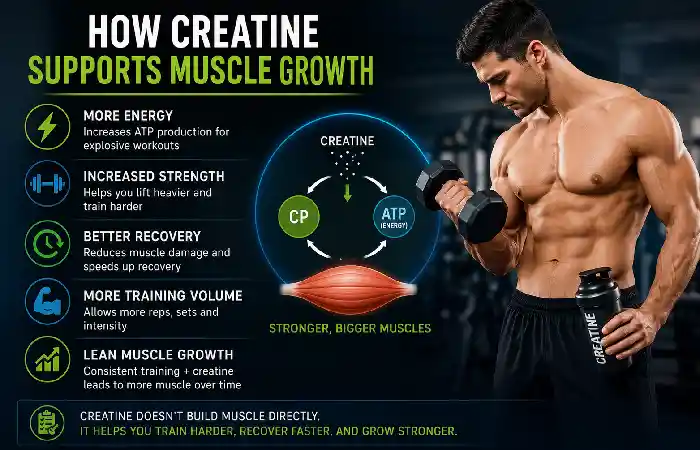
Creatine is not directly responsible for muscle growth. What Creatine is Responsible for is Your Body’s Capacity to Get more work out of each workout.
Main Benefits
Increased Strength
Higher ATP availability allows you to complete:
- More repetitions
- Heavier lifts
- Better workout intensity
Greater training volume leads to improved muscle growth over time.
Better Recovery
Recent studies seem to indicate that creatine can assist in lowering muscle tissue damage, which assists to speed up the recuperation process between really high intensity work outs.
After training, consider the best post-workout supplements for recovery to replenish nutrients and speed up muscle repair alongside creatine.
Increased Muscle Hydration
Creatine draws water into muscle cells.
This can:
- Improve muscle fullness
- Support protein synthesis
- Create an environment favorable for muscle growth
Enhanced Lean Muscle Gain
Research shows resistance training combined with creatine results in more gains of lean body mass than resistance training alone (ISSN)
How Creatine Helps Build Muscle
| Effect | Benefit |
| More ATP production | Better workout performance |
| Increased training volume | Greater muscle stimulus |
| Improved recovery | More consistent workouts |
| Muscle cell hydration | Supports growth environment |
| Higher strength | Progressive overload becomes easier |
Combining creatine with the best protein powder for muscle gain can support muscle recovery and help maximize lean muscle development.
Creatine Monohydrate vs Other Forms
Lots of companies sell various forms of creatine, yet when the scientific facts are looked at, creatine monohydrate wins.
| Type | Cost | Effectiveness | Research Support |
| Creatine Monohydrate | Low | ★★★★★ | Excellent |
| Micronized Creatine | Moderate | ★★★★★ | Excellent |
| Creatine HCL | High | ★★★★☆ | Moderate |
| Buffered Creatine | High | ★★★☆☆ | Limited |
| Creatine Ethyl Ester | High | ★★☆☆☆ | Poor |
Which One Should You Choose?
For most people, creatine monohydrate offers the best combination of:
- Effectiveness
- Safety
- Affordability
- Scientific evidence
You’ll still have the same type of performance for the same amount with micronized creatine, it simply is easier to dissolve.
Recommended Dosage
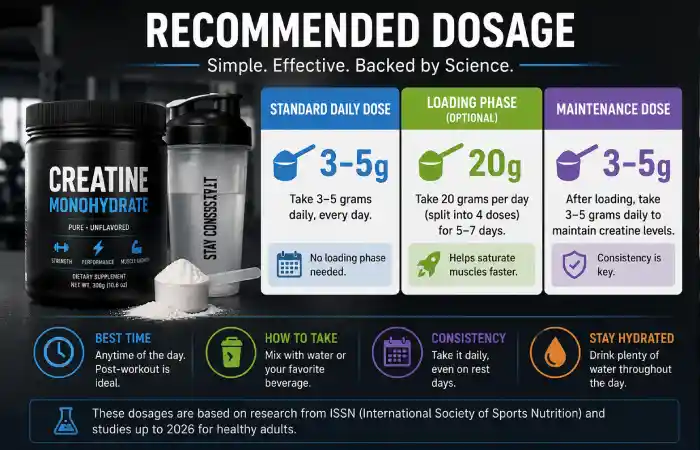
The most widely studied dosage is:
Standard Maintenance
- 3–5 grams daily
This amount is sufficient for most adults.
Optional Loading Phase
Some people choose:
- 20 grams daily
- Split into four 5-gram servings
- For 5–7 days
Followed by:
- 3–5 grams daily
Loading helps saturate muscles faster but is not required.
Best Time to Take Creatine
Research suggests consistency matters more than timing.
Many people take creatine:
- After workouts
- With carbohydrates and protein
- At the same time every day
Dosage Guide
| Goal | Daily Dose |
| Muscle Growth | 3–5 g |
| Maintenance | 3–5 g |
| Loading (Optional) | 20 g for 5–7 days |
| Vegetarians | 3–5 g |
Creatine is one of the most effective performance supplements, but it’s even more useful when you understand how it fits into a complete guide to muscle-building supplements.
Common Myths
Myth 1: Creatine Is a Steroid
False.
Not a steroid, it’s a natural molecule that works by an altogether different method.
Myth 2: Creatine Damages Kidneys
The evidence for creatine safety in otherwise healthy individuals taking it at reasonable doses seems good. If you’ve got kidney disease already, then consult with your doctor first before starting it.
Myth 3: Creatine Causes Fat Gain
FALSE. It seems initial gain is due to water retention within muscle cells and NOT body fat.
Myth 4: You Must Cycle Creatine
Doesn’t seem necessary in healthy individuals.
Myth 5: Women Shouldn’t Take Creatine
If you’re female FALSE. It does the same thing for women.
Prefer a more natural approach? Explore these natural muscle-building supplements that can complement your training and nutrition plan.
Safety and Side Effects
Creatine is among the most extensively studied sports supplements available.
Possible Mild Side Effects
- Temporary water retention
- Mild stomach discomfort (if taken in large doses)
- Bloating during loading phase
These effects are generally minimized by taking the recommended daily dose with adequate water. (PMC)
Although creatine has a strong safety profile, it’s still worth learning about common muscle-building supplement side effects before starting any supplement stack.
Who Should Be Cautious?
Consult a healthcare provider if you have:
- Kidney disease
- Liver disease
- Pregnancy or breastfeeding considerations
- Any chronic medical condition requiring medication management
2026 Research Summary
| Research Finding | Practical Benefit |
| Improves strength during resistance training | Lift heavier weights |
| Increases lean body mass over time | Better muscle growth |
| Increased performance during high-intensity exercises | More productive workouts |
| It is also perfectly safe for adults over the age of 18 to consume for an extended period | Suitable for ongoing supplementation |
| Most effective when combined with training | Maximizes fitness results |
Troubleshooting
| Problem | Possible Cause | Solution |
| Feeling bloated | Loading phase | Skip loading and use 3–5 g daily |
| No noticeable results | Inconsistent use | Take creatine every day |
| Upset stomach | Large single dose | Split into smaller servings |
| Slow progress | Inadequate training or protein | Improve workout program and nutrition |
| Weight increase | Water in muscles | Normal response, not fat gain |
Frequently Asked Questions
Will creatine actually help you build muscle?
Yes. It enhances your performance to increase strength, training volume, and recover better to handle harder resistance training sessions day in and day out.
How quickly will I notice the effects of creatine?
With the use of a loading phase, you could notice full saturation in muscle cells within just one week. On average, noticeable results from 3 to 4 weeks of daily 3–5gram supplementation may be noted.
Can I use creatine if I’m a beginner?
Absolutely!
If you are a healthy beginner performing consistent resistance training, you can definitely incorporate creatine into your regimen with the help of nutrition and training.
Is creatine safe to take long-term?
Long-term research studies show that creatine monohydrate is safe in healthy adults even when taken on a long-term basis and the standard dosage.
Will taking creatine every day be OK?
Yes! Taking 3-5 grams every day will aid in the maintenance of muscles’ creatine stores and enhance workout performance as you go.
Conclusion
However creatine has remained a of one of the world’s most widely studied and best performing supplementation to support gains in strength and exercise output along with increased lean muscle development. And the best for most individuals comes in the form of creatine monohydrate due to the extensive evidence, and its inexpensive and very safe usage. It’s an effective support tool to your training in addition to consistent protein, and appropriate rest.
Afiya Jafar is a fitness and wellness writer who focuses on making health, exercise, and healthy lifestyle information simple and practical. Her work covers workouts, fitness motivation, strength training, nutrition, weight management, stress management, mindfulness, and everyday wellness.
Read Full Bio of Afiya Jafar →
Sameena Begum reviews selected health, wellness, fitness, and digital content for clarity, factual presentation, consistency, and reader usefulness. Her review work helps maintain clear and responsible editorial standards across PhysicalFitt content.
Read Full Bio of Sameena Begum →
Dr. Khizrana Begum is a qualified medical professional with MBBS and MD qualifications and 5+ years of experience in the medical field. She works as a General Physician and Dermatologist, with expertise in general medicine, dermatology, preventive healthcare, and skin health.
Read Full Bio of Dr. Khizrana Begum →