
Last Updated: September 4, 2026
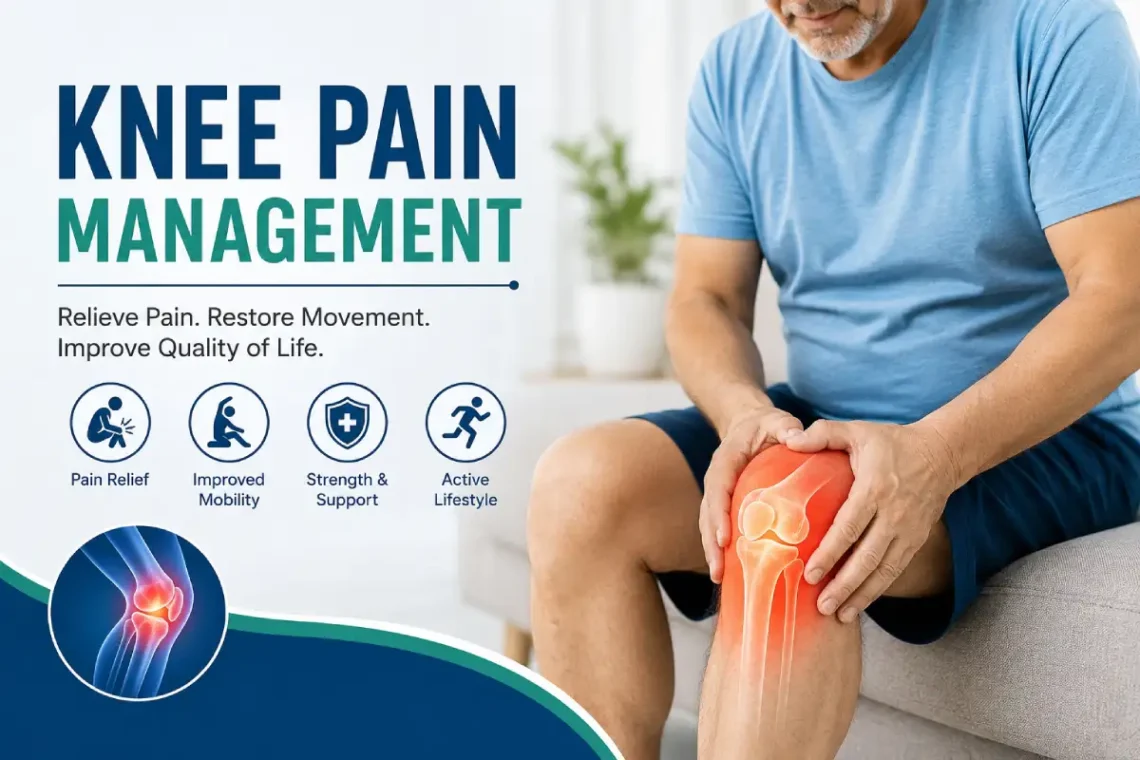
Managing knee pain has its origins in knowing why your knee hurts and subsequently deciding on the strategies most relevant to what’s making it hurt. Why your knee hurts may be from a trauma or injury, or can be caused by an overload on the area (e.g., by doing too much), arthritis, a lack of muscle strength or altered movement, or some other disorder. However, for mild knee complaints activity modification, home treatment, and attention paid to the symptoms often suffices but ongoing severe, or unusual symptoms merit advice from a healthcare professional.
Happily there’s a growing opinion that knee pain doesn’t necessarily necessitate an end to moving.
Clinical advice tends increasingly toward the concept of correctly applied exercise, education, and appropriate weight loss for knee osteoarthritis.
❝
This article is a part of
Pain and Recovery Hub
What Causes Knee Pain?
There are many causes for a painful knee and so it must not just be treated from this symptom alone.
A number of reasons you may be in pain:
– Osteoarthritis – a degenerative change to a joint and cartilage can cause painful, stiff, limited joints.
– Sprains and strains of a muscle and the ligaments will occur after a twist, a quick jerky movement.
– Injured meniscus – you will likely experience pain, swelling and possibly catching or locking of the knee.
– Tendinitis- with much activity involving running, jumping or others of the type, a tendon can be tender.
– Patellofemoral pain – This refers to the pain which occurs around or within the kneecap and usually with activity but may be associated with activity or weakness of muscles, and movement mechanics.
– Bursitis – Inflammation of a small bursa sack around the knee will cause a locally painful swelling.
– Gout or infection- A suddenly acutely painful, swollen, hot, red knee needs urgent attention from a healthcare professional.
Pain at the knee can be related to sudden injury or repeated stress; Johns Hopkins says that aging, injury, and repetitive stress will lead to a painful knee.
Warning: not every painful knee that gets arthritis must be treated for this cause alone. The type of pain, location, onset, swelling, limitation in movement, and any history of injury can all lead to a professional opinion being obtained.
How to Manage Knee Pain
For most, effective management of knee pain involves a mix of symptoms management and using and modifying movement and treating the underlying cause.
For a minor flair or minor injury rest from provoking activity may help for the shorter term and for some pain or inflammation ice is appropriate, other helpful treatments for pain and swelling for injuries include the use of compression and elevation, the NHS suggest applying to the skin with ice pack covered in a tea towel for up to 20 minutes at a time, not direct to skin.
Typically for long term knee issues the objective is not to eliminate movement completely.
Evidence snapshot for knee osteoarthritis management
| Management approach | Typical role | Current evidence/guidance |
| Therapeutic exercise | Foundation of management | Strongly supported |
| Weight management when appropriate | Can reduce symptoms and improve function | Strongly supported |
| Topical NSAID | Short-term symptom relief | Recommended in current guidance |
| Physical therapy | Individualized strength/mobility program | Commonly recommended |
| Oral NSAIDs | Short-term medication option | May help but require safety considerations |
| Corticosteroid injection | Selected patients | Can provide short-term relief |
| Surgery | Severe structural disease or failed conservative care | Reserved for appropriate cases |
Always talk to your doctor or pharmacist before starting any new medication, especially if you have existing health problems or are taking other drugs.
Best Exercises for Knee Pain
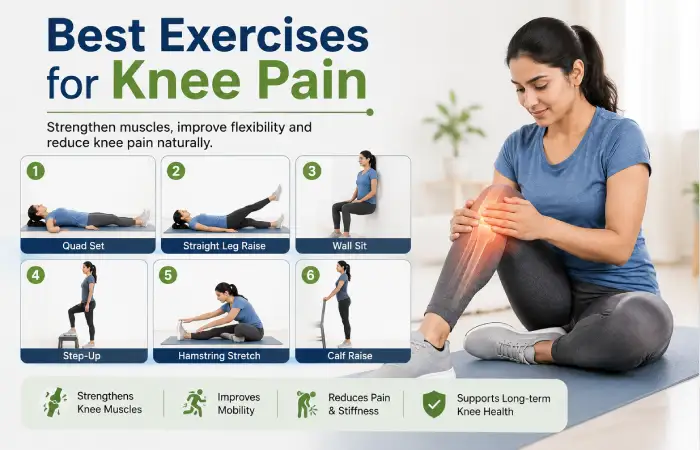
The best exercise depends on why your knee hurts, but strengthening and mobility work are commonly important components of rehabilitation.
Good starting options may include:
- Straight-leg raises
- Side-leg raises
- Supported squats
- Glute bridges
- Hamstring stretches
- Quadriceps stretches
- Gentle knee-bending exercises
HSS physical therapists emphasize strengthening the muscles around the knee and improving flexibility and mobility.
Begin within a comfortable range of motion. Some mild muscular strain can be tolerated, but sharp, or increasingly painful joint sensation indicates a need to pause and evaluate further.
Strengthening Exercises for the Knees
Strong quadriceps, hamstrings, gluteal muscles, and hip muscles will help support the knee throughout the course of the day.
Good beginner exercises include:
- Straight-leg raises for quadriceps strengthening, as this will not repeat bending at the knee.
- Glute bridges to strengthen hip extensor muscles.
- Side-leg raises for hip abductor strength which also has an influence on lower limb stability.
- Chair squats for functional leg strengthening with a controllable degree of knee bend.
- Step-ups can be added after simple exercises have become easier to do.
HSS recommends building the strength of the legs and gluteal muscles as these muscles are used to help to balance the knee during every day movements, and advise doing strength training exercises approximately 2 to 3 times per week, remembering that form should be prioritized, and resistance should be increased when appropriate.
A physical therapist can recommend modifications to any of the above exercise in accordance with patients’s current pain levels and help to tailor the exercises so that resistance and repetitions work for patients with persistent knee pain.
Stretching and Mobility for Knee Pain
Stiff hip, hamstrings, quadriceps or calves can influence how you move around and can be associated with knee pain.
Some mobility exercises you may find helpful:
- Hamstring stretch
- Quadriceps stretch
- Calf stretch
- Shallow knee bends
- Hip mobility exercises
Ensure that when you stretch, you are not forced to perform the exercise painfully. HSS advocate performing stretching along side strengthening because the load which the knee has to cope with is dependent on muscle strength as well as movement.
Taking breaks from seated rest and regular moving may also reduce any stiffness associated with prolonged sitting
Low-Impact Exercises for Knee Health
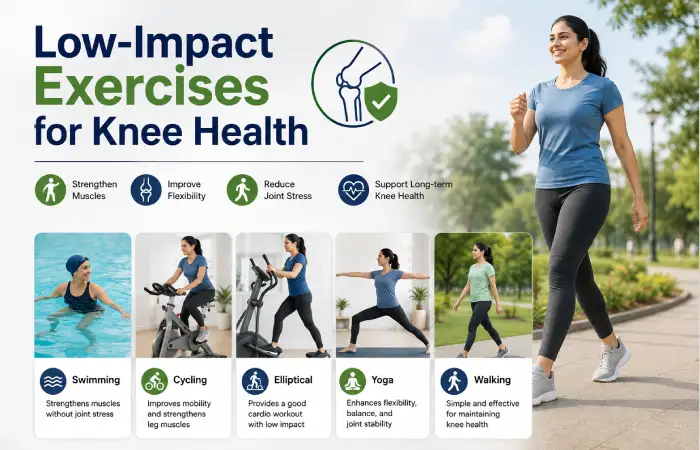
You do not have to run or jump to improve cardiovascular fitness.
Low-impact options include:
- Walking
- Stationary cycling
- Swimming
- Water aerobics
- Elliptical training
- Gentle yoga
HSS specifically highlights walking, biking, water exercise and yoga as potentially useful choices for people with sore knees when the activities can be performed comfortably.
Choosing an activity
| Activity | Joint impact | Best for |
| Swimming | Very low | Cardio with reduced weight-bearing |
| Water aerobics | Very low | Beginners and painful joints |
| Cycling | Low | Cardio and controlled knee movement |
| Walking | Low | Everyday fitness |
| Elliptical | Low | Higher-intensity cardio |
| Running | Higher | Only when tolerated and appropriate |
If walking for 30 minutes causes discomfort, shorter sessions may be easier to tolerate. You can gradually increase duration as your symptoms allow.
How to Protect Your Knees During Exercise
Good knee protection is less about avoiding exercise and more about managing load intelligently.
Warm up first. Spend several minutes doing gentle movement before more demanding activity.
Increase gradually. Avoid suddenly doubling your walking distance, running volume or resistance training.
Use proper technique. Keep movements controlled and choose a range of motion you can manage comfortably.
Wear appropriate footwear. Comfortable, activity-appropriate shoes can make exercise easier to tolerate.
Modify painful activities. If jumping or running aggravates your knee, temporarily switch to cycling, swimming or another lower-impact activity.
Don’t push through worsening pain. HSS advises finding an activity that allows you to remain active without progressively increasing symptoms.
When Should You See a Healthcare Professional for Knee Pain?
Seek medical advice if knee pain:
- Does not improve after a reasonable period of home care.
- Continues to interfere with walking or everyday activities.
- Keeps returning.
- Causes significant swelling.
- Causes the knee to lock or give way.
- Started after a significant injury.
- Makes it difficult to bear weight.
The Bottom Line
Effective knee pain treatment relies on achieving the correct balance between protecting the knee joint and continuing to mobilize it. Many individuals benefit from having the correct choice of strengthening, stretching and non weight bearing exercise, which helps regain function and control symptoms. The correct method will vary however, depending on the underlying causes of the pain.
Begin progressively, listen to your symptoms and don’t accept chronic or significant knee pain as something you have to put up with. If your symptoms are significant, are accompanied by swelling, give you a feeling of instability or “locking” of the knee and, recurrently and as in association with such, fever, or if you sustained a knock or trauma to the knee joint, the safest course of action is to seek professional assessment.