
 Afiya Jafar
Fitness & Wellness Writer
Afiya Jafar is a fitness and wellness writer who focuses on making health, exercise, and healthy lifestyle information simple and practical.
Read Full Bio of Author →
Afiya Jafar
Fitness & Wellness Writer
Afiya Jafar is a fitness and wellness writer who focuses on making health, exercise, and healthy lifestyle information simple and practical.
Read Full Bio of Author →
 Sameena Begum
Health, Fitness & Digital Content Reviewer
Sameena reviews selected health, wellness, fitness, and digital content for clarity, factual presentation, and reader usefulness.
Read Full Bio of Reviewer →
Sameena Begum
Health, Fitness & Digital Content Reviewer
Sameena reviews selected health, wellness, fitness, and digital content for clarity, factual presentation, and reader usefulness.
Read Full Bio of Reviewer →
The first step to beating workout procrastination is changing how you think about exercise. You may not need more motivation, and you probably don’t need a more rigid workout plan. A lot of times, the problem is that the workout is hard, inconvenient, boring, or overreaching, and that there’s a “friction” of starting that’s taking up too much energy and making exercise less likely. If you can learn how to lower that friction, you can make it easier to get moving and end up more consistent with workouts.
In a study published in Psychology of Sport and Exercise, there was actually a connection found between workout procrastination and the disparity between people’s intentions to exercise and what they end up doing. Exercise procrastination even predicted later physical activity levels and explained the gap in intention-behavior.
What Is Workout Procrastination?
Workout procrastination” is when you delay or postpone a workout or exercise session even when you planned on exercising. When you find yourself making the following excuses:
- I’ll workout after dinner
- I’ll get back into it next Monday
- I don’t have time today
- I’ll wait until I’m more motivated
- I can skip this one workout
One delay may not be a problem. The issue develops when postponing exercise becomes a regular pattern.
This can create a cycle:
Intention → Delay → Guilt → New promise → Another delay
Breaking that cycle requires making the first step easier.
Why Do People Procrastinate Working Out?
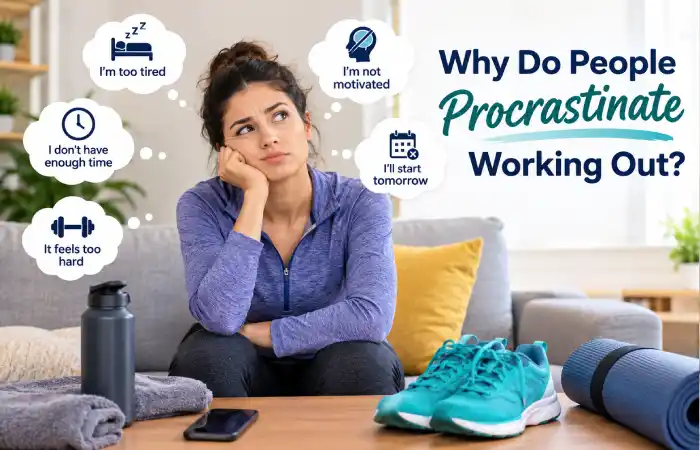
Why we procrastinate on our workouts. There are all sorts of reasons that we procrastinate on our workouts, and it isn’t always about being lazy.
Your workout feels too big
If you only have 15-20 minutes every morning to between rushing to get ready and leave for work, it may be tough to fit in a whole hour workout. If your brain views a workout as being enormous, you’ll probably delay it until you think you have more time.
You’re waiting for motivation can be sporadic and varies from day to day.
If you won’t do it unless you’re excited to do it, you’ll have an inconsistent workout schedule.
You have too many decisions to make
Choosing a workout, your exercises, your clothes, your workout clothes, the equipment you will need, where you will work out, and how long you will work out can create unnecessary friction.
You’re aiming too high
You may want to start working out six days a week if you aren’t already working out one or two days a week, but trying to do that may be too lofty a goal, and you’re likely to miss days.
You haven’t got a specific plan vague, “I’ll work out tomorrow,” isn’t nearly as helpful as “Tomorrow, I will work out at 3 p.m. on the bike at home, for half an hour.”
Research looking at the intention-behavior gap in exercise identified action planning, coping planning, and perceived behavioral control as key factors for turning intentions into exercise behavior.
10 Ways to Overcome Workout Procrastination
-
Make the First Workout Smaller
Instead of committing to an intense one-hour session, start with a manageable target.
Try:
- 10 minutes of walking
- 10 minutes of mobility exercises
- A short bodyweight workout
- One or two strength exercises
- A brief cycling session
The goal is to make starting feel achievable.
WHO’s guidelines say: “any physical activity is better than doing nothing – and more is better than less – so even small amounts of activity will have health benefits.
-
Schedule Exercise Like an Appointment
Do not leave your workout as an open-ended task.
Instead of:
“I’ll exercise sometime tomorrow.”
Try:
“I’ll walk for 20 minutes at 7:00 AM after breakfast.”
A specific time and trigger remove some of the decision-making involved in getting started.
-
Prepare Everything Beforehand
Reduce the number of steps between deciding to exercise and actually exercising.
Put your:
- Workout clothes
- Shoes
- Water bottle
- Gym bag
- Headphones
- Workout plan
where they are easy to access.
If you exercise at home, keep your equipment ready rather than storing everything away after every session.
-
Use the Five-Minute Starting Rule
Tell yourself that you only need to start for five minutes.
Put on your shoes, begin your warm-up, and reassess after five minutes.
You may decide to continue. If you genuinely cannot continue, stopping is still different from spending the entire day avoiding exercise.
This strategy changes the question from:
“Do I want to complete a workout?”
to:
“Can I start for five minutes?”
-
Stop Chasing the Perfect Workout
A common form of procrastination is believing that a workout only counts if it is long or intense.
For example:
“I only have 20 minutes, so I’ll skip today.”
Replace that thinking with:
“I have 20 minutes, so I’ll use 20 minutes.”
Your short session may not replace every longer workout, but it can help maintain the behavior and reduce the tendency to abandon your routine completely.
-
Choose Activities You Enjoy
Exercise does not have to mean spending an hour on a treadmill or lifting weights in a gym.
You can choose:
- Walking
- Cycling
- Swimming
- Dancing
- Yoga
- Strength training
- Sports
- Hiking
- Home workouts
The best activity is one you can realistically perform and continue.
-
Create an If-Then Plan
An if-then plan prepares you for predictable obstacles.
For example:
If I complete my work day, then I put on my workout clothes.
I don’t have time to do my usual workout, then I do a ten-minute version of it.
If I don’t do one session, then I do my workout again the next time I am scheduled to do it.
This approach is especially useful because it prevents a small problem from automatically becoming a complete break in your routine.
-
Use Accountability
Involve a friend in your training plan, work out with someone, attend a class or hire a qualified personal trainer. Being accountable can turn exercise into a duty rather than a nice to have. You can also log your exercise sessions using mobile fitness applications or activity monitors and get a better understanding of your progress.
-
Track Consistency Instead of Perfection
Create a simple workout calendar.
Put a checkmark on every day you complete your planned activity.
Do not use tracking to punish yourself. Use it to identify patterns.
If you repeatedly miss Monday workouts, for example, Monday may not be the right workout day. Adjust the schedule instead of blaming yourself.
-
Focus on the Process
Large fitness goals can take months to achieve. That makes them poor daily motivators for some people.
Instead of focusing exclusively on:
“I need to lose 10 kg.”
focus on:
“I’ll complete three planned workouts this week.”
Process goals give you something specific that you can act on today.
How Much Exercise Should You Aim For?
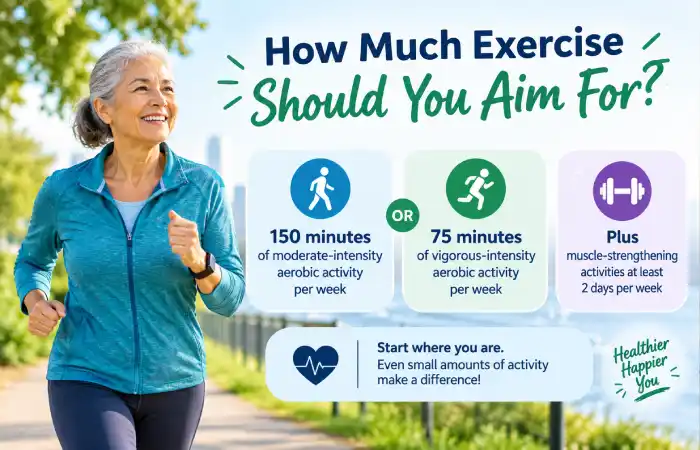
The minimum required to safeguard your health is as follows:
For overall health benefits, adults (aged 18-64 years) should accumulate at least 150 minutes of moderate intensity aerobic activity (or at least 75 minutes of vigorous intensity aerobic activity, or an equivalent combination of both moderate and vigorous intensity activity) a week.
The Bottom Line
Overcoming Workout Procrastination It’s not about pushing yourself to be more disciplined. It’s about taking the barriers out of the way of working out. Select a realistic workout schedule.
Schedule it.
Get ready. Begin with five minutes. Eliminate barriers. Measure your consistency.
Prepare for busy days.
Don’t let a single missed workout get you down. You don’t have to want to work out all the time. You just need a plan that allows you to take the first step so effortlessly that you’re OK going through with it.
Afiya Jafar is a fitness and wellness writer who focuses on making health, exercise, and healthy lifestyle information simple and practical. Her work covers workouts, fitness motivation, strength training, nutrition, weight management, stress management, mindfulness, and everyday wellness.
Read full bio of Afiya Jafar
Sameena reviews selected health, wellness, fitness, and digital content for clarity, factual presentation, and reader usefulness.
Read full bio of Sameena Begum