
 Afiya Jafar
Fitness & Wellness Writer
Afiya Jafar is a fitness and wellness writer who focuses on making health, exercise, and healthy lifestyle information simple and practical.
Read Full Bio of Author →
Afiya Jafar
Fitness & Wellness Writer
Afiya Jafar is a fitness and wellness writer who focuses on making health, exercise, and healthy lifestyle information simple and practical.
Read Full Bio of Author →
 Sameena Begum
Health, Fitness & Digital Content Reviewer
Sameena reviews selected health, wellness, fitness, and digital content for clarity, factual presentation, and reader usefulness.
Read Full Bio of Reviewer →
Sameena Begum
Health, Fitness & Digital Content Reviewer
Sameena reviews selected health, wellness, fitness, and digital content for clarity, factual presentation, and reader usefulness.
Read Full Bio of Reviewer →
 Dr. Khizrana Begum
General Physician & Dermatologist
Dr. Khizrana Begum is a General Physician and Dermatologist with MBBS and MD qualifications and 5+ years of experience in the medical field.
Read Full Bio of Medical Reviewer →
Dr. Khizrana Begum
General Physician & Dermatologist
Dr. Khizrana Begum is a General Physician and Dermatologist with MBBS and MD qualifications and 5+ years of experience in the medical field.
Read Full Bio of Medical Reviewer →
BCAA vs EAA is one of the most common comparisons people make when they enter the gym as a newbie or have years under their belts. These are both amino acid supplement products that aim to help with your muscle recovery.
They work slightly differently.
What’s the bottom line?
Do you have to pay for either product?
Evidence that will be released in sports nutrition throughout 2026 points toward EAA supplement products as the superior option for promoting protein synthesis due to containing the all nine EAAs. Let me tell you what this means in plain english!
❝
This article is a part of
Muscle Building Hub
Understanding Amino Acids
These are basically the building blocks of protein. Protein building blocks are critical for all your muscles, tendons, hormones, and enzymes in the body.
All together there are 20 amino acids categorized in 3 groups.
| Type | Number | Produced by Body |
| Essential Amino Acids (EAAs) | 9 | ❌ No |
| Non-Essential Amino Acids | 11 | ✅ Yes |
| Branched Chain Amino Acids (BCAAs) | 3 (part of EAAs) | ❌ No |
The amino acid group which is called the Essential amino acid group is a one where our bodies cannot make them for ourselves and you must be getting your intake of them by foods or dietary supplements.
Foods naturally rich in EAAs include:
- Eggs
- Chicken
- Fish
- Beef
- Milk
- Greek yogurt
- Whey protein
Amino acids are only one part of an effective supplement strategy. Explore our complete guide to muscle-building supplements to learn how different products support muscle growth.
What Are BCAAs?
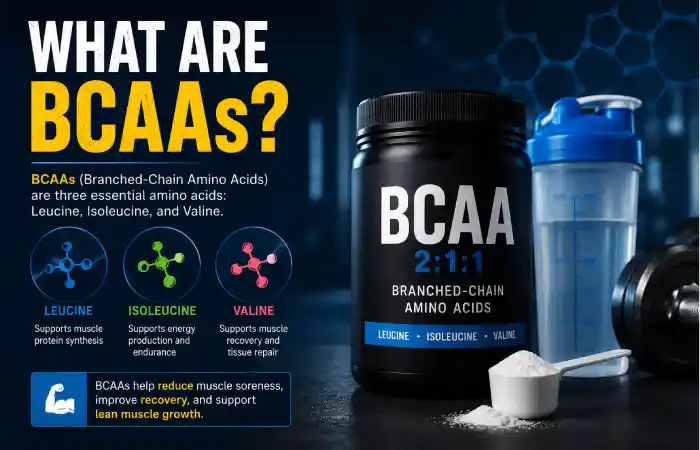
BCAAs (Branched-Chain Amino Acids) contain only three essential amino acids:
- Leucine
- Isoleucine
- Valine
These three account for around 35–40% of the essential amino acids found in skeletal muscle. (ISSN)
Why are BCAAs popular?
Leucine acts as a trigger that signals your muscles to begin protein synthesis after exercise.
Potential benefits include:
- Reduced muscle soreness
- Better workout endurance
- Less fatigue during training
- Faster recovery after resistance exercise
Common BCAA Ratio
| Supplement | Leucine | Isoleucine | Valine |
| Standard | 2 | 1 | 1 |
| Advanced | 4 | 1 | 1 |
| High Leucine | 8 | 1 | 1 |
Most experts recommend the classic 2:1:1 ratio, since higher leucine formulas have shown limited additional benefit.
What Are EAAs?
EAAs include all nine essential amino acids:
- Leucine
- Isoleucine
- Valine
- Lysine
- Methionine
- Phenylalanine
- Histidine
- Threonine
- Tryptophan
Since muscle tissue requires all essential amino acids to repair and grow, EAAs provide the complete “building materials” instead of just the trigger.
Benefits of EAA Supplements
- Maximizes muscle protein synthesis
- Supports muscle recovery
- Preserves lean muscle during dieting
- Helps endurance athletes
- Useful during fasted workouts
- May improve exercise performance
Key Differences
BCAA vs EAA Comparison
| Feature | BCAA | EAA |
| Total Amino Acids | 3 | 9 |
| Muscle Growth | Moderate | Excellent |
| Muscle Recovery | Good | Excellent |
| During Fasting | Helpful | Better |
| Complete Protein Support | No | Yes |
| Stimulates Protein Synthesis | Partial | Complete |
| Best For | Recovery | Muscle Building |
Scientific Comparison (2026 Evidence)
| Outcome | BCAA | EAA |
| Muscle Protein Synthesis | 3 Stars | 5 Stars |
| Recovery | 4 Stars | 5 Stars |
| Muscle Gain | 3 Stars | 5 Stars |
| Strength Improvement | 3 Stars | 4 Stars |
| Fat Loss Support | 3 Stars | 4 Stars |
Which Supports Muscle Growth Better?
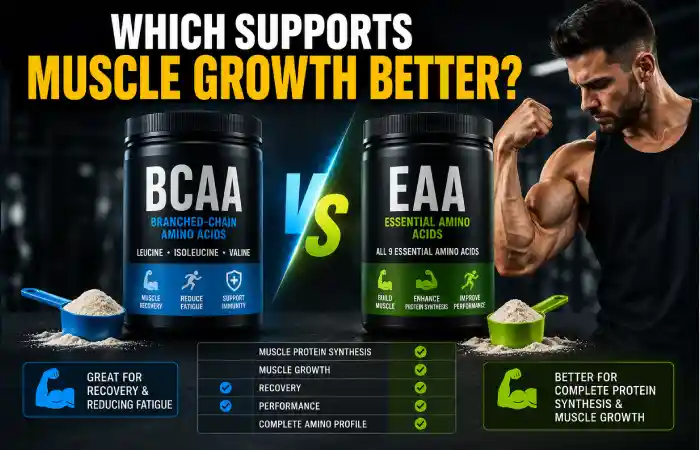
Which is best to take – BCAA or EAA for muscle building? Currently all the evidence available on the subject of sports nutrition favors EAAs. They still aid the recovery of your muscles, but unlike BCAAs, EAAs contain all the components your body has the capacity to make new muscles with.
The BCAAs only feature three amino acids: leucine, isoleucine, and valine. Only leucine plays the role in signaling the beginning of muscle protein synthesis (MPS), that’s what we know the rebuilding of muscles fibers in response to a workout session. But, this is just the beginning of the muscle building story. We need to ensure that our body have the other 6 essential amino acids to finish building the muscles.
This includes all nine EAAs, meaning they give your body a head start in protein production, while also helping maintain it during prolonged exercise sessions. EAAs, therefore, provide excellent results in a calorie deficit, at the end of a strength training session, and if you aren’t quite meeting your daily protein goals.
If you prefer minimally processed products, these natural muscle-building supplements can help support muscle development alongside a balanced diet.
Why EAAs Are More Effective for Muscle Growth
- Deliver all 9 muscle repair essentials.
- Aid the total muscle building process, not just initiate it.
- Assist to retain lean muscle during weight loss or a fasting period.
- Enhance recovery post heavy exercise.
- Offer better overall support for strength and muscle gains. (PMC)
BCAA vs EAA for Muscle Growth
| Factor | BCAA | EAA |
| Amino Acids Included | 3 | 9 |
| Triggers Muscle Protein Synthesis | ✅ Yes | ✅ Yes |
| Supports Complete Muscle Building | ❌ Limited | ✅ Yes |
| Best for Recovery | Good | Excellent |
| Best for Lean Muscle Gain | Moderate | Excellent |
| Ideal for Calorie Deficit | Fair | Very Good |
Since protein powders already provide essential amino acids, choosing the best protein powder for muscle gain can often complement or even reduce the need for additional amino acid supplements.
What Does the Research Say?
Ongoing studies in sports nutrition journals reinforce that EAAs induce higher levels of muscle protein synthesis compared to BCAAs alone. Leucine provides the “on switch” for growth but without the other EAAs as raw building materials to form new muscle tissue, growth can not proceed effectively. Also, in people who are already consuming adequate amounts of protein from their diets in forms of eggs, meat, fish, dairy or whey, supplementing alone with BCAAs has not demonstrated increased benefits because all essential amino acids are provided by foods.
Who Should Choose BCAA?
BCAAs may still be useful if you:
- Prefer a low-calorie intra-workout drink.
- Perform long endurance workouts where reducing fatigue is a priority.
- Train fasted and want a light supplement during exercise.
- Already consume sufficient complete protein but want additional recovery support.
Who Should Choose EAA?
EAAs are generally the better option if you:
- Want to maximize muscle growth.
- Are following a calorie-restricted diet.
- Struggle to meet your daily protein target.
- Follow a vegetarian or vegan diet with fewer complete protein sources.
- Recover from frequent or high-volume resistance training.
While BCAAs and EAAs support recovery, creatine for muscle growth is widely recognized for improving strength, power, and muscle performance.
Expert Verdict
What’s the right choice for most of us (those looking to get jacked) is thatEAAs contain all of the amino acids necessary for the building of new muscle protein. Still, bothBCAAsandEAAsaren’t an excuse to throw nutrition out the window. Aim for 1.6–2.2g protein/kg of body weight every day, progressive strength training, sufficient sleep and good recovery; Supplements enhance this-not replace it.
Looking to optimize your recovery? Check out the best post-workout supplements for recovery to build a more complete post-exercise nutrition plan.
Do You Need Either?
The answer depends on your daily protein intake.
If you eat enough protein
Example:
- Chicken
- Eggs
- Fish
- Milk
- Whey protein
Then you probably do not need BCAA supplements.
Your meals already contain BCAAs and EAAs naturally.
You may benefit from EAAs if:
- You train while fasting.
- You’re following a calorie-restricted diet.
- You’re vegan or vegetarian with lower-quality protein sources.
- You’re recovering from intense training.
- You struggle to meet daily protein goals.
BCAAs may still be useful if:
- You sip supplements during long endurance sessions.
- You dislike protein shakes during workouts.
- You need a low-calorie intra-workout drink.
Comparison Graph (Relative Muscle Growth Support)
| Supplement | Muscle Growth Score |
| Food Protein | 100 |
| Whey Protein | 98 |
| EAA | 90 |
| BCAA | 65 |
Product Comparison
| Product Type | Best For | Typical Serving | Pros | Cons |
| BCAA Powder | Recovery during workouts | 5–10 g | Affordable, flavored | Incomplete amino profile |
| EAA Powder | Muscle growth & recovery | 10–15 g | Complete amino profile | Usually more expensive |
| Whey Protein | Daily muscle building | 20–30 g protein | Complete protein, highly researched | Not suitable for dairy intolerance |
Troubleshooting
I’m taking BCAAs but not gaining muscle.
Possible causes:
- Protein intake is too low.
- Training intensity is insufficient.
- Overall calorie intake is inadequate.
- Recovery and sleep are poor.
- Expecting BCAAs to replace complete protein.
Frequently Asked Questions
Are EAA better than BCAA?
Yes. Because EAAs contain the nine essential amino acids that are necessary to facilitate the synthesis of complete muscle protein, the overwhelming consensus is that EAAs are a better choice for muscle growth.
Should I take BCAA and EAA?
Yes, you can, but it is generally considered to be unnecessary since BCAAs are included within EAAs.
Are BCAAs obsolete?
Not really, they do still serve specific purposes related to endurance exercise and intra-workout hydration, but the general recommendation these days is for complete proteins or EAAs.
Is whey better than EAA?
For healthy adults in most situations, yes, since whey protein is considered a complete protein source with both essential and non-essential amino acids.
For beginner should I purchase BCAA or EAA?
When faced with a choice between the two, EAAs often represent a better value and a superior choice.
Before adding amino acid products to your routine, learn about common muscle-building supplement side effects and how to use supplements responsibly.
Conclusion
The consensus on BCAA vs EAA is thatEAAsare generally superior for overall muscle growth and recovery because they provide all of the nine building blocks the body needs to create new protein. While BCAAs might be beneficial for some aspects of training such as aiding recovery and endurance, they shouldn’t substitute for a proper, whole-foods diet and total protein intake. Always ensure your protein intake, diet, training, and sleep are in line before supplementing. For the vast majority of people, the majority of their gains will come from high-quality sources of protein and an adequate diet with the addition of EAA’s (only when necessary to boost your overall protein intake).
Afiya Jafar is a fitness and wellness writer who focuses on making health, exercise, and healthy lifestyle information simple and practical. Her work covers workouts, fitness motivation, strength training, nutrition, weight management, stress management, mindfulness, and everyday wellness.
Read Full Bio of Afiya Jafar →
Sameena Begum reviews selected health, wellness, fitness, and digital content for clarity, factual presentation, consistency, and reader usefulness. Her review work helps maintain clear and responsible editorial standards across PhysicalFitt content.
Read Full Bio of Sameena Begum →
Dr. Khizrana Begum is a qualified medical professional with MBBS and MD qualifications and 5+ years of experience in the medical field. She works as a General Physician and Dermatologist, with expertise in general medicine, dermatology, preventive healthcare, and skin health.
Read Full Bio of Dr. Khizrana Begum →