
 Afiya Jafar
Fitness & Wellness Writer
Afiya Jafar is a fitness and wellness writer who focuses on making health, exercise, and healthy lifestyle information simple and practical.
Read Full Bio of Author →
Afiya Jafar
Fitness & Wellness Writer
Afiya Jafar is a fitness and wellness writer who focuses on making health, exercise, and healthy lifestyle information simple and practical.
Read Full Bio of Author →
 Sameena Begum
Health, Fitness & Digital Content Reviewer
Sameena reviews selected health, wellness, fitness, and digital content for clarity, factual presentation, and reader usefulness.
Read Full Bio of Reviewer →
Sameena Begum
Health, Fitness & Digital Content Reviewer
Sameena reviews selected health, wellness, fitness, and digital content for clarity, factual presentation, and reader usefulness.
Read Full Bio of Reviewer →
 Dr. Khizrana Begum
General Physician & Dermatologist
Dr. Khizrana Begum is a General Physician and Dermatologist with MBBS and MD qualifications and 5+ years of experience in the medical field.
Read Full Bio of Medical Reviewer →
Dr. Khizrana Begum
General Physician & Dermatologist
Dr. Khizrana Begum is a General Physician and Dermatologist with MBBS and MD qualifications and 5+ years of experience in the medical field.
Read Full Bio of Medical Reviewer →
One of the simplest ways to increase your cardiovacularity, shed some calories, boost weight loss, or gain some stamina no matter what the weather. Today’s treadmills now have various settings that make it easy to set your desired pace, resistance, incline, heart rate, or even follow guided, pre-programmed routines that cater to novice walkers and accomplished runners.
No matter what your objective — fat loss, endurance training, or simply to get in shape–you will benefit significantly more from following a prescribed Treadmill Workout Routine than you would by just walking at a set pace every day. This guide outlines treadmill basics, helps you avoid treadmill errors, and will guide you in selectin the perfect workout routine to maximize your desired outcome.
❝
This article is a part of
Cardio Hub
Why Choose Treadmill Cardio?
The treadmill still stands as one of the most prevalent machines in cardio workouts. This is due to its consistent, quantifiable, low entry workout levels.
Benefits include
- Burns calories efficiently
- Improves heart health
- Supports weight loss
- Strengthens legs and core
- Beginner friendly
- Adjustable intensity
- Safe during bad weather
- Tracks progress accurately
Benefits of Treadmill Training
Compared with outdoor running, treadmills allow greater workout control.
| Benefit | Treadmill | Outdoor Running |
| Pace Control | Excellent | Moderate |
| Incline Options | Adjustable | Terrain dependent |
| Weather Impact | None | High |
| Injury Risk | Lower for beginners | Moderate |
| Workout Tracking | Built-in | Requires smartwatch |
| Interval Training | Easy | Moderate |
2026 insight- Several smart treadmills incorporate AI based coaching, dynamic speed setting, and a whole selection of running trails on-screen to ensure you get a more exciting and tailored cardiovascular training session when you workout inside.
Walking Workout Routine
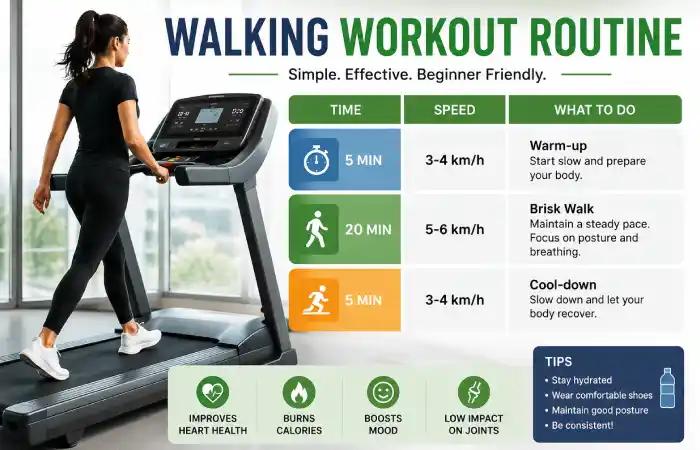
Beginner Walking Plan
| Time | Speed |
| 5 min | Warm-up (3–4 km/h) |
| 20 min | Brisk walk (5–6 km/h) |
| 5 min | Cool-down |
Perform this routine:
- 3–5 days weekly
- Maintain good posture
- Swing your arms naturally
- Avoid holding the handrails unless needed for balance
Walking consistently can improve cardiovascular fitness while placing less stress on the joints.
Running Workout Routine
Running increases calorie burn and builds endurance.
Intermediate Running Session
| Stage | Duration |
| Warm-up walk | 5 min |
| Easy jog | 10 min |
| Moderate run | 15 min |
| Recovery jog | 5 min |
| Cool down | 5 min |
Increase either speed or duration gradually each week to reduce the risk of overuse injuries.
If you’re just starting your fitness journey, follow our beginner cardio workout plan before progressing to longer or higher-intensity treadmill sessions.
Incline Walking for Fat Loss
The Benefits of Treadmill incline walking is the king of all treadmill workouts when it comes to torching calories without beating up on your joints. This is because by tipping your treadmill to an incline, your body is forced to move harder against gravity, engaging larger muscles such as glutes, hamstrings, calves, and your core. Increased muscle activity results in a faster heart rate and greater calorie burn – without high-speed running.
Perhaps most appealing is the fact that anyone who is a novice in exercise, or has knee pain, an old injury or is over the age of 50, can take advantage of the power of an incline workout to get a serious cardio burn with very little stress on your joints.
Treadmill workouts are just one option. Explore our complete guide to cardio exercises in the gym to compare different machines and training methods.
Indeed, even most trainers advocate adding an incline before an added boost in speed when getting the best results on the treadmill.
Why Incline Walking Helps Burn More Fat
While traversing a steep slope consumes oxygen and energy, doing so when flat walking uses your body more and more of your calorie-burning power when working out. If walking in tandem with proper meal choices and regular activity, inclination walking aids with making a sound calorie deficiency and ultimately, weight loss.
To maximize body fat reduction while maintaining lean muscle, learn how to structure cardio for fat loss with the right intensity and frequency.
Additional benefits include:
- Burns calories for glutes, Hamstrings & Calves
- Improve the overall Cardiovascular System of the body
- Increases Leg Muscles Endurance
- Less pressure and damage to your Knees compared to Fast Running
- Serves to jump-start metabolism to shed those plateau weight loss weight-loss plateau
If your primary goal is reducing body weight, our guide to cardio for weight loss covers the best workout routines and calorie-burning strategies.
Recommended Incline Levels
| Fitness Goal | Speed | Incline |
| Beginner Fitness | 4–5 km/h | 2–4% |
| Fat Loss | 5–6 km/h | 5–8% |
| Endurance Training | 5–6.5 km/h | 8–10% |
| Hill Challenge | 4.5–5.5 km/h | 10–12% |
Tip: If you’re new to incline walking, start with a 2–3% incline and gradually increase it over several weeks as your fitness improves.
Sample 30-Minute Incline Walking Workout
| Time | Speed | Incline |
| 5 minutes | Easy warm-up | 1% |
| 5 minutes | Brisk walk | 4% |
| 10 minutes | Moderate effort | 6–8% |
| 5 minutes | Power walk | 10% |
| 5 minutes | Cool-down | 1% |
This workout combines steady-state cardio with gradual intensity changes to maximize calorie burn while remaining beginner friendly.
Best Practices for Incline Walking
Optimize your training:
- Stand tall, without leaning forward
- Don’t shrug shoulders and keep your abs engaged
- Keep your arms swinging instead of holding onto the rails
- Stick with walking or running shoes that have cushioning
- Get on with an incline without having big jumps
- Drink water and keep your training heart rate within your target training zone
If you’re walking on an incline three to five days a week in addition to a balanced diet and resistance training, then an incline workout can contribute significantly towards better cardiovascular health, maintain lean muscle mass, and in the long run, to lose fat.
HIIT Treadmill Workout
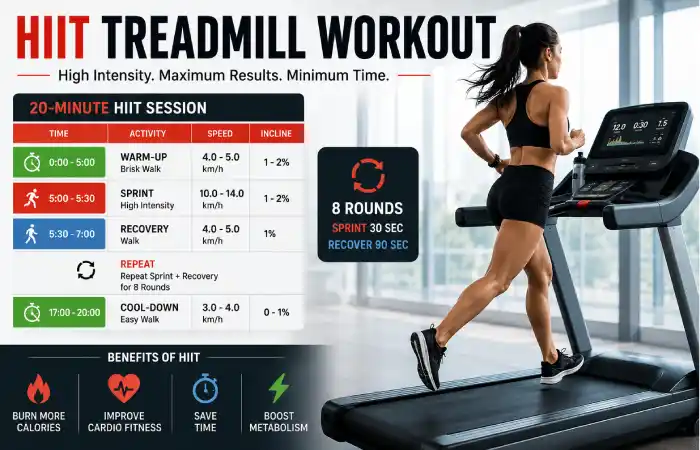
High-Intensity Interval Training (HIIT) alternates short bursts of intense effort with recovery periods.
20-Minute HIIT Routine
| Time | Activity |
| 5 min | Warm-up |
| 30 sec | Sprint |
| 90 sec | Walk |
| Repeat 8 rounds | Intervals |
| 5 min | Cool-down |
Benefits include:
- More calories burned.
- More efficient and enhanced fitness and cardio.
- Quicker workouts.
- Higher workout calorie output even after you are done.
Limit HIIT sessions to 2–3 times per week to allow adequate recovery.
You can make treadmill sessions more effective by incorporating HIIT cardio workouts that alternate between high- and low-intensity intervals.
Walking vs Running Comparison
| Feature | Running | Walking |
| Beginner Friendly | ⭐⭐⭐ | ⭐⭐⭐⭐⭐ |
| Calories Burned | High | Moderate |
| Joint Stress | Higher | Low |
| Fat Loss | Excellent | Good |
| Endurance | Excellent | Moderate |
| Recovery Time | Longer | Short |
Sample Weekly Treadmill Schedule
| Day | Workout |
| Monday | Brisk Walking |
| Tuesday | HIIT |
| Wednesday | Recovery Walk |
| Thursday | Running |
| Friday | Incline Walking |
| Saturday | Endurance Run |
| Sunday | Rest or Light Walk |
Common Treadmill Mistakes
Avoid these frequent errors:
- Skipping the warm-up
- Using the same speed every workout
- Holding the handrails continuously
- Looking down while walking or running
- Wearing worn-out running shoes
- Ignoring incline settings
- Taking overly long strides
- Increasing intensity too quickly
Product Comparison (2026)
| Feature | Mid-Range | Budget Treadmill | Premium Smart Treadmill |
| Motor Power | 3.0 HP | 2.0 HP | 4.0+ HP |
| Incline | Auto | Manual | Smart Auto |
| Workout Programs | 20–40 | Basic | 100+ |
| Screen | HD Display | LCD | Interactive Touchscreen |
| Heart Rate Tracking | Included | Optional | Advanced Sensors |
| Best For | Home Fitness | Beginners | Serious Training |
2026 Fitness Trend Snapshot
| Cardio Trend | Popularity |
| Incline Walking | ★★★★★ |
| HIIT Workouts | ★★★★★ |
| AI-Coached Cardio | ★★★★☆ |
| Heart Rate Zone Training | ★★★★★ |
| Virtual Running Routes | ★★★★☆ |
Troubleshooting
| Problem | Solution |
| Knee discomfort | Reduce speed, improve footwear, add incline gradually |
| Workout feels too easy | Increase incline before increasing speed |
| Heart rate too high | Slow down and extend recovery intervals |
| Boredom | Use interval programs, music, podcasts, or virtual routes |
| Plateau | Change workout intensity weekly and track progress |
If you’re combining treadmill workouts with strength training, read whether cardio before or after weights is the better option for your goals.
Frequently Asked Questions
Is treadmill cardio good for weight loss?
Yes – Together with a portion-restricted diet plan, treadmill running sessions assist to generate calorie lack for ongoing fat reduction.
How many minutes can a newbie use treadmill?
Start out of 20-30 minutes every time three to five periods weekly then increase your training duration or intensity.
It’s preferable to run on the inclined setting compared to the flat surface. Incline walking vs. Incline jogging Incline walking could possibly be the lowest impact treadmill method for training while still melting a few hundred calories.
How usually do i really do high-intensity on a treadmill?
Do HIIT workouts around the treadmill a couple of days each week, using one lower intensity treadmill exercise or another cardio activity on another 2-3 days.
Should i utilize the treadmill every single day?
In case you are vary the intensity, incorporating lighter restoration sessions as needed, each day usage will be safe.
Conclusion
Consistent structure on the treadmill can also aid in weight control, cardiovascular fitness, and a higher degree of cardiovascular endurance for virtually anyone. Alternating between walking and running on the treadmill is the first strategy to implement. However, for even greater effectiveness and to avoid plateaus, you may want to consider also incorporate a treadmill, high intensity interval training (HIIT), and even sessions working on treadmill incline and declination (incline workouts).
Ensure proper posture is being maintained at all times when working on a treadmill and slowly build up the duration, frequency and intensity of your cardio workouts.
Use tracking tools that will also allow for the monitoring of data like workout history, your heart rate, and others. Coupled with healthy dietary habits and appropriate rest, treadmill exercise will serve as a great path to health in the years to come.
Afiya Jafar is a fitness and wellness writer who focuses on making health, exercise, and healthy lifestyle information simple and practical. Her work covers workouts, fitness motivation, strength training, nutrition, weight management, stress management, mindfulness, and everyday wellness.
Read Full Bio of Afiya Jafar →
Sameena Begum reviews selected health, wellness, fitness, and digital content for clarity, factual presentation, consistency, and reader usefulness. Her review work helps maintain clear and responsible editorial standards across PhysicalFitt content.
Read Full Bio of Sameena Begum →
Dr. Khizrana Begum is a qualified medical professional with MBBS and MD qualifications and 5+ years of experience in the medical field. She works as a General Physician and Dermatologist, with expertise in general medicine, dermatology, preventive healthcare, and skin health.
Read Full Bio of Dr. Khizrana Begum →