

Last Updated: August 27, 2026
Why is it important to regularly screen your health? Health checkups are a fundamental component of preventive healthcare as they present you and your doctor with the opportunity to review your general health prior to the condition escalating. A checkup entails more than just screening for disease, it often entails a risk assessment, the provision of immunizations, lifestyle counseling and testing to assess specific components such as cholesterol and your medical history.
In India, the health risks outlined previously are particularly significant. The ICMR-INDIAB study has stated that an estimated 101 million Indians had diabetes, 136 million had prediabetes and 315 million suffered from hypertension by 2021, with correspondingly high percentages suffering from obesity and hypercholesterolemia. It therefore stands to reason that it is beneficial to get a check of vital health indicators, even when one is feeling fit and well.
What Is a Health Checkup?
A checkup is a scheduled visit to a healthcare provider to assess your general health status, assess any risk factors for health conditions and for reviewing preventive healthcare, deciding if you need any specific screening test.
An annual visit might include a medical history evaluation, physical measures of the patient, assessment of blood pressure, review of social habits, vaccinations, and mental health screening, along with possibly ordering screening lab work or cancer screenings. The specific tests recommended shouldn’t look the same for every patient.
A checkup is also different from a diagnostic test. A checkup typically is preventive and usually can be done when the patient is Asymptomatic for most of the issues looked for. Diagnostic tests are ordered when we are looking into a specific symptom, abnormal screening value or a known illness.
Why Regular Health Checkups Matter
There are conditions that cannot present at face value. There could be high blood pressure, high blood glucose, or high cholesterol without ever noticing this until it results in some serious complication or two.
Worldwide, there are 1.28 billion adults aged 30–79 with hypertension, and an estimated 46% of these adults were unaware of their diagnosis according to WHO. In my opinion blood pressure should be measured since it’s easily checkable for an often contributing factor.
With regular preventative visits, you will be:
- Monitoring a change in weight, blood pressure, glucose, and cholesterol.
- Reviewing vaccinations and age appropriate screening.
- Discussing diet, exercise, sleep, tobacco and alcohol intake, as well as taking into account your family history and possible corresponding risks.
- Determining if referral to a specialist may be appropriate at this time; and/or,
- Collecting a baseline of health measurements from which further future comparisons may be made.
That said, however, checkups on an routine basis should enhance, not substitute, medical evaluation of new or unusual health changes.
What Happens During a Health Checkup?
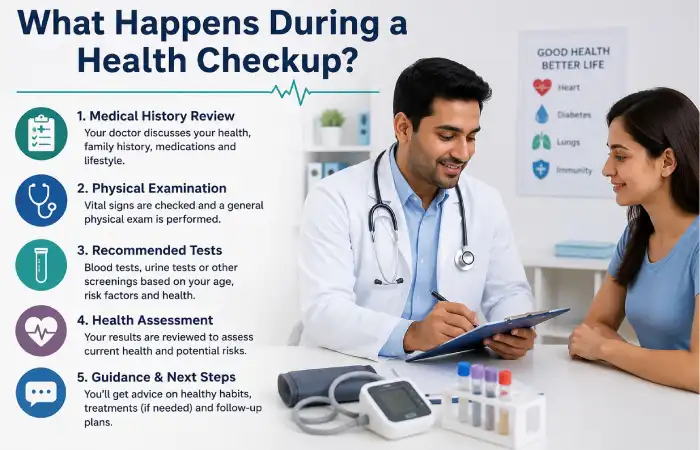
A routine physical is usually initiated by a questionnaire covering your medical history, medications, allergies, family history, habits and concerns for the visit. After your input, the provider will likely measure your weight, height, and your vital signs – such as your blood pressure and your pulse. Depending upon your age and needs, the exam could cover your heart, lungs, abdomen, skin or other systems.
Often, based on your personal health risk factors, the provider will advise you about tests or screening exams that might be beneficial for you.
Cholesterol and glucose screening as well as immunizations and discussion of cancer prevention and depression screening can be included in periodic physical exams, according to the JAMA practice guideline mentioned above.
Common Health Tests
There is no single blood-test panel that every healthy person needs. Common tests may include:
| Test or assessment | Usually determined by | What it can help assess |
| Blood pressure | Age, previous readings, risk | Hypertension and cardiovascular risk |
| Blood glucose/HbA1c | Age and diabetes risk | Diabetes or abnormal glucose regulation |
| Lipid profile | Age and overall risk | Cholesterol and cardiovascular risk |
| Complete blood count | Symptoms and clinical history | Blood-cell abnormalities such as anemia |
| Kidney function | Medical history and risk | Kidney health |
| Liver tests | Symptoms, medications and risk | Liver function/injury markers |
| Urinalysis | Symptoms and clinical context | Selected urinary or kidney abnormalities |
A “more comprehensive” package is not automatically a better package. Testing should have a clinical reason, because unnecessary tests can produce incidental findings, false positives, anxiety, and additional costs.
Blood Pressure and Heart Health Checks
Perhaps the easiest measurement to add for your health is blood pressure. According to Mayo Clinic, blood pressure test procedures are part of many regular checkups and that how often you should get your blood pressure checked varies depending on age and health status.
For most adults 18-39 with healthy blood pressure levels and low cardiovascular risks, Mayo Clinic states checks every two to five years; adults 40 and older, as well as younger adults considered high-risk, may need checkups more often.
Blood Tests and Health Screening
Blood tests can offer helpful information related to your metabolic health. However screening should be more risk-based, rather than assuming everyone requires every possible test that they might potentially need. Tests such as screening for diabetes require testing for glucose where that risk is increased.
Testing of lipids would be useful for establishing individual risk of cardiovascular disease.
Many other tests would be indicated on the basis of presence of signs and symptoms, current use of medications, family history of disease, age, or presence of an existing medical disease. As with blood tests, screenings for cancer are aimed at particular risk factors and patient age. For example, the USPSTF guideline, for average risk females of average risk, screening with a mammogram is recommended every 2 years starting between ages 40-50 through age 74 (depending on which study is considered). USPSTF, for average-risk adults, screening should begin at age 45 for colorectal cancer, and offers 4 tests at different frequencies of intervals.
The USPSTF guidelines presented are only some screening guidelines and not universal.
Different countries have different screening guideline criteria and individualized risk, which influences patient choices and recommendations.
How Often Should You Get a Checkup?
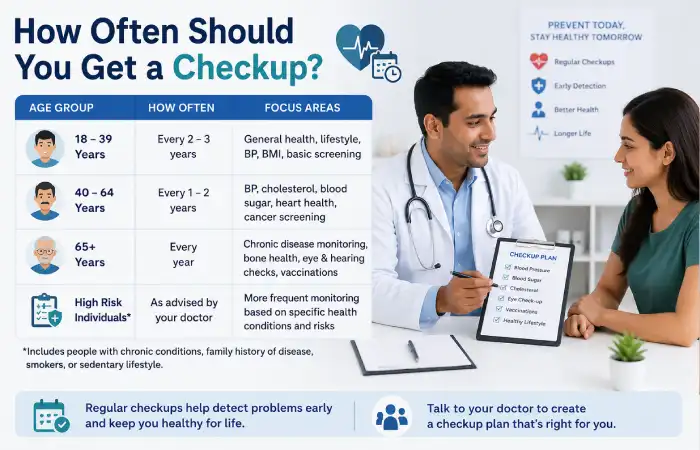
The fact is, there isn’t really a rule to guarantee you’re getting precisely the health test each year that you (the individual, healthy, young adult) really need. The journal JAMA states that even a healthy, young person may not need a yearly visit.
| Life stage | General approach |
| Children and teenagers | Regular age-specific preventive visits and vaccinations |
| Young adults | Periodic preventive care based on health and risk factors |
| Adults 40+ | More frequent assessment may become appropriate as chronic-disease risk increases |
| Older adults | Regular preventive care with additional age-related assessments |
| Higher-risk individuals | Schedule determined by the healthcare professional |
People with diabetes, hypertension, chronic illnesses, significant family history, pregnancy, long-term medications, or other risk factors may need more frequent follow-up.
Preparing for a Health Checkup
Having a list can make the appointment more fruitful.
It’s wise to bring a printed list of prescriptions, OTCs, vitamins and supplements and to include health history (your own and that of immediate family members) or any symptom you have detected. For example, MedlinePlus suggests writing questions, studying health history, deciding if you are due for or need screenings or immunizations and presenting a list of meds to the doctor. Find out whether you need to fast before an blood test before going to the doctor to avoid doing it unless necessary.
Health Checkups by Age
Age is only one factor in decisions of screening procedures. The most sensible strategy is to “couple” age with: sex; family history; life style; prior history; and co existing disease.
As a reasonable proposal, a well young person requires relatively few laboratory tests, where older adults or individuals at risk of diabetes require more routine biochemical surveillance. Women would undergo relevant reproductive and breast screening procedures, and older adults could be tested regarding risk of falls, hearing, memory etc.
This is why a doctor-led preventive assessment can be more useful than automatically purchasing the largest available “full-body” package.
Health Checkup Package vs Individual Screening
| Option | Best suited for | Main advantage | Potential limitation |
| Basic preventive visit | Generally healthy adults | Personalized assessment | May require separate lab appointments |
| Comprehensive package | People wanting several routine measurements together | Convenience | May include tests you do not need |
| Individual screening tests | Specific risk factors or follow-up | More targeted | May require multiple appointments |
| Home monitoring | Tracking selected measurements | Convenient for ongoing monitoring | Does not replace clinical assessment |
The factors you really want to consider and compare in any commercial health checkup package include real tests in offer, the clinical basis behind them, laboratory licensing, collection procedures, and how reports are explained and discussed with you in a final follow-up.
Questions to Ask Your Healthcare Professional
A quick thought before concluding the visit:
- What screenings are right for me based on age and risk?
- I really need to do these other?
- Tests I have abnormal test results Which ones of these will do over time?
- Do the elements of family history or my lifestyle alter the recommendation for any screenings?
- Am I up to date on my shots and vaccinations?
- Is there any other follow-up or a specialist needed?
- Which symptoms warrant an earlier visit with you?
The Bottom Line
When performed appropriately, a well-woman exam is the best it can be-personalized, evidence-based and primarily designed for prevention, not just the completion of as many tests as possible. With consistent screening, significant factors for health – such as increased blood pressure or poor glucose levels and cholesterol – can be discovered early, when easier to treat or manage. – Susan B. Thomas This year, don’t just get a check-up.
Also Use It to Understand Your General Health, Screenings You Need, and Preventive Schedule: Learn the recommendations from an actual expert when discussing these important aspects of your care with the right health professional .
Medical Disclaimer: This article is intended for general educational purposes and not to serve as a substitute for professional medical advice, diagnosis or treatment. The optimal recommended screening schedule may depend on your gender, age, family medical history, lifestyle factors and local guidelines for the country in which you live.