
Last Updated: September 8, 2026
Health facilities are a category of buildings in which human receive services concerning health-related prevention, diagnosis and therapy, long-term care or treatment/ rehabilitation. They may consist of general hospitals, out-patient clinics, diagnostic or intensive care centers, intensive care units (ICU), specialist rehabilitation units or nursing homes. Since there are variations amongst those centers, recognizing differences might contribute a patient to make right health facility based on his/her symptoms, cost, diagnosis, treatment, and type of medical assistance.
By becoming knowledgeable with health facilities may not only offer people a much simpler access to care, but also an efficient and optimal help they can get from them.
Whereas a regular health check should not be in a hospital for it may only be performed in a GP’s office, urgent cases would typically demand help in a hospital. Specialist clinics would serve a purpose in cases when a patient should obtain certain diagnostics or needs rehabilitation after undergoing surgery.
What Are Healthcare Facilities?
A healthcare facility is any establishment which a person can go for treatment, preventive measures, or diagnosis, along with therapy and rehabilitation and some may even for long-term care. The categories range from hospitals, clinics and also outpatient centers including rehabilitation services and diagnostics.
According to the CDC, health care settings refer to a collective name that refers to different types of care locations such as urgent care centers, outpatient specialist facilities along with outpatient surgery centers, rehabilitative centers, long-term and intermediate nursing facilities, and hospitals with services of acute care.
The actual care needed at a facility is also subject to what symptoms you are experiencing as some medical needs require more urgent attention then others, depending on your medical condition and what type of care you need (inpatient or outpatient).
For instance, a normal check-up would necessitate going to a primary care clinic while if symptoms were critical then to the hospital’s emergency services department
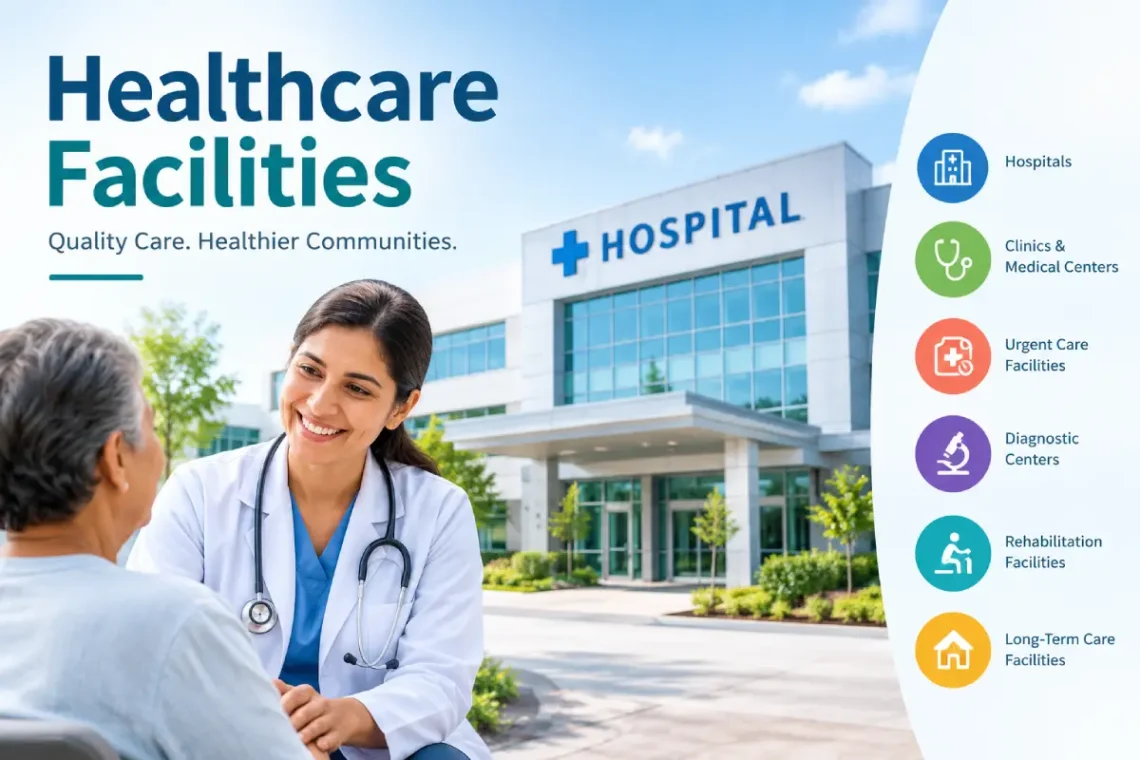
Types of Healthcare Facilities
Healthcare facilities serve different purposes. Choosing the appropriate setting can help patients receive the right level of care without unnecessary delays or costs.
| Facility | Typical purpose | Common care setting |
| Hospital | Emergency, inpatient, surgery and complex care | Inpatient & outpatient |
| Clinic/medical center | Routine and specialty medical care | Outpatient |
| Urgent care | Non-life-threatening urgent conditions | Outpatient |
| Diagnostic center | Imaging and laboratory testing | Outpatient |
| Rehabilitation facility | Recovery and functional improvement | Inpatient & outpatient |
| Long-term care facility | Ongoing nursing and supportive care | Residential/inpatient |
These categories are consistent with major healthcare-setting classifications, although exact definitions can vary by country and regulatory system.
Hospitals
A hospital can be the most complete healthcare facility because it can offer emergency services, inpatient services, surgery, diagnostive tests, intensive care, and specialty services.
Hospitals may also be specialized; there are many types of specialized hospitals including cancer centers, psychiatric hospitals, children’s hospitals, and long-term acute-care hospitals among many other types. Classification of healthcare facilities by the CDC is similar and distinguishes between acute-care, specialty children’s, critical-access, and psychiatric long-term acute-care facilities among other types as.
Hospitals are generally appropriate for:
- Serious injuries or illnesses
- Major surgery
- Severe infections
- Complex diagnostic problems
- Conditions requiring hospitalization
- Medical emergencies
If a person has potentially life-threatening symptoms, emergency medical services or an emergency department may be more appropriate than an outpatient facility.
Clinics and Medical Centers

It is usually outpatient treatment in a clinic or center, with a person going home after receiving services. It might involve primary care, screening tests, referrals to specialists, monitoring of chronic conditions, or routine, superficial, follow-up visits, or minor treatment.
Examples include:
- Primary care clinics
- Family medicine practices
- Pediatric clinics
- Specialty clinics
- Dental clinics
- Outpatient rehabilitation clinics
- Dialysis centers
- Ambulatory surgery centers
The CDC specifically includes general and specialty outpatient clinics, dental clinics, dialysis centers, outpatient rehabilitation clinics, and ambulatory surgery centers among healthcare-facility settings.
Urgent Care Facilities
Urgent care facilities are designed for medical problems that need prompt attention but are not generally life-threatening emergencies.
They can be useful when a primary care appointment is unavailable and the condition cannot reasonably wait.
Common examples include:
- Minor cuts and wounds
- Sprains and strains
- Mild burns
- Fever and flu-like illnesses
- Minor infections
- Some fractures
- Other non-life-threatening conditions
Urgent care should not replace emergency care when someone has symptoms of a potentially serious or life-threatening condition.
Diagnostic Centers
Diagnostic centers help healthcare professionals identify or monitor medical conditions through laboratory tests and diagnostic imaging.
Depending on the facility, services may include:
- Blood and urine testing
- X-rays
- Ultrasound
- CT scans
- MRI
- Other laboratory or imaging services
Some diagnostic services operate independently, while others are integrated into hospitals or medical centers. The CDC lists outpatient laboratories as an example of a healthcare-related facility.
A diagnostic center may therefore be an important part of a patient’s care pathway even when the patient does not need hospitalization.
Rehabilitation Facilities

Help people to regain functional abilities and recover function (e.g. Rehabilitation therapy for illness, injury, after surgery or to re-adapt functionality). Services can include: physical therapy; occupational therapy; speech therapy; additional more specialist programs.
Facilities and settings: Outpatient clinics or an inpatient facility depending on service required; rehab centres and outpatient rehab services is a key health service (according to the CDC), these are amongst others described.
Function being improved: mobility, strength, function of independent living; communication; or to perform day to day activities.
Long-Term Care Facilities
Long-term care facilities provide ongoing support for people who need extended assistance with healthcare or daily living.
Examples can include:
- Nursing homes
- Skilled nursing facilities
- Inpatient hospice
- Certain rehabilitation hospitals
- Other residential healthcare settings
The CDC covers nursing homes, skilled nursing facilities, inpatient hospice care, and some residential treatment facilities under their category for long-term care.
Long-term care is not a standard hospitalization because a facility might be focusing on ongoing nursing support and rehabilitation and supportive care or comfort care and not just acute medical care in short-term care facility.
Choosing a Healthcare Facility
Choosing the right healthcare facility starts with understanding what type of care you need.
| Situation | Facility to consider |
| Routine checkup | Primary care clinic |
| Specialist consultation | Specialty clinic or medical center |
| Non-life-threatening urgent problem | Urgent care |
| Serious or potentially life-threatening emergency | Hospital/emergency department |
| Imaging or laboratory testing | Diagnostic center/laboratory |
| Recovery after injury or surgery | Rehabilitation facility |
| Ongoing nursing or residential care | Long-term care facility |
Other factors matter too. Before selecting a facility, consider:
- Services offered: Confirm that the facility provides the treatment, testing, or specialty you require.
- Location and accessibility: A nearby facility can make appointments, follow-up visits, and ongoing treatment easier.
- Insurance and cost: Check whether the facility and relevant providers are covered by your insurance or healthcare plan.
- Credentials and quality: Look for appropriate licensing, accreditation where applicable, qualified professionals, and transparent quality information.
- Availability: Consider appointment availability, operating hours, emergency services, and expected waiting times.
- Continuity of care: Facilities that communicate effectively with your primary care provider and other specialists can make care coordination easier.
Healthcare Facility Standards
Setting standards for the healthcare facility The development of standards for healthcare facilities sets an agreed level of expectation around safety, infrastructure, staffing, equipment, infection control, accessibility, and quality. Standards vary between countries, facility type and jurisdiction. For instance, in India, the standards set by the Indian Public Health Standards (IPHS), outline levels of public sector health facility performance regarding infrastructure, equipment, human resources, and the provision of a defined set of essential and desirable services.
The Ministry of Health and Family Welfare in India noted in March 2026 that “All health facilities were assessed by IPHS as per guidelines with 63% scoring above 50%”.
International standards guidelines for healthcare facilities include infection control, accessibility, engineering, environmental design, equipment, and way finding. Standards matter for the patient: As a result standards assist a care facility design that facilitates safe and accessible, efficient, effective, and patient centred.
Conclusion
Proper healthcare centers will also take into consideration where patients get the appropriate care in the appropriate time. There are many types of these healthcare centers such as hospitals, clinics, urgent care centers, diagnostic centers, long-term care facilities and rehabilitation centers. Each place is specially made in order to satisfy the specific needs of the patients.
Selecting a place in which you will receive a proper healthcare depends on many factors. These factors consist of the level and emergency of your care, availability of health facilities, price of healthcare centers, insurance of the patient’s condition, location and also quality of certain care. Through knowing the types, you are making a more rational choice for yourself or the persons around you.