
 Afiya Jafar
Fitness & Wellness Writer
Afiya Jafar is a fitness and wellness writer who focuses on making health, exercise, and healthy lifestyle information simple and practical.
Read Full Bio of Author →
Afiya Jafar
Fitness & Wellness Writer
Afiya Jafar is a fitness and wellness writer who focuses on making health, exercise, and healthy lifestyle information simple and practical.
Read Full Bio of Author →
 Sameena Begum
Health, Fitness & Digital Content Reviewer
Sameena reviews selected health, wellness, fitness, and digital content for clarity, factual presentation, and reader usefulness.
Read Full Bio of Reviewer →
Sameena Begum
Health, Fitness & Digital Content Reviewer
Sameena reviews selected health, wellness, fitness, and digital content for clarity, factual presentation, and reader usefulness.
Read Full Bio of Reviewer →
Screen Time and Sleep Why are they related? While blue light emitted from screens has the potential to impact sleep, other screen behaviors can do so in a number of ways. Using screens before bed can delay when you go to sleep, influence how quickly you fall asleep, and impact your overall quality of sleep. However, it is not just the presence of blue light!
Studies also show that the time of day, and context, you use your screen may be just as important as the time you spend on it. A meta-analysis of 21 cohort studies (with over 548,000 participants) in 2025 found an extra hour of daily screen time was associated with an estimated reduction in total sleep time of about 3-5 minutes and an increased risk of short sleep.
How Screen Time Affects Sleep
Here’s how screens impact sleep:
- Lights: Reading on screens in the evening can shift the timing of the body’s clock and melatonin.
- Thinking: Games, videos, conversations, work and social media can make you feel more awake.
- Time shift: 30 minutes of scrolling can easily turn into an hour late so you’re hitting the pillow later.
- Alerts: Vibration, sounds and blips can wake you in your sleep space.
- Excitement: News, arguments, exciting social media and games and any news to you keep you awake.
According to a consensus study from the National Sleep Foundation, “cutting back on screen use in the evening appears to promote earlier bedtimes and more sleep, although certainty in that conclusion varies depending on age, device, content and timing.
2026 Evidence Snapshot
| Finding | Research evidence |
| More daily screen time | Associated with slightly shorter sleep duration |
| Screen use in bed | Associated with delayed sleep onset |
| Interactive screen use | Can have a stronger relationship with delayed sleep |
| Social media before bed | Associated with later sleep and poorer sleep indicators in several studies |
| Television | Associations exist, but are generally weaker or more inconsistent than interactive use |
| Gaming | Can be particularly disruptive when prolonged or close to bedtime |
Evidence varies by age, study design, device, and type of screen activity. Association does not always prove that screen use directly causes a sleep problem.
Blue Light and Sleep
Blue-enriched light is another culprit screens. Light is one of the main signals the circadian system relies on to tell the brain when to go to sleep. For the human circadian system, light exposure in the evening can delay and suppress sleep signals coming from our internal clock.
However, it would be unfair to blame screens alone for their effect on sleep. The content we consume on a screen can have an impact too. Reading from a backlit electronic book reader has been shown to cause a decrease in melatonin secretion and a delay in sleep compared with reading a printed book, for example.
Evening Smartphone Use
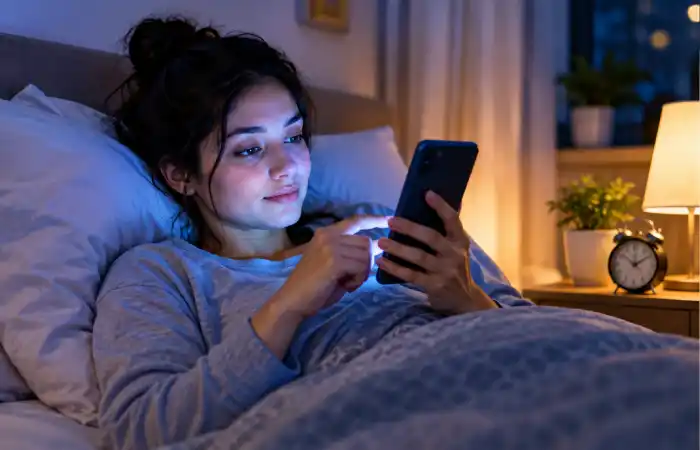
Mobile phones are even more difficult as they pack lights, entertainment, conversations, social media, game, and notifications all in one little device.
Leaving the phone on the nightstand can also lead to more temptation to check messages or the time. Among teens, activation of the phone’s ringer in the overnight hours has been linked to more reporting of sleep problems.
Try these changes:
- Turn on Do Not Disturb or Sleep mode.
- Silence non-essential notifications.
- Charge your phone away from the bed.
- Use a separate alarm clock if checking your phone encourages scrolling.
- Set an evening app limit for highly stimulating apps.
Television and Sleep
Types of Media – Television has a different relationship with sleep than an interactive device. Watching a relaxing program may be less physically activating than playing video games or using social media, but it can still push back bedtimes and emit light. A review of the research indicates television is associated with shorter sleep for some groups, although less consistently than it is for interactive devices.
Rather than watch television up until the second you drift off to sleep, set a watch off time to watch television and then turn to an activity not involving a screen.
Social Media Before Bed
Why social media is especially hard to quit Social media is particularly hard to quit because it is ongoing and tailored to the user. Notifications, messages, comments and FOMO can motivate you to continually check your devices. A 2026 study relying on objectively measured pre-bedtime social media use found links with decreased sleep efficiency, with further impacts on awakenings and sleep fragmentation on the weekends. However, the sample size was small so these results should be taken with a grain of salt.
Gaming and Sleep
Gaming exposes you to a screen and tends to engage a player’s mind and emotions intensely. Playing competitive games can help perk you up, and multiplayer games might motivate you to play on because there are others still gaming on the other end.
While the evidence isn’t entirely consistent, it’s been correlated time and again – especially in certain groups – that playing games right up until bedtime can be associated with falling asleep later or having poorer sleep. Good advice is to stop playing during your usual wind-down period – not when you are already lying in bed ready to go.
Setting Healthy Screen Limits
There is no single screen-time number that works for every adult. A better approach is to look at timing, purpose, and consequences.
| Screen habit | Practical adjustment | Potential sleep concern |
| Checking messages in bed | Move messaging earlier | Delays bedtime |
| Social media late at night | Set an evening cutoff | Mental stimulation |
| Gaming immediately before bed | Finish earlier | High alertness |
| TV until falling asleep | Set a viewing cutoff | Extends screen exposure |
| Phone beside pillow | Charge it across the room | Notifications and checking |
| Work on laptop late at night | Create a work shutdown time | Mental activation |
For children and teenagers, screen management should also consider age, school schedules, total sleep needs, and family routines.
Creating a Screen-Free Bedtime Routine
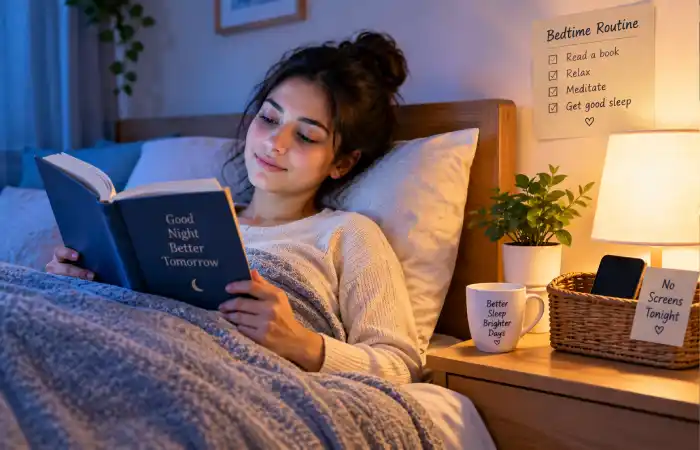
A screen-free bedtime routine does not need to be complicated.
Try a sequence such as:
60 minutes before bed: finish demanding screen activities.
30 minutes before bed: dim the lights and prepare the bedroom.
15 minutes before bed: read a printed book, stretch gently, practice breathing, or listen to quiet audio.
Bedtime: keep the bedroom dark, comfortable, and free from unnecessary notifications.
Sleep Foundation guidance similarly recommends minimizing screen exposure during the period before bedtime.
Digital Wellness and Sleep
Digital wellness is not about eliminating technology. It is about using technology in a way that supports your health and daily life.
Useful tools include:
- Screen-time dashboards
- App timers
- Focus or Sleep modes
- Notification controls
- Night-display settings
- Website blockers
- Sleep tracking
Product and Tool Comparison
| Useful for | Tool | Limitation |
| Tracking and limiting usage | Built-in Screen Time/Digital Wellbeing | Requires self-discipline |
| Reducing notifications | Sleep/Focus mode | Does not stop all screen use |
| Preventing late-night scrolling | App blocker | Can be bypassed |
| Reducing evening light exposure | Blue-light/night mode | Does not remove mental stimulation |
| Keeping phone away from bed | Separate alarm clock | Adds another device |
These tools work best as behavioral supports, not as replacements for a consistent sleep routine.
Better Alternatives to Evening Screen Time
Replacing screen time is often easier than simply removing it.
Try:
- Reading a paperback book
- Gentle stretching
- Journaling
- Preparing clothes for tomorrow
- Listening to calm audio
- Taking a warm shower
- Practicing slow breathing
- Having a quiet conversation
- Preparing a relaxing bedroom
The goal is to give your brain a clear transition from daytime activity to nighttime rest.
The Bottom Line
How does screen time relate to sleep? While there’s a clear link between screens and sleep, it’s not just a matter of how much – the time of day, what we’re doing, apps and notifications, and our bedtime routines can all have an impact. Replacing screens with calming pre-sleep activities and turning phones off before bed can make a difference.
Afiya Jafar is a fitness and wellness writer who focuses on making health, exercise, and healthy lifestyle information simple and practical. Her work covers workouts, fitness motivation, strength training, nutrition, weight management, stress management, mindfulness, and everyday wellness.
Read full bio of Afiya Jafar
Sameena reviews selected health, wellness, fitness, and digital content for clarity, factual presentation, and reader usefulness.
Read full bio of Sameena Begum