
Last Updated: August 5, 2026
A Full-Body Workout For Weight Loss For Women is one of the most effective ways you can combine both strength training and burning calories while building muscle without needing to be in the gym 6 days a week. Instead of working just legs, just your arms or just your abs, you are working many of your major muscles at once.
This is important if you are hoping to drop your body fat, since optimal weight loss requires a balanced approach and doesn’t mean just burning as many calories in your workout as humanly possible. A truly sustainable method will also include resistance training, consistent physical activity, healthy eating, proper rest and adaptation to training.
The current recommendations for physical activity in the US are at least 150 minutes of moderate-intensity aerobic activity per week along with muscle-strengthening activity on 2 days per week.
Why Full-Body Training Works
As a full-body workout, each workout is highly efficient since it targets your legs, glutes, back, chest, shoulders, arms and core simultaneously.
Not only can one full-body workout simultaneously hit different muscle groups within one training day, but a new 2024 systematic review and meta-analysis of 14 studies that compared various training splits in 392 participants revealed that there were similar increases in strength gains and hypertrophy when the total volume was the same whether following full-body or split programs.
And another meta-analysis which considered 40 different studies with 1,312 heathy and young women showed benefits in lean body-mass/muscle hypertrophy, body composition, and strength; higher training volumes being beneficial in multiple aspects..
2026 Evidence Snapshot
| Evidence | What it means | Finding |
| Adult activity guidelines | Combine strength with regular movement | 150 min moderate activity/week |
| Strength training recommendation | Full-body training can efficiently cover major muscles | At least 2 days/week |
| Full-body vs. split meta-analysis | Choose the routine you can consistently follow | Similar strength and muscle gains when volume is matched |
| Female resistance-training meta-analysis | Strength training has value beyond calorie burning | Improved strength, lean mass and body-fat percentage |
Important Considerations: A workout does not lose just belly fat and just thigh fat or just arm fat. It’s lost all over the body, and as with every system in your body, everyone loses it differently, and that dictates your goal: to lose overall fat in your body for a better physique rather than to “spot lose”.
Best Compound Exercises
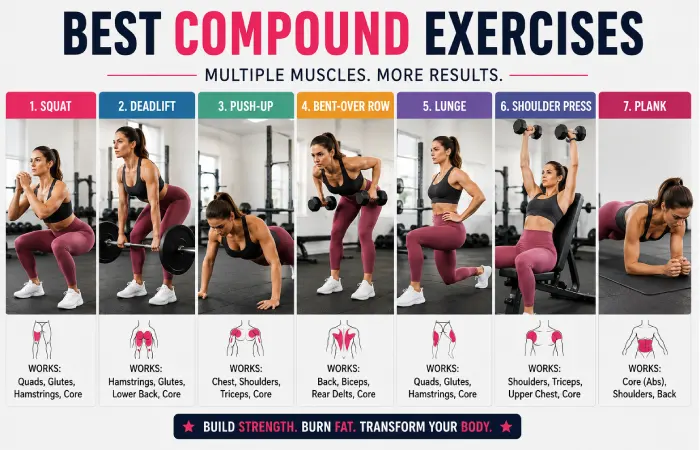
Because they use more than one muscle group, the compound moves also activate more than one joint and it’s exactly this feature that makes them ideal to perform time-efficient full-body workout routines.
Squats
The quads, glutes and core take advantage of this move.
- Beginner: Bodyweight squat
- Progression: Goblet squat / dumbbell squat
Target 8-12 clean reps.
Romanian Deadlifts
Hip-hinge type move to hit the posterior chain, hamstrings and glutes.
Ensure the back is neutral – in a push up from the hips, not just bending forward.
- Beginner: light weights
- Progression: build up to heavier ones.
Push-up
Press Push-up hitschest, spalle,bicepsand core. If a floor push-upis too tough, then try to do an in-clinepush up supported at a table, bench or wall.
Row
It strengthens the upper back,bicepsand therear delts.
At home this is best performed withweightsor a Resistance band. In a gym, a cable/seated-row work s best.
Reverse Lunge
It works the legs, including the glutes and challenges balance, but in the same way you would balance yourself over your toes with a standing lunge, this involves using opposite legs.
- Beginner: bodyweight.
- Progression: use weights.
Overhead Press
This hit theshouldersandtricepsand you’ll need good core engagement to perform them properly.
Don’t start too heavy and keep it controlled.
Planks
You are building up the core ability to stabilise thebody In plank form. You don’t have to hold for three minutes – make each clean set work for a good range and don’t feel the need to set out to complete all three minutes without taking a breather in between quality repetitions.
Protip: A beginner does not require the use ofseven exercises every week! You should select four or six simple, key movement s that will work around the major movement patterns.
Weekly Routine
A practical beginner schedule is three non-consecutive strength sessions per week, with walking or other enjoyable aerobic activity on the remaining days.
| Day | Workout | Duration |
| Monday | Full Body A | 30–45 min |
| Tuesday | Brisk walk / easy cardio | 20–40 min |
| Wednesday | Full Body B | 30–45 min |
| Thursday | Walking + mobility | 20–40 min |
| Friday | Full Body A | 30–45 min |
| Saturday | Optional walk, cycling or recreational activity | 20–60 min |
| Sunday | Rest / gentle movement | — |
Full Body A
- Goblet squat — 2–3 × 8–12
- Dumbbell Romanian deadlift — 2–3 × 8–12
- Incline push-up — 2–3 × 6–12
- One-arm dumbbell row — 2–3 × 8–12/side
- Reverse lunge — 2 × 8–10/side
- Plank — 2 × 20–40 seconds
Full Body B
- Dumbbell squat — 2–3 × 8–12
- Glute bridge — 2–3 × 10–15
- Dumbbell shoulder press — 2–3 × 8–12
- Resistance-band row — 2–3 × 10–15
- Step-up — 2 × 8–12/side
- Dead bug — 2 × 8–12/side
Overload – If you can complete your top set in the specified repetition range with perfect technique then consider upping weight a small amount or adding reps/sets. It doesn’t have to be the end of your days to get your workout done.
Home vs Gym Options
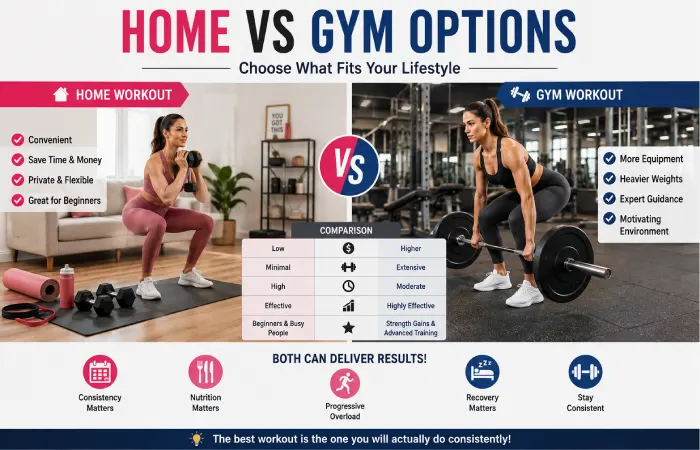
You don’t need a gym membership to begin.
| Equipment | Home | Gym | Best use |
| Bodyweight | ✓ | ✓ | Zero-cost beginner training |
| Resistance bands | ✓ | ✓ | Rows, presses and glute work |
| Dumbbells | ✓ | ✓ | Versatile progressive resistance |
| Adjustable dumbbells | ✓ | — | Space-efficient home setup |
| Machines | — | ✓ | Guided resistance for beginners |
| Barbells | — | ✓ | Heavier progressive loading |
A great setup for a home environment that can potentially substitute for most beginner full body movements can be an adjustable dumbbell set + resistance bands + a sturdy mat.
If a beginner is a little nervous about free weights, machines may also be beneficial since the nature of the guided movement allows for a simplified learning process of resistance training.
Photo opportunity: Include original photo of a woman performing a goblet squat with dumbbells in a basic home workout space.
Photo opportunity: Include original gym photo of a beginner utilizing a leg press or cable/seated row machine correctly.
Original photos is ideal over generic stock images when it comes to showing set-up of exercise movements, since you will be able to see the specific position of the equipment and exercise.
Recovery Tips
More exercise isn’t automatically better.
Just like hard days of intense training require a day of rest, your same major muscle groups should be granted recovery time between particularly heavy workouts, especially considering that sleep, diet, hydration and even the amount of work being completed all affect your ability to be consistent.
In the fat-loss phase resistance training, is essential because one component of building an optimal physique also include holding onto as much lean muscle tissue as you possibly can. Studies in women have confirmed the benefits of training with weight during the weight-loss phase of a female body-improvement in body composition and strength. (CDC)
Five recovery basics
- Leave recovery time between hard full-body sessions.
- Sleep consistently.
- Eat enough protein and nutrient-dense foods.
- Keep daily movement consistent instead of relying entirely on workouts.
- Increase training difficulty gradually.
If you are just beginning your journey, start off at lower sets and with lighter loads. Similarly, if you are new to exercise, WHO guideline suggest a gradual increase of frequencies and intensifies of exercises and duration with small doses.
Troubleshooting: Why Am I Not Losing Weight?
“I work out but the scale isn’t changing.”
Your workout is only one part of the equation. Review food intake, daily activity, sleep and consistency. Also remember that body weight can fluctuate because of water, food volume and menstrual-cycle changes.
“My workouts are making me extremely sore.”
Reduce the number of sets, lower the resistance and focus on technique. You don’t need severe soreness to make progress.
“I don’t have dumbbells.”
Use bodyweight exercises or resistance bands. Squats, lunges, incline push-ups, glute bridges, planks and band rows can create a useful beginner workout.
“I can’t exercise for 45 minutes.”
That’s fine. Start with 15–20 minutes and build gradually. Some activity is better than none, and weekly activity can be accumulated across shorter sessions.
“I have knee or back pain.”
Don’t just power on through pain that does not subside and feels like it is getting better then back worse or worse again. Work on the movement or get individual assessment with a health and or exercise professional if there has been a previous injury or a medical condition has not been fully recovered.
FAQs
Do full-body workouts help women lose weight?
Yes. Women who are interested in a body recomposition goal involving fat loss will benefit from a full-body resistance training protocol in addition to an entire healthy lifestyle that incorporates appropriate eating.
How often should a woman do full body workouts?
Most beginners will do well performing 2-3 total-body strength workouts per week. Official guidelines for adults recommend performing strengthening exercises on two or more days each week.
Do full body workouts shed belly fat?
You can lose fat off your entire body, but exercise doesn’t have to selectively get it to come off a particular area.
Getting fit with body recomposition exercises while doing resistance training, cardiorespiratory work, eating correctly and consistently will be the answer more likely than exercise alone or even belly exercise only.
Is a 30-minute full-body workout good?
Yes. 30 minute full body workouts that combine challenging lifts for all major muscle group lifts will be effective.
Is it better to train full-body home or the gym for weight loss?
A better question would be “What location can I consistently add progressive weight/stress over time.” They are good for body weight exercises because no weight or apparatus is needed. They also provide cheap at-home workout apparatus if needed or if needed to progressively load their body.
The Bottom Line
The best Full-Body Workout for Female Weight loss isn’t the one that leaves you feeling on the ground. It is the workout that you’ll do consistently and recover from, the workout you will get progressively better from. I’ve coached many women who see great progress using anywhere from 2-3 full body training sessions weekly, compound lifts being the main focus, along with a brisk walk or cardio several times weekly and the resistance increased over time.
Evidence suggests that full body training isn’t superior to split training aslong as volume levels are kept consistent throughout the week.
If your starting your weight loss journey in 2026 , keep the programming simple, progressive and most of all sustainable.