
 Afiya Jafar
Fitness & Wellness Writer
Afiya Jafar is a fitness and wellness writer who focuses on making health, exercise, and healthy lifestyle information simple and practical.
Read Full Bio of Author →
Afiya Jafar
Fitness & Wellness Writer
Afiya Jafar is a fitness and wellness writer who focuses on making health, exercise, and healthy lifestyle information simple and practical.
Read Full Bio of Author →
 Sameena Begum
Health, Fitness & Digital Content Reviewer
Sameena reviews selected health, wellness, fitness, and digital content for clarity, factual presentation, and reader usefulness.
Read Full Bio of Reviewer →
Sameena Begum
Health, Fitness & Digital Content Reviewer
Sameena reviews selected health, wellness, fitness, and digital content for clarity, factual presentation, and reader usefulness.
Read Full Bio of Reviewer →
 Dr. Khizrana Begum
General Physician & Dermatologist
Dr. Khizrana Begum is a General Physician and Dermatologist with MBBS and MD qualifications and 5+ years of experience in the medical field.
Read Full Bio of Medical Reviewer →
Dr. Khizrana Begum
General Physician & Dermatologist
Dr. Khizrana Begum is a General Physician and Dermatologist with MBBS and MD qualifications and 5+ years of experience in the medical field.
Read Full Bio of Medical Reviewer →
Mindfulness for stress, where individuals concentrate on present moment mental state, thoughts, physical sensations and emotion in a non-judgmental way. This means not worrying or thinking about events of the past, or anxieties of the future, but simply concentrating and being awareness of everything of what is occurring in that moment. A study published in 2026 reaffirmed that mindfulness-based interventions could provide a suitable intervention for lowering perceived stress.
Indeed in a systematic review and meta-analysis of 17 r.c.t., with a sample size of 1,641 non-clinical adults, it has been demonstrated that those who undertook mindfulness-based interventions reported statistically significantly less stress in comparison with the control groups.
Mindfulness is a basic process and no specific tools, or time of 24hours, meditation is involved. Instead a few moments through a daily routin, of paying attention, will do the job by a process of breathing, walking eating. Body attention or a few moments in quiet.
❝
This article is a part of
Stress Management Hub
What Is Mindfulness for Stress?
Mindfulness is the deliberate noticing and observing of an experience with non-judgmental, curious awareness (or attention, awareness, and without any immediate reaction).
When we are stressed, attention may become “stuck” on problems, tasks and due dates, unpleasant sensations or things that could happen in the future. Mindfulness builds a brief space of moment in between taking in any thought and reacting to it.
For example, instead of thinking:
“I can’t handle everything.”
you might notice:
“I’m having the thought that I can’t handle everything, and I notice tension in my shoulders.”
While the slight change doesn’t change the overwhelming, stressful situation; it has a calming effect, leading to you responding rather than reactively reacting.
Known as mindfulness this practice can be either ‘formal’ taking place at specified times (meditation is an example) or ‘informal’ practiced on a daily basis (eating, showering, exercising or working can all be considered as examples). According to the Mayo Clinic Mindfulness ‘is being aware of your thoughts, emotions, body sensations and environment around you without any judgement.’
How Can Mindfulness Help With Stress?
Stress affects more than just how you think; it affects a person’s attention, mood, and sleep, muscle tension, behavior. Mindfulness could help to better acknowledge a stress reaction in yourself, and to re-focus your attention on the here-and-now rather than allow it to automatically process and follow each nagging thought.
One meta-analysis, completed in 2026 based on 56 samples and a total of 24,494 subjects, found that mindfulness was moderately negatively correlated to perceived stress-i.e., greater mindfulness was correlated with less stress; however, those authors concede this style of evidence is not proof of a causal relation.
What the 2026 evidence shows
| Finding | Evidence | Participants / studies |
| Mindfulness interventions significantly reduced perceived stress vs. controls | 2026 systematic review & meta-analysis | 17 RCTs; 1,641 adults |
| Greater mindfulness was associated with lower perceived stress | 2026 meta-analysis | 56 samples; 24,494 participants |
| Both delivery approaches showed benefits | Digital + in-person interventions | Included in 2026 review |
Simple Mindfulness Exercises
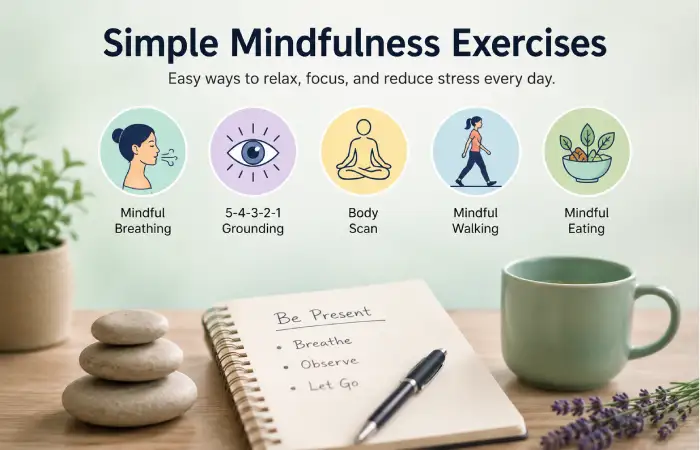
You don’t need to sit cross-legged or completely empty your mind. Try one of these beginner-friendly exercises.
- Five-senses grounding
Pause and notice:
- 5 things you can see
- 4 things you can physically feel
- 3 things you can hear
- 2 things you can smell
- 1 thing you can taste
Move slowly through each sense rather than rushing to complete the list.
- One-minute body check
Close your eyes if comfortable.
Notice your:
- Jaw
- Shoulders
- Chest
- Abdomen
- Hands
- Legs and feet
Don’t try to force relaxation. Simply notice where your body feels comfortable, tense, warm, cool or neutral.
- Mindful walking
Walk slowly for two to five minutes.
Pay attention to your feet touching the ground, the movement of your legs, your breathing and the environment around you.
- Mindful eating
Choose one small portion of food. Notice its appearance, smell, texture, temperature and taste.
This turns an ordinary activity into a short mindfulness practice.
Mindful Breathing for Stress
Breathing is the easiest practice to fall back on when stress hits and it has suddenly increased for you.
Try the following:
Sit down at ease with your shoulders slack, feel where you feel your breath in the body and slow down your inhalations and slow down your exhalations for your inhalations to eventually automatically resume when your exhalations naturally end and when your mind strays, try to bring attention back to your breath, without control, just observing it.
When your breath doesn’t want to follow then it just means we focus our attention on the flow without expecting anything and then switch to what feels right.
Mayo Clinic classifies mindful breathing and suggests we focus just a moment when possible, can be done at any time during our daily life. If it feels uncomfortable or doesn’t work for you try a different anchor, say your feet against the floor, or the noises around you
Mindfulness Meditation for Beginners
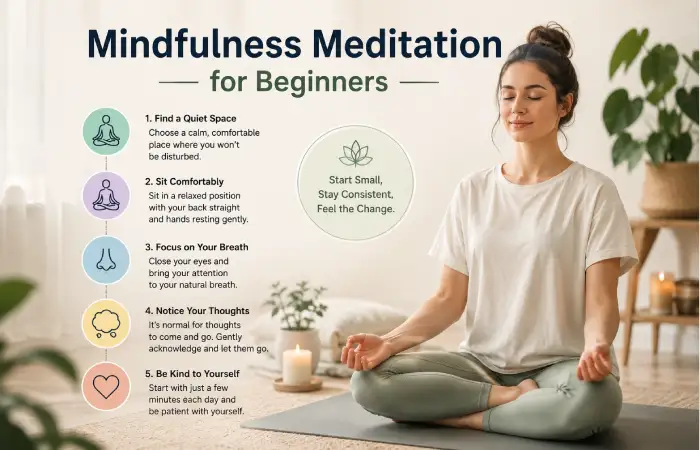
If you’re completely new to meditation, start small.
A simple 5-minute mindfulness meditation
1: Sit comfortably and notice your surroundings.
2: Bring attention to your breathing.
3: Notice thoughts as they appear without trying to fight them.
4: Notice sensations in your body.
5: Return attention to your breathing and slowly open your eyes.
Your mind will probably wander. That’s normal.
The point is not to avoid thoughts, but simply to notice where your attention has gone and bring it back compassionately.
Similarly, Mayo Clinic states it take practice and you may even cause yourself more stress for having taken some time to meditation for your thoughts have taken a bit of detour!
Mindfulness and Emotional Well-Being
Stress may impact the ease with which we take action upon experiencing frustration, confusion and the challenging feelings in which the self is enmeshed. Mindfulness encourages you to become aware of your emotions instead of taking immediate action.
Pause → Notice → Name → Breathe → Choose a response
You might silently say:
- “I’m feeling frustrated.”
- “My shoulders are tense.”
- “I’m noticing worry.”
- “I need a short pause.”
It isn’t suppressing thoughts or faking positive, however, but building the awareness that permits action instead of mere reaction.
NCCIH states that current research evidence indicates that mindfulness meditation can lower the severity of stress-related problems like anxiety and depression and possibly help sleep.
How to Practice Mindfulness Every Day
Consistency matters more than having a perfect meditation routine.
Try this simple daily schedule:
| Time | Duration | Practice |
| Morning | 2–5 min | Mindful breathing |
| Work/study break | 1–2 min | Body or senses check |
| Lunch | 3–5 min | Mindful eating |
| Evening | 5–10 min | Guided meditation |
| Before bed | 3–5 min | Slow breathing/body scan |
Start with 5 minutes a day if that’s realistic. Once the habit feels comfortable, gradually increase the duration.
You can also attach mindfulness to an existing habit—for example, practicing three mindful breaths before opening your laptop, eating lunch or getting into bed.
Should You Use a Mindfulness App?
A meditation app can be useful if you prefer guided instructions or struggle to practice consistently on your own.
| Option | Best for | Considerations | Advantages |
| Self-guided mindfulness | Independent beginners | Requires self-discipline | Free, flexible, no equipment |
| Meditation app | People who prefer guidance | Some content requires subscriptions | Guided sessions and reminders |
| Structured MBSR program | People wanting a formal program | More time and commitment | Organized curriculum and teacher support |
| Therapist-led support | Significant or persistent distress | Higher cost/availability varies | Personalized professional guidance |
The Bottom Line
It does not involve a break from your stressful life. Mindfulness involves pausing to be aware of the here and now and approaching experiences with a new quality of attention.
For the beginner five minutes a day will include conscious breathing or scanning through the body, it will build until short daily walking meditation or mindful eating and brief periods of awareness occur throughout the day.
Afiya Jafar is a fitness and wellness writer who focuses on making health, exercise, and healthy lifestyle information simple and practical. Her work covers workouts, fitness motivation, strength training, nutrition, weight management, stress management, mindfulness, and everyday wellness.
Read Full Bio of Afiya Jafar →
Sameena Begum reviews selected health, wellness, fitness, and digital content for clarity, factual presentation, consistency, and reader usefulness. Her review work helps maintain clear and responsible editorial standards across PhysicalFitt content.
Read Full Bio of Sameena Begum →
Dr. Khizrana Begum is a qualified medical professional with MBBS and MD qualifications and 5+ years of experience in the medical field. She works as a General Physician and Dermatologist, with expertise in general medicine, dermatology, preventive healthcare, and skin health.
Read Full Bio of Dr. Khizrana Begum →