
Last Updated: September 16, 2026
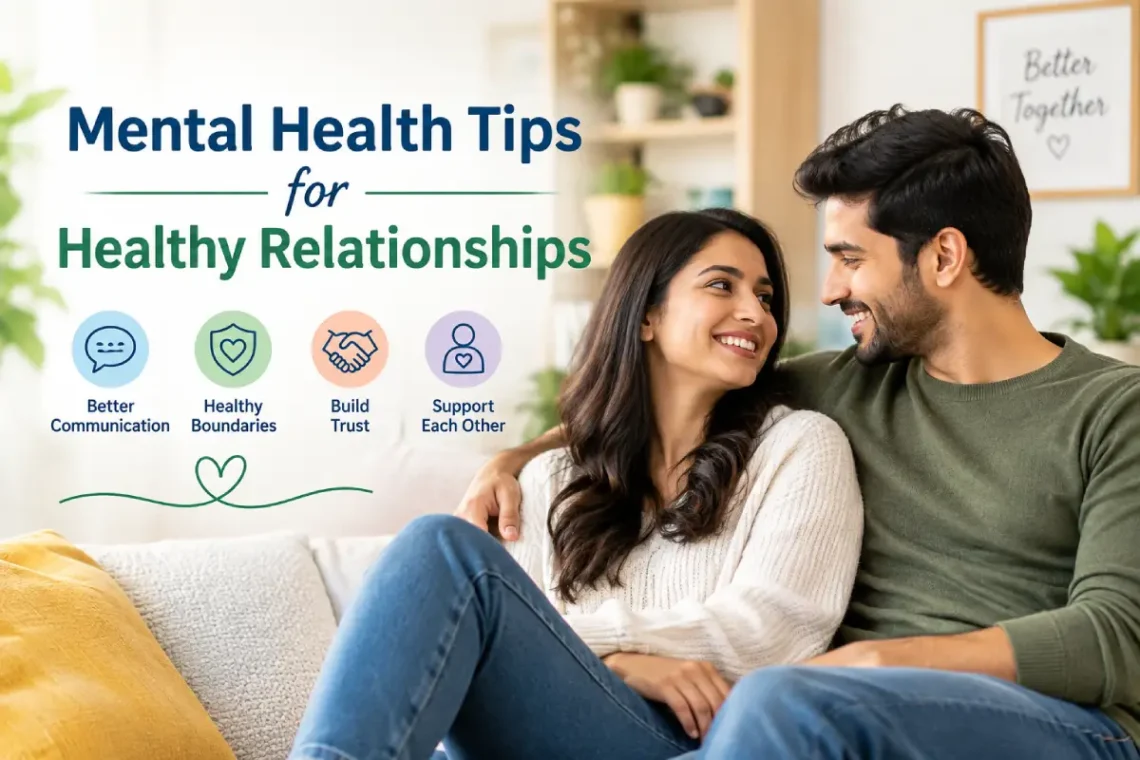
Relationships can promote your emotional well-being, help you to bond, and have someone to do things with, but it does take work. 5 mental health tips for healthy relationships include the following: communicating, establishing boundaries, resolving conflict, meeting your needs.
Having a healthy relationship does NOT mean not disagreeing. This means that both individuals can communicate, respect each other, cope with disagreements in a safe way and take care of each other‘s health.
According to WHO, around 1 in 6 people suffer with feeling lonely, which explains why feeling connected is so important for mental, as well as physical, health:
Mental Health and Relationships
Mental health and relationships are related. Relationships provide part of the support network, identified as important during difficult times. Continued conflict, loneliness, exploitation and neglect are factors which may be a source of emotional stress.
Healthy relationships commonly involve:
- Respect and kindness
- Trust, honesty
- Open communication
- Safety of the emotional and physical well-being
- Facilitating regimes that patients, families, and physicians can practically incorporate into their lifestyle.
- Individual perceptions of acceptability is a fundamental determinant of compliance.
Ensuring community understanding of the importance of ICOP management through education of public and health professionals.
Independency of the individual; the ability of people to live independently and freely. The concept of individual independence also supports the idea that individuals are fully capable of making choices about their own lives.
The Mental Health Foundation states that, ‘Healthy relationships enable us to feel loved and supported without feeling smothered and trapped. ’
2026 evidence snapshot
| Social connection finding | Latest reported figure |
| People experiencing loneliness globally | 15.8% / about 1 in 6 |
| Loneliness among adolescents | 20.9% |
| Loneliness among adults aged 18–29 | 17.4% |
| Loneliness among adults aged 30–59 | 15.1% |
| Loneliness among adults 60+ | 11.8% |
These figures come from the WHO Commission on Social Connection’s analysis of data covering 153 countries and territories.
The takeaway is simple: quality relationships matter, not just the number of people around you.
Healthy Communication
A proper dialogue is perhaps the most important corner stones to a happy relationship: open and sincere communication combined with willingness to understand each other.
Try these habits:
- Listening to the introduction that was provided.
- Avoid blame statements such as “You did not pay attention” and use I statements, such as “I was not sure you understood”.
- Take that part in with a grain of salt. Don‘t judge or second-guess yourself. Instead of preconceiving your ideas, ask questions.
- When both parties are can be beneficial in making uncomfortable topics easier to discuss.
- Recognize the feelings of the individual involved even if you don‘t agree with them.
- Make use of “I” statements. For instance, instead of, “You never listen to me,” say, “I feel ignored when I didn‘t get to say how I feel.”
If we have been actively listening and have check ins, this can help prevent the small issues turning into bigger conflicts.
Setting Relationship Boundaries
Boundaries are limits that are there to help keep your time, private life, feelings and values safe.
Healthy boundaries might include:
- Learning that telling people ‘no’ is ok, and that the answer can sometimes be no
- Having self time
- Keeping a social life and hobbies
- Discussion around expectations of privacy
- Communicaitng whose behavior is not OK
- Respecting your partner‘s boundaries
The attempt to set a boundary is never a means to try and control another human being. Setting a boundary is a way of telling someone what you need and what you are okay with.
The Mental Health Foundation area specific suggests boundaries should be established and respected in order to sustain healthier relationships.
Building Trust and Connection

Achievements accumulate. One grand gesture doesn‘t build trust. Trust is established through several simple acts done consistently over time.
You can strengthen trust by:
- Keeping promises.
- Honest.
- Expressing gratitude.
- Delivering on commitments.
- Allowing independences to each other.
- Being reliable during rough patches.
Connection also means planning intentional time together. A quick chat, shared meal, walk or electronics free activity can be a chance to connect.
Meanwhile, good connection doesn‘t mean losing your self or identity. Healthy relationship “should reinvigorate individuals” and “people in it should continue and even develop their interests and desires for friendships and other things”.
Managing Relationship Stress
Experiencing money worries, high job demands, family issues, health problems and difficulties communicating can all affect a couple‘s relationship.
When tension rises:
- Switch to short break so that the hot discussion is interrupted.
- It‘s not about attacking the individual but really about understanding what the real issue is.
- The mindset of focusing on solutions you can have control over.
- Do not digress into past arguments that are irrelevant to the present discussion.
- Repeat once the emotions have calmed down.
The NHS suggests if there are heated moments when the conflict cannot be explained calmly, then you should take some time-out, and resume when more settled.
Supporting a Partner’s Mental Well-Being
Carrying for someone is not a synonym for taking responsibility for their mental health.
You can:
- Stop and listen long enough.
- Inquire about what support they are seeking.
- Prompted the user to seek help if needed.
- Use discretion.
- Say so periodically.
- Establish your personal emotional boundaries.
Remember to ask your partner, ‘What do you need from me?’ if your partner is upset, questions such as ‘Should I….’ may not be helpful.
It‘s vital, when helping someone else, to also take care of yourself. The National Health Service suggests that helping others’ needs to be balanced with setting boundaries and taking time out for yourself, with others you trust.
Maintaining Individual Self-Care
A healthy relationship should complement your life, not replace your entire support system.
Continue making time for:
- Sleep and physical activity
- Hobbies
- Friends and family
- Relaxation
- Personal goals
- Time alone
- Mental-health practices
Maintaining independence can reduce emotional overload and help prevent a relationship from becoming the sole source of emotional support.
Resolving Conflicts in Healthy Ways

Conflicts are normal. They aren‘t the problem, how you deal with them is the problem.
Healthy conflict resolution involves:
Identify → Listen → Understand → Compromise → Repair
Do not use insults, threats, humiliation, intimidation or try to control the other person.
It is very effective to report the behavior and not attack the character.
Recognizing Unhealthy Relationship Patterns
Not every difficult period means a relationship is unhealthy. However, persistent patterns deserve attention.
Potential warning signs include:
- Controlling behavior
- Isolation from friends or family
- Manipulation
- Constant criticism
- Extreme jealousy
- Repeated boundary violations
- Fear of expressing yourself
- Threats or intimidation
- Emotional, physical, or sexual abuse
Guidance from PPF online in 2026 emphasizes that open communication, respecting boundaries, accountability, independence, and emotional support are all positive “green flags” that indicated a healthy dynamic in relationships, while any incident of controlling or disrespectful behavior may be an indicator of something unhealthy.
If there is abuse in the relationship, or you do not feel safe, ignore the concept of communication as a solution and place safety above all else.
When to Seek Professional Support
Think about seeking professional help when relationship difficulties are long-term, impact your daily functioning and cannot be easily solved.
Professional support may be useful when:
- Arguments continue without end.
- Your world is not functioning well. You are feeling anxious/lack of motivation.
- A huge amount of trust has been severely compromised.
- Communication fails time and time again.
- You are swamped and emotionally depleated.
- It is having an adverse effect on sleep, work or social performance.
- This happening where you are- you are being abused or are feeling unsafe.
Counseling may be offered to a couple or on an individual basis. Family counseling or family therapy may be used, which Mayo Clinic states can be effective in some cases in working through relationship problems.
Final Takeaway
The most effective mental health tips for healthy relationships are not expecting a relationship to be perfect in anyway, but in expecting a healthy relationship in which individuals feel valued, listened to, unthreatened, supported and allows for individual like to be free to be true to who they are.
Note that the plays an important role in the relationships, and be careful and eager during that in the areas of communication, boundaries, have trust, self-care, resolution of conflicts and support in constructive ways. When the problems in the relationship begin to get involved with your mental health and the safety, the asking for professional help might be a useful consideration.