
 Afiya Jafar
Fitness & Wellness Writer
Afiya Jafar is a fitness and wellness writer who focuses on making health, exercise, and healthy lifestyle information simple and practical.
Read Full Bio of Author →
Afiya Jafar
Fitness & Wellness Writer
Afiya Jafar is a fitness and wellness writer who focuses on making health, exercise, and healthy lifestyle information simple and practical.
Read Full Bio of Author →
 Sameena Begum
Health, Fitness & Digital Content Reviewer
Sameena reviews selected health, wellness, fitness, and digital content for clarity, factual presentation, and reader usefulness.
Read Full Bio of Reviewer →
Sameena Begum
Health, Fitness & Digital Content Reviewer
Sameena reviews selected health, wellness, fitness, and digital content for clarity, factual presentation, and reader usefulness.
Read Full Bio of Reviewer →
 Dr. Khizrana Begum
General Physician & Dermatologist
Dr. Khizrana Begum is a General Physician and Dermatologist with MBBS and MD qualifications and 5+ years of experience in the medical field.
Read Full Bio of Medical Reviewer →
Dr. Khizrana Begum
General Physician & Dermatologist
Dr. Khizrana Begum is a General Physician and Dermatologist with MBBS and MD qualifications and 5+ years of experience in the medical field.
Read Full Bio of Medical Reviewer →
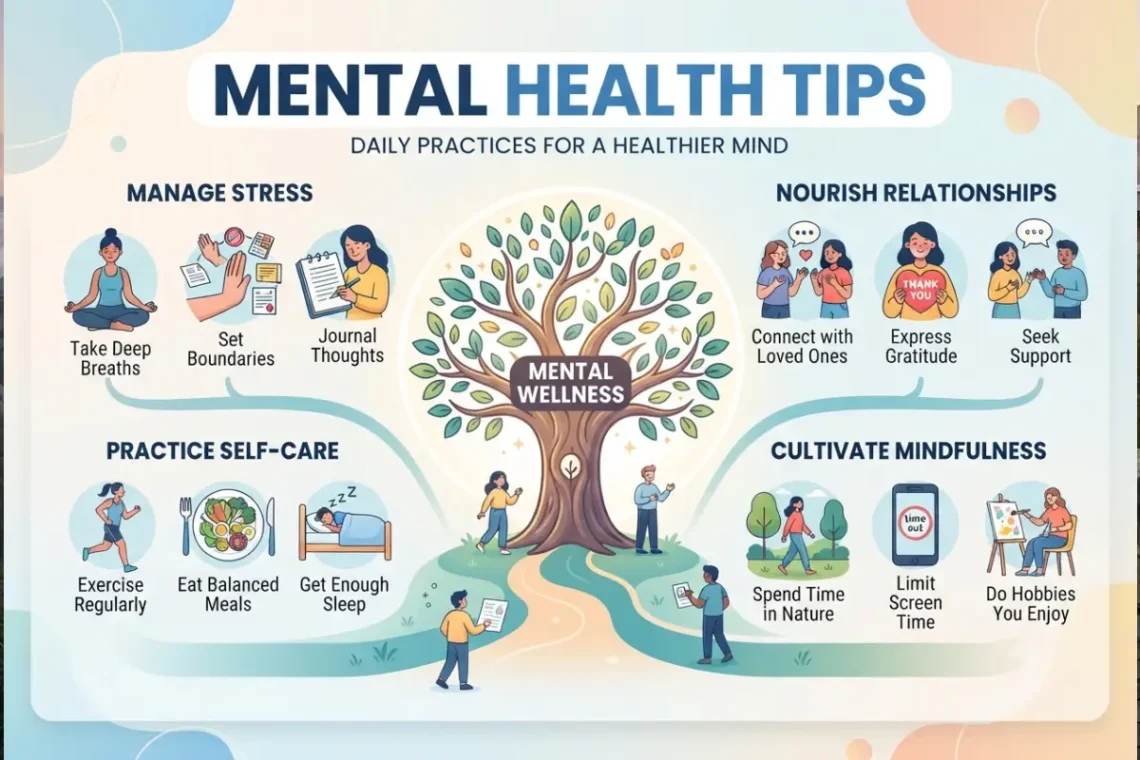
Tips for a healthy mind: Tips for mental well being can help you maintain good lifestyle habits, deal with day to day pressures, achieve the rest needed, keep meaningful contact and form lasting relationships and know when to ask for help. Mental well being has very little to do with only the avoidance of mental ill-being and so much more to do with positive resourcefulness of one’s self to meet life’s challenges, functional efficiency and meaningful relation.
Sleep and mental health influence each other, so maintaining a consistent bedtime routine and following mental health tips for better sleep can support better rest and emotional well-being.
WHO definition of mental well being is defined as a “state of well being in which the individual realizes their own abilities, cancope with the stresses of everyday life, can work productively andfruitfully and is able to contribute to the community”. Mental well being may be influenced by ‘individual’ (such as psychological factors, behavior patterns and personal experiences), ‘family’ (family experiences such as relationship dynamics),’community’ (neighborhood resources, social support structures), and ‘wider’ (social and economic contexts) influences.
WHO estimates the burden of mental disorders. In 2021 nearly one in seven people worldwide suffered from mental disorders-most prevalent of which include anxiety and depressive orders.
Such that mental well being is something worth cherishing rather than responding when we are sick.
❝
This article is a part of
Mental Hub
What Is Mental Health?
Mental health affects how we think, feel, behave, and how we cope with stress, respond to other people and the decisions that we make, as well as affecting your emotional, psychological and social well-being.
A major point to bear in mind is that Mental wellbeing doesn’t necessarily mean that we should be feeling happy at all times. All of us can get into situations where it is appropriate to feel certain emotions. Feelings of stress, grief, anger, frustration, sadness, sadness, or fear or anxiety are all a very human reaction to certain situations. So the answer may well be:
Learning to recognize and manage your emotions is an important part of mental wellness. Practicing these mental health tips for emotional wellness can help you handle everyday emotional challenges more effectively.
“I am feeling these particular emotions and I can process them, cope with them and carry on functioning in ways that matter to me?”
Mental wellbeing can shift across the lifespan, and you may be feeling mentally well for many months and suddenly experience much greater stress and a sense of less wellbeing when events happen such as relationship issues, illness, job losses, bereavements, financial stress, etc. Somebody with a clinically recognised condition will also have fluctuations through various periods of greater mental wellbeing, and others.
Mental health vs. mental illness
| Mental health | Mental illness |
| Refers broadly to emotional and psychological well-being | Refers to diagnosable mental health conditions |
| Changes throughout life | Can be temporary, recurring or persistent |
| Everyone has mental health | Not everyone has a mental disorder |
| Supported by healthy environments and habits | May require professional assessment and treatment |
| Can coexist with a diagnosis | May affect thoughts, emotions, behavior or functioning |
Mental health tips can support well-being, but they should not be presented as a cure for a diagnosed condition.
Why Mental Health Matters
Mental health is not just about how you feel.
It can have an impact on your:
- Sleep
- Ability to concentrate
- Ability to get motivated
- Relationships
- Ability to make decisions
- Work and studies
- Ability to be physically active
- Eating habits
- Ability to cope with and handle stress
- Quality of life
According to the WHO, mental disorders may also impact the relationships that people have, their education, work, and physical health.
The effect in terms of number of people is very high-WHO estimates show that close to 1.1 billion of people were living with mental health illness in 2021.
Mental health data snapshot
| Indicator | Source | Latest available figure |
| People worldwide living with a mental disorder | WHO | Nearly 1 in 7 |
| Global anxiety disorders, 2021 | WHO | 359 million |
| Global depression, 2019 | WHO | 280 million |
| U.S. adults ever told they had a depressive disorder | CDC | 19% |
| U.S. high-school students reporting poor mental health most/all of the time in the previous 30 days | CDC | 29% |
The reasons for this variance in dates is that large health datasets aren’t updated all together. These numbers represent the newest available figure for each respective source not a single year globally.
Practical Mental Health Tips for Everyday Life
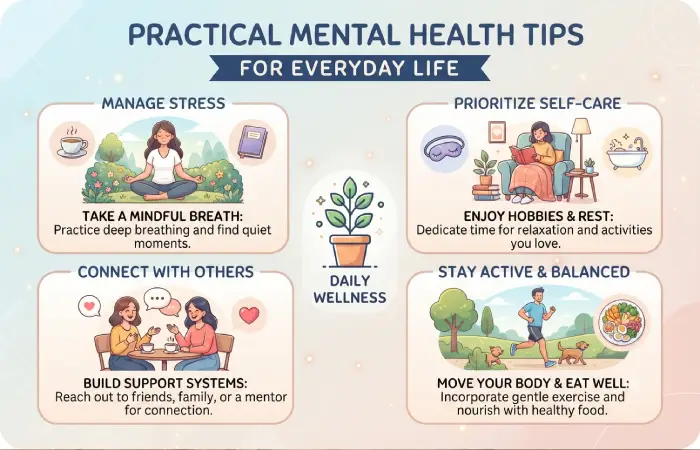
Small, consistent habits can make mental wellness easier to maintain, which is why incorporating simple daily mental health tips into your routine can be beneficial.
The best mental health habits are usually the ones you can actually maintain.
You do not need to completely redesign your life.
Instead, start with one or two manageable changes.
-
Build a predictable daily routine
A basic routine gives your day structure.
Try keeping relatively consistent times for:
- Waking up
- Meals
- Work or study
- Physical activity
- Relaxation
- Going to bed
A routine can reduce the number of decisions you need to make throughout the day.
-
Move your body regularly
Physical activity is often cited as one of the most consistently recommended lifestyle strategies for maintaining overall health.
According to WHO, “Regular physical activity will improve mood and reduce depression and anxiety”.
Workplace demands and stress can affect your mood, energy, and productivity, making practical mental health tips for work useful for creating healthier boundaries and routines.
This is not something you will always require a gym membership to achieve.
Examples of beneficial activities are:
- Walking
- Cycling
- Dancing
- Swimming
- Gardening
- Stretching
- House chores
- Leisure sports
WHO suggest adults should do 150-300 of moderate aerobic activity per week, or the equivalent in vigorous effort, noting that “Some physical activity is better than none”.
-
Spend time outside
Natural, outdoor spaces may be quite helpful in offering a reprieve from the workload, displays and monotony.
A brief walk around a local park or neighborhood offers several good behaviors in one experience-movement, light, novelty of space, and maybe companionship!
-
Make time for enjoyable activities
Hobbies are not a waste of time.
Hobbies can take the form of reading, cooking, gardening, music, art, games, sport, photography etc and offer the chance to enjoy your time, be creative and recharge.
Students often deal with academic pressure, deadlines, social challenges, and changes in their daily routines, so following these mental health tips for students can support healthier ways to manage everyday stress.
This doesn’t mean that every hobby needs to become a productivity task as well.
Fun is the target.
-
Practice self-compassion
“The people who talk to themselves the worst actually talk the best friends are ever given.”
When things have go wrong instead:
“I screw everything up all of the time!”
Use:
“This did not go as I planned. What can I learn from this failure?”
Self compassion is not about never making a mistake. It’s about responding to them in a non judgmental way.
Mental Health Tips for Managing Stress
Stress is a normal response to challenging situations. It becomes a health concern if it persists over time, feels overwhelming or it starts to impact significantly on day to day life.
There are some easy stress management tips promoted by the WHO and these include having exercise, getting enough sleep, making a healthy choice with food, connecting with people and reducing consumption of negative news when you are stressed by it.
Try the “pause and reset” technique
When stress rises:
- Stop what you’re doing for a moment.
- Take several slow breaths.
- Identify what you are feeling.
- Identify what is actually within your control.
- Choose one small next action.
This can be more practical than trying to solve everything simultaneously.
Supportive relationships can contribute to emotional well-being, and practicing mental health tips for healthy relationships can help you build stronger, respectful, and supportive connections.
Reduce unnecessary mental overload
Constant notifications, news updates, social media and multitasking can make it difficult to mentally switch off.
Consider:
- Turning off non-essential notifications
- Creating phone-free periods
- Checking news at designated times
- Taking short breaks between demanding tasks
- Avoiding unnecessary multitasking
Break large problems into smaller tasks
Instead of:
“I need to fix my entire life.”
try:
“What is one thing I can do in the next 15 minutes?”
Small actions are easier to start and can create momentum.
Mental Health Tips for Better Sleep
Sleep and mental health influence each other.
Worry may prevent you from getting to sleep and when you don’t sleep well, or get too little sleep, then emotional regulation and coping is more challenging. WHO suggest consistent time to go to bed, comfortable environment, avoidance of screens before bed, heavy foods and caffeinated and alcoholic beverages.
Create a simple evening routine
For example:
9:00 PM: Finish demanding work
9:30 PM: Reduce screen use
9:45 PM: Shower/read/stretch
10:15 PM: Quiet activity
10:30 PM: Bed
Your actual schedule can be different. Consistency is more important than copying someone else’s routine.
If you cannot sleep
If bed feels more like an arena to go through the thought processes once more, then it clearly isn’t an enjoyable place to be. Try and do so: If this remains a problem, talk it through with someone who can help.
Mental Health Tips for Emotional Well-Being
Emotional well-being doesn’t mean eliminating negative emotions.
Instead, develop better ways of recognizing, expressing and responding to them.
Name what you feel
Try:
- “I’m frustrated.”
- “I’m worried about tomorrow.”
- “I’m disappointed.”
- “I’m overwhelmed.”
- “I feel lonely.”
Putting a feeling into words can make it easier to understand what you need.
Keep a short journal
You don’t need to write several pages.
A journal can also help you notice patterns over time.
Don’t automatically believe every thought
Stress can make thoughts feel more certain than they really are.
For example:
Thought: “Everyone thinks I’m failing.”
Ask:
- What evidence supports this?
- What evidence doesn’t?
- Is there another explanation?
- What would I tell a friend in the same situation?
This way of logical thinking and reasoning would be in line also with the practice of Cognitive Behavioral Therapy (CBT).
Mental Health Tips for Building Healthy Habits
A healthy mental wellness routine doesn’t have to contain 20 different activities.
Focus on a few foundations.
The mental wellness basics
| Habit | Simple starting point |
| Sleep | Keep a consistent sleep schedule |
| Movement | Take a daily walk |
| Food | Eat regular balanced meals |
| Connection | Contact someone you trust |
| Relaxation | Spend 5–10 minutes slowing down |
| Nature | Spend time outdoors |
| Purpose | Work toward one meaningful goal |
| Enjoyment | Schedule an activity you genuinely like |
The key is consistency, not perfection.
Skip one day doesn’t mean you have failed.
Get back to the routine as soon as you can
Mental Health Tips for Work and Productivity
When the equilibrium between working load, expectations, recovery time and your mental health is disrupted work stress will have a negative effect.
Separate urgent from important
At the start of the day, identify:
- One essential task
- Two important tasks
- Everything else
This can prevent a long task list from becoming overwhelming.
Use realistic work blocks
Try working for a defined period followed by a short break.
During the break:
- Stand up
- Walk
- Drink water
- Stretch
- Look away from the screen
Create a shutdown ritual
At the end of your working day:
- Check unfinished tasks.
- Write down tomorrow’s priorities.
- Close work applications.
- Put away work materials.
- Transition into personal time.
The goal is to give your brain a clear signal that work has ended.
Watch for burnout warning signs
Potential warning signs can include:
- Persistent exhaustion
- Increasing cynicism
- Reduced motivation
- Difficulty concentrating
- Feeling unable to recover after rest
- Increasing irritability
If work-related distress becomes persistent or significantly affects your functioning, professional support may be appropriate.
Mental Health Tips for Social Connections
Humans need connection.
Social support can provide emotional comfort, practical assistance and a sense of belonging.
Make connection smaller and easier
This doesn’t require planning a big party for your loved ones or your social circle.
You can attempt this:
- Sending a text to a loved one.
- Calling a friend on the phone.
- Having tea with a family member.
- Going for a walk with a friend or family member.
- Having lunch with a colleague at work.
- Joining a club.
- Participating in a local activity.
Additionally, the Mayo Clinic suggests to maintain connections to loved ones and support groups while in the process of recovery from your illness or other challenges in your life.
If you feel isolated
Don’t wait until you feel completely better before reconnecting.
Start with one person.
A simple:
“I’ve had a difficult week. Do you have 10 minutes to talk?”
can be enough.
Mental Health Tips for Different Life Stages
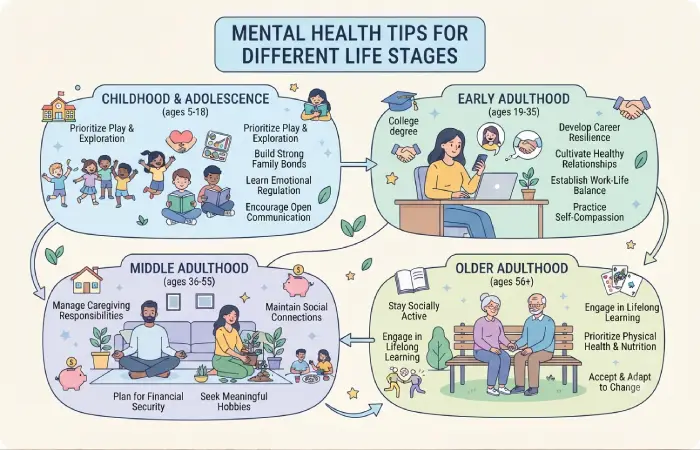
Mental health needs change throughout life.
Children and teenagers
Young people may benefit from:
- Consistent sleep
- Physical activity
- Supportive relationships
- Time away from excessive digital stimulation
- Opportunities for play
- Emotional conversations
- Predictable routines
- Access to professional help when needed
WHO and UNICEF emphasize recognizing emotions, being kind to yourself, staying active, connecting with loved ones and talking to a trusted person when overwhelmed.
Young adults
Common challenges can include:
- Academic pressure
- Career uncertainty
- Financial stress
- Relationship changes
- Moving away from family
- Social comparison
Focus on building routines rather than trying to have every part of life figured out immediately.
Working adults
Prioritize:
- Boundaries
- Sleep
- Movement
- Relationships
- Recovery time
- Realistic workloads
Older adults
Protective habits can include:
- Maintaining social relationships
- Remaining physically active
- Learning new things
- Participating in meaningful activities
- Addressing persistent changes in mood
Mental health remains important at every age.
When to Seek Mental Health Support
Self care is helpful but does not substitute for a visit with a professional health provider or mental health specialist when it is clearly indicated.
If you or a loved one is experiencing any of the following symptoms it may be time to visit your family doctor or to speak with a professional from a community mental health center:
- symptoms do not resolve
- anxiety or low mood are interfering with daily life
- continued sleeping disorders
- changing work or school behavior
- affecting relationships
- withdrawal from social activities
- feel that you can no longer carry on with life
- you have turned to drink or drugs for comfort
- there are thoughts of harming or killing yourself
Mayo Clinic explains that, by generally not be an appropriate way to address the underlying symptoms in mental illnesses; Lifestyle modifications should not substitute for professional care with a physical illness but are likely to complement an appropriate therapy plan.
What type of professional can help?
Depending on your needs, support may come from:
- Primary-care doctor
- Psychologist
- Psychiatrist
- Licensed therapist or counselor
- Social worker
- Other qualified mental health professionals
A healthcare professional can help determine what type of assessment or treatment is appropriate.
If you’re in immediate danger
If you are in danger and believe that you may harm yourself or others, please contact emergency services in your country or visit the nearest emergency department.
Do not try to use this article to get help in a crisis.
How to Create a Mental Wellness Routine
A mental wellness routine works best when it fits your real life.
Example morning routine
7:00 AM: Wake up
7:05 AM: Drink water
7:10 AM: Light movement
7:20 AM: Breakfast
7:40 AM: Identify top priorities
8:00 AM: Start work/study
Example evening routine
8:30 PM: Finish major tasks
9:00 PM: Reduce stimulating screen use
9:15 PM: Prepare for tomorrow
9:30 PM: Read, stretch or relax
10:15 PM: Quiet environment
10:30 PM: Bed
The exact times don’t matter.
The principle is to create predictable transitions.
Mental Health Tips: What Works Best?
Different strategies work for different people.
| Strategy | Best suited for | Main benefit |
| Walking | Stress, low activity | Movement + change of environment |
| Journaling | Emotional processing | Reflection |
| Meditation | Stress management | Present-moment awareness |
| Exercise | Mood, stress, general health | Physical + psychological benefits |
| Social connection | Loneliness, stress | Support and belonging |
| Sleep routine | Poor sleep | Consistency |
| Nature | Stress and mental fatigue | Environmental reset |
| Professional therapy | Persistent distress | Structured professional support |
There is no single “best” mental health tip for everyone.
The strongest routine is usually the one that is safe, realistic and sustainable.
Mental Health Tools and Products: What Should You Choose?
Digital and physical tools can support a mental wellness routine, but they should be treated as support tools, not cures.
Common options
| Tool | Potential use | What to look for |
| Journal | Tracking thoughts/emotions | Simple format you will actually use |
| Meditation app | Guided relaxation | Evidence-informed content |
| Habit tracker | Building routines | Low-friction design |
| Sleep tracker | Monitoring sleep patterns | Don’t obsess over daily scores |
| Fitness tracker | Encouraging movement | Useful activity insights |
| Therapy platform | Accessing professional care | Qualified clinicians + appropriate privacy |
When evaluating a mental health app or online service, check:
- Who created the content?
- Are clinicians involved?
- Is evidence cited?
- What happens to your data?
- Are limitations clearly explained?
- Does it encourage professional care when appropriate?
Avoid products that promise to cure depression, anxiety or other mental illnesses without professional assessment.
Mental Health Tips: What Not to Do
The other side of good mental health advice is what not to do:
1 Don’t self-diagnose via social media
A short Tik Tok video cannot tell you if you’ve got depression, anxiety, ADHD or PTSD. Verywell Mind reported warnings about inaccurate mental health information surfacing on social media. Online information should be supplemented, not used instead of professional support.
2 Don’t blame yourself
A confluence of biological, psychological, social, environmental situations affects your mental health.
You going through a rough patch doesn’t necessarily mean you are not trying hard enough.
3 Don’t discontinue therapy or medication due to an online tip
If you are already being treated for something, speak to your medical professional about medication changes and therapy.
4 Don’t aim for quick fix
Healthy routines work with repetition. Rather than hoping a single brisk walk or a short meditation session will immediately reset your mental health, view progress as a matter of weeks and months.
Mental Health Tips: A Simple Daily Checklist
Use this as a quick daily check-in.
Morning
- Did I get enough rest?
- What is one important thing I need to accomplish?
- How am I feeling today?
Afternoon
- Have I eaten regularly?
- Have I moved my body?
- Have I taken a real break?
- Am I becoming overwhelmed?
Evening
- Did I connect with someone?
- Did I spend some time away from screens?
- What went well today?
- What can wait until tomorrow?
- Am I giving myself enough time to sleep?
You don’t need every box checked.
The checklist is designed to increase awareness—not create another source of pressure.
Frequently Asked Questions About Mental Health Tips
What are the top mental health tips?
In terms of all-around coping, some of the more helpful tips are to get enough sleep, stay active, maintain healthy relationships, get regular meals, practice stress management, take frequent breaks, engage in joyful activities, and seek support when required.
How do I naturally enhance mental health?
Lifestyle practices such as physical movement, sufficient rest, a balanced diet, keeping friends, going outdoors, and practicing stress management methods should support your mental well-being. “Natural” mental health strategies should not replace adequate treatments if mental health conditions are present.
How do I boost my mental health on a daily basis?
Adopt behaviors to do it over again if realistic enough. A quick walk, sleeping routine, calling a trusted individual, taking regular small breaks from work, etc., will work.
Will exercise boost mental health?
There is proof that links exercise with an elevated mental state. Physical activity decreases rates of depression and anxiety and increases emotional well-being, per the WHO.
Will better sleep elevate mental health?
Healthy rest habits improve not only physical but also psychological health, as they work to assist with coping or managing stress.
Will social connection elevate mental health?
Mental health issues can be eased by supportive people in the lives of individuals, as they provide coping mechanisms. Social interaction is among the frequently recommended mental health care strategies.
The Bottom Line
Managing your mental health does not need to involve huge life changes.
Start by implementing the fundamentals; make sure to stick to sleep routine, engage in some form of physical activity, establish some healthy eating patterns, make space for connect with your chosen support system and things you enjoy, and learn some coping tools to help you handle the stresses of life.
Then, take the time to notice what your brain and body are experiencing.
Adapt it, if it’s not working for you.
And when distress doesn’t ease or you are noticing it impacting on various other aspects of life, please don’t automatically assume it is just you that should be managing this situation alone. Professional mental health is a valuable tool for taking optimal care of yourself.
Perfectly healthy mental status every day isn’t the objective.
The goal is to have a range of healthy habit, supports and awareness to help you work your way through tough days-and knowing when and how to seek out more support.
Afiya Jafar is a fitness and wellness writer who focuses on making health, exercise, and healthy lifestyle information simple and practical. Her work covers workouts, fitness motivation, strength training, nutrition, weight management, stress management, mindfulness, and everyday wellness.
Read Full Bio of Afiya Jafar →
Sameena Begum reviews selected health, wellness, fitness, and digital content for clarity, factual presentation, consistency, and reader usefulness. Her review work helps maintain clear and responsible editorial standards across PhysicalFitt content.
Read Full Bio of Sameena Begum →
Dr. Khizrana Begum is a qualified medical professional with MBBS and MD qualifications and 5+ years of experience in the medical field. She works as a General Physician and Dermatologist, with expertise in general medicine, dermatology, preventive healthcare, and skin health.
Read Full Bio of Dr. Khizrana Begum →