
 Afiya Jafar
Fitness & Wellness Writer
Afiya Jafar is a fitness and wellness writer who focuses on making health, exercise, and healthy lifestyle information simple and practical.
Read Full Bio of Author →
Afiya Jafar
Fitness & Wellness Writer
Afiya Jafar is a fitness and wellness writer who focuses on making health, exercise, and healthy lifestyle information simple and practical.
Read Full Bio of Author →
 Sameena Begum
Health, Fitness & Digital Content Reviewer
Sameena reviews selected health, wellness, fitness, and digital content for clarity, factual presentation, and reader usefulness.
Read Full Bio of Reviewer →
Sameena Begum
Health, Fitness & Digital Content Reviewer
Sameena reviews selected health, wellness, fitness, and digital content for clarity, factual presentation, and reader usefulness.
Read Full Bio of Reviewer →
 Dr. Khizrana Begum
General Physician & Dermatologist
Dr. Khizrana Begum is a General Physician and Dermatologist with MBBS and MD qualifications and 5+ years of experience in the medical field.
Read Full Bio of Medical Reviewer →
Dr. Khizrana Begum
General Physician & Dermatologist
Dr. Khizrana Begum is a General Physician and Dermatologist with MBBS and MD qualifications and 5+ years of experience in the medical field.
Read Full Bio of Medical Reviewer →
So if you‘ve been searching for 7 exercises to do every day, you don‘t need a gym, costly machines, or a complex program. Simply a quick circuit of squats, pushups, glute bridges, lunges, bird dogs, calf raises, and easy mobilization can get your larger muscle groups moving and help develop a lasting workout practice.
The trick is knowing that “every day” can mean doing only some days more than “shattering” your body. For most people a better guide is a mix of gentle pedaling every day with some planned strength and aerobic work on other days.
CDC recommends that adults do a minimum of 150 minutes of moderate intensity of aerobic activity each week, and participating in muscle strengthening activity on at least two days. Being active is better than not being active; activity can be accumulated in short bout spread throughout the week.
Why Do These Exercises Every Day?
Regular movement during the day can also allow for easier maintenance of strength, mobility, balance and physical activity patterns and can assist in counteracting prolonged sitting.
There is a difference, however, between moving every day and training hard every day.
An easy daily routine is a variety. On an energetic day, you can do two or three practice sessions. On a busy, relaxed day, doing a single light session can suffice.
WHO recommendations also focus on being active regularly and suggest adults take between 150–300 minutes of moderate aerobic activity a week (or equivalent amount of vigorous activity) plus muscle strengthening activities on two or more days.
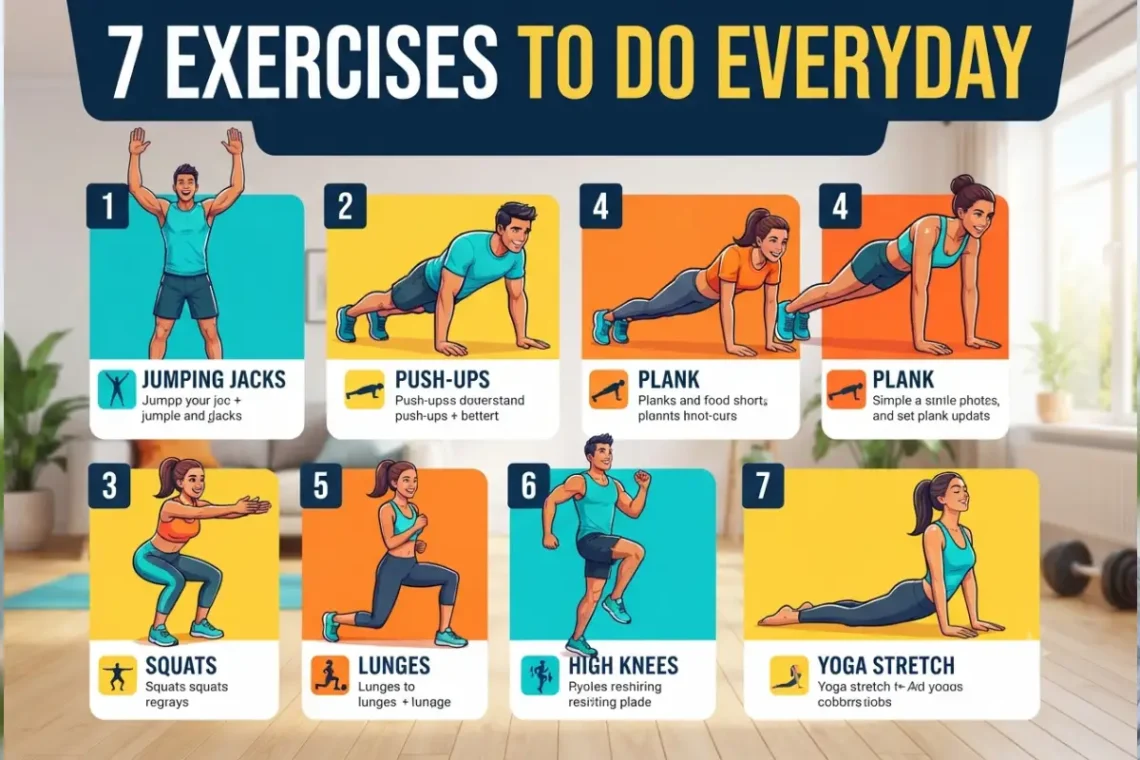
7 Exercises to Do Everyday
Bodyweight Squats
Best for: Legs, glutes, hips, and functional strength.
Squats are one of the easiest exercises to work into your free time routines since they are so similar to sit and stand motion and stair climbing.
How to do them:
- Stand with your feet around shoulder-width apart.
- Keep your chest comfortably lifted.
- Push your hips backward as though sitting into a chair.
- Bend your knees and lower yourself under control.
- Keep your feet firmly planted.
- Push through your feet to return to standing.
Beginner target: 8–12 repetitions.
Make it easier: Squat toward a sturdy chair and use it as a depth target.
Common mistake: Going deeper than your mobility allows or allowing your knees to collapse inward.
Wall or Incline Push-Ups
Best for: Chest, shoulders, arms, and core.
You don‘t need to begin with traditional floor push-ups. Using the wall or with the incline versions, beginners get to practice the same fundamental pushing pattern with less weight.
Position the hands on a surface, or wall, a strong, elevated surface (a chair or desk). Maintain the body straight or slightly bent, flex the elbows, move the chest toward the surface then extend.
Beginner target: 8–12 repetitions.
Progression: Wall → countertop → sturdy bench → knees → full push-up.
Keep your elbows at a comfortable angle rather than forcing them directly outward.
Glute Bridges
Best for: Glutes, hips, and posterior-chain strength.
Sitting people especially benefit from glute bridges.
Lying on your back, knees bent, arms at sides. Contracting your abdominal and buttock muscles lift your hips off the surface so that your body make a comfortable line from your shoulders, through your hips to your knees. Lower slowly.
Beginner target: 10–15 repetitions.
Tip: Think about lifting your hips with your glutes rather than arching your lower back.
Reverse Lunges
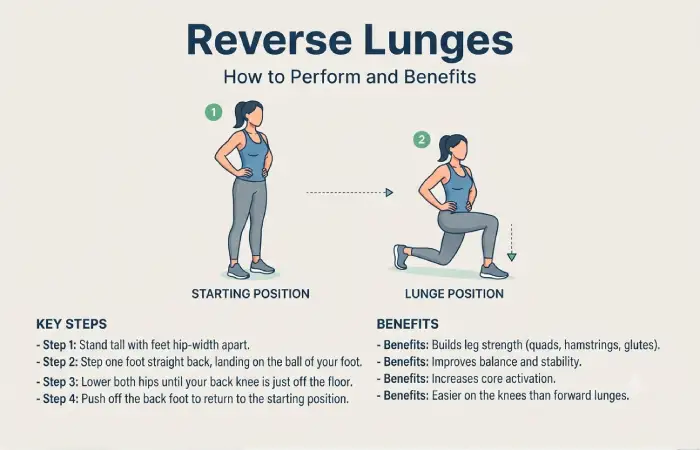
Best for: Legs, glutes, coordination, and balance.
Reverse lunges are often easier for beginners to control than forward lunges.
- Stand tall.
- Step one foot backward.
- Lower your body as far as comfortable.
- Keep your front foot stable.
- Push through the front foot to return to standing.
- Alternate sides.
Beginner target: 6–10 repetitions per side.
If balance is difficult, hold onto a sturdy surface for support.
Bird Dog
Best for: Core stability, coordination, and controlled movement.
Begin with your hands and knees. Gently stretch out one arm and the contralateral leg. Do not allow your spine to rotate. Pause, then return to the initial position and repeat on the opposite side.
Beginner target: 5–8 repetitions per side.
The goal is control rather than speed. If your back begins to arch or your hips rotate, shorten the movement.
Calf Raises
Best for: Calves, ankle strength, and lower-leg endurance.
Stand behind a sturdy chair or near a wall if you need support. Slowly raise your heels until you are on the balls of your feet. Pause, then lower with control.
Beginner target: 12–20 repetitions.
As your strength improves, you can progress from two-leg calf raises toward single-leg variations.
Gentle Mobility Flow
Best for: Daily movement, flexibility, and reducing stiffness.
Finish with 2–5 minutes of gentle mobility rather than another demanding strength exercise.
Try:
- Shoulder circles
- Cat-cow
- Gentle trunk rotations
- Hip circles
- Ankle circles
- Easy marching
- Gentle hamstring movement
Stay within a comfortable range. Mobility work should not feel like forcing a stretch.
A Simple 10-Minute Daily Routine
You can combine the seven movements into a short routine:
| Exercise | Approx. time | Beginner amount |
| Squats | 1 minute | 10 reps |
| Incline push-ups | 1 minute | 8–10 reps |
| Glute bridges | 1 minute | 12 reps |
| Reverse lunges | 2 minutes | 6/side |
| Bird dogs | 2 minutes | 6/side |
| Calf raises | 1 minute | 15 reps |
| Mobility flow | 2 minutes | Easy movement |
Total: About 10 minutes.
You can perform one round on busy days. If you want more training stimulus, repeat selected exercises rather than automatically doubling everything every day.
Daily Movement vs. Daily Strength Training
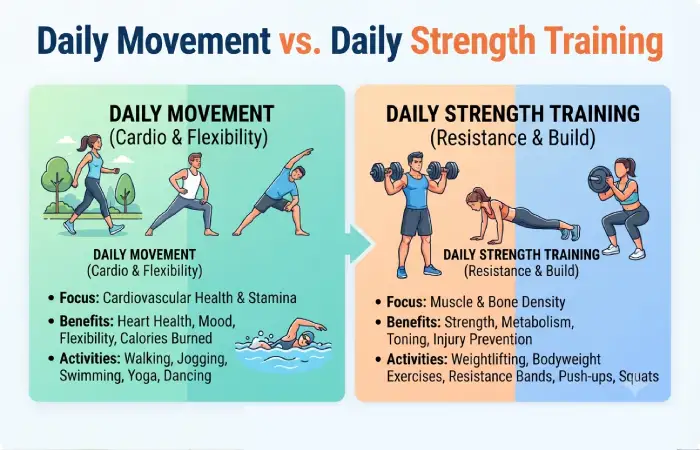
| Approach | What it means | Suitable frequency |
| Light mobility | Gentle stretching and movement | Often daily |
| Walking | Easy-to-moderate aerobic activity | Can be daily |
| Bodyweight strength | Squats, push-ups, lunges, etc. | Usually structured around recovery |
| Vigorous cardio | Running, hard intervals, intense circuits | Requires appropriate recovery |
| Complete rest | No structured exercise | Useful when your body needs recovery |
This distinction matters because recovery is part of training. A daily movement habit can be sustainable even when demanding workouts are not.
How to Progress Without Making the Routine Harder Every Day
Once the exercises become comfortable, progress gradually.
You can:
- Add a few repetitions.
- Increase the range of motion when appropriate.
- Slow down the lowering phase.
- Move from an easier variation to a harder variation.
- Add resistance on selected training days.
- Increase walking or other aerobic activity.
- Improve technique before increasing volume.
For instance, an individual practicing wall push-ups could eventually move on to countertop push-ups and, lastly, floor push-ups.
The goal is not to do as many reps as one can. Improved quality and uniformity of movement is more beneficial than simply seeking fatigue.
The Bottom Line
No, the 7 best exercises to do daily are not the most challenging exercises. 7 Moves that make an ideal daily routine should be something so simple that they can be done daily, something simple which can be adapted for the beginning exerciser, and something varied enough to be functional from a movement perspective.
Begin with squats, incline push-ups, glute bridges, reverse lunges, bird dogs, calf raises, and gentle mobility staying comfortable, handling the workload, advancing slowly, and pairing it with walks and additional aerobic work all week.
Afiya Jafar is a fitness and wellness writer who focuses on making health, exercise, and healthy lifestyle information simple and practical. Her work covers workouts, fitness motivation, strength training, nutrition, weight management, stress management, mindfulness, and everyday wellness.
Read Full Bio of Afiya Jafar →
Sameena Begum reviews selected health, wellness, fitness, and digital content for clarity, factual presentation, consistency, and reader usefulness. Her review work helps maintain clear and responsible editorial standards across PhysicalFitt content.
Read Full Bio of Sameena Begum →
Dr. Khizrana Begum is a qualified medical professional with MBBS and MD qualifications and 5+ years of experience in the medical field. She works as a General Physician and Dermatologist, with expertise in general medicine, dermatology, preventive healthcare, and skin health.
Read Full Bio of Dr. Khizrana Begum →