
 Afiya Jafar
Fitness & Wellness Writer
Afiya Jafar is a fitness and wellness writer who focuses on making health, exercise, and healthy lifestyle information simple and practical.
Read Full Bio of Author →
Afiya Jafar
Fitness & Wellness Writer
Afiya Jafar is a fitness and wellness writer who focuses on making health, exercise, and healthy lifestyle information simple and practical.
Read Full Bio of Author →
 Sameena Begum
Health, Fitness & Digital Content Reviewer
Sameena reviews selected health, wellness, fitness, and digital content for clarity, factual presentation, and reader usefulness.
Read Full Bio of Reviewer →
Sameena Begum
Health, Fitness & Digital Content Reviewer
Sameena reviews selected health, wellness, fitness, and digital content for clarity, factual presentation, and reader usefulness.
Read Full Bio of Reviewer →
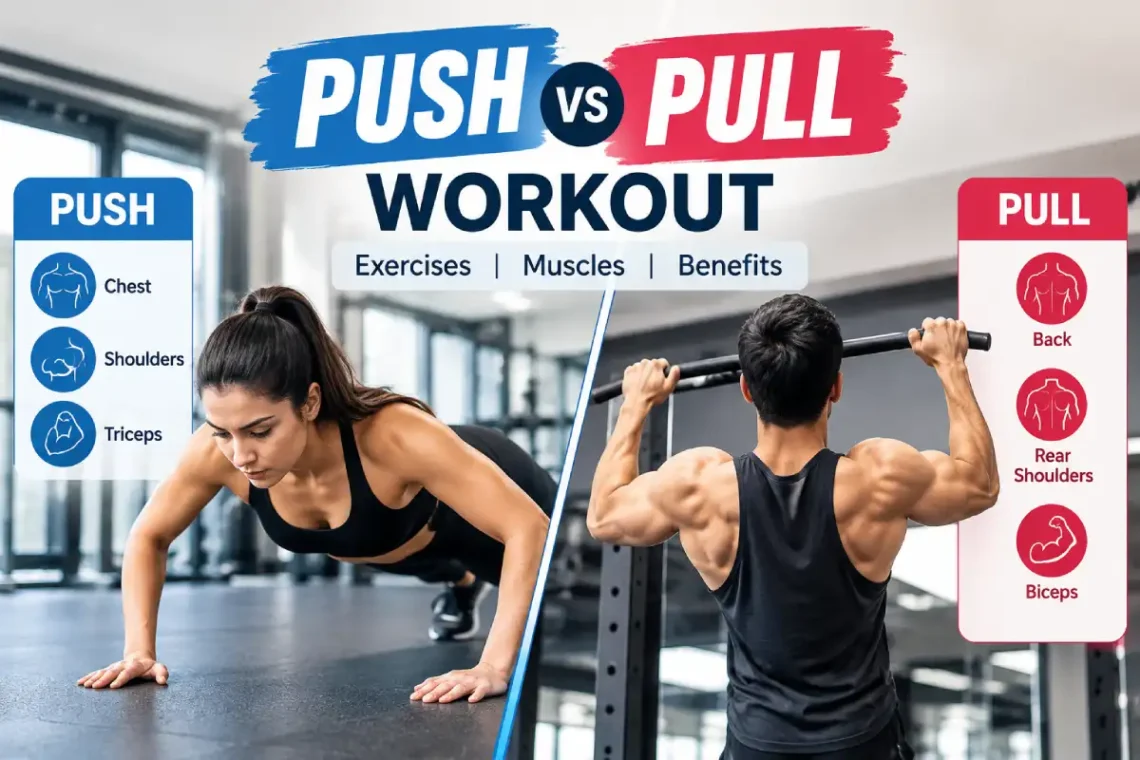
In case you’re wondering what’s a push vs pull workout, here’s an easy way to remember: push workouts train the muscles that push or drive resistance away from your body. Pull workouts train the muscles that pull or bring resistance towards your body. Organizing your strength workouts based on movement makes strength training less complicated and allows a time to rest for antagonistic muscle groups.
Usually, push workouts target the chest, shoulders, and triceps, whereas pull workouts target the back, rear shoulders, biceps, and forearms. A program may also combine push and pull movements for the lower body.
What Is a Push Workout?
A push workout groups exercises where you push a weight away from your body.
Common push muscles include:
- Chest
- Front and side shoulders
- Triceps
- Quadriceps when lower-body pushing movements are included
Popular Push Exercises
| Exercise | Beginner option | Primary muscles |
| Bench press | Machine chest press | Chest, triceps, shoulders |
| Push-ups | Incline push-ups | Chest, triceps, shoulders |
| Shoulder press | Machine shoulder press | Shoulders, triceps |
| Dumbbell lateral raise | Light dumbbells | Side delts |
| Triceps pushdown | Resistance band pushdown | Triceps |
A beginner does not need every exercise. Two or three compound movements followed by one or two isolation exercises can create a manageable session.
What Is a Pull Workout?
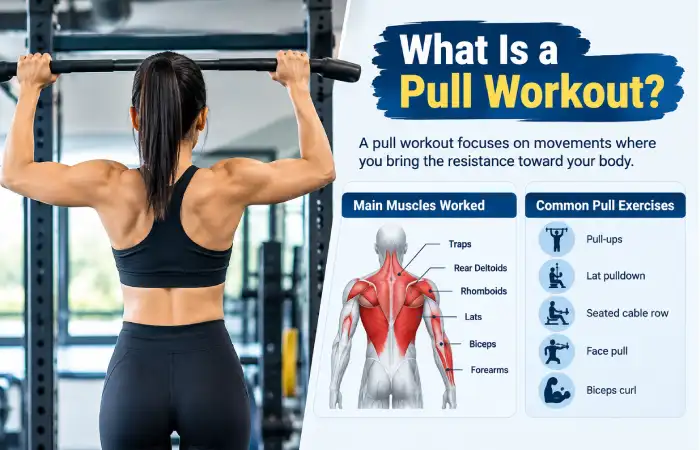
A pull workout focuses on movements where you bring resistance toward your body.
The main muscles include:
- Latissimus dorsi
- Rhomboids and trapezius
- Rear deltoids
- Biceps
- Forearms
Common pulling exercises include pull-ups, lat pulldowns, rows, face pulls and biceps curls. Healthline similarly defines push-pull training around pressing versus pulling muscle actions and notes that the approach can be used to organize training and recovery.
Popular Pull Exercises
| Exercise | Beginner option | Primary muscles |
| Lat pulldown | Assisted pull-up | Lats, biceps |
| Seated cable row | Chest-supported machine row | Back, biceps |
| Dumbbell row | Supported dumbbell row | Lats, upper back |
| Face pull | Light resistance band | Rear delts, upper back |
| Biceps curl | Cable or dumbbell curl | Biceps, forearms |
Push vs Pull Workout: What’s the Difference?
The easiest way to remember the difference is the direction of force.
| Push Workout | Pull Workout |
| Moves resistance away | Brings resistance toward you |
| Chest | Back |
| Shoulders | Rear delts |
| Triceps | Biceps |
| Bench press | Rows |
| Push-ups | Pull-ups |
| Shoulder press | Lat pulldown |
| Triceps extensions | Biceps curls |
Push and pull training is not necessarily about choosing one over the other. A balanced strength program normally needs both movement patterns.
Basic-Fit’s 2026 beginner guidance similarly describes pushing as moving weight away from the body and pulling as bringing weight toward the body.
Push vs Pull vs Push-Pull-Legs
One common source of confusion is the difference between push/pull training and push-pull-legs (PPL).
A push-pull routine generally separates upper-body movements into push and pull sessions. A PPL program adds a dedicated leg day.
For example:
Push: Chest, shoulders, triceps
Pull: Back, rear delts, biceps
Legs: Quads, hamstrings, glutes and calves
The PPL structure is widely used because it provides a simple way to organize training around movement patterns and recovery.
Beginner Push-Pull Workout Plan
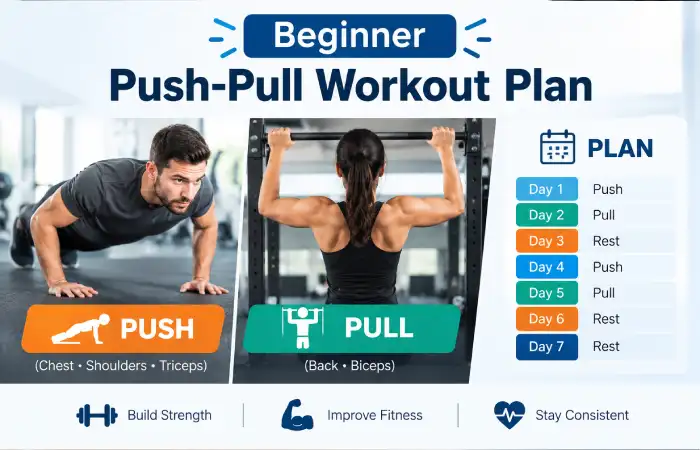
You do not need to train six days a week to use a push-pull structure.
3-Day Beginner Schedule
| Day | Workout |
| Monday | Push |
| Tuesday | Rest |
| Wednesday | Pull |
| Thursday | Rest |
| Friday | Legs + core |
| Weekend | Rest or light activity |
For beginners, starting with three non-consecutive resistance-training sessions can be easier to recover from than immediately adopting a high-frequency program.
Push Day
- Machine or dumbbell chest press — 3 × 8–12
- Seated shoulder press — 3 × 8–12
- Incline push-up — 2 × 8–15
- Lateral raise — 2 × 10–15
- Triceps pushdown — 2 × 10–15
Pull Day
- Lat pulldown — 3 × 8–12
- Seated cable row — 3 × 8–12
- Chest-supported dumbbell row — 2 × 8–12
- Face pull — 2 × 10–15
- Dumbbell curl — 2 × 10–15
Use a weight that allows controlled repetitions with good technique rather than sacrificing form to lift heavier.
How Many Times Should You Train Push and Pull?
There is no “one size fits all” frequency. Your training age, total weekly volume, recovery, schedule and goals all matter.
The 2026 ACSM resistance-training update promotes individual-specific training volume and load and indicates about 10 SETSMusclegroup of training per week as a practical hypertrophy focus
It has been found that if weekly training volume is equated, the manner in which training volume is distributed in a training regimen may not influence strength or hypertrophic results. A randomized trial comparing split and full bodytraining groups using equal weekly set volume yielded similar neuromuscular adaptations.
That means that a good split is not necessarily one that will give you the maximum advantage but one that you can perform reproducibly and still get a good recovery.
Equipment Comparison for Push and Pull Workouts
| Equipment | Pull exercises | Push exercises | Best for |
| Dumbbells | Rows, curls | Presses, raises | Home or gym |
| Barbell | Barbell rows | Bench press, overhead press | Strength-focused training |
| Cable machine | Rows, pulldowns | Chest press, pushdowns | Adjustable resistance |
| Resistance bands | Rows, pulldowns | Presses, triceps work | Home workouts |
| Machines | Row/lat pulldown | Chest/shoulder press | Beginners and controlled training |
You do not need expensive equipment. ACSM’s 2026 guidance notes that bodyweight exercises, resistance bands and home-based resistance training can also produce meaningful improvements in strength and hypertrophy.
Common Push vs Pull Workout Mistakes
- Training only pushing muscles
Doing lots of chest and shoulder exercises while ignoring your back can create an unbalanced routine. Include both horizontal and vertical pulling movements.
- Doing too much volume
More is not necessarily better. When volume is too high, it is harder to recover and the session quality might be compromised.
- Ignoring the legs
Push and pull terminology is often used for upper-body workouts, but a complete program still needs lower-body training.
- Changing programs too frequently
Give your routine enough time to practice technique and progress before replacing it.
- Training every set to failure
You can train strength and hypertrophy without every set going to absolute failure. You can usually keep good technique and steady progression longer.
Push vs Pull Workout Troubleshooting
What if I am only able to train 3 days a week?
Follow a push, pull and legs routine, or if you prefer to have each big muscle worked more often then a full-body will do the trick.
What if I can train 4 days?
A push/pull/push/pull schedule can be effective, as long as it is intentionally populated with lower body exercises.
Can you do push and pull on the same day?
Absolutely. An entire “push & pull” full body session is perfect if your time is limited. This style works to up your energy expenditure and can alternate pressing & pulling movements.
Which is more effective for increasing and defined muscle, push or pull?
They recruit different movement patterns, so pitting ‘sports against each other’ is hogwash. They both should be part of an integrated program.
Final Takeaway
The push vs pull routine is best thought of as two movement types rather than two training methodologies. Although the programs are set up differently, pushing movements work pressing muscles like the chest, shoulders and triceps, while pulling movements work back, rear shoulders and biceps.
If you are new to training this is the absolute minimum you should be doing; a sustainable routine, sound technique, progressive overload, sufficient recovery and consistency. Either a three day push/pull/legs, four-day push/pull or a full-body routine; the type of training should reflect your goals and fit conveniently into your weekly life.
Afiya Jafar is a fitness and wellness writer who focuses on making health, exercise, and healthy lifestyle information simple and practical. Her work covers workouts, fitness motivation, strength training, nutrition, weight management, stress management, mindfulness, and everyday wellness.
Read full bio of Afiya Jafar
Sameena reviews selected health, wellness, fitness, and digital content for clarity, factual presentation, and reader usefulness.
Read full bio of Sameena Begum