
 Afiya Jafar
Fitness & Wellness Writer
Afiya Jafar is a fitness and wellness writer who focuses on making health, exercise, and healthy lifestyle information simple and practical.
Read Full Bio of Author →
Afiya Jafar
Fitness & Wellness Writer
Afiya Jafar is a fitness and wellness writer who focuses on making health, exercise, and healthy lifestyle information simple and practical.
Read Full Bio of Author →
 Sameena Begum
Health, Fitness & Digital Content Reviewer
Sameena reviews selected health, wellness, fitness, and digital content for clarity, factual presentation, and reader usefulness.
Read Full Bio of Reviewer →
Sameena Begum
Health, Fitness & Digital Content Reviewer
Sameena reviews selected health, wellness, fitness, and digital content for clarity, factual presentation, and reader usefulness.
Read Full Bio of Reviewer →
 Dr. Khizrana Begum
General Physician & Dermatologist
Dr. Khizrana Begum is a General Physician and Dermatologist with MBBS and MD qualifications and 5+ years of experience in the medical field.
Read Full Bio of Medical Reviewer →
Dr. Khizrana Begum
General Physician & Dermatologist
Dr. Khizrana Begum is a General Physician and Dermatologist with MBBS and MD qualifications and 5+ years of experience in the medical field.
Read Full Bio of Medical Reviewer →
It is normal for children to experience sickness, ranging from the simple sniffles and bugginess to conditions needing quick doctor intervention. The viruses and bacteria common to kids are present almost everywhere: home, school, day care, and so on. Most of these recover quickly, but as an infant or child-caregiver, one must be aware of the warning signs of trouble.
This guide is to discuss the more prevalent illnesses occurring in children, probable symptoms, ways to prevent it and when to seek professional physician’s treatment.
Children can experience many different types of illnesses, from short-term infections to conditions that require ongoing care. Explore our complete guide to common diseases to learn more about health conditions, their symptoms, causes, risk factors, and prevention.
❝
This article is a part of
Health Conditions Hub
What Are Common Childhood Diseases?
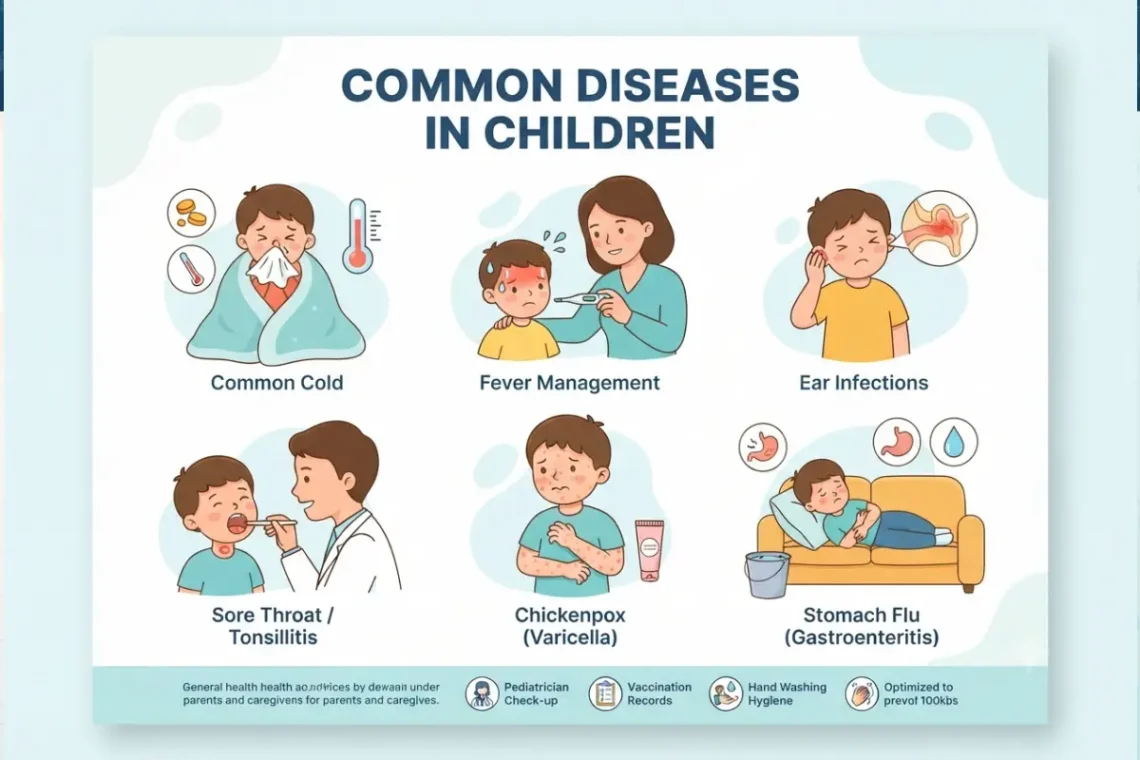
Childhood illnesses: are infections and common disorders to which babies and children of all ages, to teenagers may suffer from. The most familiar childhood illnesses; including ‘the cold’, ‘the flu’ and childhood ear infections ‘diarrhoea and vomiting’ and ‘skin complaints’, also there can be ‘allergies’ or ‘asthma’
However, it is not the case that every cough, fever, abdominal pain or a rash, signifies an illness or a serious condition in a child. Different conditions can exhibit similar symptoms, so parents should not only rely on symptoms.
Common Childhood Infections
Infections are among the most frequent reasons children become unwell. They may be caused by viruses, bacteria, or other organisms.
Common examples include:
- Common cold
- Influenza (flu)
- Ear infections
- Chickenpox
- Measles
- Mumps
- Sore throat and tonsillitis
- Gastrointestinal infections
Specific causes of diseases such as measles and mumps, if prevented by vaccination, are decreased in frequency. In a modern recommendation for health of children, “Immunisation as a means of disease prevention is highlighted for control of severe communicable diseases”.
Respiratory Illnesses in Children
A child seems especially prone to respiratory illnesses. Often the child will have a cold, and sometimes they will get a runny nose, a cough, a sore throat, a fever, or nasal blockage because of it.
Infections are among the most common reasons children become unwell and may be caused by viruses, bacteria, or other organisms. Learn more about common infectious diseases and how these illnesses can spread and affect different parts of the body.
| Condition | General concern | Common symptoms |
| Common cold | Usually mild | Runny nose, congestion, cough, mild fever |
| Flu | Can be more severe | Fever, cough, tiredness, body aches |
| Bronchiolitis | Greater concern in babies | Cough, breathing difficulty, wheezing |
| Croup | Medical assessment may be needed | Barking cough, noisy breathing |
| Asthma | Requires ongoing management | Wheezing, coughing, breathing difficulty |
Asthma is a common childhood condition that affects breathing and can often be controlled with appropriate treatment.
Seek urgent medical attention if a child has significant difficulty breathing, becomes unusually sleepy or difficult to wake, develops blue or grey lips/skin, or appears seriously unwell.
Digestive Conditions in Children
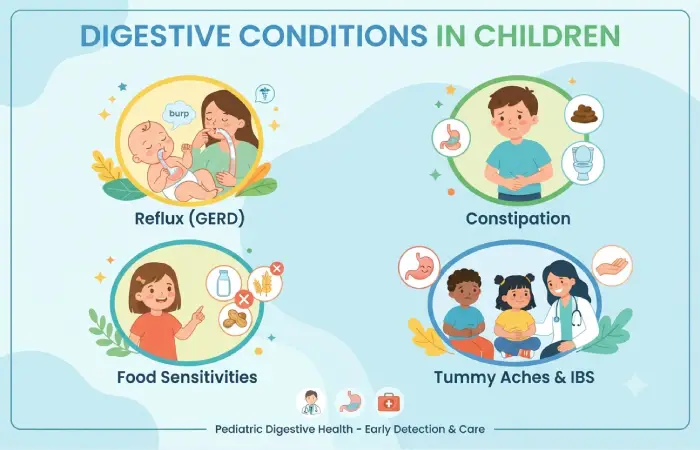
Children are particularly prone to illnesses affecting the lungs and airways, including colds, flu, bronchiolitis, croup, and asthma. Explore common respiratory diseases to learn more about respiratory conditions, symptoms, causes, and risk factors.
Vomiting and diarrhoea are common childhood problems and are often caused by infections. The main concern is dehydration, particularly in babies and young children.
Possible warning signs include:
- Reduced urination
- Dry mouth
- Unusual sleepiness or weakness
- Inability to keep fluids down
- Sunken eyes
- Significant worsening of symptoms
Children with vomiting or diarrhoea should be monitored closely for their ability to drink and urinate. Severe dehydration requires medical attention.
Common Skin Conditions
There are a number of common childhood rashes and skin conditions which affect babies and children including-eczema, chicken pox, impetigo, ringworm, scabies, other viral rashes amongst a list of others recommended by NHS guidance.
Children with a rash should be seen to in urgent medical assessment with difficulty in breathing, swelling of body parts, serious ill health and where a rash is changing fast.
However you shouldn’t consider all rashes to be a part of the disease called allergy; all aspects like look, how the rash has spread, additional conditions associated with the condition, and child’s general health are important.
Childhood Allergies
An allergic reaction is your immune system overreacting to something which normally is not harmful to anyone. As children may have allergic reactions to the foods, medicines, pollens, house-dust mites, insect bites or to some other such materials.
Some childhood conditions can affect the heart, including congenital heart problems that may be present from birth. Learn more about common heart diseases and the symptoms and warning signs associated with cardiovascular conditions.
Symptoms the child may have are: –
- Sneezing and runny nose.
- Itching and watering of eyes.
- Rash and hives on skin.
- Coughing or wheezing in the chest, and difficulty to breath.
- Swelling anywhere on body.
- Digestive symptoms.
A critical allergic reaction could be a health emergency. Incase the child find it too difficult to breath, has the swelling on the tongue or the back of the neck, or gets fainty etc. it should be treated as an medical emergency.
Symptoms and Warning Signs
Typical illnesses such as fever, cough, vomiting, diarrhoea, sore throat, tiredness and rash can be caused by many childhood illnesses.
It is more useful for parents to concentrate on the child rather than focus solely on a name of a potential disease.
Be aware of symptoms to watch for:
- difficulty breathing
- extreme drowsiness or unusual confusion
- fits
- serious signs of dehydration
- any persistent or worsening symptoms
- any rapidly spreading or unusual rash
- severe pain
- vomiting, which the child is unable to manage (or can’t hold down the water which she needs)
- when a baby is younger than three months and is not themselves
Vomiting, diarrhoea, stomach infections, and other gastrointestinal problems are also common during childhood. For more information about conditions affecting the digestive system, explore common digestive diseases.
Trust your instincts-if the child ‘doesn’t seem right’ and different than usual. Guidance from the NHS re childhood issues states that they are worried when your baby:
- breathing
- awareness
- skin colour
- temperature
- hydration
- eating or drinking
Childhood Disease Prevention
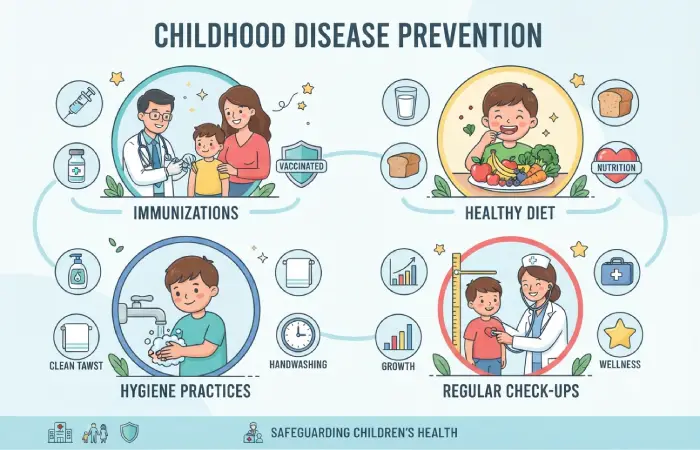
It’s impossible to prevent every illness from being caught, however there are simple things that many families do on a day-to-day basis that have been shown to decrease the likelihood of illness developing from viruses, bacterial infections etc:
Good prevention practices:
- Regular and effective handwashing is essential.
- Keep immunizations up to date as prescribed according to age, and check that they haven’t lapsed during their lifetime or from time of childhood infection.
- Where possible, try not to share articles with sick relatives and friends, particularly cups and cutlery.
- Educate the child on how to cough or sneeze through their elbow, covering the mouth with the part of the elbow that’s used to cough and sneeze into when there is a viral or bacterial infection apparent in the home or at school.
- Clean frequently-handled surfaces, especially if there is an infection prevalent in society; particularly areas which are often used by many people when in communal places.
- Adequate good nourishment, rest and activity.
- Avoid having sick children at school or elsewhere if not at school and make sure children are monitored closely if thought possible of infecting others by a particular cause.
Preventing a disease through immunisation means that the childhood illness simply would not be contracted; in this instance preventing several illnesses with serious consequences in their future life.
Vaccination and Infection Prevention
Immunization can reduce or prevent from the vaccine-preventable diseases which is the one of the best methods to shield a child from it. Vaccines may different from country to country, therefore, parents need to refer to the immunization schedule prescribed by his pediatrician or country’s local authority. The parents at India need to check the immunization schedule for their children by referring their respective health worker instead of referring an article on line which mentions for some vaccination at some months from some weeks or.
Some children can also develop conditions related to the way the body processes energy, nutrients, and hormones. Learn more about common metabolic diseases and the factors that can affect metabolic health.
Beside prevention vaccination there are also measures to preventing diseases such as having safe food and water, personal hygiene, right food and, prompt medical treatment.
According to WHO there are other aspects like nutrition, treatment and immunization for preventing diseases in children.
When Children Need Medical Care
Many minor childhood illnesses can improve with rest, fluids, and appropriate home care. However, parents should contact a healthcare professional when symptoms are severe, persistent, worsening, or unusual for the child.
Emergency care may be needed when a child has:
- Severe breathing difficulty
- Blue or grey skin or lips
- Loss of consciousness
- Seizures
- Severe dehydration
- A serious allergic reaction
- Significant changes in awareness or responsiveness
For less urgent concerns, a pediatrician or other qualified healthcare professional can assess symptoms and determine whether testing or treatment is necessary.
Key Takeaway
Respiratory infections, stomach upsets (gastroenteritis) ear infections, skin infections, allergies/asthma and also many infectious diseases that can be prevented by routine vaccination are fairly common to all children. In most cases, childhood diseases are self limiting, but parents must know which symptoms to be aware of.
A child should never be diagnosed solely on a list of symptoms consulted on the internet. The child should be observed on how they react to symptoms, their hydration levels, breathing rate, actions and general well-being, the routine immunizations need to be kept up to date as well as practicing good hygiene and consult a doctor when concerned.
Afiya Jafar is a fitness and wellness writer who focuses on making health, exercise, and healthy lifestyle information simple and practical. Her work covers workouts, fitness motivation, strength training, nutrition, weight management, stress management, mindfulness, and everyday wellness.
Read Full Bio of Afiya Jafar →
Sameena Begum reviews selected health, wellness, fitness, and digital content for clarity, factual presentation, consistency, and reader usefulness. Her review work helps maintain clear and responsible editorial standards across PhysicalFitt content.
Read Full Bio of Sameena Begum →
Dr. Khizrana Begum is a qualified medical professional with MBBS and MD qualifications and 5+ years of experience in the medical field. She works as a General Physician and Dermatologist, with expertise in general medicine, dermatology, preventive healthcare, and skin health.
Read Full Bio of Dr. Khizrana Begum →