
 Afiya Jafar
Fitness & Wellness Writer
Afiya Jafar is a fitness and wellness writer who focuses on making health, exercise, and healthy lifestyle information simple and practical.
Read Full Bio of Author →
Afiya Jafar
Fitness & Wellness Writer
Afiya Jafar is a fitness and wellness writer who focuses on making health, exercise, and healthy lifestyle information simple and practical.
Read Full Bio of Author →
 Sameena Begum
Health, Fitness & Digital Content Reviewer
Sameena reviews selected health, wellness, fitness, and digital content for clarity, factual presentation, and reader usefulness.
Read Full Bio of Reviewer →
Sameena Begum
Health, Fitness & Digital Content Reviewer
Sameena reviews selected health, wellness, fitness, and digital content for clarity, factual presentation, and reader usefulness.
Read Full Bio of Reviewer →
 Dr. Khizrana Begum
General Physician & Dermatologist
Dr. Khizrana Begum is a General Physician and Dermatologist with MBBS and MD qualifications and 5+ years of experience in the medical field.
Read Full Bio of Medical Reviewer →
Dr. Khizrana Begum
General Physician & Dermatologist
Dr. Khizrana Begum is a General Physician and Dermatologist with MBBS and MD qualifications and 5+ years of experience in the medical field.
Read Full Bio of Medical Reviewer →
Weight loss is hardly ever “hard to do because someone don’t know to work out.” Weight loss is hard when you loose and keep your fire alive even during those times when the scale doesn’t move, your motivation wanes or your life getschaotic and you don’t have time. When it comes to motivation for weight loss, it works best when you: abandon the need for a roller coaster; create SMART goal;establish habit you can do on repeat; incorporateeasy progress checks.
Take your plan for weight loss offline!
Combine exercise and healthy food; Get quality sleep; Cut the chronic stress. Realistic goals. Forget those crash diet promises the US Centers for Disease Control and prevention has also set a 13– pound target, on the low end of recommended 13–140-pound range, along with regular physical activity.
❝
This article is a part of
Fitness Motivation Tips Hub
Strength training can be part of a well-rounded fitness routine, including when your goals extend beyond weight loss. If you’re also working toward increased strength and muscle development, learn more about motivation for building muscle.
Setting Healthy Weight Loss Goals
One of the quickest ways to extinguish any desire to pursue any fitness goals whatsoever is by making yourself a goal that is completely out of your hands. For instance, “I’m going to lose 20 pounds this month.” In these circumstances, it makes more sense to pursue goals you have more agency over:
-
- “Walk 20 minutes, four times this week,”
- “Have strength-training sessions twice this week,”
- “Add a vegetable to one meal a day,”
- “Follow up on my workout for 30 consecutive days.”
CDC also encourages setting SMART goals – specific, Measurable, Achievable, Relevant, and Time-bound – and suggests choosing only a couple of fitness goals to pursue at a time.
It is also useful to create process goals and outcome goals.
Weight loss is easier to approach when you focus on sustainable habits rather than relying on motivation alone. For more strategies to stay consistent with your fitness goals, explore this complete guide to fitness motivation.
| Goal type | Why it helps | Example |
| Process goal | Completely within your control | Walk 30 minutes 5 days/week |
| Fitness goal | Shows physical improvement | Perform 10 full push-ups |
| Nutrition goal | Builds healthy eating habits | Include protein and vegetables at lunch |
| Outcome goal | Provides a measurable milestone | Lose 5% of body weight |
A 5% weight reduction can already provide meaningful health benefits, according to CDC.
The goal is not to become perfect. It is to make your next healthy action easier than your last one.
Regular physical activity plays an important role in a sustainable weight-loss routine. If you struggle to get started or stay consistent, these strategies for motivation to exercise can help you make workouts a regular habit.
Staying Focused During Plateaus
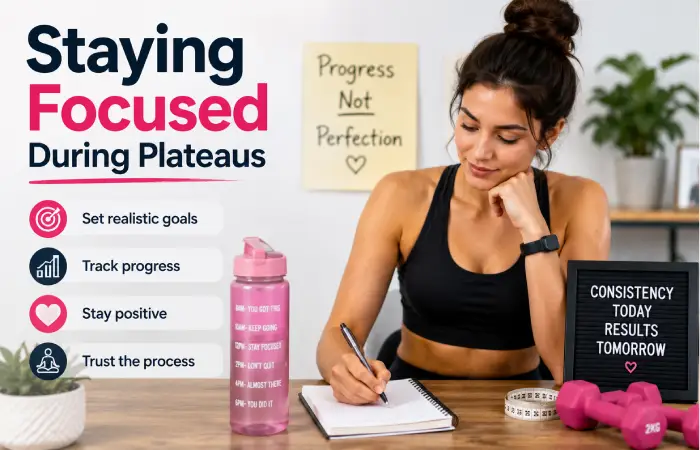
Even with very focused, engaged weight loss participants, weight plateaus can send even them looking sideways and wondering if what they are doing is making a difference.
But again, the scale is one tool and is the measurement that can go up and down due to: fluid levels, what you eat, how much you’ve moved your body. And other factors of bodily changes
During a plateau, track additional indicators:
-
- Waist measurements
- Workout consistency
- Walking or running distance
- Strength improvements
- Energy levels
- Sleep quality
- How your clothes fit
This gives you more evidence of progress than relying on one number.
Where necessary, talk to a licensed provider about weight management challenges that persist.
Building Healthy Habits
Motivation is what gets you going; habits will keep you there. Rather than awaiting enthusiasm to work out. Tie that activity into some existing activity or routine.
Often, it is less of an obstacle to start small compared to initiating a tough regimen that will simply be short-lived.
According to CDC guidelines, all adults require 150 minutes weekly of moderate vigorous physical fitness for one 2 days every week in strength and conditioning training exercise. Beginner exercisers gradually gain the level gradually. Exercise at your leisure You will discover activities that make life far better: some range from biking, water fitness training to strolling. Yoga or group classes could also contribute to an energetic and healthy life style.
Healthy behavior change requires efforts over a period of opportunity, and is not without hurdles to attain, points out the NIDDK.
Creating realistic exercise goals can make it easier to remain consistent throughout your weight-loss journey. For additional ideas on staying focused and getting more from your training, check out these workout motivation tips.
Tracking Weight Loss Progress
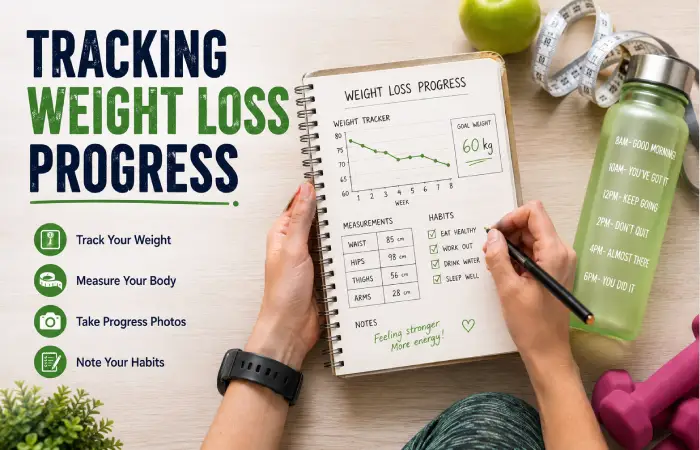
Tracking creates feedback. Feedback makes it easier to identify what is working.
A simple weekly dashboard could include:
| Metric | What to record |
| Weight | Weekly trend |
| Exercise | Sessions completed |
| Steps | Daily average |
| Strength | Reps or resistance |
| Waist | Periodic measurement |
| Sleep | Average hours |
| Energy | Simple 1–5 rating |
Do not turn tracking into a source of anxiety. The purpose is to understand your habits, not judge yourself.
Fitness trackers can make this easier.
| Tracker | Key motivation features | Best for |
| Fitbit Charge 6 | Exercise modes, heart rate, Active Zone Minutes, GPS | Activity-focused users |
| Garmin vívosmart 5 | Steps, intensity minutes, Body Battery, sleep and stress | Habit and wellness tracking |
| Apple Watch SE 3 | Activity Rings, workouts, GPS and fitness encouragement | Users wanting broader smartwatch features |
The Fitbit Charge 6 has over 40 workout modes and its own built-in GPS. The Garmin vvosmart 5 gives an estimate of steps, intensity minutes and calorie burn along with sleep and stress monitoring and Body Battery. The Apple Watch SE 3 uses Activity Rings and workout tracking to keep you active throughout the day and is able to motivate with customized workout inspiration.
A tracker is not essential although. A diary, spreadsheet, phone app or a simple calendar are more than effective if the key is to keep you honest.
You don’t have to rely on a gym to stay active. If convenience or your schedule makes home exercise a better option, these strategies can help with motivation to work out at home.
Avoiding Burnout
More exercise is not automatically better.
Trying to train intensely every day while severely restricting food can create physical and mental fatigue. Burnout may appear as:
-
- Constant tiredness
- Losing interest in workouts
- Irritability
- Poor recovery
- Skipping workouts repeatedly
- Feeling guilty when taking rest days
Build recovery into your plan. Alternate harder sessions with easier activities, schedule rest days, and choose realistic workout durations.
Your motivation strategy should also allow for imperfect days.
If you miss Monday’s workout, Tuesday is not a failure. Simply restart Tuesday.
NIDDK specifically recommends expecting setbacks and returning to healthy behaviors rather than treating one setback as failure.
A simple motivation formula
Motivation → Action → Consistency → Habit → Progress
The key takeaway here is that motivation doesn’t need to stay high every minute of the process, says Laker. Your environment will also determine how motivated you need to stay-Have your workout gear laid out, block out exercise time in your calendar, prepare food for yourself in advance and find an exercise buddy.
Fitness goals can vary from person to person, and finding an approach that fits your lifestyle can make consistency easier. Women looking for additional strategies can explore this guide to fitness motivation for women.
FAQs
How to stay motivated to exercise for weight loss?
Focus your efforts on actions you’re able to influence and devise manageable and achievable goals. Partner up with a workout buddy or a close friend that can hold you accountable and encourage you to stick with your new goals. Use a fitness app, a journal, or simply write down how many days each week you workout; also celebrate non-scale victories.
What if I lose motivation during a weight-loss journey?
If you are lacking the motivation to lose weight, then do not completely forgo exercise altogether. Reduce the expectations you place on the vigor of your workout routine or reduce the amount of time you exercise to reintegrate exercise into your routine.
How much exercise do I need to lose weight?
People need a variety of exercises to maintain general health and wellness.
Generally, Americans need a 24/7 approach to life including physical activity as well as mindful exercise 5 times per day.
Even more importantly, you would need to have a balanced and clean diet.
How often should I check my weight?
People should go easy on checking pounds per daily or even per month if they desire check up their progress when they want by counting steps, doing exercise, running, lifting weights, going cycling as well as other exercise forms that not only focus on calories count but also how to remain healthy physically and mentally by the weight management program .
Which is the best fitness tracker for weight loss?
There isn’t one type of all-in-one gadget to inspire losing some pounds. The fitbit charge 6 is geared towards more hardcore workouts and sport modes.
The garmin vvosmart 5 measures steps, heart health, stress levels and recovery.
And the series watch 7 3 measures workout metrics to build up habits as it provides comprehensive coverage on your health data.
Final Thoughts
Fitness motivation for weight loss isn’t necessarily about staying inspired at all times, but establishing an approach you will follow at times when motivation is low.
This involves setting realistic goals, implementing habit-based goals, tracking a variety of forms of progress, anticipating plateaus, and preventing burnout. What’s even more crucial is that setbacks are treated as information rather than failure.
Achieving long-term sustainable weight loss is no sprint, it’s a marathon; the most sustainable plan isn’t one that one can stick to perfectly for two weeks, but one that can consistently be adhered to for months or even years, supported by CDC and NIDDK’s recommendations with sustainable physical activity, realistic goals, monitoring, and social support.
Afiya Jafar is a fitness and wellness writer who focuses on making health, exercise, and healthy lifestyle information simple and practical. Her work covers workouts, fitness motivation, strength training, nutrition, weight management, stress management, mindfulness, and everyday wellness.
Read Full Bio of Afiya Jafar →
Sameena Begum reviews selected health, wellness, fitness, and digital content for clarity, factual presentation, consistency, and reader usefulness. Her review work helps maintain clear and responsible editorial standards across PhysicalFitt content.
Read Full Bio of Sameena Begum →
Dr. Khizrana Begum is a qualified medical professional with MBBS and MD qualifications and 5+ years of experience in the medical field. She works as a General Physician and Dermatologist, with expertise in general medicine, dermatology, preventive healthcare, and skin health.
Read Full Bio of Dr. Khizrana Begum →