
 Afiya Jafar
Fitness & Wellness Writer
Afiya Jafar is a fitness and wellness writer who focuses on making health, exercise, and healthy lifestyle information simple and practical.
Read Full Bio of Author →
Afiya Jafar
Fitness & Wellness Writer
Afiya Jafar is a fitness and wellness writer who focuses on making health, exercise, and healthy lifestyle information simple and practical.
Read Full Bio of Author →
 Sameena Begum
Health, Fitness & Digital Content Reviewer
Sameena reviews selected health, wellness, fitness, and digital content for clarity, factual presentation, and reader usefulness.
Read Full Bio of Reviewer →
Sameena Begum
Health, Fitness & Digital Content Reviewer
Sameena reviews selected health, wellness, fitness, and digital content for clarity, factual presentation, and reader usefulness.
Read Full Bio of Reviewer →
Getting motivated for exercise comes not about having motivation always handy, but about establishing habits to stick with you even when the spark fizzles. Although we all may start out excited to exercise, life happens – from packed schedules and boredom to the fatigue and slow results you’re seeing, exercise eventually can transform from a fun endeavor into one of many daily duties. You do not even have to look forward to it.
Actually, it takes habits that make exercise attainable, fun to schedule, and easy to start for it to ultimately become one of the pillars of healthy living.
For instance, official recommendations encourage healthy adults to obtain a minimum of 150 minutes per week involving medium depth activity – that can go along with two muscle – creating periods of activity per week, with or without both components added toward goals that are already present. Remember though, that some activity is not anything!
❝
This article is a part of
Fitness Motivation Tips Hub
Common Motivation Challenges
One of the biggest mistakes most beginners make: There’s just so much I can do! But there’s not and even in fitness even professionals have day they don’t really feel like going work-out. Common difficulties in not continuing a regular training are too little time, unrealistic targets and not having visible results.
Cleveland Clinic says beginner can lose their motivation too quick or train too much at the beginning.
Additionally relying only on outer motivation (wanting to weight loss, changing your appearance) for a longer period time of a time. More important are the inner motivations that will stay with your a life long time- and that your need no an exterior push: -more energy,-strength,-better sleep. So it’s important to find your inner-motivation, there are many scientific results that suggest the deeper you your inner motivation goes , the longer you will exercise.
What you can do at the moment: Your training is too challenging (too much time) then you may feel disappointed after a week or two again, maybe this is your next training lesson, try another length of time.
Finding the right reason to exercise can make it much easier to stay consistent. If you’re looking for more ways to stay committed to your goals, explore our complete guide to fitness motivation.
Daily Motivation Strategies

Do less to reduce the barrier before you even feel ready. The “five minutes to get ready”. “I will just change and do five or ten minutes”.
Nine times out of ten, once we get started we keep going.
Five and ten minutes are better than no exercise at all.
Use an implementation intention such as: “After I finish breakfast on Monday, Wednesday and Friday, I will walk for 20 minutes.” NASM recommends this type of specific “when X happens, I will do Y” planning because it turns a vague intention into a predetermined action.
Make sure it enjoyable! Turn a activity into something you will certainly anticipate. Try listening to a podcast walking or make an attempt an outside run.
Find a workout teacher that you like to comply with or select exercises that you love.
You can get active without having to visit a conventional fitness center.
A useful daily rule is:
Never require a perfect workout. Require yourself to start.
That mindset prevents one missed or shortened session from becoming a week-long break.
If your main goal is losing weight, motivation can help you stay focused when progress feels slow. Learn practical strategies for building motivation for weight loss and maintaining consistency.
Creating a Workout Schedule
Treat exercise like an appointment rather than something you will “fit in” later.
For beginners, a realistic schedule might look like this:
| Day | Activity | Approx. time |
| Monday | Brisk walking + basic strength | 30 min |
| Tuesday | Walking or enjoyable activity | 20–30 min |
| Wednesday | Strength workout | 30 min |
| Thursday | Light walking/recovery | 20–30 min |
| Friday | Cardio or favorite activity | 30 min |
| Saturday | Strength + walking | 30 min |
| Sunday | Rest or easy movement | Optional |
This is a framework, not a requirement. The CDC states that weekly activity can be divided into smaller periods rather than completed in one long session.
Start below your maximum capacity. If you schedule six difficult workouts when you realistically have time or energy for three, the plan will eventually become frustrating.
A better approach is to create a minimum workout and an ideal workout. For example, your minimum might be a 10-minute walk, while your ideal session is a 40-minute workout. Completing the minimum still keeps the habit alive.
Building muscle takes consistent training and patience, especially when results aren’t immediate. These strategies for fitness fitness motivation for building muscle can help you stay committed to your strength-training goals.
Finding an Accountability Partner

Accountability can make exercise easier because another person creates an external reason to show up.
Your accountability partner could be a friend, sibling, coworker, spouse or training partner. You do not necessarily need to perform the same workout. You can simply agree to check in after completing your planned activity.
In an instance like that, try messaging them that “just finished my workouts.” The two can also try signing up for a couple of fitness walks together, sign up for a class together or even log into a fitness forum or community online.
“Exercise communities, and a social or connected exercise environment are projected to be a major fitness trend for 2026 and well into the future,” according to the American Council on Exercise.
If you prefer exercising alone, technology can provide another form of accountability.
Knowing what to do is only part of maintaining an exercise routine. Use these workout motivation tips to overcome common barriers and make your workouts more consistent.
Fitness App vs. Fitness Tracker vs. Smartwatch
| Tool | Best for | Main advantage | Limitation |
| Fitness app | Guided workouts | Structured sessions | Can become repetitive |
| Fitness tracker | Activity tracking | Simple progress feedback | Tracking alone does not create motivation |
| Smartwatch | Advanced tracking | Combines workouts, activity and notifications | Higher cost |
Do not buy technology simply because you think it will make you disciplined. Choose a tool that solves a specific problem in your routine.
Rewarding Your Progress
Your reward system should reinforce consistency rather than punish missed workouts.
Forget giving yourself a treat only for shedding five pounds. Instead, treat the actions you are in control of. – Getting in three designated workouts a week or one month of steady walking, or any increase in strength can get a deserved reward.
Keep a simple record of:
- workouts completed
- walking time or steps
- strength improvements
- workout duration
- energy or mood after exercise
- weekly consistency
Progress is not always visible in the mirror. You may become stronger, recover faster, walk farther or feel more energetic before seeing obvious physical changes.
Stay away from non-motivational rewards. Treat yourself to an ice cream cone after exercising may be short-lived gratification, but a new paperback, movie night with friends or fitness equipment a new novel can serve as a great motivator that’s healthier than sugar and ice. Don’t get caught in an either/or situation with exercise.
Skipping a session isn’t a tragedy, it happens.
But deciding that since you missed a Monday exercise routine the whole week isn’t worth it is the biggest workout pitfall.
You don’t always need a gym or expensive equipment to stay active. If you prefer exercising in your own space, discover practical strategies for motivation to work out at home.
What to Do When You Lose Motivation
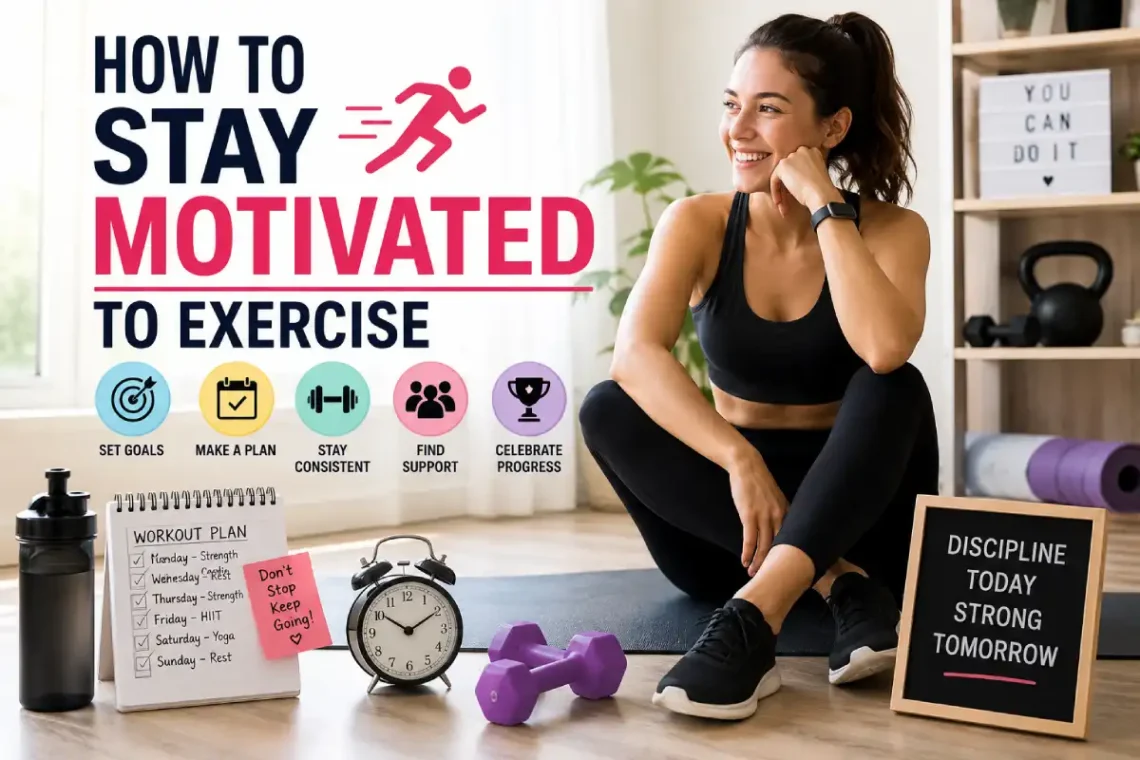
When motivation suddenly drops, use this five-step reset:
- Reduce the workout to 10 minutes.
- Choose an activity you actually enjoy.
- Remove one obstacle from your environment.
- Ask an accountability partner to check in.
- Review your progress instead of judging yourself.
If you are chronically fatigued, injured, or have a health condition that impacts exercise, you should discuss your increased training with a qualified health professional. The CDC recommends you discuss your appropriate level of activity with a doctor if you have a chronic disease and prior to intense physical activity for certain reasons.
Everyone has different fitness goals and challenges. Women looking for strategies tailored to their fitness journey can explore our guide to fitness motivation for women.
FAQs
How can I stay consistent with daily exercise?
You don’t have to do an intense workout every day. It’s important to have a realistic schedule and focus on a sustainable structure rather than always striving for an extreme feat; light days like walks or a mobility routine can be helpful.
What if I am not feeling like it?
Don’t let it feel like a test of will. Take advantage of the five-minute rule; start with five minutes of motion when you dress for your workout and see if you can keep going,” suggests a certified personal trainer. If you still find yourself struggling, either give yourself permission to do something light, or just stop.
How long until you’re a seasoned exerciser?
Experts say the 21 days it supposedly takes to form a habit is not really an exact science – it differs per individual and depends on their circumstances.
Do fitness trackers help with consistency?
A fitness tracker can aid the process as long as seeing your progress can keep you going, or it simply serves as a simple guide. But remember it’s not a miracle to get you active and up.
It does not in any way have to do anything in setting a practical plan for workouts.
What’s the workout advice for beginners?
Adults are asked to accumulate at minimum 150-minutes of moderate aerobic workout and engage in muscle strengthening activities for two days of the week at the very least.
These guidelines will help guide a fitness program for individuals as they start to learn how to workout.
You can also do more for workouts.
The Bottom Line
Actually learning how to remain motivated to exercise relies on setting up a structure, that is not dependant on being able to produce motivation each morning. Do it small, book your activity. Do activities which give you pleasure, monitor your progress, record progress that means something, and ensure that accountability comes into play for the support you require.
To 2026 the smartest way is not necessarily trying the latest hot workout, or relying upon those inane motivation quotes. It is rather cultivating something with regard to lasting relating motion; making movement uncomplicated adequate to initiate with, simple enough to continue doing; meaningful adequate to continue performing – that’s not much more.
Afiya Jafar is a fitness and wellness writer who focuses on making health, exercise, and healthy lifestyle information simple and practical. Her work covers workouts, fitness motivation, strength training, nutrition, weight management, stress management, mindfulness, and everyday wellness.
Read full bio of Afiya Jafar
Sameena reviews selected health, wellness, fitness, and digital content for clarity, factual presentation, and reader usefulness.
Read full bio of Sameena Begum