

 Afiya Jafar
Fitness & Wellness Writer
Afiya Jafar is a fitness and wellness writer who focuses on making health, exercise, and healthy lifestyle information simple and practical.
Read Full Bio of Author →
Afiya Jafar
Fitness & Wellness Writer
Afiya Jafar is a fitness and wellness writer who focuses on making health, exercise, and healthy lifestyle information simple and practical.
Read Full Bio of Author →
 Sameena Begum
Health, Fitness & Digital Content Reviewer
Sameena reviews selected health, wellness, fitness, and digital content for clarity, factual presentation, and reader usefulness.
Read Full Bio of Reviewer →
Sameena Begum
Health, Fitness & Digital Content Reviewer
Sameena reviews selected health, wellness, fitness, and digital content for clarity, factual presentation, and reader usefulness.
Read Full Bio of Reviewer →
 Dr. Khizrana Begum
General Physician & Dermatologist
Dr. Khizrana Begum is a General Physician and Dermatologist with MBBS and MD qualifications and 5+ years of experience in the medical field.
Read Full Bio of Medical Reviewer →
Dr. Khizrana Begum
General Physician & Dermatologist
Dr. Khizrana Begum is a General Physician and Dermatologist with MBBS and MD qualifications and 5+ years of experience in the medical field.
Read Full Bio of Medical Reviewer →
Healthy lifestyle does not mean eating a flawless diet and attending gym all day to shed a little extra weight. It is made of little habits of daily life that will improve your physical health,mental fitness,energy levels,sleep patterns and quality of life for the rest of your life. Healthy foods to eat ,physical activities , enough sleeping hours , stress management and avoiding damaging habits form the base of it.
Don’t feel discouraged if there is a big list to tick – in reality, you don’t have to bring about changes all day – small and gradual changes you make can build into sustainable lifestyle habits.
Here, the important areas covered to lead a healthy life style are discussed.
Maintaining a healthy lifestyle involves making informed choices about nutrition, activity, sleep, and overall wellness. Explore these practical health tips to support a healthier everyday routine.
❝
This article is a part of
General Health Hub
What Is a Healthy Lifestyle?
A healthy lifestyle consists of routine practices which nurture both the physical and mental wellbeing of an individual. Practices of having diverse nutrition, enough exercises, sleeping on regular hours, decreasing and avoiding stress and its factors, abandoning the habit of smoking and taking less drugs, consuming not-too-harmful items in limited scale and doing regular medical checks would fall under healthy living. World Heath Organization said health living is the combination of good diet, physical exercises, quality sleep and other activities the reduce hazard.
However the healthy living should accommodate the needs and culture of the person.
It should not only be a single format that everyone has to follow all the times of your life according to your age, culture, budget, health conditions and works.
Benefits of a Healthy Lifestyle
It’s not really hard to imagine that a healthy pattern of health habits could result in an excellent state of cardiovascular, physical functioning, and mental health, to begin with – not to mention healthy body shape, sleep, or energy. Physical exercise, for instance, has been connected with a lowering of several types of chronic illnesses, and positive association with a solid state of mind.
Building a healthier lifestyle starts with small actions that become consistent over time. Learn how to develop healthy habits that can support your long-term health and well-being.
| Potential benefit | Healthy habit |
| Provides essential nutrients and supports healthy weight management | Balanced diet |
| Supports cardiovascular fitness, muscles and bones | Regular movement |
| Supports recovery, concentration and overall health | Adequate sleep |
| Supports emotional well-being and resilience | Stress management |
| Reduces exposure to major health risks | Avoiding tobacco |
| Helps identify certain health problems earlier | Preventive healthcare |
A healthy lifestyle is therefore broader than weight loss. Someone can improve their health without seeing a dramatic change on the scale.
Healthy Eating Habits
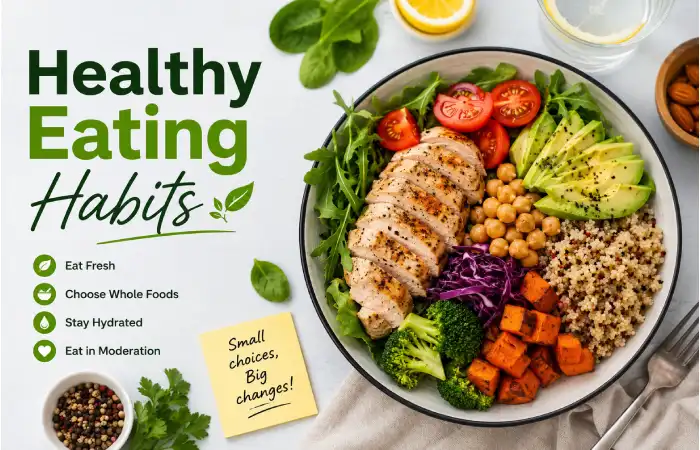
Base your meals on; vegetables, fruits, whole cereals, pulses, beans, nuts and seeds, plus a reasonable quantity of protein. WHO recommends that adults over 10 have 400g of fruits and vegetables each day, plus 25g of naturally occurring dietary fiber also per day.
WHO recommends free sugars intake of less than 10% of daily energy requirements, and for salt to be limited to less than 5g per day for adults.
Use structure, when making your meals as a rough guide, you should aim to have at least one item from the following; vegetables or fruit, protein source, high- fiber carbohydrate plus a healthy quantity of fat.
Regular Physical Activity
That does not need involve heading to the gym, although running, cycling, dancing, swimming, domestic tasks, playing games or working from home counts as exercise. What to do A total of 150 minutes a week of moderate activity or 75 minutes of intensive activity would be best for adults, plus two or more sessions of muscle strengthening. That makes more sense considering that the WHO said in 2022 that almost a billion people –31% of all adults on the planet,1.8billion– “did not move enough”.
| Equipment needed | Activity approach | Best for |
| Walking shoes | Brisk walking | Beginners |
| Optional resistance bands/dumbbells | Home workouts | Convenience |
| Gym equipment | Gym training | Progressive strength |
| Bicycle | Cycling | Cardio and recreation |
| Pool access | Swimming | Low-impact exercise |
Taking care of your health also means focusing on prevention and making choices that may reduce potential health risks. Discover these preventive health tips for a more proactive approach to wellness.
When recommending products, prioritize function, fit, durability, safety, and actual usefulness rather than marketing claims. A basic fitness tracker can be useful for monitoring activity, but it is not necessary for becoming healthier.
Getting Enough Sleep
When referring to “health”, sleep should always be considered a fundamental part of a balanced life, rather than an optional period of recovery. Most adults need approximately seven hours of sleep nightly to function optimally, and not meeting this recommendation is consistently linked with many negative health effects. (According to CDC).
Have a regulated sleep and wake schedule daily. When doing activities before bed, it should be stimulating in an unproductive way. Keep the bedroom dark, comfortable and clean. Ensure you’re getting natural light at some part of the day.
If regardless to these adjustments in your schedule you can’t seem to obtain healthy sleep, and feel extremely fatigued during the day, or have another kind of symptoms, you should consider consulting a doctor.
Managing Daily Stress
A small amount of stress can be normal, but if this becomes a frequent and unattended problem it can impact a variety of areas including sleep patterns, appetite, mood, ability to concentrate and health. Here are just a few simple suggestions you can easily incorporate into your life: Go for a walk outside Focus on your breathing Journal Take a stretch practice mindfulness or meditation Engage in a hobbie Socialize Take a scheduled break from your work or studies The idea is not to prevent or remove any situation which might be seen as an ‘unnatural’ situation, but to establish routines to aid in the recovery from stress or to how to react in and to those stresses.
Healthy living should include regular attention to your overall health, not just daily lifestyle choices. Learn more about regular health checkups and why routine healthcare can be an important part of staying healthy.
Building Healthy Routines
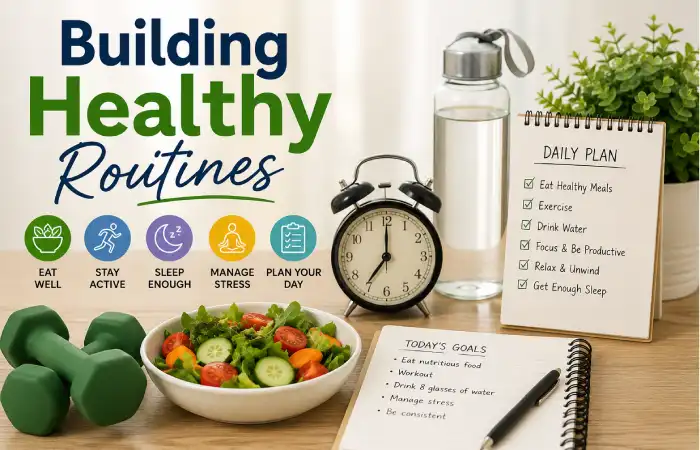
When you “hack” your habit, you attach a new healthy behavior onto your established routine. For instance, instead of trying to vaguely “eat healthier, exercise more, get more sleep.” Try “walk 20-30 minutes post-dinner on week nights.”
Here is a possible, effective day with built in habits:
* Morning: Rise at the same time daily. Drink some water. Eat a healthy breakfast if it works. Get some natural sunlight.
* Day Time: Move you body throughout the day. Eat real nutrient-rich foods. Take mini breaks and stretch and/or walk. Stay Hydrated.
* Evening: Cut out excessive screen stimulation. Plan your day for tomorrow. Implement a relaxing ritual ( meditate, read a book or take a warm shower or bath.) Head to bed at a regular time.
Similarly, The American Heart Association, also state that: “Making the switch to healthy habits is easier when you take one step at a time.”
Common Unhealthy Lifestyle Habits
Here’s some examples of healthy behaviors you may eventually be sabotaging: sitting too much, eating highly processed foods regularly, taking in too much added sugar, not getting enough sleep, smoking, drinking too much alcohol, and regularly getting no exercise.
You’ll notice that, currently, Healthline is giving similar advice (avoiding many highly processed foods and added sugars, exercising regularly, sitting less, good sleep, not smoking and using preventive care). Just one salad or one fast-food burger doesn’t automatically make it the standard for whether you’re making healthy choices or not.
How to Maintain a Healthy Lifestyle
Consistency wins over perfection in most cases.
Begin by identifying 2–3 habits to commit to that would realistically integrate into your life right now.focus on tracking actions, instead of a solitary result (x lbs down, y mph faster)… instead focus on:how many days did I manage to exercise this week? Average hours of sleep. How many veggie & fruit servings did I consume day (on average). Number of times per week I stayed with my established, planned routine.
A simple healthy-lifestyle framework
Quality sleep is an essential part of a balanced lifestyle and can influence your energy, mood, recovery, and daily performance. Follow these practical sleep health tips to build a healthier sleep routine.
| Area | Practical starting target |
| Nutrition | Eat a varied diet based mainly on minimally processed foods |
| Fruit & vegetables | Aim for at least 400 g daily if age 10+ |
| Activity | Work toward 150 minutes of moderate activity weekly |
| Strength | Include muscle-strengthening activity at least 2 days weekly |
| Sleep | Aim for at least 7 hours as an adult |
| Stress | Schedule regular recovery and relaxation |
| Tobacco | Avoid smoking and tobacco products |
| Healthcare | Keep appropriate screenings and vaccinations up to date |
These targets are based on current public-health recommendations, but individual needs can differ because of age, pregnancy, medical conditions, medications, fitness level, and other factors.
A healthy lifestyle also involves finding effective ways to handle everyday pressure and maintain emotional well-being. Explore these stress management tips to learn practical ways to manage stress.
Final Takeaway
The foundation of a healthy lifestyle rests not on overwhelming, herculean feats, but rather on many good decisions you make again and again. Eat lots of nutrient-dense, colorful foods, stay active regularly, get enough sleep, learn how to cope with stress, skip the tobacco (or stop now, and get help doing so!), and make effective, use of preventive medical care as well.
The most potent of strategies is one you can actually stick with for decade after decade; begin with modest alterations that can be made automatic, monitor progress at a realistic level, and turn those initial modifications into habits.
Afiya Jafar is a fitness and wellness writer who focuses on making health, exercise, and healthy lifestyle information simple and practical. Her work covers workouts, fitness motivation, strength training, nutrition, weight management, stress management, mindfulness, and everyday wellness.
Read Full Bio of Afiya Jafar →
Sameena Begum reviews selected health, wellness, fitness, and digital content for clarity, factual presentation, consistency, and reader usefulness. Her review work helps maintain clear and responsible editorial standards across PhysicalFitt content.
Read Full Bio of Sameena Begum →
Dr. Khizrana Begum is a qualified medical professional with MBBS and MD qualifications and 5+ years of experience in the medical field. She works as a General Physician and Dermatologist, with expertise in general medicine, dermatology, preventive healthcare, and skin health.
Read Full Bio of Dr. Khizrana Begum →