
 Afiya Jafar
Fitness & Wellness Writer
Afiya Jafar is a fitness and wellness writer who focuses on making health, exercise, and healthy lifestyle information simple and practical.
Read Full Bio of Author →
Afiya Jafar
Fitness & Wellness Writer
Afiya Jafar is a fitness and wellness writer who focuses on making health, exercise, and healthy lifestyle information simple and practical.
Read Full Bio of Author →
 Sameena Begum
Health, Fitness & Digital Content Reviewer
Sameena reviews selected health, wellness, fitness, and digital content for clarity, factual presentation, and reader usefulness.
Read Full Bio of Reviewer →
Sameena Begum
Health, Fitness & Digital Content Reviewer
Sameena reviews selected health, wellness, fitness, and digital content for clarity, factual presentation, and reader usefulness.
Read Full Bio of Reviewer →
 Dr. Khizrana Begum
General Physician & Dermatologist
Dr. Khizrana Begum is a General Physician and Dermatologist with MBBS and MD qualifications and 5+ years of experience in the medical field.
Read Full Bio of Medical Reviewer →
Dr. Khizrana Begum
General Physician & Dermatologist
Dr. Khizrana Begum is a General Physician and Dermatologist with MBBS and MD qualifications and 5+ years of experience in the medical field.
Read Full Bio of Medical Reviewer →
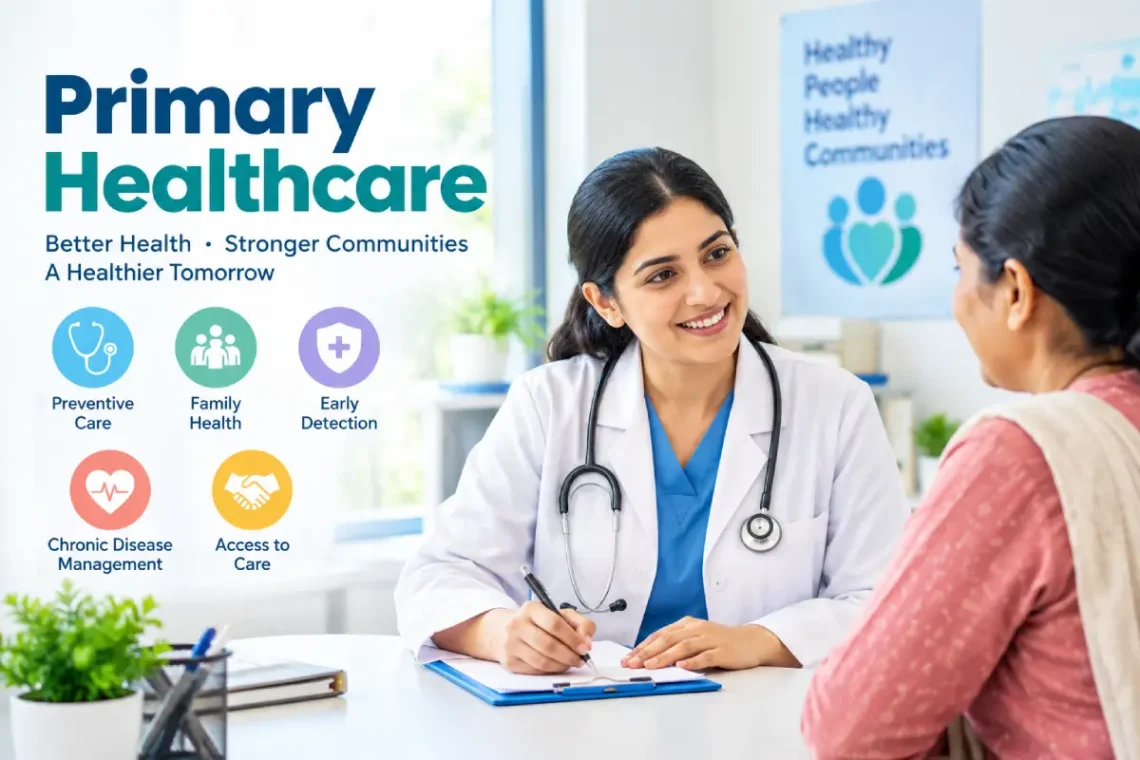
Typically, people first enter the health system in primary care settings. While this embraces more than simple treatment, this domain addresses prevention, education, checks-ups, screenings, and chronic illness management as well as acute presentations and onward referrals where complex treatment is needed.
To achieving universal health coverage, equitable, resilient and people-centered health systems, the WHO has outlined primary health care as their base.
❝
This article is a part of
Health Care Hub
What Is Primary Healthcare?
Primary care consists of indispensable health care delivered as accessible as possible from one’s living and working environments- designed for common health needs while promoting good health maintenance and prevention.
Generally primary care represents the initial level of care unlike tertiary or secondary care. A primary care professional might provide diagnosis and management, care for existing conditions, monitoring and referred for specialist attention if required.
WHO’s overall model of primary health care involves three interlocking elements
- Primary care and essential public health functions
- Policies and actions across different sectors
- Empowered individuals and communities
This makes primary healthcare broader than simply visiting a general physician.
Importance of Primary Healthcare
When supported, strong primary healthcare is focused on access and prevention. Individuals receive regular check-ups and screening as well as being identified, monitored and treated early-rather than seeking out professional health services when it is “too late.”
preventive healthcare,
including health screenings, immunizations, routine checkups, and early
detection.
Hospitals can also take away the “stress” when ordinary, everyday health needs can be serviced closer to home.
WHO stresses investment in strong primary healthcare as one way to ensure access to care without hardship.
For individuals, primary healthcare can provide:
- Early detection of health problems
- Preventive services
- Routine health monitoring
- Treatment for common illnesses
- Chronic disease management
- Health education
- Referrals to specialists
- Follow-up and continuity of care
Primary Healthcare Services
Primary healthcare services vary between countries and facilities, but commonly include:
| Service | Typical purpose |
| General consultations | Diagnosis and treatment of common conditions |
| Immunization | Protection against vaccine-preventable diseases |
| Maternal and child care | Support during pregnancy, infancy and childhood |
| Health screening | Identifying potential diseases early |
| Chronic disease care | Monitoring conditions such as diabetes and hypertension |
| Health education | Supporting healthier behaviours |
| Mental healthcare | Identification and basic management of common mental-health concerns |
| Basic diagnostics | Supporting diagnosis and monitoring |
| Referral services | Connecting patients with specialists when necessary |
Primary healthcare may involve different healthcare providers,
including general practitioners, nurses, community health workers, pharmacists, and allied health professionals.
India’s Ayushman Arogya Mandir programme has expanded the scope of primary healthcare to include areas such as reproductive and child health, communicable diseases, non-communicable diseases, palliative and elderly care, mental health, oral health, ENT care and basic emergency care.
Primary Care Providers

Primary healthcare can involve several healthcare professionals rather than one type of provider.
Depending on the facility and healthcare system, patients may interact with:
- General practitioners or family physicians
- Primary care doctors
- Nurses
- Community health workers
- Pharmacists
- Allied health professionals
- Midwives
- Other trained healthcare workers
In India, primary healthcare has traditionally been delivered through facilities such as Sub Health Centres and Primary Health Centres, while the system has increasingly moved toward comprehensive primary healthcare models.
Preventive Care in Primary Healthcare
One of the biggest advantages of primary healthcare is its emphasis on prevention rather than waiting for disease to become severe.
Depending on the services required, patients may receive primary care through different healthcare facilities, such as clinics, outpatient centers, and community health facilities.
Preventive care may include:
- Vaccinations
- Blood pressure checks
- Diabetes screening
- Cancer screening
- Lifestyle counselling
- Nutrition guidance
- Weight management
- Tobacco and substance-use counselling
- Maternal and child health services
This is especially important as chronic diseases become a growing healthcare challenge.
India’s primary healthcare system has expanded population-level screening for conditions including hypertension, diabetes and several common cancers.
Routine Health Checkups
Getting regular health checkups can allow potential conditions to be detected even before obvious symptoms appear. The necessary frequency can vary from age to specific conditions the person may have and family history as well as risk factors and can only be determined with guidance from a doctor as to what checkups or tests can be beneficial.
A routine primary care visit may involve:
- Reviewing medical history
- Discussing current symptoms or concerns
- Checking vital signs
- Reviewing medications
- Assessing lifestyle factors
- Recommending appropriate screening
- Providing preventive advice
Regular primary care also gives patients an opportunity to discuss concerns they might otherwise ignore.
Health Screening and Early Detection
Screening helps to predict potential illnesses and health conditions before they show any physical symptom.
Primary healthcare settings will be useful in this setting as they are more localized and accessible to the people who do not usually frequent hospitals.
Extensive screening work conducted by India’s Ayushman Arogya Mandir sites is expected to be completed by end of 2025. The government revealed that 39.50 crore cases of hypertension screening, 36.70 crore cases of diabetes screening, 32.40 crore cases of oral cancer screening, 15.23 crore cases of cervical cancer screening and more than 8.37 crore cases of breast cancer screening were done by November 30, 2025.
The future of primary care is increasingly connected to digital healthcare, including teleconsultations, electronic health records, and remote monitoring.
Such numbers show that primary healthcare system has the potential to shift delivery from a purely treatment-oriented system to proactive and preventative care.
Primary Healthcare for Families
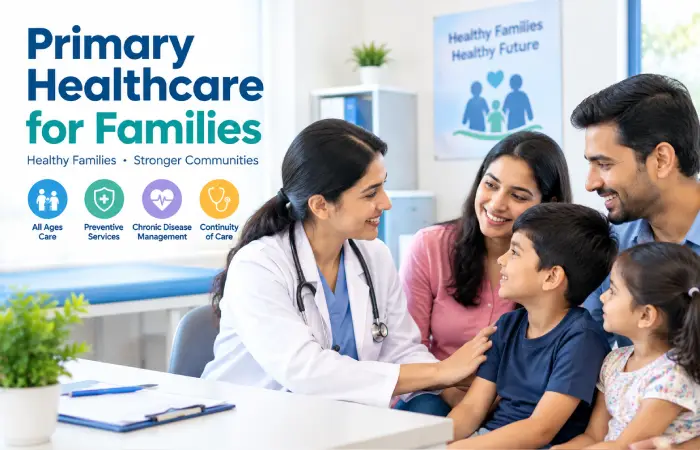
Primary healthcare is valuable for families because different members can require different types of care at different stages of life.
For example:
- Children may need vaccinations and developmental monitoring.
- Adults may need preventive screenings and chronic disease management.
- Pregnant women may require antenatal and maternal services.
- Older adults may need medication reviews, chronic disease monitoring and elderly care.
Having an accessible primary care provider can also make it easier to maintain health records and coordinate care when specialist treatment is required.
Access to Primary Healthcare
The issue of access remains one of the biggest challenges in healthcare. Access could be impeded on account of geography or distance, costs of healthcare services, human resources available, long queues/wait times and insufficient access to investigative facilities, to name a few examples. India has been increasing its investment in the area of primary healthcare.
Between October 2, 2022 (when these mandirs were to be transformed) and December 31, 2025, 182,944 Ayushman Arogya Mandirs had been operationalized according to a report from the Ministry of Health and Family Welfare.
These mandirs were planned to offer enhanced primary healthcare services in all rural, urban and tribal areas.
Teleconsultation and digital health tools are also becoming increasingly important for extending healthcare access. WHO’s recent work highlights digital transformation as one area with potential to strengthen primary healthcare systems.
Future of Primary Healthcare
The future of primary healthcare is likely to be increasingly preventive, connected and digitally enabled.
Healthcare systems are moving toward:
- Greater disease prevention
- Community-based screening
- Digital health records
- Teleconsultations
- Remote monitoring
- Integrated mental healthcare
- Better chronic disease management
- More coordinated referrals
- AI-supported healthcare workflows
However, technology should complement rather than replace accessible healthcare professionals. WHO emphasizes people-centred primary healthcare and stronger health systems rather than technology alone.
Strong primary care also depends on healthcare access,
ensuring that people can obtain appropriate services regardless of location, cost, or other barriers.
Conclusion
Primary healthcare forms the bedrock of a well-functioning, accessible and preventive-focused healthcare system, which both facilitates an individual’s experience with day-to-day health concerns, and provides services relating to screening, prevention, managing chronic disease, and referrals for specific needs to be addressed by the required specialists.
With expanding Ayushman Arogya Mandirs, primary healthcare in India is transitioning, bringing services more closely aligned to communities. With screening, telecare and digital services playing increasingly prominent roles, primary healthcare must continue at the forefront of transforming health delivery.
Afiya Jafar is a fitness and wellness writer who focuses on making health, exercise, and healthy lifestyle information simple and practical. Her work covers workouts, fitness motivation, strength training, nutrition, weight management, stress management, mindfulness, and everyday wellness.
Read Full Bio of Afiya Jafar →
Sameena Begum reviews selected health, wellness, fitness, and digital content for clarity, factual presentation, consistency, and reader usefulness. Her review work helps maintain clear and responsible editorial standards across PhysicalFitt content.
Read Full Bio of Sameena Begum →
Dr. Khizrana Begum is a qualified medical professional with MBBS and MD qualifications and 5+ years of experience in the medical field. She works as a General Physician and Dermatologist, with expertise in general medicine, dermatology, preventive healthcare, and skin health.
Read Full Bio of Dr. Khizrana Begum →