
 Afiya Jafar
Fitness & Wellness Writer
Afiya Jafar is a fitness and wellness writer who focuses on making health, exercise, and healthy lifestyle information simple and practical.
Read Full Bio of Author →
Afiya Jafar
Fitness & Wellness Writer
Afiya Jafar is a fitness and wellness writer who focuses on making health, exercise, and healthy lifestyle information simple and practical.
Read Full Bio of Author →
 Sameena Begum
Health, Fitness & Digital Content Reviewer
Sameena reviews selected health, wellness, fitness, and digital content for clarity, factual presentation, and reader usefulness.
Read Full Bio of Reviewer →
Sameena Begum
Health, Fitness & Digital Content Reviewer
Sameena reviews selected health, wellness, fitness, and digital content for clarity, factual presentation, and reader usefulness.
Read Full Bio of Reviewer →
 Dr. Khizrana Begum
General Physician & Dermatologist
Dr. Khizrana Begum is a General Physician and Dermatologist with MBBS and MD qualifications and 5+ years of experience in the medical field.
Read Full Bio of Medical Reviewer →
Dr. Khizrana Begum
General Physician & Dermatologist
Dr. Khizrana Begum is a General Physician and Dermatologist with MBBS and MD qualifications and 5+ years of experience in the medical field.
Read Full Bio of Medical Reviewer →
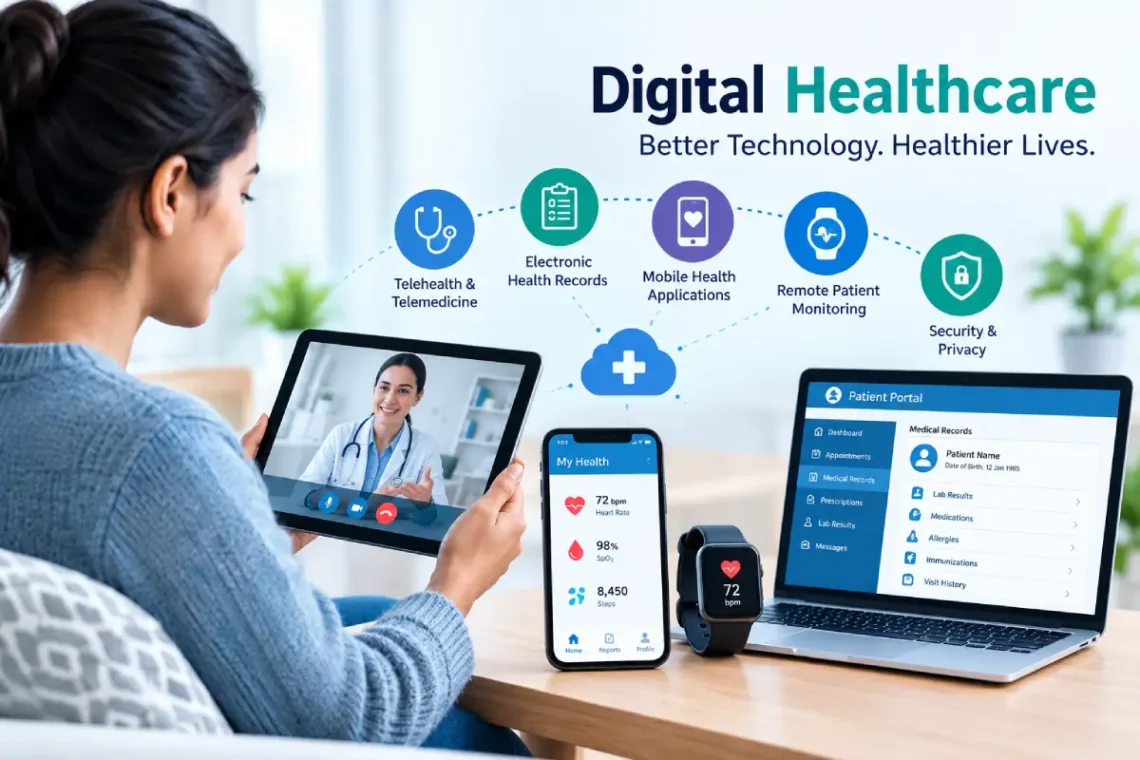
Digital health services apply digital technology to delivery, management, and improvement of health care delivery and treatment. Telehealth, electronic health record (EHR), mobile health applications, remote patient monitoring, digital health platforms, wearable devices, health care information systems, and connected technology are elements of digital health services.
The use of digital health in 2026 will grow considerably, and that video conferencing is just the first stage. Key elements to digital health in 2026 will include interoperability, remote monitoring, workflow automation using AI, connected medical devices and the use of patient produced information for the generation of health data.
Healthcare services are increasingly being supported by technology, making it easier for patients and professionals to access information, communicate, and manage care.
❝
This article is a part of
Health Care Hub
What Is Digital Healthcare?
Digital healthcare is the use of digital technologies to support healthcare delivery and health management.
It covers several connected areas:
- Telehealth and telemedicine
- Electronic health records
- Mobile health applications
- Remote patient monitoring
- Wearable health devices
- Digital health platforms
- Online healthcare services
- Health information exchange
- Healthcare data analytics
- Artificial intelligence and clinical decision-support tools
According to the National Cancer Institute, “digital health is an interdisciplinary field that incorporates technology, health services, data infrastructure, clinical informatics, data science, patient-generated health data, and personal medicine.”
Digital tools can complement primary healthcare by enabling virtual consultations, digital records, remote monitoring, and more convenient communication between patients and providers.
Digital Healthcare vs. Traditional Healthcare
| Feature | Digital Healthcare | Traditional Healthcare |
| Consultation | In person + virtual | Usually in person |
| Health records | Electronic and connected | Paper or local systems |
| Monitoring | Clinic + home monitoring | Primarily clinic-based |
| Communication | Apps, portals, video, messaging | Phone/in-person |
| Data | Can be integrated and analyzed | Often fragmented |
| Patient access | Potentially available remotely | Location dependent |
| Follow-up | Continuous or remote monitoring | Scheduled visits |
Technology can also strengthen preventive healthcare through health apps, digital reminders, remote monitoring, and tools that encourage people to track important aspects of their health.
All services don’t have to go digital. For instance the clinical aspect of a physical exam, emergency services, surgery, procedures and most diagnostic services cannot be replaced with purely digital approaches, they must exist within a traditional clinic.
Telehealth and Telemedicine
Telehealth refers broadly to healthcare supported by electronic communication technologies, while telemedicine generally focuses more specifically on remote clinical services.
Examples include:
- Video consultations
- Telephone consultations
- Remote follow-ups
- Digital prescriptions
- Virtual specialist consultations
- Remote review of test results
- Secure patient-provider messaging
Telemedicine has its uses when a patient requires a follow-up examination and doesn’t necessarily require a hands-on consultation.
Though technology can not fulfill every need. It is possible the doctor will require an actual physical examination and laboratory tests, imaging or an emergency analysis before reaching an assessment.
Practical tip: Treat telehealth as an additional access channel—not automatically as a replacement for physical healthcare.
Digital Health Platforms
A digital health platform can bring multiple healthcare functions together in one system.
The effectiveness of digital solutions ultimately depends on the involvement of qualified healthcare providers who can use technology alongside professional knowledge and patient-centered care.
Depending on the platform, patients or healthcare organizations may use it for:
- Appointment scheduling
- Virtual consultations
- EHR access
- Prescription management
- Laboratory reports
- Payments and billing
- Remote monitoring
- Patient communication
- Health-data analytics
For healthcare organizations, the most important consideration is usually integration.
You need one that doesn’t appear amazing yet isn’t interoperable and can’t communicate with a provider’s or consumer’s present EHR system or their lab, pharmacy, imaging or billing services. This contributes to yet another data silos.
In India there is a rise toward interoperation and standards in the digital health ecosystem. Back in June, C-DAC said it was rolling out work over citizen applications, provider solutions, interoperability framework, registries and data standards, among other efforts.
Digital technology is also changing how healthcare facilities manage patient records, appointments, diagnostics, communication, and other essential healthcare operations.
Digital Health Platform Comparison
| Integrated platform | Platform capability | Basic system |
| ✓ | Appointment management | ✓ |
| ✓ | Teleconsultation | Sometimes |
| ✓ | EHR integration | Limited |
| ✓ | Remote monitoring | Limited |
| Advanced | Analytics | Basic |
| High | Interoperability | Limited |
| ✓ | Patient portal | Sometimes |
Online Healthcare Services
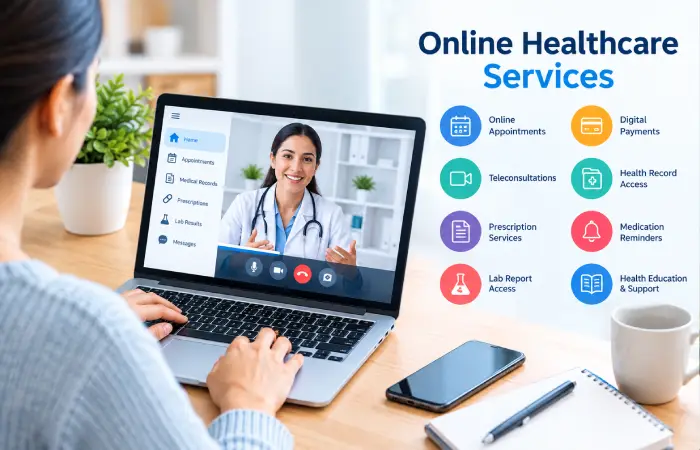
Online healthcare services allow patients to interact with healthcare providers or manage parts of their healthcare journey digitally.
Common services include:
- Online appointments
- Teleconsultations
- Prescription services
- Laboratory-report access
- Digital payments
- Health-record access
- Medication reminders
- Online health education
- Follow-up communication
These services can improve convenience, particularly for routine care and follow-ups.
However, users should verify that the provider is appropriately qualified and that the service follows applicable healthcare, privacy and data-protection requirements.
Electronic Health Records
An Electronic Health Record (EHR) is a digital version of a patient’s health information that can support clinical care.
An EHR may contain:
- Medical history
- Diagnoses
- Medications
- Allergies
- Laboratory results
- Imaging information
- Clinical notes
- Vaccination information
- Treatment plans
The major advantage of an EHR is that relevant information can be available to authorized healthcare professionals when needed.
Expanding digital services can improve healthcare access by helping people connect with medical professionals and health information remotely, particularly when visiting a healthcare facility is difficult.
India’s NextGen eHospital system, for example, incorporates electronic health-record standards and integration with the Ayushman Bharat Digital Mission ecosystem. NIC reported in 2026 that the system was live across 68 health facilities.
What Makes a Good EHR?
Look for:
- Interoperability
- Reliable backups
- Access controls
- Audit logs
- Secure authentication
- Usability
- Data portability
- Appropriate clinical workflows
An EHR should make information easier to use—not simply turn paper records into digital screens.
Remote Patient Care
Remote patient care allows healthcare teams to monitor or support patients outside traditional clinical settings.
Remote patient monitoring can use connected devices to collect information such as:
- Blood pressure
- Blood glucose
- Heart rate
- Oxygen saturation
- Weight
- Temperature
The data can then be sent for review to a health team.
The chronic diseases can be managed using the discussed mechanism as well as the treatment phase could be monitored post operation of chronic disease.
Increase of IoMT (Internet of Medical things) which involves interconnection of networks of medical devices and sensors, communication networks and cloud platforms. It increases the amount of cybersecurity risks.
Mobile Health Applications
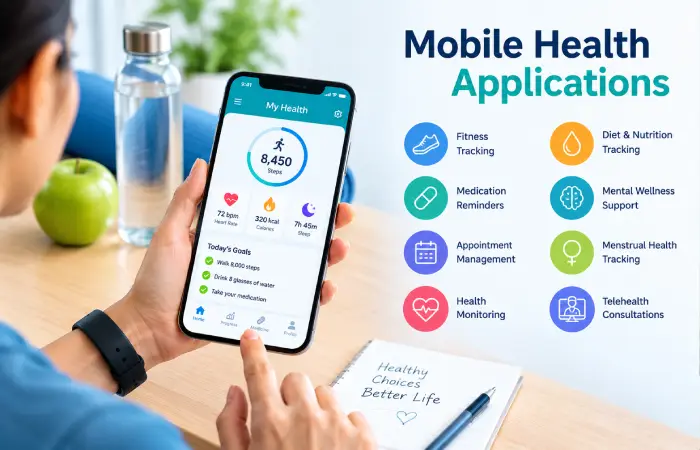
Mobile health (mHealth) refers to health-related applications and services delivered through smartphones and other mobile devices.
Examples include:
- Fitness tracking
- Medication reminders
- Appointment management
- Menstrual health tracking
- Blood-glucose logging
- Mental-wellness tools
- Telehealth applications
- Patient portals
Not every health app is a medical device or clinically validated tool.
Before relying on an app for important health decisions, check:
- Who developed it?
- Is there clinical evidence?
- What data does it collect?
- Who can access the information?
- Is the provider transparent about limitations?
- Does it clearly distinguish education from medical advice?
Digital Health Data
Digital healthcare creates incredible volumes of data from sources such as EHR’s, medical devices, apps, lab systems, patient portals and wearable devices.
The usefulness of this data relies on the following: it is accurate, interoperable, secured and appropriately utilized.
The data flow in digital healthcare:
Patient → Device/App → Secure Platform → Healthcare Provider → Clinical Decision → Patient
Data can support:
- Personalized care
- Population-health management
- Clinical research
- Preventive healthcare
- Remote monitoring
- Healthcare planning
- Quality improvement
But more data does not automatically mean better healthcare. Poor-quality, incomplete or incorrectly interpreted information can lead to poor decisions.
Digital Healthcare Security and Privacy
Healthcare data is highly sensitive, making cybersecurity one of the most important parts of digital healthcare.
Major risks include:
- Phishing
- Ransomware
- Unauthorized access
- Data breaches
- Weak passwords
- Insecure connected devices
- Poor access controls
- Third-party data exposure
How Healthcare Data Can Be Protected
Healthcare organizations should consider:
- Encryption
- Multi-factor authentication
- Role-based access
- Regular security testing
- Software updates
- Employee cybersecurity training
- Secure backups
- Audit logging
- Data-minimization practices
Future of Digital Healthcare
The next stage of digital healthcare will likely be defined by connected ecosystems rather than isolated apps.
Important developments include:
- Artificial Intelligence
AI can assist with documentation, data analysis, decision support, medical imaging and other healthcare workflows. Human clinical oversight remains important, particularly where AI outputs can affect diagnosis or treatment.
- Remote Monitoring
Connected devices can increasingly provide continuous or frequent measurements outside hospitals.
- Interoperable Health Records
Healthcare systems are moving toward making relevant information available across authorized providers rather than keeping data trapped in disconnected systems.
- Personalized Healthcare
Combining clinical information, patient-generated data and analytics may support more individualized care.
- Stronger Cybersecurity
As healthcare becomes more connected, security will need to be designed into platforms and devices from the beginning.
WHO emphasizes that digital-health interventions should be ethical, safe, secure, reliable, equitable and sustainable, with interoperability, privacy and confidentiality among the key principles.
Conclusion
Digital healthcare is fundamentally changing the ways that patients, physicians and healthcare organizations access information and care. It’s enables telehealth to provide enhanced access, EHRs to provide greater information continuity, and mobile tools and telemonitoring to deliver portions of health care to the home. The most useful digital healthcare tools for patients add value to the hands of professional physicians, while the best digital healthcare platforms allow for secure information exchange without hindering existing clinical processes.
Afiya Jafar is a fitness and wellness writer who focuses on making health, exercise, and healthy lifestyle information simple and practical. Her work covers workouts, fitness motivation, strength training, nutrition, weight management, stress management, mindfulness, and everyday wellness.
Read Full Bio of Afiya Jafar →
Sameena Begum reviews selected health, wellness, fitness, and digital content for clarity, factual presentation, consistency, and reader usefulness. Her review work helps maintain clear and responsible editorial standards across PhysicalFitt content.
Read Full Bio of Sameena Begum →
Dr. Khizrana Begum is a qualified medical professional with MBBS and MD qualifications and 5+ years of experience in the medical field. She works as a General Physician and Dermatologist, with expertise in general medicine, dermatology, preventive healthcare, and skin health.
Read Full Bio of Dr. Khizrana Begum →