

Last Updated: July 31, 2026
Mental toughness for athletes is one of the biggest factors separating good performers from elite competitors. While physical training develops speed, strength, and endurance, mental training helps athletes remain calm under pressure, recover from setbacks, and consistently perform at their highest level.
Research published across sports psychology literature continues to show that psychological skills training improves confidence, emotional regulation, concentration, and competitive performance. By 2026, many elite teams dedicate as much attention to mental conditioning as physical preparation.
Whether you’re a beginner athlete, weekend competitor, or aspiring professional, developing mental toughness can improve your results in every sport.
What Is Mental Toughness?
Mental toughness is the ability to:
- Stay confident under pressure
- Control emotions
- Maintain focus
- Recover quickly from mistakes
- Perform consistently despite challenges
It doesn’t mean ignoring emotions—it means managing them effectively.
Athletes with strong mental toughness can:
- Bounce back after losses
- Stay composed in championship moments
- Train consistently
- Handle criticism positively
- Adapt to unexpected situations
Why Athletes Need Mental Strength
Physical ability alone rarely guarantees success.
Two athletes with identical fitness levels often produce different results because of their mindset.
Mental strength helps athletes:
- Perform consistently
- Reduce performance anxiety
- Stay motivated during long seasons
- Improve decision-making
- Trust their training
- Avoid giving up after setbacks
Benefits of Mental Toughness
| Physical Skills | Mental Skills |
| Strength | Confidence |
| Speed | Focus |
| Endurance | Emotional control |
| Technique | Decision making |
| Agility | Resilience |
Elite performance requires both. (APA)
2026 Comparison: Mental Skills and Athletic Performance
| Mental Skill | Performance Impact | Evidence from Sports Psychology |
| Focus Training | Higher consistency | High |
| Visualization | Better skill execution | High |
| Positive Self-Talk | Increased confidence | High |
| Goal Setting | Better motivation | High |
| Controlled Breathing | Reduced anxiety | High |
| Reflection Journaling | Faster learning | Moderate |
Handling Pressure During Competition
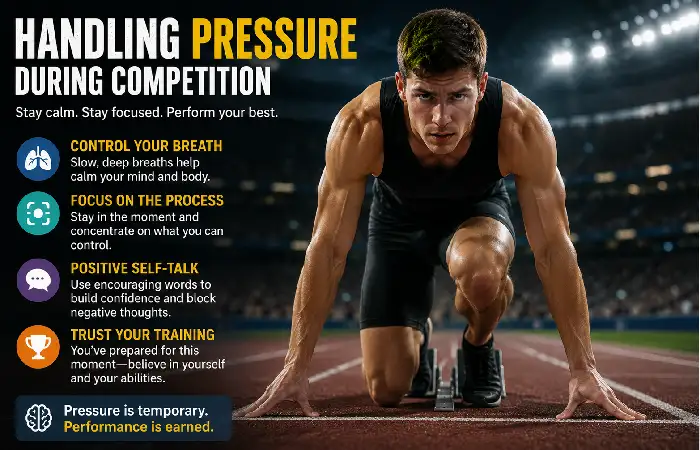
Competition pressure affects nearly every athlete.
Symptoms include:
- Racing heart
- Sweaty hands
- Negative thoughts
- Muscle tension
- Poor concentration
Instead of trying to eliminate pressure, mentally tough athletes learn to perform with it.
Practical Strategies
- Control Your Breathing
Try box breathing:
- Inhale 4 seconds
- Hold 4 seconds
- Exhale 4 seconds
- Hold 4 seconds
Repeat 5 cycles.
- Focus on Process Goals
Instead of:
“I must win.”
Think:
“Stay balanced.”
“Keep good technique.”
“Finish every play.”
Process goals reduce anxiety.
- Develop a Reset Routine
After mistakes:
- Deep breath
- Positive cue word
- Reset posture
- Focus on next action
Many elite athletes use this exact routine.
Improving Focus
Distractions exist everywhere:
- Crowd noise
- Opponents
- Coaches
- Social media
- Internal doubts
Focus is trainable.
Daily Focus Exercises
Visualization
Spend 5 minutes imagining:
- Perfect technique
- Successful competition
- Calm reactions
- Strong finishes
Visualization activates many of the same neural pathways involved in physical performance.
Mindfulness Training
Practice:
- 10 minutes of breathing
- Body awareness
- Present-moment attention
Benefits include:
- Better concentration
- Reduced stress
- Faster recovery from distractions
Attention Cue Words
Examples:
- “Explode”
- “Calm”
- “Drive”
- “Finish”
One word can quickly refocus attention.
Comparison: Distracted vs. Focused Athlete
| Distracted Athlete | Focused Athlete |
| Thinks about winning or losing | Concentrates on the next action |
| Dwells on mistakes | Learns and moves on quickly |
| Reacts emotionally to setbacks | Responds calmly under pressure |
| Notices every distraction | Maintains attention on performance |
| Loses confidence easily | Trusts preparation and training |
Daily Focus Training Plan
| Exercise | Duration | Benefit |
| Mindfulness meditation | 5–10 minutes | Improves concentration |
| Visualization | 5 minutes | Builds confidence and mental rehearsal |
| Deep breathing | 3–5 minutes | Reduces stress and anxiety |
| Reaction drills | 10 minutes | Sharpens attention and decision-making |
| Performance journal | 5 minutes | Identifies distractions and tracks progress |
Key Takeaway
Improving focus isn’t about eliminating distractions—it’s about learning to refocus quickly whenever your attention shifts. By practicing visualization, mindfulness, breathing exercises, and consistent pre-performance routines, athletes can strengthen their concentration and perform with greater confidence under pressure. Like physical fitness, mental focus improves through regular, intentional training.
Recovering From Defeat
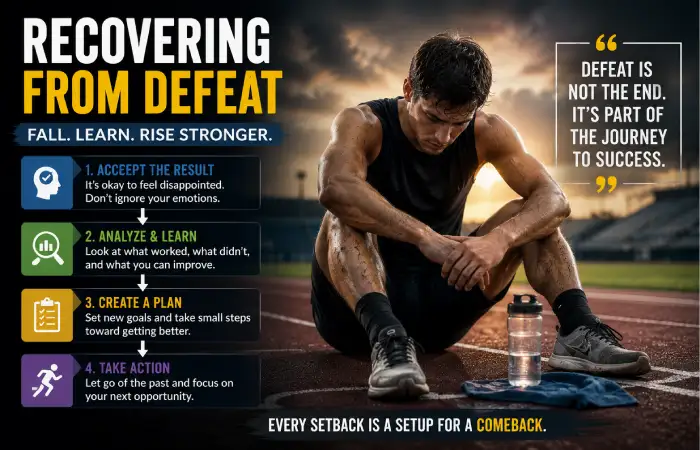
Every athlete loses.
The difference lies in the response.
Mentally tough athletes view defeat as feedback instead of failure.
Recovery Framework
Step 1
Accept the result.
Don’t deny mistakes.
Step 2
Analyze objectively.
Ask:
- What worked?
- What didn’t?
- What can improve?
Step 3
Create an improvement plan.
Example:
Instead of:
“I failed.”
Think:
“My endurance dropped after 30 minutes. I’ll improve conditioning.”
Step 4
Return to training quickly.
Avoid dwelling on losses.
Consistency builds confidence.
Healthy Reflection Questions
- What did I learn?
- What will I improve?
- What can I control?
- What should I repeat?
Pre-Competition Mindset
Your mindset before competition influences performance.
Successful athletes avoid last-minute panic.
Instead, they follow routines.
Sample Pre-Competition Routine
| Time | Activity |
| Night before | Prepare equipment |
| Morning | Balanced breakfast |
| 60 minutes before | Dynamic warm-up |
| 20 minutes before | Visualization |
| 10 minutes before | Controlled breathing |
| Competition | Focus on process |
Consistency creates confidence.
2026 Mental Preparation Checklist
✔ Sleep 7–9 hours
✔ Hydrate well
✔ Review strategy
✔ Use positive self-talk
✔ Visualize success
✔ Control breathing
✔ Trust your training
Troubleshooting Common Mental Challenges
| Challenge | Possible Cause | Solution |
| Performance anxiety | Fear of failure | Breathing + visualization |
| Losing confidence | Negative self-talk | Replace with constructive cues |
| Difficulty focusing | External distractions | Mindfulness practice |
| Fear after defeat | Dwelling on mistakes | Reflection and action plan |
| Inconsistent motivation | Unclear goals | Set SMART goals and track progress |
Products That Can Support Mental Training
While no product replaces consistent practice, some tools can complement mental training:
| Tool Type | Best For | Considerations |
| Guided meditation apps | Mindfulness and relaxation | Look for athlete-specific sessions |
| Sports psychology books | Learning mental skills | Choose evidence-based authors |
| Performance journals | Goal tracking and reflection | Use daily for best results |
| Heart-rate monitors | Breathing and recovery training | Helpful for biofeedback practice |
Frequently Asked Questions
How can athletes become mentally tougher?
Athletes develop mental toughness through consistent practice of visualization, positive self-talk, mindfulness, goal setting, and learning from setbacks. Like physical fitness, mental strength improves with regular training.
Can mental toughness be learned?
Yes. Research in sports psychology shows that mental skills can be developed through structured practice and coaching rather than being purely innate.
What is the best exercise for mental toughness?
Visualization combined with controlled breathing is one of the most effective exercises because it prepares the mind for pressure while improving emotional control.
Does confidence equal mental toughness?
Not exactly. Confidence is one component of mental toughness. True mental toughness also includes resilience, focus, discipline, and emotional regulation.
How often should athletes practice mental training?
Experts recommend spending 10–20 minutes daily on mental skills such as visualization, breathing exercises, journaling, or mindfulness alongside physical training.
Conclusion
Mental toughness for athletes is developed through deliberate practice, not natural talent alone. By strengthening focus, managing pressure, learning from defeat, and following a consistent pre-competition routine, athletes can improve both performance and confidence. Pairing mental conditioning with physical training creates a well-rounded approach that supports long-term success in sport.