

 Afiya Jafar
Fitness & Wellness Writer
Afiya Jafar is a fitness and wellness writer who focuses on making health, exercise, and healthy lifestyle information simple and practical.
Read Full Bio of Author →
Afiya Jafar
Fitness & Wellness Writer
Afiya Jafar is a fitness and wellness writer who focuses on making health, exercise, and healthy lifestyle information simple and practical.
Read Full Bio of Author →
 Sameena Begum
Health, Fitness & Digital Content Reviewer
Sameena reviews selected health, wellness, fitness, and digital content for clarity, factual presentation, and reader usefulness.
Read Full Bio of Reviewer →
Sameena Begum
Health, Fitness & Digital Content Reviewer
Sameena reviews selected health, wellness, fitness, and digital content for clarity, factual presentation, and reader usefulness.
Read Full Bio of Reviewer →
 Dr. Khizrana Begum
General Physician & Dermatologist
Dr. Khizrana Begum is a General Physician and Dermatologist with MBBS and MD qualifications and 5+ years of experience in the medical field.
Read Full Bio of Medical Reviewer →
Dr. Khizrana Begum
General Physician & Dermatologist
Dr. Khizrana Begum is a General Physician and Dermatologist with MBBS and MD qualifications and 5+ years of experience in the medical field.
Read Full Bio of Medical Reviewer →
Most people will face, more than once in their lives, circumstances that are so incredibly difficult that they simply think of giving up – maybe an insurmountable workout regime, or a botched work project, or a goal just too ambitious to even begin. Everybody faces these challenges from time to time; in the end, it’s the individuals who have learnt how to combat adversity that not only survive but thrive in their ventures.
Mental toughness is not an inborn personal trait; but it is rather a skill that is nurtured, built and gained with certain habit and practices, like positive self-talk, self discipline and accepting defeats as lessons. It could be argued that just as there are bodybuilders who train rigorously for strengthening their physical strength, those who commit themselves can even develop a stronger mentally – a trait you need in every aspect of your life and career to go far.
❝
This article is a part of
Mental Strength Hub
What Is Mental Toughness?
It’s not an unwavering denial of all negative thoughts, but simply: the mental strength to stay focused, calm, committed, and confident, especially when everything seems against you or all things go sideways. For all that other negative stuff (where your motivation falters, where the physical challenge comes in, where you have uncertainty) Mental Toughness is that thing which keeps you going towards what matters.
Let’s not confuse mental toughness with: never feeling bad, being scared, or being emotionless. Mental Toughness is: the process and capability to actually feel what you are feeling and use your value to create choices and action even when those feels are not the most comfortable in the world.
For example:
- Continuing your workout even when you’re tired.
- Staying focused after receiving criticism at work.
- Recovering quickly after failing an exam or competition.
- Remaining patient during a long weight-loss journey.
In each of these situations, your mental toughness will assist you in thinking through how you respond, rather than acting on pure emotion.
Mental Toughness vs. Resilience
However you may consider using other terms as the terms can actually mean slightly different things:
| Mental Toughness | Resilience |
| Helps you perform well under pressure. | Helps you recover after setbacks. |
| Focuses on persistence and self-discipline. | Focuses on adaptation and recovery. |
| Encourages consistent action despite discomfort. | Encourages bouncing back after difficulties. |
| Useful before and during challenges. | Most valuable after challenges occur. |
Together, these qualities help you navigate life’s ups and downs more effectively.
Although they are closely related, understanding mental toughness vs. mental resilience can help you recognize how each quality supports personal growth and performance.
Mental Toughness vs. Motivation
Motivation is the key word for most people to reach their goals. The problem with motivation is that it comes and goes. It will hit some days, and not the others.
Mental toughness will allow you to take action regardless of how much motivation you currently have.
| Motivation | Mental Toughness |
| Temporary feeling | Long-term mindset |
| Depends on emotions | Depends on discipline |
| Can disappear quickly | Grows stronger with practice |
| Starts action | Sustains action |
This is why successful athletes, entrepreneurs, and professionals focus more on building discipline than waiting for motivation.
Is Mental Toughness the Same as Being Emotionless?
No.
Being mentally tough doesn’t mean suppressing your emotions or pretending nothing bothers you.
Instead, mentally strong people:
- Accept difficult emotions.
- Stay calm during stressful situations.
- Learn from mistakes.
- Ask for help when needed.
- Continue moving forward despite discomfort.
This balanced approach promotes both emotional well-being and long-term success.
Can Anyone Develop Mental Toughness?
Yes.
Psychologists state that mental toughness is not an inherited trait, but something that you are able to train over a series of weeks. Like physical fitness can be developed in our muscles, our minds grow with continuous training.
Daily, simple actions like, sticking to your word and yourself, trying something new beyond your comfort zone, saying you appreciate people/experiences in your life and journaling can develop the steel in your mind over the period of few weeks.
If you’re wondering how to build mental toughness, start with small daily challenges that gradually improve your discipline, confidence, focus, and ability to handle adversity.
Why Mental Toughness Matters in Fitness and Life
Almost never does life follow perfectly according to your plan. Goals take more effort and time than imagined, something unexpected happens, plans fail. Mental toughness allows you to face any problem with certainty and without aggravation.
In whatever arena of life you’re competing in, whether it’s training for a marathon or starting your own business, studying for exams or getting fit, you’re probably going to find it requires more tenacity than natural gifts.
Helps You Stay Consistent
People are highly motivated to begin new goals but fizzle out after couple of weeks.
Mental toughness will allow you to:
- Work out consistently.
- Eat healthy during stressful times.
- Maintain long-term goals financially.
- Continue to develop skills.
- Build a habit that lasts.
Consistency makes the result, while mental toughness helps to maintain consistency.
Improves Performance Under Pressure
Pressure is everywhere. You can feel it in job interviews, during public presentations, while giving speeches or watching sports, and in sensitive negotiations. Psychologically strong individuals do not allow stress to hinder or stop them from concentrating on the things that they have control over, and thinking with clarity.
Builds Confidence Through Action
Confidence normally does not come before the action itself. Instead confidence builds with every conquered trial. Some Examples of trials are:
* Your first 5K run.
* Difficult task or project you have just completed.
* Speaking out in a meeting.
* Learn a new skill.
And with each successful attempt you build self-belief.
Supports Better Mental Health
Mental toughness does not get rid of stress. But it allows to cope with stressful situation differently. Those people who have tougher mental resilience tend to:
* Recover after failures more quickly.
* Fear of failure less.
* Manage anxiety.
* Stay positive during difficult times.
* Accept changes more readily.
Helps You Handle Failure
Failure is often what contributes to success.
Psychologically strong individuals do not attempt to ignore failure, but to learn from it. For example, when you’d ordinarily tell yourself “i am not quite cut out”, and you instead think about “what did I miss”, “how will I do it differently, and how can I become better”, this may lead to new discoveries or improvements.
Improves Relationships
Mental toughness isn’t only about personal success.
It also helps you become:
- More patient.
- A better listener.
- Less reactive during disagreements.
- More understanding of others.
- Better at managing conflict.
These qualities strengthen both personal and professional relationships.
Supports Long-Term Success
Generally, short term achievement rely on talent while achievement in the long term rely on consistency and diligence. Psychologically strong persons don’t get up when their progress seems very slow or there is no visible improvement, or even after there is a general loss of the motivation to continue what has been started or it begins to be overwhelming or one meets a tough challenge.
Characteristics of Mentally Tough People
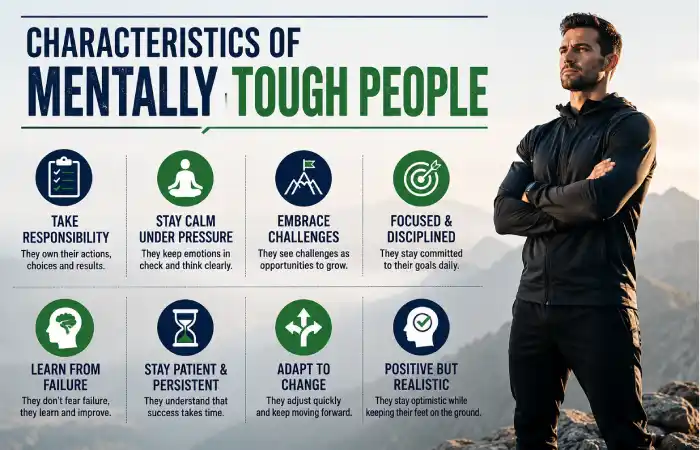
What makes you tough? A whole lot of us will say it’s the desire to win. But actually, mental toughness is less about a particular mindset or attitude; its more about the habits, routines, and the behaviors we have put in place that enable us to continue on with a task even when it’s really hard.
Here are the most common characteristics of mentally tough individuals.
-
They Take Responsibility
Taking responsibility is a key characteristic of the mentally tough people.
They never ever blame anyone, luck, fate etcetera for not succeeding, and instead they query “what am I able to take charge of now?”
-
They Stay Calm Under Pressure
Mentally Strong people do not collapse under stress. Instead they give it time, consider with care and react strategically.
Such persons will often make wise selections even if you do see other persons becoming agitated and going into crisis mode. The ability of psychologically strong individuals is the readiness to cope.
-
They Embrace Challenges
Instead of shying away from demanding circumstances or difficulties and challenges, it’s about approaching obstacles, confident that with these you are growing.
-
They Practice Self-Discipline
Self discipline should come at no point only if they feel extremely moved, as they build up their routines, and adhere to them even on weeks they don’t like performing them.
Examples include:
- Exercising regularly.
- Sleeping on time.
- Managing finances responsibly.
- Limiting distractions.
- Completing important tasks before entertainment.
-
They Learn from Failure
Failure becomes feedback instead of a final verdict.
Every setback provides information that helps them improve their next attempt.
This growth mindset encourages continuous learning rather than perfection.
-
They Stay Patient
Meaningful goals rarely happen overnight.
Mentally tough people understand that consistent effort over months or years often produces the best results.
Instead of chasing quick wins, they focus on sustainable progress.
-
They Adapt to Change
Life constantly changes.
Those who practice and are naturally resilient dont deny that change is a threat. They simply change their tactics to reach their overall goal.
With such flexibility, theyre sure to survive!
-
They Maintain a Positive but Realistic Mindset
You dont have to fake good feelings; that can only take you so far. Being mentally resilient is about admitting the difficulty and knowin that when all is said and done, a little effort goes a long way toward a solution!
Benefits of Developing Mental Toughness
So, developing mental strength isn’t about getting good at handling hard times; it’s about becoming more self-assured, competent, and rugged version of you. So whether you’re looking to shed weight or gain some muscle or gain a promotion or become happy in your private life or so on, mental strength makes you go after and get after and follow through your desired goals.
Let’s look at the biggest benefits.
-
You Become More Consistent
One of the best indicators of success is consistency. More people than not don’t fail because they can’t, but because they quit showing up. Mental toughness allows you to:
- Power through your workouts when you are tired.
- Stick to your diet with cravings on attack.
- Keep learning new things.
- You have long-term goals.
- Create positive habits daily.
Example
Suppose you follow a 12 week fitness programme:
- An unmotivated individual might quit after a rough work week, skipping a couple workouts.
- A mentally tough person will continue their plan because they realize that perfect consistency trumps nothing consistently.
Little tasks repeated in time make big results happen.
-
You Handle Stress Better
Stress is a common fact of life-a demanding job, bills to pay, familial obligations and health issues all add up. The mentally tough don’t eliminate stress, but their approach towards them can change dramatically.
You’ll often see them:
- Remain in control during hectic times
- Act in problem-solving modes
- Rather than get bogged down by emotions
- Take control of things they can influence
- Rather than worry about those they can’t
- Their reaction isn’t “everything’s falling apart,” but, “what can I tackle now?”..
-
You Recover Faster After Failure
Everyone experiences setbacks.
You might:
- Miss a promotion.
- Fail an exam.
- Lose a competition.
- Gain back lost weight.
- Miss several workouts.
The mentally tough know that one setback doesn’t erase Months of work.
When failures happen they:
- Analyze it,
- learn from it,
- adapt their approach, and
- move on toward success.
This rapid recovery is one of the top advantages to developing mental toughness..
-
You Build Greater Self-Confidence
Confidence isn’t inborn.
It is built step-by-step as you tackle and accomplish one challenge after another.
Each small win teaches your brain,
” I’ve overcome tough challenges before…I can and will conquer them again.”
Some Examples are:
- Running the full 26 miles.
- Giving a speech to a crowd of 5,000 people.
- Completing a huge business proposal and submitting it.
- Sticking with an early wake-up routine all month.
- Giving up one of your bad habits for the long-term.
Confidence is built on the foundation of ACTION-not waiting until you “feel ready.”
-
You Make Better Decisions
Large emotions can often result in irrational responses:
- Stress buying,
- emotional eating,
- quit before you are done,
- impulsive argumentative responses,
- procrastination, and
- important task avoidance.
Mental toughness creates an “O.S.L.M.R.” or “Observation-Statement-Learning-Modification-Resilience” for all situations you encounter.
This means that rather than reacting on instinct, mentally tough individuals pause before taking action, weigh the facts of a situation, and choose the response which most nearly aligns with their desired long-term success.
-
You Become More Adaptable
Life rarely follows a perfect plan.
Unexpected situations happen all the time.
Examples include:
- Job changes.
- Injuries.
- Family emergencies.
- Economic uncertainty.
- Business setbacks.
Mentally tough individuals adapt instead of resisting change.
They understand that flexibility often leads to better outcomes than stubbornness.
-
You Improve Your Relationships
Mental toughness also benefits your relationships.
Individuals who are emotionally strong tend to be:
- Good listeners.
- Patient.
- Respectful of others.
- Calm during disagreements.
- Supportive of those who are struggling.
These traits nurture trust and lead to stronger relationships both personal and professional.
-
You Achieve Long-Term Goals
Great things seldom occur overnight.
Whether or not you’re aspiring to:
- “Lose 20 kg”
- “Run a marathon”
- “Establish a successful enterprise”
- “Ransome for the future”
- “Master Spanish”
Psychological durability makes sure to stick with things for long adequate to determine real progress.
Benefits at a Glance
| Benefit | How It Helps |
| Greater consistency | Helps you stick to routines even when motivation is low. |
| Better stress management | Keeps emotions under control during difficult situations. |
| Faster recovery | Helps you bounce back after setbacks. |
| Higher confidence | Builds trust in your own abilities through action. |
| Better decision-making | Encourages thoughtful choices instead of emotional reactions. |
| Adaptability | Makes it easier to handle unexpected changes. |
| Stronger relationships | Improves communication and emotional control. |
| Long-term success | Supports sustained progress toward meaningful goals. |
The Science Behind Mental Resilience
Researchers have spent a considerable time examining the reasons as to why certain individuals thrive in times of hardship. And what the scientists discovered wasn’t about hardwired genes. Mental toughness actually has a lot to do with our Biology, our environment, and the habits we form day in and day out.
The encouraging news is that your brain can continue developing throughout your life.
Your Brain Can Change
One of the most exciting discoveries in neuroscience is neuroplasticity.
Neuroplasticity simply means:
Your brain can create new connections and strengthen existing ones based on repeated experiences.
Every time you:
- Practice self-discipline,
- Manage stress effectively,
- Learn a new skill,
- Solve problems calmly,
your brain reinforces the pathways that support those behaviors.
Over time, these actions become easier and more automatic.
The Role of Stress
Stress often gets a bad reputation, but not all stress is harmful.
Researchers generally distinguish between two types:
| Healthy Stress | Harmful Stress |
| Short-term and manageable | Long-lasting and overwhelming |
| Encourages learning | Increases burnout |
| Improves focus | Reduces concentration |
| Builds resilience | Weakens mental health |
Small, manageable challenges—such as learning a difficult skill or completing an intense workout—can strengthen resilience when balanced with proper recovery.
Emotional Regulation
Mental toughness depends heavily on emotional regulation.
This means recognizing your emotions without allowing them to control your behavior.
For example:
Instead of saying,
“I’m too stressed to exercise.”
A mentally resilient person might think,
“I’m stressed today, but a short workout may actually help me feel better.”
This simple shift often leads to healthier choices.
The Growth Mindset
Psychologist Carol Dweck’s research introduced the concept of the growth mindset.
People with a growth mindset believe:
- Skills improve with effort.
- Mistakes are opportunities to learn.
- Challenges help them grow.
- Success comes through consistent practice.
By contrast, a fixed mindset assumes abilities cannot change, making setbacks feel permanent.
Developing a growth mindset is one of the most effective ways to strengthen mental toughness.
The Habit Loop
Much of what we do each day happens automatically through habits.
A habit follows three steps:
- Cue – Something triggers the behavior.
- Routine – You perform the action.
- Reward – Your brain receives a positive outcome.
For example:
| Cue | Routine | Reward |
| Morning alarm | Go for a walk | Feel energized |
| Feeling stressed | Deep breathing | Feel calmer |
| Finish work | Exercise | Reduced stress and improved mood |
Building positive habit loops makes mental toughness easier to maintain.
Sleep and Recovery
Mental resilience isn’t built through constant effort alone.
Recovery is equally important.
Research consistently shows that adequate sleep supports:
- Memory.
- Emotional regulation.
- Decision-making.
- Concentration.
- Stress management.
Without enough rest, even highly motivated people find it harder to stay disciplined. (James Clear)
Recovery should be viewed as part of training—not a reward for working hard.
How to Build Mental Toughness Every Day
Building mental toughness doesn’t require dramatic life changes.
Small, consistent actions practiced daily often produce the biggest improvements over time.
-
Keep Small Promises to Yourself
Every promise you keep builds self-trust.
Examples include:
- Drinking enough water.
- Making your bed.
- Reading for 10 minutes.
- Completing your planned workout.
- Going to bed on time.
These simple habits reinforce discipline.
-
Step Outside Your Comfort Zone
Growth happens when you challenge yourself.
Try activities such as:
- Speaking in meetings.
- Taking cold showers.
- Learning a new skill.
- Running an extra kilometer.
- Starting conversations with new people.
Small challenges prepare you for bigger ones.
-
Practice Positive Self-Talk
Your internal dialogue affects your performance.
Instead of saying:
- “I’m terrible at this.”
Try saying:
- “I’m still learning.”
Instead of:
- “I’ll never succeed.”
Say:
- “Progress takes time.”
Positive self-talk isn’t pretending everything is perfect—it’s choosing words that encourage growth.
-
Focus on What You Can Control
Many people waste energy worrying about things outside their control.
Instead, focus on:
- Attitude
- Effort
- Preparation
- Habits
- Response to challenges
Let go of things you cannot influence.
-
Build Daily Discipline
Discipline grows through repetition.
Choose a few habits and complete them every day.
Examples:
- Exercise for 30 minutes.
- Read 15 pages.
- Meditate for 10 minutes.
- Journal each evening.
- Prepare healthy meals.
Small wins create long-term confidence.
Comparison Table: Motivation vs. Discipline vs. Mental Toughness
| Factor | Motivation | Discipline | Mental Toughness |
| Driven by | Emotions | Habits | Purpose and resilience |
| Reliability | Low | High | Very High |
| Works under pressure | Sometimes | Usually | Consistently |
| Long-term success | Limited | Strong | Excellent |
| Can be developed | Yes | Yes | Yes |
Common Habits That Weaken Mental Strength
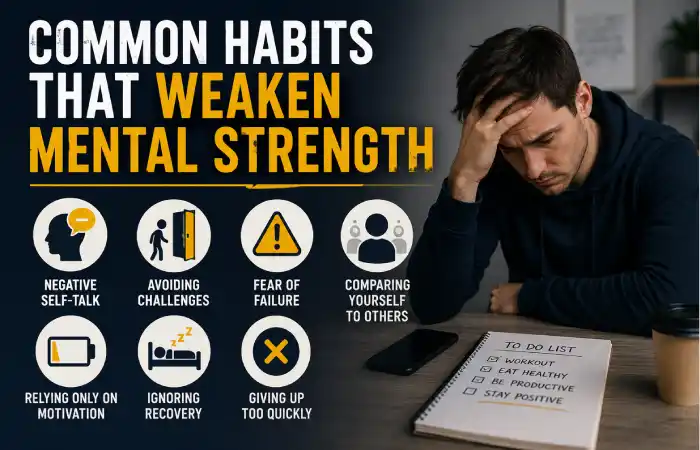
Building mental toughness isn’t only about developing good habits—it also requires identifying behaviors that slowly drain your confidence, resilience, and self-discipline. Many people unknowingly weaken their mental strength through everyday actions.
The good news is that these habits can be changed with awareness and consistent practice.
-
Negative Self-Talk
The way you speak to yourself influences your thoughts, emotions, and actions.
If your inner voice constantly says things like:
- “I’m not good enough.”
- “I always fail.”
- “I’ll never reach my goal.”
your brain begins to accept these statements as facts.
How to Fix It
Replace negative thoughts with realistic, encouraging ones.
Instead of:
❌ “I can’t do this.”
Say:
✅ “This is challenging, but I can improve with practice.”
Over time, positive self-talk builds confidence and resilience.
-
Avoiding Challenges
Staying inside your comfort zone feels safe, but it limits growth.
People who avoid difficult conversations, challenging workouts, or new opportunities often miss valuable learning experiences.
How to Fix It
Challenge yourself regularly.
Examples include:
- Trying a harder workout.
- Speaking during meetings.
- Learning a new skill.
- Taking on a leadership role.
- Setting bigger personal goals.
Small challenges gradually increase your confidence.
-
Fear of Failure
Many people avoid taking action because they’re afraid of making mistakes.
Unfortunately, avoiding failure also means avoiding growth.
Successful people don’t see failure as the opposite of success—they see it as part of the journey.
How to Fix It
Ask yourself:
- What can I learn from this?
- What’s the worst realistic outcome?
- Will this matter in a year?
Changing your perspective reduces fear and encourages action.
-
Comparing Yourself to Others
Social media makes it easy to believe everyone else is more successful, happier, or stronger.
Constant comparison can damage motivation and self-esteem.
Remember:
People usually share their highlights—not their struggles.
How to Fix It
Instead of comparing yourself to others, compare yourself to who you were last month or last year.
Focus on your own progress.
-
Relying Only on Motivation
Motivation changes from day to day.
If you only work when you feel motivated, you’ll struggle to stay consistent.
How to Fix It
Build routines instead of waiting for inspiration.
Examples:
- Exercise at the same time every day.
- Prepare meals in advance.
- Schedule focused work sessions.
- Follow a bedtime routine.
Habits reduce the need for constant motivation.
-
Ignoring Recovery
Many people believe they need to push themselves constantly to become mentally stronger.
In reality, recovery is an important part of growth.
Without enough sleep, rest, and relaxation, your ability to focus and manage emotions declines.
How to Fix It
Prioritize:
- 7–9 hours of quality sleep.
- Rest days from intense exercise.
- Time away from screens.
- Relaxation techniques like deep breathing or meditation.
A well-rested mind performs better under pressure.
-
Giving Up Too Quickly
Success rarely happens overnight.
People often quit because they expect immediate results.
Mentally tough individuals understand that meaningful progress takes time.
How to Fix It
Break large goals into smaller milestones.
Celebrate each achievement along the way.
Small victories build momentum.
Habits That Strengthen vs. Weaken Mental Toughness
| Strengthens Mental Toughness | Weakens Mental Toughness |
| Positive self-talk | Constant self-criticism |
| Consistent routines | Waiting for motivation |
| Learning from mistakes | Fear of failure |
| Accepting challenges | Avoiding discomfort |
| Healthy recovery | Ignoring rest |
| Patience | Expecting instant success |
| Personal growth | Comparing yourself to others |
Mental Toughness Exercises and Training Techniques
Mental toughness improves through regular practice, just like physical fitness. These exercises are simple enough for beginners while still being effective for experienced individuals.
One of the most practical ways to strengthen your mindset is through consistent mental toughness exercises that challenge your ability to stay focused, disciplined, and resilient.
-
Practice the “One More” Rule
Whenever you think you’re finished, challenge yourself to do just one more.
Examples:
- One more push-up.
- One more page of reading.
- One more minute of running.
- One more sales call.
- One more task before taking a break.
This teaches your brain that you can go beyond your perceived limits.
-
Set Daily Non-Negotiables
Choose a few habits you will complete every day, regardless of your mood.
Examples:
- Walk for 20 minutes.
- Drink enough water.
- Read for 15 minutes.
- Stretch before bed.
- Write in a journal.
Keeping these promises builds self-discipline.
-
Practice Mindfulness
Mindfulness trains you to focus on the present moment instead of worrying about the past or future.
Simple techniques include:
- Deep breathing for five minutes.
- Paying attention to your surroundings during a walk.
- Eating meals without distractions.
- Observing your thoughts without judging them.
These practices improve emotional control and concentration.
-
Use Visualization
Before an important event, imagine yourself succeeding.
Athletes often visualize:
- Crossing the finish line.
- Executing perfect technique.
- Remaining calm under pressure.
Visualization prepares your mind for real-life situations and increases confidence.
-
Keep a Progress Journal
Writing down your experiences helps you identify patterns and recognize improvement.
Each day, answer questions like:
- What challenge did I overcome today?
- What lesson did I learn?
- What can I improve tomorrow?
- What am I grateful for?
A journal provides evidence of your growth over time.
-
Build Emotional Awareness
Instead of reacting immediately, pause and ask yourself:
- What emotion am I feeling?
- Why do I feel this way?
- What’s the best response?
This habit helps you make thoughtful decisions rather than emotional ones.
-
Challenge Yourself Regularly
Every week, try something slightly outside your comfort zone.
Ideas include:
- Speaking to someone new.
- Learning a difficult skill.
- Taking on extra responsibility.
- Completing a challenging workout.
- Waking up earlier than usual.
Growth happens through repeated exposure to manageable challenges.
For athletes, developing mental toughness in athletes can help improve focus, confidence, consistency, and performance when facing pressure or setbacks.
Weekly Mental Toughness Challenge
| Day | Challenge |
| Monday | Complete your workout without checking your phone. |
| Tuesday | Do one task you’ve been avoiding. |
| Wednesday | Practice 10 minutes of mindfulness. |
| Thursday | Learn something new for 20 minutes. |
| Friday | Replace every negative thought with a constructive one. |
| Saturday | Try a new challenge outside your comfort zone. |
| Sunday | Reflect on the week’s lessons and plan the next week. |
How Athletes Develop Mental Toughness
Elite athletes are often admired for their physical abilities, but behind every great performance is a strong mindset.
Training the mind is just as important as training the body.
A structured mental toughness training routine can help you develop greater discipline, emotional control, focus, and confidence over time.
Here are some of the techniques successful athletes commonly use.
They Focus on the Process
Instead of obsessing over winning, athletes concentrate on the actions that lead to success.
For example, rather than thinking:
“I have to win this race.”
they focus on:
- Maintaining proper form.
- Controlling their breathing.
- Executing their training plan.
- Giving maximum effort.
Focusing on the process reduces pressure and improves performance.
They Accept Discomfort
Hard training sessions are physically and mentally demanding.
Mentally tough athletes understand that discomfort is temporary and often necessary for improvement.
Instead of avoiding difficult workouts, they embrace them as opportunities to grow.
They Build Consistent Routines
Elite performers rely on routines before competitions.
These routines may include:
- Warm-up exercises.
- Positive affirmations.
- Visualization.
- Controlled breathing.
- Listening to calming music.
Consistent routines reduce anxiety and improve focus.
They Learn From Every Performance
Whether they win or lose, successful athletes ask:
- What went well?
- What could I improve?
- What will I change next time?
This continuous feedback loop helps them improve with every competition.
They Stay Patient
Championship-level performance doesn’t develop overnight.
Athletes often train for years before achieving major success.
Their patience allows them to continue improving even when results are slow.
Lessons Everyone Can Apply
You don’t need to be a professional athlete to develop mental toughness.
Apply these principles in everyday life by:
- Staying consistent with healthy habits.
- Focusing on daily improvement.
- Viewing mistakes as learning opportunities.
- Practicing discipline instead of waiting for motivation.
- Celebrating small wins along the way.
Building the right habits of mentally strong people can make it easier to handle challenges, recover from setbacks, and maintain a positive mindset.
Mental toughness is built through repeated actions—not one big moment.
Frequently Asked Questions
Can mental toughness be learned?
Yes. Mental toughness is a skill that develops through consistent habits, self-discipline, emotional regulation, and learning from challenges. Anyone can improve it with regular practice.
How long does it take to build mental toughness?
There is no fixed timeline. Some people notice improvements within a few weeks of practicing healthy habits, while lasting mental resilience develops over months and years of consistent effort.
Is mental toughness the same as resilience?
Not exactly. Mental toughness helps you stay focused and perform under pressure, while resilience helps you recover after setbacks. Together, they create a strong and adaptable mindset.
Can exercise improve mental toughness?
Yes. Regular physical activity teaches discipline, persistence, stress management, and confidence. Many people find that consistent exercise strengthens both physical and mental resilience.
What are the best daily habits for building mental toughness?
Some of the most effective habits include:
- Exercising regularly.
- Getting enough sleep.
- Practicing mindfulness.
- Keeping promises to yourself.
- Using positive self-talk.
- Learning from mistakes.
- Stepping outside your comfort zone.
Why do mentally tough people still experience stress?
Mental toughness doesn’t eliminate stress. Instead, it helps people respond to stress in healthier and more productive ways.
Can children and teenagers develop mental toughness?
Absolutely. Encouraging responsibility, problem-solving, perseverance, and healthy coping skills from an early age helps young people build confidence and resilience that benefits them throughout life.
Final Thoughts
Mental toughness is one of the most valuable life skills you can develop. It influences how you respond to setbacks, handle pressure, and stay committed to your goals when motivation fades. More importantly, it is not reserved for elite athletes or high achievers—it is a skill that anyone can strengthen through consistent practice.
Remember that building mental toughness is a gradual process. You won’t become mentally stronger overnight, just as you won’t build physical fitness after a single workout. Every small action—keeping a promise to yourself, learning from a mistake, completing a challenging task, or choosing discipline over comfort—helps strengthen your mindset.
Instead of striving for perfection, focus on steady progress. Celebrate small victories, learn from setbacks, and keep moving forward even when the journey feels difficult.
Over time, these daily choices will help you become more resilient, disciplined, and confident—not only in fitness but in every area of your life.
Afiya Jafar is a fitness and wellness writer who focuses on making health, exercise, and healthy lifestyle information simple and practical. Her work covers workouts, fitness motivation, strength training, nutrition, weight management, stress management, mindfulness, and everyday wellness.
Read Full Bio of Afiya Jafar →
Sameena Begum reviews selected health, wellness, fitness, and digital content for clarity, factual presentation, consistency, and reader usefulness. Her review work helps maintain clear and responsible editorial standards across PhysicalFitt content.
Read Full Bio of Sameena Begum →
Dr. Khizrana Begum is a qualified medical professional with MBBS and MD qualifications and 5+ years of experience in the medical field. She works as a General Physician and Dermatologist, with expertise in general medicine, dermatology, preventive healthcare, and skin health.
Read Full Bio of Dr. Khizrana Begum →