
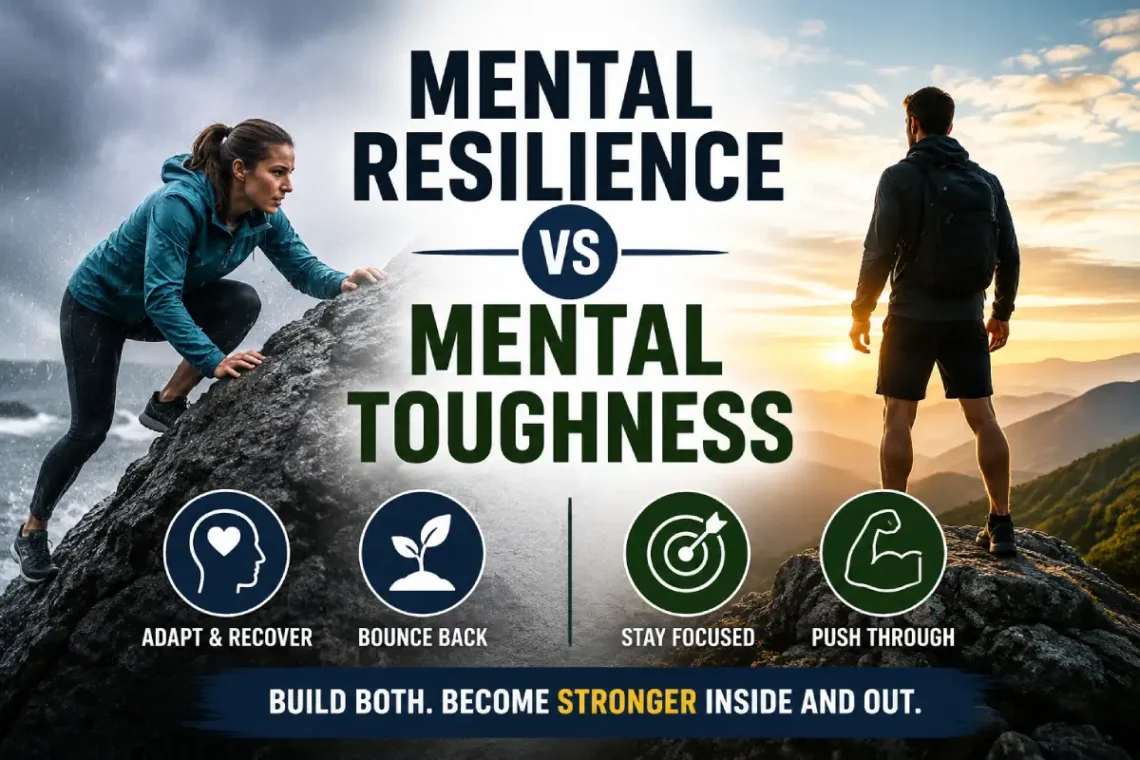
Resilience vs Mental Toughness
Here is an introduction to the resilience versus mental toughness distinction if you are looking to rebound from adversity, function in stress-filled environments, perform more consistently, and without disregarding your emotional health. Both are used somewhat informally at times, but the research into psychology and performance suggests they are similar and not interchangeable concepts.
In a nutshell, Mental toughness is doing what needs to be done even in the face of difficulty to accomplish your goal. Resilience is bending not breaking when things are out of your control. Here are 6 similarities and 12 differences … The best isn’t choosing one.
❝
This article is a part of
Mental Strength Hub
Definitions Explained
What Is Mental Resilience?
Mental resilience is ability to get up; bounce back; adapt; persevere against challenging, difficult situations, stress and loss.
American Psychological Association defines resilience as a process rather than a fixed characteristic or trait. It is the sum of many thoughts, behaviors, and actions that can be learned and practiced. The significant component of resilience is that one has to pass through stress, sadness, anxiousness or disappointment in order to be resilient.
As an example, if you failed to get a job. How resilience would looks like in this situation;
- Expressing disappointment
- Getting it in perspective
- Seeking support
- Rearranging your strategy
- Try again with revised approach
In this, it is quite clear resilience has its strong relations with flexibility, recuperation, emotion regulation, coping and learning.
What Is Mental Toughness?
Mental toughness typically refers to characteristics such as focus, confidence, persistence, a goal orientation, and motivation under circumstances that place an individual under pressure, encounter challenges, or face adversities.
It has been found to relate to the use of effective coping skills, mental well-being, work and school performance, and the presence of a range of positive attributes, even as its definition continues to be a topic of ongoing investigation.
Mental toughness could do the following for you:
- Continue studying when an exam becomes difficult
- Stay composed during a competitive event
- Finish a demanding workout
- Follow through on an important goal
- Maintain concentration when under pressure
Before comparing the two concepts, it helps to understand mental toughness and how it influences focus, discipline, confidence, and performance.
Key Differences
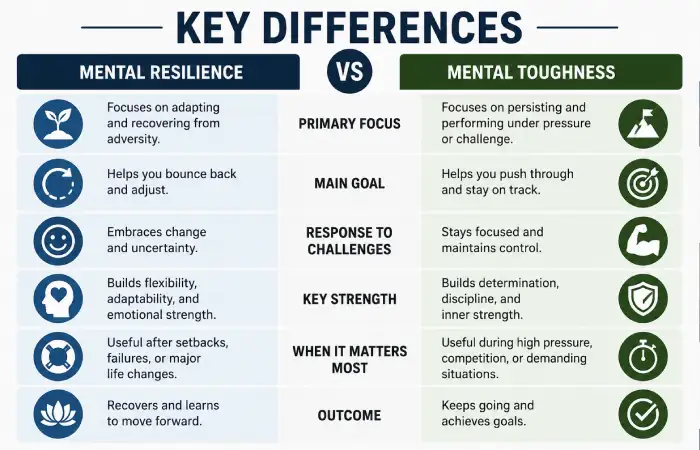
The easiest distinction is recovery versus performance under pressure.
| Factor | Mental Resilience | Mental Toughness |
| Primary focus | Adaptation and recovery | Persistence and performance |
| Typical question | “How do I recover from this?” | “How do I keep going?” |
| Strongest skill | Flexibility | Determination |
| Emotional response | Accepts and regulates emotions | Helps maintain focus despite discomfort |
| Setbacks | Learn, adapt, recover | Persist toward the objective |
| Pressure | Manage and adapt to it | Perform effectively through it |
| Long-term role | Supports sustainable well-being | Supports consistent goal pursuit |
| Best metaphor | A flexible tree bending in wind | An athlete staying focused during the final minutes |
The important overlap
These aren’t opposing traits.
A hardy individual might bounce back from setback, only to then exercise mental toughness in pursuit of an additional objective. Similarly, an individual with great mental toughness might be more equipped to withstand hardship during a tough experience and then recover from such.
A 2023 study of trail runners, however, more strongly emphasizes this association and simultaneously demonstrates that the mental toughness remains as a specialized psychological concept associated to sport.
Practical mental toughness exercises can help you develop the focus, emotional control, and perseverance associated with a stronger mindset.
Similarities
Both qualities can help people respond constructively to challenges.
They commonly involve:
Resilience: Do not immediately fall apart when things gets hard.
Self-control: Able to think of, feelings of attentiveness and also your actions can be kept to some degree, to manage.
Self-belief: Some prior achievements may make you feel you can, and are able, to get stuck in when challenged.
Adaptability: It is fairly easy to see how these qualities may enable us to develop more effective ways of dealing with the new circumstances.
Proactive behaviour: Both of these enable us to persist with behaviour which will be of use to us, at times when motivation would appear to falter.
There is also some evidence that indicates mental toughess will be linked with improved ways of coping as well as better outcomes (in both educational and health).
The difference becomes especially relevant when looking at mental toughness in athletes, where performing under pressure is a key part of competition.
When Each Matters Most
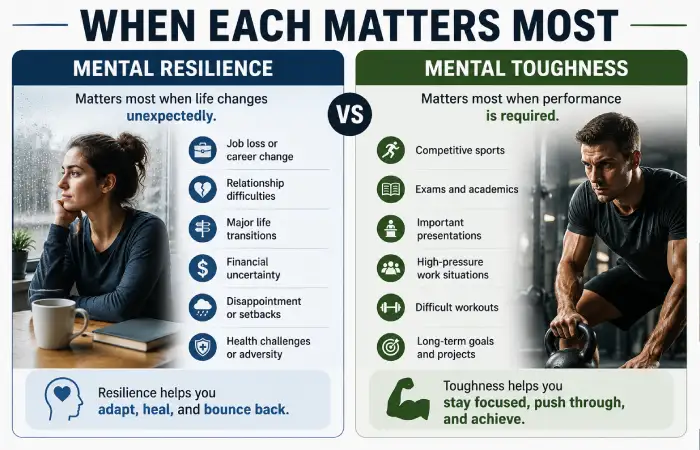
Mental resilience matters most when life changes unexpectedly
Resilience is particularly useful after:
- Failure or rejection
- Relationship difficulties
- Major life transitions
- Work or academic stress
- Financial uncertainty
- Disappointment
- Significant adversity
Its purpose isn’t to make you emotionally unaffected. Instead, it helps you process the challenge, adapt, and return to healthy functioning.
Mental toughness matters most when performance is required
Mental toughness can be especially useful during:
- Competitive sports
- Exams
- Presentations
- Difficult workouts
- Business challenges
- Long-term projects
- High-pressure decisions
Think of resilience as helping you regroup, while toughness helps you stay engaged with the task.
Structured mental toughness training can help people practice staying focused and composed while facing demanding situations.
How to Develop Both
You don’t need extreme challenges to develop psychological strength. Small, repeatable practices are more practical.
- Practice cognitive reframing
Instead of automatically thinking, “I failed, so I’m not capable,” ask:
“What does this experience teach me, and what can I do differently next time?”
This turns a setback into information.
- Train controlled discomfort
Train up toughness by taking the opportunity to engage in small, challenging feats: going for that scheduled gym session, reviewing the notes for your big lecture (phone strictly away), completing that crucial project and only then allowing yourself some fun.
The goal isn’t suffering, just learning there are more than two responses to a little bit of pain.
- Build recovery into your routine
Resilience requires recovery. Protect sleep, physical activity, social connection, relaxation, and time away from constant performance demands.
Some studies of resilience interventions are promising, although findings have been varied and have spurred ongoing calls for higher quality research with better longer term follow-up.
- Strengthen your support network
Resilience isn’t purely an individual achievement. Supportive relationships can be an important protective factor during adversity.
- Use process goals
Rather than focusing only on outcomes, identify actions you control.
Instead of:
“I must get the highest score.”
Try:
“I will study for 45 focused minutes and complete 20 practice questions.”
That approach develops both persistence and adaptability.
Developing the habits of mentally strong people can support both mental toughness and the ability to adapt constructively when circumstances change.
2026 Evidence Snapshot
There is no scientifically validated 2026 percentage score showing that one trait is universally “stronger” than the other. Treating them as competing scores would oversimplify the research.
| Evidence area | What current research supports |
| Resilience | Adaptation and recovery are learnable processes |
| Mental toughness | Associated with performance, coping and positive psychological characteristics |
| Training | Resilience interventions show potential, but evidence quality varies |
| Relationship | The concepts overlap but should not automatically be treated as identical |
| Best approach | Build recovery skills and goal-persistence skills |
The APA emphasizes that resilience can be learned, while systematic-review evidence suggests mental toughness is associated with useful coping and performance-related outcomes.
Important: The table above is an evidence summary, not a numerical “research score.” Avoid publishing invented percentages or graphs claiming that resilience is, for example, 40% more effective than toughness.
If your goal is to build mental toughness, consistent practice and exposure to manageable challenges can gradually improve your ability to handle pressure.
FAQs
Are mental strength and toughness different?
They overlap and correlate but define different aspects. Resilience involves flexibility, adapting and bounce back whereas mental strength often relates to the enduring self that persist focus and can continue performing despite high pressure conditions.
What better Resilience or mental strength?
None are universally superior. Resilience is required to bounce back and then be ready to tackle another adversity. The mental tougher enduring person continues in the challenge though a setback may hit.
Is there people mentally toughed but not resilient?
Yes. Many could continue their mission despite intense pressure but would break afterwards. Psychological health should involve an ability to pull back to recover and adapt rather than push or persist forever.
How many time to improve mental resilience?
There is no rule on time for improving Mental Resilience, but through overcoming the difficult situation repetitively with effective dealing strategies, stable social connection and positive lifestyle patterns.
Can mental tougness be learned?
Yes researchers find that mental toughhess relate to psychological skill or trait that can be learned.
However, they may be different views of different people and how to measure it still being argued by scientists or clinicians.
Troubleshooting: Why Your Mental Strength Training May Not Work
Problem: “I keep pushing through everything.”
Possible issue: You may be confusing toughness with ignoring recovery. Add rest, emotional processing, and support.
Problem: “I give up after one failure.”
Possible issue: Build smaller process goals and practice responding to setbacks without judging yourself.
Problem: “I feel like I must never show emotion.”
Possible issue: Emotional suppression isn’t the definition of resilience. Resilience includes adapting to difficult emotions rather than pretending they aren’t there.
Problem: “I keep setting huge goals but don’t follow through.”
Possible issue: Break the goal into measurable daily actions and track consistency rather than relying on motivation.
Final Takeaway
Ultimately the mental resilience vs. Mental toughness question best answer is: they help each other out.
Resilience helps you bend without breaking and bounce back from challenging situations and adversity while mental toughness helps you stick to the plan and purposeful activity, as the temptation is there to bail out!
So don’t plan to become immune to pressure over time. Plan instead to learn to adapt, to bounce back and bounce forward effectively.

Sameena Begum
Sameena Begum has a broad interest in technology, beauty, health, fitness, wellness, lifestyle, and consumer topics. She values clear, accurate, and practical information and pays close attention to details, readability, and relevance.
Read full bio of Sameena Begum
Afiya Jafar
Afiya Jafar is a fitness and wellness writer who focuses on making health, exercise, and healthy lifestyle information simple and practical. Her work covers workouts, fitness motivation, strength training, nutrition, weight management, stress management, mindfulness, and everyday wellness.
Read full bio of Afiya Jafar