
 Afiya Jafar
Fitness & Wellness Writer
Afiya Jafar is a fitness and wellness writer who focuses on making health, exercise, and healthy lifestyle information simple and practical.
Read Full Bio of Author →
Afiya Jafar
Fitness & Wellness Writer
Afiya Jafar is a fitness and wellness writer who focuses on making health, exercise, and healthy lifestyle information simple and practical.
Read Full Bio of Author →
 Sameena Begum
Health, Fitness & Digital Content Reviewer
Sameena reviews selected health, wellness, fitness, and digital content for clarity, factual presentation, and reader usefulness.
Read Full Bio of Reviewer →
Sameena Begum
Health, Fitness & Digital Content Reviewer
Sameena reviews selected health, wellness, fitness, and digital content for clarity, factual presentation, and reader usefulness.
Read Full Bio of Reviewer →
Yoga poses are movements that you make with your body to improve mobility, strength, balance, body awareness, breathing, and relaxation. You don’t need to already be flexible, strong, or a yoga-pro. Many of the basic yoga poses can be modified for beginners, low mobility, varying body sizes and levels of fitness.
The point isn’t to make your body do the picture in the magazine. It’s to learn to move with control, breathe calmly and select a variation of each movement that feels difficult but not painful. Here we’ll cover the biggest category of yoga movements, options for newbies, ways to strengthen and loosen up, cool-down postures, typical problems, tools to use, how to be safe, and a practical day-to-day routine that actually works.
❝
This article is a part of
Yoga Hub
What Are Yoga Poses?
Yoga postures Yoga poses, or asana, are a set of physical stances commonly practiced during yoga. Modern practices tend to pair these poses with breath work and meditation – though yoga is much more than just a series of exercises. Today’s yoga usually incorporates poses, breathing exercises and meditation, according to NCCIH.
Though, this varies: Any pose doesn’t just involve stretching just one muscle.
While holding an asana or following the practice, some focus may be placed on:
- Joint mobility
- Muscular endurance
- Balance
- Coordination
- Posture
- Core stability
- Flexibility
- Breathing awareness
- Concentration
- Relaxation
Similarly poses have different levels of complexity. A relatively simple Mountain pose gives us the basics of correct alignment and the awareness of the body whereas a single Leg balances needs so much body control. Backbends require even more flexibility, mobility, control, technique and preparedness!
This brings us to the more relevant concept – progressing and not just increasing the degree of complex of yoga pose. It isn’t necessary to take up the hardest possible form of a Pose to get any Yoga benefits!
If your goal is to improve your range of motion and reduce stiffness, incorporating gentle stretching and mobility-focused poses can make your practice more effective. For a more focused routine, explore these yoga poses for flexibility.
Benefits of Practicing Yoga Poses
Yoga has been researched for many other physical and mental health outcomes. There is existing evidence that suggests that appropriate use of yoga may help reduce stress, increase mental well-being, improve sleep and improve balance and can help manage some types of pain. NCCIH also reports on evidence suggesting benefits for other issues that include low-back pain, neck pain, headaches, knee osteoarthritis, and anxiety and depressive symptoms.
Yoga can also be adapted to support comfortable movement when dealing with back stiffness or certain types of low-back discomfort. If you want a routine focused specifically on this area, see these yoga poses for back pain.
-
Better flexibility and mobility
Regular practice increases ease within movement capacity you already have. Hip opening poses, forward folds, twists and shallow backbends present your body with movement options likely absent in modern, desk-driven living.
There are no “right” shapes, you should not be trying to force yourself into any particular shape and a successful yoga practice is one that stretches gently beyond where you already are comfortable to and expands it steadily.
-
Improved balance
Trying to balance while you’re standing on one leg – and constantly switching sides, controlling your center of balance, trying not to fall – helps your body improve in terms of coordination and balance. “Yoga provides balance poses that start very simply, like Tree Pose, for instance, and become much more complex as you continue.
A 2025 systematic review of randomized trials also showed promising results for the impact of yoga on fall rates, bone health and balance as far as healthy older adults were concerned.
-
Strength and muscular endurance
Yoga can make muscles work without conventional weights.
Plank challenges the core and upper body. Chair Pose challenges the legs. Warrior poses require lower-body endurance. Bridge Pose engages the glutes and posterior chain.
This does not mean that yoga must always equate to progressive resistance training. If the primary aim is maximal strength or significant muscle hypertrophy, more specific resistance training might be beneficial.
-
Stress management
Yoga’s combination of movement, controlled breathing and attention may help reduce perceived stress.
A 2026 systematic review and meta-analysis of 30 controlled trials of 2,288 participants demonstrated that yoga provided similar benefits for stress, anxiety and depression scores versus controls, although the evidence was found to be of low quality. These findings are encouraging, but do not substitute for professional mental health care.
-
Body awareness
Yoga encourages you to notice:
- How your feet contact the floor
- Where you are holding tension
- Whether you are gripping your jaw or shoulders
- How your breathing changes
- How a movement feels from one side to the other
That awareness can be more valuable than achieving a visually impressive pose.
-
Support for healthy movement
A regular practice may give you more opportunities to move joints through comfortable ranges, build muscular endurance and practice controlled transitions.
The goal is not to perform yoga perfectly. The goal is to create a sustainable movement habit.
Understanding the Different Types of Yoga Poses
Instead of memorizing dozens of Sanskrit names, start by understanding what each pose category asks your body to do.
| Pose category | Primary challenge | Examples | Beginner level |
| Standing | Strength and stability | Mountain, Warrior II | Easy–moderate |
| Seated | Mobility and posture | Easy Pose, Staff Pose | Easy |
| Balancing | Coordination and control | Tree Pose | Easy–moderate |
| Backbend | Spinal extension and front-body opening | Cobra, Bridge | Easy–moderate |
| Twist | Rotational movement | Seated Twist | Easy–moderate |
| Forward bend | Posterior-chain mobility | Forward Fold | Easy–moderate |
| Hip opening | Hip mobility | Butterfly, Low Lunge | Easy–moderate |
| Restorative | Relaxation and recovery | Child’s Pose, supported poses | Easy |
Difficulty is individual. A pose classified as beginner-friendly can still be inappropriate in its full expression for someone with a current injury, limited mobility or poor balance.
Essential Yoga Poses for Beginners
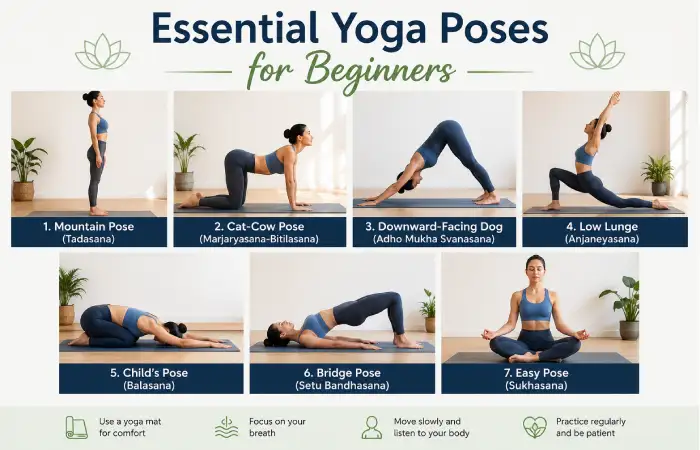
If you are completely new, start with a small group rather than trying to learn 30 poses in one session.
Mountain Pose — Tadasana
Mountain Pose is one of the simplest foundational standing positions.
How to do it:
- Stand with your feet comfortably positioned.
- Keep your knees soft rather than aggressively locking them.
- Let your shoulders relax away from your ears.
- Lengthen through the crown of your head.
- Keep your gaze relaxed.
- Breathe slowly and evenly.
Focus on: posture, grounding and body awareness.
Do not treat Mountain Pose as “just standing.” It teaches you how to stack and stabilize your body before more complicated standing poses.
Standing poses are useful for building balance, body awareness, leg strength, and stability while giving you a variety of ways to practice outside of seated or floor-based movements. Explore these standing yoga poses for a dedicated sequence.
Cat-Cow — Marjaryasana-Bitilasana
Cat-Cow is a gentle movement between spinal flexion and extension.
How to do it:
- Start on hands and knees.
- Place hands approximately under the shoulders.
- Place knees comfortably beneath the hips.
- As you inhale, gently move toward the cow position.
- As you exhale, gently round the spine toward the cat position.
- Move slowly rather than forcing the range.
This is particularly useful as a warm-up because it introduces controlled spinal movement.
Child’s Pose — Balasana
Child’s Pose is commonly used as a resting or recovery position.
How to do it:
- Begin kneeling.
- Bring your hips toward your heels as comfortable.
- Fold your torso forward.
- Extend your arms or rest them alongside your body.
- Let your breathing become relaxed.
If your hips do not comfortably reach your heels, place a folded blanket or bolster underneath your hips.
Downward-Facing Dog — Adho Mukha Svanasana
Downward-Facing Dog combines shoulder, hip and posterior-chain movement.
Beginner technique:
- Start on hands and knees.
- Press firmly through your hands.
- Lift your knees and move your hips upward and backward.
- Keep your knees slightly bent if your hamstrings feel tight.
- Allow your spine to lengthen.
- Avoid forcing your heels toward the floor.
A common beginner mistake is prioritizing straight legs over spinal position.
Bridge Pose — Setu Bandhasana
Bridge Pose can strengthen the glutes and posterior chain while introducing a gentle backbend.
- Lie on your back.
- Bend your knees and place your feet on the floor.
- Keep feet comfortably separated.
- Press through the feet.
- Lift your hips gradually.
- Keep the movement controlled.
- Lower slowly.
Stop if you experience sharp pain in the back, neck or knees.
Beginner starting sequence
A simple sequence can be:
Mountain → Cat-Cow → Downward Dog → Low Lunge → Child’s Pose → Bridge → Easy seated breathing
You don’t need a complicated 60-minute flow to begin.
Standing Yoga Poses
Standing poses are useful for building strength, balance, coordination and confidence.
Warrior I — Virabhadrasana I
Warrior I combines a standing lunge position with an upright torso and active legs.
Key focus: stable feet, controlled knee position and a comfortable hip position.
Avoid forcing your front knee into a specific angle simply because you have seen it in a photograph.
Warrior II — Virabhadrasana II
Warrior II challenges the legs while requiring the torso to remain controlled.
Beginner cue: Keep the front knee tracking generally in the direction of the toes rather than allowing it to collapse inward.
Triangle Pose — Trikonasana
Triangle Pose introduces lateral movement and challenges the legs, hips and torso.
Use a yoga block under the lower hand if reaching the floor causes you to rotate or collapse.
Chair Pose — Utkatasana
Chair Pose resembles sitting into an imaginary chair.
It can challenge the quadriceps, glutes and core.
Modification: Reduce the depth of the squat. You do not need to lower as far as possible.
Seated Yoga Poses
Seated poses can make it easier to focus on breathing, spinal position and controlled mobility.
Easy Pose — Sukhasana
A comfortable cross-legged seated position is commonly used for breathing and meditation.
If sitting on the floor causes your lower back to round heavily, sit on a folded blanket, cushion or yoga bolster.
Staff Pose — Dandasana
Sit with the legs extended forward and work on maintaining an upright torso.
Do not force the legs completely straight if doing so causes discomfort.
Seated Forward Bend — Paschimottanasana
This pose emphasizes the back of the legs and posterior chain.
The goal is not to touch your forehead to your knees.
Instead, hinge from the hips while maintaining comfortable breathing.
Seated Spinal Twist
A gentle seated twist can help you practice controlled spinal rotation.
Avoid aggressively pulling yourself deeper using your arms. Let the rotation remain comfortable and controlled.
If you prefer a lower-impact starting point, seated poses provide a stable base for working on mobility, posture, breathing, and flexibility. Learn more with these seated yoga poses for beginners.
Balancing Yoga Poses
Balance improves through practice, not through forcing yourself to remain perfectly still.
Tree Pose — Vrikshasana
- Stand tall.
- Shift your weight onto one foot.
- Place the other foot against the ankle or inner leg where comfortable.
- Keep your gaze on a stable point.
- Use a wall or chair if needed.
- Switch sides.
Important: Avoid placing the foot directly against the side of the knee joint.
Beginner balance progression
Try:
Two-foot standing → supported one-foot balance → Tree Pose with support → Tree Pose without support → more challenging variations
There is no benefit in skipping the progression just to reach a harder pose sooner.
Backbend Yoga Poses
Backbends involve spinal extension and should be approached gradually.
Cobra Pose — Bhujangasana
Lie on your stomach with your hands near the shoulders.
Lift the chest gently while keeping the movement controlled.
You do not need to straighten your arms or create a dramatic arch.
Sphinx Pose
Sphinx is a gentler alternative to a deeper cobra.
Support your upper body on your forearms and focus on comfortable chest opening rather than maximizing spinal extension.
Bridge Pose
Bridge can be a useful beginner-friendly introduction to backbending while also training the glutes and posterior chain.
Common mistake: pushing into the pose simply because you can lift your hips higher.
More range is not automatically better.
Twisting Yoga Poses
Twists should feel controlled rather than forced.
Seated Spinal Twist
Sit comfortably and rotate your torso gradually.
Keep the movement within your available range.
Supine Spinal Twist
Lie on your back and allow one bent knee to move across your body.
Use a folded blanket under the knee if it does not comfortably reach the floor.
Do not aggressively push the knee downward.
Twisting is one area where beginners often confuse intensity with effectiveness.
Forward Bend Yoga Poses
Forward bends commonly target the posterior chain, including the hamstrings and back of the body.
Standing Forward Fold — Uttanasana
From standing, hinge at the hips and let the upper body move forward.
Bend your knees as much as necessary.
Beginner priority: lengthen through the spine rather than trying to place your hands flat on the floor.
A block can bring the floor closer to you.
Seated Forward Bend
The same principle applies when seated: prioritize controlled hip movement and comfortable breathing over maximum depth.
Hip Opening Yoga Poses
“Hip opening” is a broad yoga term. It can involve different combinations of hip flexion, extension, rotation and abduction.
Butterfly Pose — Baddha Konasana
Bring the soles of your feet together and allow your knees to move outward.
Do not press aggressively on your knees.
Low Lunge
A low lunge can create a useful hip-flexor stretch.
Keep your front foot stable and adjust your stance until the position feels controlled.
Pigeon Pose
Pigeon can be much more demanding than it looks.
Beginners should not force the front leg into a particular angle. Use support under the hip if needed, or choose a gentler figure-four variation while learning.
Restorative Yoga Poses
Restorative positions emphasize comfort, support and relaxation rather than intensity.
Examples include:
- Child’s Pose
- Supported Child’s Pose
- Legs-Up-the-Wall
- Supported Reclined Bound Angle
- Constructive Rest
- Gentle Supine Twist
The objective is different from a strength-focused session.
You are not trying to “push through.”
Instead, use props to make the position sustainable and let your breathing settle.
Yoga Poses for Strength and Flexibility
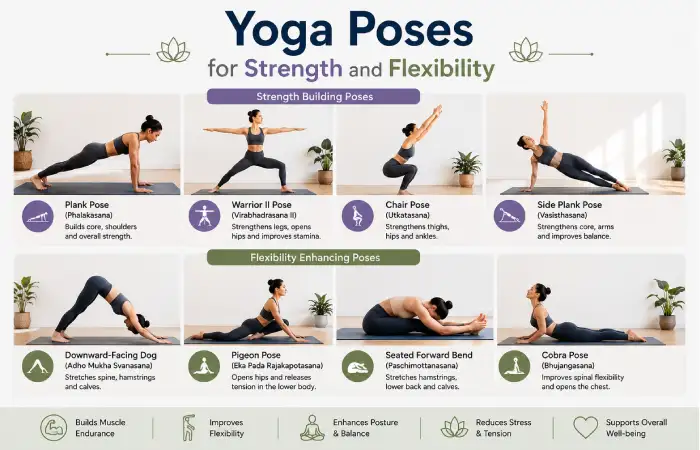
Yoga can train both strength and flexibility, but the training effect depends on the pose, style, duration, progression and individual.
| Goal | Useful poses | What they emphasize |
| Core endurance | Plank, Side Plank | Trunk stability |
| Leg strength | Chair, Warrior I, Warrior II | Lower-body endurance |
| Glute strength | Bridge | Hip extension |
| Shoulder strength | Plank, Downward Dog | Upper-body support |
| Hamstring mobility | Forward Fold, Seated Forward Bend | Posterior-chain flexibility |
| Hip mobility | Low Lunge, Butterfly | Hip movement |
| Spinal mobility | Cat-Cow, gentle twists | Controlled spinal movement |
| Balance | Tree, supported Warrior variations | Stability and coordination |
Strength vs. flexibility: what should you prioritize?
If you are new to yoga, you don’t need to choose one.
A balanced practice can contain:
- A standing strength pose
- A balance pose
- A mobility-focused pose
- A gentle backbend
- A relaxing finishing pose
For people seeking significant muscle growth or maximum strength, yoga can complement rather than replace progressive resistance training.
Yoga Poses for Stress Relief and Relaxation
Stress-relief sessions should usually feel calmer than strength-focused sessions.
Try:
- Child’s Pose
- Cat-Cow
- Seated breathing
- Gentle seated twist
- Supported forward fold
- Legs-Up-the-Wall
- Savasana
A 2026 meta-analysis found beneficial effects of yoga interventions on stress, anxiety and depression measures, although the researchers rated the overall evidence as low-level.
That makes yoga a potentially useful complementary wellness practice, not a replacement for medical or psychological care when it is needed.
Beyond physical benefits, yoga can combine movement, controlled breathing, relaxation, and mindful awareness to help manage everyday stress. For a calmer practice, try these yoga poses for stress relief.
A simple 10-minute relaxation sequence
| Time | Pose |
| 1 minute | Comfortable seated breathing |
| 2 minutes | Cat-Cow |
| 2 minutes | Child’s Pose |
| 2 minutes | Gentle seated twist |
| 2 minutes | Legs-Up-the-Wall |
| 1 minute | Relaxed breathing |
Move slowly and avoid turning relaxation into another performance challenge.
Common Mistakes to Avoid During Yoga Practice
- Trying to copy advanced poses immediately
Instagram and social media often show highly flexible practitioners performing advanced positions.
That is not a sensible benchmark for a beginner.
- Forcing flexibility
Stretching should not become a competition.
A strong pulling sensation may occur, but sharp pain is a reason to stop and reassess.
- Holding your breath
Breathing should generally remain steady.
If you cannot breathe comfortably, the pose may be too intense or poorly adjusted.
- Locking your joints
Beginners sometimes aggressively straighten elbows and knees.
Instead, think about active stability without excessive joint locking.
- Ignoring asymmetry
One side may be more mobile than the other.
Do not force the tighter side to match the more flexible side immediately.
- Chasing perfect alignment
Alignment is useful, but bodies differ.
A useful instruction should help you move safely and comfortably rather than force every person into exactly the same shape.
- Staying in painful positions
Yoga is not supposed to be a test of how much discomfort you can tolerate.
Sharp, severe, worsening or unusual pain deserves attention.
- Progressing too quickly
If a beginner struggles with basic balance, jumping directly into an advanced inversion is unnecessary.
Build the foundation first.
How to Create a Daily Yoga Pose Routine
A daily routine does not have to be long.
Consistency usually matters more than creating an elaborate sequence you will abandon after a week.
10-minute beginner routine
Minute 1: Mountain Pose + breathing
2–3: Cat-Cow
3–5: Downward Dog with gentle movement
5–6: Low Lunge, right side
6–7: Low Lunge, left side
7–8: Bridge Pose
8–9: Child’s Pose
9–10: Comfortable seated breathing
20-minute balanced routine
Warm up with Cat-Cow and gentle movement.
Then perform:
- Mountain Pose
- Warrior I
- Warrior II
- Triangle
- Downward Dog
- Low Lunge
- Tree Pose
- Bridge
- Supine Twist
- Child’s Pose
- Savasana
Do not worry about completing every pose every day.
Yoga Equipment: What Do You Actually Need?
You can begin yoga with very little equipment, but a few accessories can make practice more comfortable and adaptable.
Yoga mat comparison
| Mat type | Advantages | Possible drawbacks | Best for |
| PVC | Durable, often good grip | Less eco-focused | Regular home practice |
| TPE | Lightweight, cushioning options | Durability varies | Beginners and home users |
| Natural rubber | Good grip and cushioning | Latex sensitivity may matter | Grip-focused practice |
| Cork surface | Often firm and textured | May feel different when dry | Sweaty practice / stability |
| Travel mat | Lightweight and portable | Usually thinner | Frequent travelers |
Buying tip: Do not automatically choose the thickest mat. Very soft cushioning can sometimes make balancing poses feel less stable.
Yoga blocks
Blocks can bring the floor closer to you.
For example, instead of forcing your hand to reach the floor during Triangle Pose, place your hand on a block.
That is not “cheating.”
It is a modification.
Yoga strap
A strap can help with positioning and reach without forcing the body.
It can be useful for mobility exercises, seated stretches and poses where the hands do not comfortably meet.
Yoga bolster
Bolsters are particularly useful for restorative yoga.
They provide support that allows you to relax into a pose instead of actively holding yourself there.
What should a beginner buy?
If your budget is limited:
Priority 1: Yoga mat
Priority 2: Two blocks
Priority 3: Strap
Priority 4: Bolster
You do not need an expensive setup to start practicing.
Yoga Safety Tips for Beginners
Most healthy people who practice yoga appropriately can do so safely, but it is a physical activity and injury is a possibility. Sprains and strains are listed by NCCIH as some of the commonest yoga injuries, and taking instruction is recommended especially while a novice.
Follow these principles:
Start gradually
Do not start off at the high-intensity inversions, deep backbends, or intense stretching activities.
Warm up
Do gentle movements before the demanding postures.
Respect pain
Discomfort and effort are not the same thing as injury pain.
Use props
Blocks, straps, blankets and bolsters are tools for adaptation.
Don’t compete
Yoga is an individual practice.
Your pose does not need to resemble someone else’s.
Be cautious with medical conditions
People who have an injury or health condition of any significance, the elderly, and pregnant women might need personal modifications. The NCCIH recommends that individuals in these groups work with their health care provider and possibly their Yoga instructor if necessary, when there’s a need.
Choose instruction carefully
If you have little prior experience of yoga, you might prefer to have an instructor show you how to do the positions and adapt the stances if you struggle.
Be especially cautious with advanced poses
Treat it like as an as an option of asana at most. Extreme spinal positions and breath work in addition to head stands and shoulder stands are not, again to repeat, the realm of an entry level trainee. Head stand and shoulder stand especially have been named by NCCIH as activities not to be tried by a novice yogi.
Once you have developed sufficient strength, mobility, balance, and body awareness, you can gradually progress toward more challenging movements. See these advanced yoga poses for safe progressions and preparation tips.
Frequently Asked Questions About Yoga Poses
What are the best yoga poses for beginners?
These are great places to start: poses such as mountain pose, cat/cow poses, child’s pose, downard facing dog, bridge and a comfortable seat pose. Simple poses, focused breath and modifications are better for beginners than complicated poses.
How many yoga poses do I need to do every day?
There are no poses mandated to practice every day. Five or six thoughtfully selected poses and simple breathing could be all that is needed for your 10 minute practice.
Should beginners be able to do yoga everyday?
Depending on the health of the person practicing, yoga should be able to practice most days. Intensity should be varied from easier, relaxing sessions to more invigorating sessions.
Can yoga improve flexibility?
Yes, this is definitely possible and you should observe an improvement in your flexibility and mobility the more that you practice yoga. The rate of this improvement can vary in each individual.
Which poses will help with stress?
Try Child’s pose or Cat-Cow or using Yoga to help stress: A number of research articles found that yoga poses help relieve stress. Some poses that are beneficial in this way include yoga poses like; chair, downward dog, happy baby poses. I’m an enormous proponent of yoga!
Which yoga poses are best for strength?
However, don’t overdo it as you could get hurt if you try advanced poses you are not at level to achieve as yet. When Yoga Can Benefit a Healthy Being. The average woman can take care of most health problems from having too much estrogen, yet can yoga heal an overactive woman?
Do I need yoga mat?
However, as a beginner, one should have a yoga mat, especially since yoga can prevent an injury. I’ll make a short yoga mat with my yoga pose book. I’ll show her all my favorite pose(as an advanced practicer). It helped strengthen body not muscle but in the other way?
Are yoga blocks necessary?
They are not needed if you can already achieve some common Yoga Asanas but would significantly benefit any beginner. Having yoga blocks and having basic knowledge of what your trying achieve when you hold any given poses can have a huge impact over any other method I’ve heard of that would assist some-one.
Is yoga safe for everyone?
No pose will always be safe to do by every practitioner, so take advice and get your poses right. Not all will feel natural but if we’ve never experienced such a pose then it will take getting use to or getting advice. When I tried some poses myself I struggled at first but they eventually became naturally easier to hold.
Can yoga replace strength training?
However if all they want are basic fitness this is adequate but a serious trainer who intends building significant muscles mass/ strength should consider adding training with weighted external devices, e.g. Weightlifting bars and the likes, and even using resistance bands.
What should I do if I cannot perform a yoga pose correctly?
Modify it, as that is the practice of yoga in its purest form, I’ll show you all ofmy favorite Yoga Asnas for beginner yogis in the new article soon. Practice poses using an easier modifier version that your current strength allows or work on them in a relaxed setting. There’s absolutely no obligation for to stretch so much it hurts. Yoga postures may not make everybody look the way they should be.
Final Takeaway
The most impressive yoga poses aren’t the best. From your first practice on the floor, the premise is much simpler: How to breathe with control and stand tall, balance and wobble, bend, twist and strengthen with controlled effort, finally soften and rest when it’s time to let go. Take on a few pose fundamentals first, then the world of yoga unfolds by standing, seated, balancing, and backbending, and more.
Modify your movement; don’t force a posture.
The better you, your yoga instructor, and you’re peers understand your capabilities as each asana or posture flows into the next, as to progress further from that foundation. When you’re making yoga more than an activity, and you choose it as part of life’s well-lived road to better well-being, understanding all about what good, and what may eventually just become some cool pretzel positions that won’t do much for you besides maybe get the good camera pics or become a source of injury.
Afiya Jafar is a fitness and wellness writer who focuses on making health, exercise, and healthy lifestyle information simple and practical. Her work covers workouts, fitness motivation, strength training, nutrition, weight management, stress management, mindfulness, and everyday wellness.
Read full bio of Afiya Jafar
Sameena reviews selected health, wellness, fitness, and digital content for clarity, factual presentation, and reader usefulness.
Read full bio of Sameena Begum