
 Afiya Jafar
Fitness & Wellness Writer
Afiya Jafar is a fitness and wellness writer who focuses on making health, exercise, and healthy lifestyle information simple and practical.
Read Full Bio of Author →
Afiya Jafar
Fitness & Wellness Writer
Afiya Jafar is a fitness and wellness writer who focuses on making health, exercise, and healthy lifestyle information simple and practical.
Read Full Bio of Author →
 Sameena Begum
Health, Fitness & Digital Content Reviewer
Sameena reviews selected health, wellness, fitness, and digital content for clarity, factual presentation, and reader usefulness.
Read Full Bio of Reviewer →
Sameena Begum
Health, Fitness & Digital Content Reviewer
Sameena reviews selected health, wellness, fitness, and digital content for clarity, factual presentation, and reader usefulness.
Read Full Bio of Reviewer →
Yoga for Flexibility will allow you to move easier with less stiffness whether it’s from lack of use or sitting in a desk for 8 hours straight. You just have to get started and you don’t have to be bornflexible! Yoga actually modifies your current ability whether it’s by a blocks, cushion, strap or nothing at all.
Although connected flexibility and mobility aren’t quite the same thing. Mobility has to do with your capacity of movement while flexibility relates to the degree of distance your joint/muscles extend to move. This Yoga for Flexibility will require active movement, holding poses, utilizing strength and maintaining consistency-not jamming yourself into awkward positions.
❝
This article is a part of
Yoga Hub
How Yoga Improves Flexibility
Yoga pairs repetitive movements, sustained stretches, breath-work, and Body awareness to help you feel more comfortable with a greater range of motion over time. A study in an Older Adult population suggested positive impacts to Spinal flexibility following 3 months of weekly 60-minute sessions including a wellrounded and Integrated yoga program.
There’s recent evidence as well including improved shoulder Flexibility and a greater range of Motion among women recovering from breast cancer treatment a following an extensive 12 week Yoga study! The key takeaway is that yoga can impact your life in meaningful ways even at accessible levels. Practice consistently but safely to reap yoga rewards!
Flexibility is an important part of a balanced yoga practice, but different poses can support different goals such as strength, balance, mobility, and relaxation. Explore our complete collection of yoga poses to find movements that fit your practice.
Best Yoga Poses for Tight Muscles
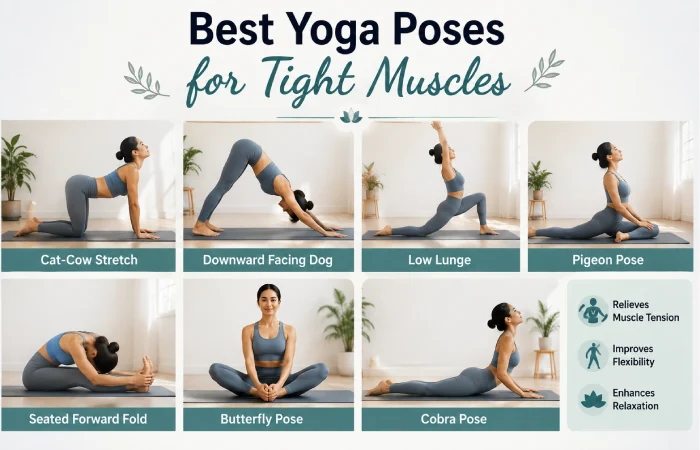
You don’t require scores of poses to begin with, instead prioritize movements which include working those particularly tight spots; hamstrings, hips, chest and back, not to mention shoulders.
| Yoga pose | Beginner approach | Main area |
| Cat-Cow | Move slowly with your breathing | Spine and upper back |
| Downward-Facing Dog | Keep knees bent if necessary | Hamstrings, calves, shoulders |
| Low Lunge | Place hands on blocks | Hip flexors and thighs |
| Standing Forward Fold | Bend the knees rather than forcing straight legs | Hamstrings and back |
| Butterfly Pose | Sit on a cushion for support | Inner thighs and hips |
| Cobra Pose | Use a gentle lift instead of pushing high | Front body and spine |
| Seated Forward Fold | Use a strap around the feet if needed | Hamstrings and back |
A few of these movement patterns are also included in Heathline and they explain we should make the depth and poses suit our flexibility level rather than forcing them.
Flexibility work doesn’t have to be limited to seated or floor-based movements. Adding standing yoga poses to your practice can help combine flexibility with balance, stability, and body awareness.
A simple beginner sequence
Begin with about a minute of Cat-Cow Pose to awaken the spine then do a Low Lunge on each side, before transitioning into Downard Dog, ending your session with the help of butterfly pose and a nice Seated Forward Fold. The 20 to 30 second static holds (when just learning how to feel the tension just enough-a good pulled sensation-NOT PAINFUL-will serve you well).
Stretching Safely
Training must push your range of motion but not cause pain. Do not bounce, jerk, or forcefully extend beyond your current limitations.
The American Heart Association advises that a mild pulling sensation can be normal, whereas sharp or stabbing pain or joint pain is a signal to stop. It also recommends avoiding locked joints during flexibility exercises.
A useful rule is “comfortable tension, not pain.” If you cannot maintain controlled breathing, you may be stretching too aggressively.
Beginners can also use yoga props strategically:
| Equipment | Best use | Value for beginners |
| Yoga mat | Grip and cushioning | Essential |
| Yoga blocks | Bring the floor closer | Very useful |
| Yoga strap | Extend your reach | Useful for hamstrings and shoulders |
| Cushion/bolster | Support seated poses | Useful for tight hips |
Seated positions can be particularly useful when incorporating gentle stretches into a flexibility routine. You can explore these seated yoga poses for movements that emphasize mobility and controlled stretching.
Compare equipment! Products. If you have suffered a significant injury, have a condition you need professional treatment for, or a high level of pain, please seek appropriate advice from your health care professional or an appropriately trained yoga instructor prior to attempting this deeper form of stretching.
Improving flexibility can help support comfortable movement and mobility throughout the body. If you’re specifically looking for movements that focus on the back, explore these yoga poses for back pain.
Weekly Flexibility Routine
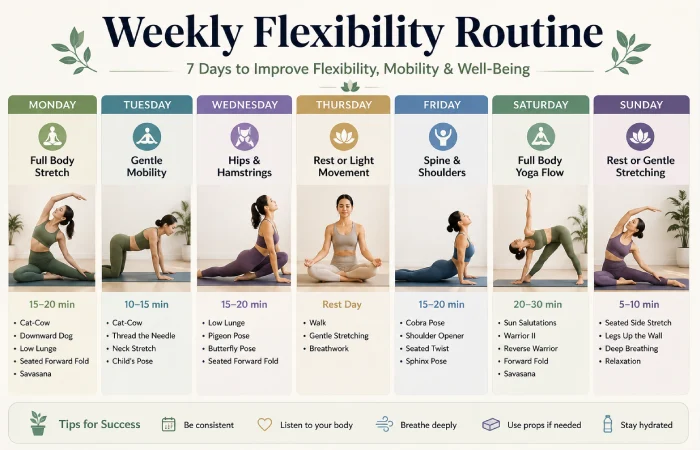
Consistency matters more than doing one long session occasionally. A practical beginner schedule is 10–20 minutes, three to five days per week.
| Day | Focus | Suggested duration |
| Monday | Full-body flexibility | 15–20 min |
| Tuesday | Gentle mobility | 10 min |
| Wednesday | Hips and hamstrings | 15–20 min |
| Thursday | Rest or light movement | — |
| Friday | Spine and shoulders | 15 min |
| Saturday | Full-body yoga flow | 20–30 min |
| Sunday | Rest or gentle stretching | 5–10 min |
You can gradually increase duration as your body adapts. There is no requirement to practice advanced poses to make progress.
As your flexibility, strength, balance, and body awareness improve, you may be ready to gradually introduce more challenging movements. Explore these advanced yoga poses when you’re ready to progress your practice.
A regular flexibility practice can also be combined with mindful breathing and relaxation techniques to create a more calming yoga routine. For poses designed around relaxation, explore these yoga poses for stress relief.
Tips for Better Results
Stretch gently before increasing the depth of the stretch. Movement like cat/cow, arm circles, or easy marching can prepare your body.
Breathe naturally. Holding your breath makes stretches feel more difficult. Take it easy;slow breaths.
Don’t compare yourself to photos online. Every anatomy is different; everybody also brings their own history of training, age, levels of activity etc.
Use props without hesitation. A block or strap is not a sign that you are doing the pose incorrectly. Props can make positions more accessible and controlled.
Track functional progress. Instead of only measuring how close your hands get to the floor, notice whether you can bend, squat, reach, sit, or move with greater ease.
Troubleshooting: Why am I not getting more flexible?
If you perform stretches on a regular basis and not see much improvement try looking at your technique/your expectations first.
Are you pushing to far through stretches?
Holding your breath?
Is it inconsistent and not to a single muscle only.
Some other common practice/technique I commonly find to be an issue, are when people mistaken their immediately post stretch looseness for increases. Increases happen typically through consistent repeated exposure. Finally: is the movement hurting and not just causing you to feel the discomfort the way a normal stretch feels like? Then cut it, don’t push through.
FAQs
Can yoga make you more flexible?
Yes. Many studies have been conducted on various population groups who regularly take part in yoga, the results have demonstrated a significant improvement in their flexibility and their range of movement. However how effective the changes will be will certainly depend upon your initial levels of flexibility , your individual anatomy, the form of yoga that you are undertaking and how consistently you practice and participate.
How often should I do yoga for flexibility?
Beginners three-to-five small doses a day of mobility work can do nicely to start out. You can also mix more into the rest of your movements.
What is the best yoga pose for flexibility?
No pose is best. A balanced practice addresses many areas of the body- hips, hamstrings, spine, shoulders, and even calves.
Can beginners do yoga for flexibility?
I absolutely do. Flexability training exercises are probably the exercise training group which people can change most simply, just to cut down or ease off the motion used. These include bending ones knee or in-short-used, eg yoga blocks or therapy bands for extra height or a stretch to assist.
Is yoga better than stretching?
Besides the stretch elements included in yoga, you’ll also practice strength building, balance development, coordinated movement patterns, respiration regulation and bodily conscious awareness. Yoga can, be used if mobility is your highest consideration as part of a comprehensive strength and stretch strategy.
Final Takeaway
The most helpful Yoga Poses for flexibility aren’t necessarily the most extreme ones. For beginners, something repeatable based on stretching with intention, on proper support and modifications with breathable movement, a consistent approach to building poses, would likely prove far more helpful than struggling into a pose that’s too advanced.
Simple movements introduced with patience and time on your mat for repetition, with an eye to measuring your success by how good your movement feels, rather than how the pose appears, can go a long way in improving flexibility with a strong body-awareness.
Afiya Jafar is a fitness and wellness writer who focuses on making health, exercise, and healthy lifestyle information simple and practical. Her work covers workouts, fitness motivation, strength training, nutrition, weight management, stress management, mindfulness, and everyday wellness.
Read full bio of Afiya Jafar
Sameena reviews selected health, wellness, fitness, and digital content for clarity, factual presentation, and reader usefulness.
Read full bio of Sameena Begum