
 Afiya Jafar
Fitness & Wellness Writer
Afiya Jafar is a fitness and wellness writer who focuses on making health, exercise, and healthy lifestyle information simple and practical.
Read Full Bio of Author →
Afiya Jafar
Fitness & Wellness Writer
Afiya Jafar is a fitness and wellness writer who focuses on making health, exercise, and healthy lifestyle information simple and practical.
Read Full Bio of Author →
 Sameena Begum
Health, Fitness & Digital Content Reviewer
Sameena reviews selected health, wellness, fitness, and digital content for clarity, factual presentation, and reader usefulness.
Read Full Bio of Reviewer →
Sameena Begum
Health, Fitness & Digital Content Reviewer
Sameena reviews selected health, wellness, fitness, and digital content for clarity, factual presentation, and reader usefulness.
Read Full Bio of Reviewer →
 Dr. Khizrana Begum
General Physician & Dermatologist
Dr. Khizrana Begum is a General Physician and Dermatologist with MBBS and MD qualifications and 5+ years of experience in the medical field.
Read Full Bio of Medical Reviewer →
Dr. Khizrana Begum
General Physician & Dermatologist
Dr. Khizrana Begum is a General Physician and Dermatologist with MBBS and MD qualifications and 5+ years of experience in the medical field.
Read Full Bio of Medical Reviewer →
Millions of people suffer from back pain at some point in their lives, resulting in the uncomfortable strain of everyday movement, sleep or sitting positions. If you’re looking for simple and effective yoga positions for back pain relief, know you’re not the only one. Practised effectively, these postures will increase your range of flexibility, engage muscles that stabilise your spine, loosen up stiffness in your body, and generally offer pain reduction and function increase with similar degrees of efficacy as any other physical exercise on individuals experiencing persistent low back pain, according to recent research on chronic low back pain.
Have never been to yoga before, returning after an extremely long break or feel a tiny intimidated? We have put together an easy workout for you and would love to let you in on what to beware of on your journey!
❝
This article is a part of
Yoga Hub
Common Causes of Back Pain
Yoga offers a wide range of movements that can be adapted to different goals, experience levels, and physical needs. Explore our complete collection of yoga poses to find practices that suit your routine.
Understanding the cause of your discomfort helps you choose the safest yoga routine.
| Cause | Can Yoga Help? | Common Symptoms |
| Poor posture | ✅ Yes | Neck and lower back stiffness |
| Sitting for long hours | ✅ Yes | Tight hips and weak core |
| Muscle strain | ✅ Yes (after acute pain settles) | Soreness after lifting |
| Herniated disc | ⚠ Only with medical guidance | Pain radiating down the leg |
| Arthritis | ✅ Gentle yoga may help | Morning stiffness |
| Sciatica | ⚠ Modified poses only | Burning leg pain |
Gentle Yoga Poses for Pain Relief
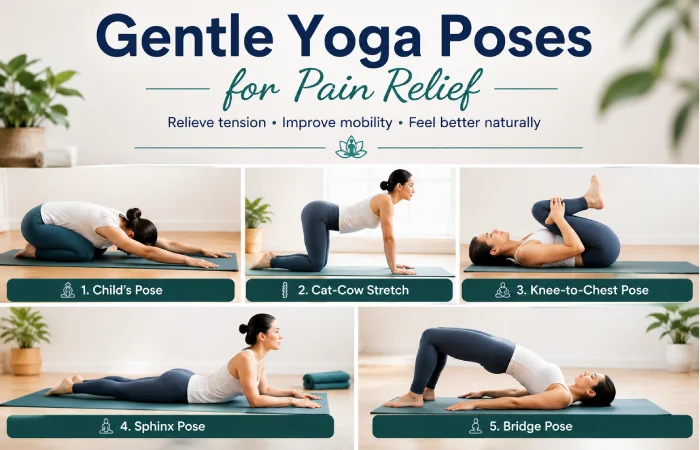
Child’s Pose (Balasana)
Best for: Lower back tightness
How to Do It
- Kneel on a yoga mat.
- Sit back on heels.
- Reach out with arms.
- Rest the forehead in the mat.
- Hold for 30 -60 secs allowing breaths deep.
Benefits:
- Gently decompresses spine
- Reduces tension on the lower back
- Calms down muscle tensions as result of stress
Stress and tension can affect how we hold and move our bodies. Combining gentle movement with relaxation and mindful breathing may help create a more calming practice. Explore these yoga poses for stress relief as another option.
Beginner Difficulty: ⭐☆☆☆☆
Cat-Cow Stretch (Marjaryasana-Bitilasana)
One of the safest yoga movements for beginners experiencing stiffness.
Steps
- Start on hands and knees.
- On inhale arch the back (Cow Pose).
- On exhale tuck in the chin, round the back (Cat Pose).
- Continue back and forth, slow breath 8-10 times.
Benefits
- Improves spinal mobility
- Warms up the back
- Enhances posture
- Increases flexibility
Supine Knee-to-Chest Pose (Apanasana)
Ideal for relieving pressure in the lumbar spine.
Instructions
- Lie flat on your back.
- Pull one knee toward your chest.
- Hold for 20–30 seconds.
- Repeat on the opposite side.
- Then hug both knees if comfortable.
Benefits
- Stretches lower back muscles
- Releases tension in the hips
- Improves circulation
Sphinx Pose
Unlike a more strenuous backbend such as back bend or deep back bend, Sphinx Pose provides a mild spinal extension that is usually well tolerated by those who experience mild lower back pain.
Benefits
- Strengthens spinal muscles
- Opens the chest
- Improves posture
- Encourages healthy spinal extension
Modification: Place a folded towel under your elbows for additional comfort.
Bridge Pose (Setu Bandhasana)
Bridge Pose will help strengthen the lower back muscles: your glutes and core.
Benefits
- Builds core stability
- Activates glute muscles
- Supports spinal alignment
- Counteracts prolonged sitting
Avoid lifting your hips excessively high—focus on a controlled movement and neutral spine.
Once you’ve developed adequate strength, flexibility, balance, and body awareness, you may want to explore more challenging movements. These advanced yoga poses can help you progress your practice gradually.
Stretches to Improve Mobility
Flexibility as vital as pain relief As mobility increases in your hips, hamstrings and spine it puts far less strain on the lower back throughout the day whilst sitting, walking and lifting. You are also advised by some experts to incorporate stretches that strengthen muscles together with movement.
Improving mobility and flexibility can be an important part of maintaining comfortable movement. Along with back-focused practices, you can explore these yoga poses for flexibility to support a greater range of motion.
Thread the Needle Pose
Best for: Tight hips and glutes
How to Do It
- Go on your back with both legs bent.
- Place your right ankle crossed on top of your left thigh.
- Reach under your left leg, grab your left leg and pull your left thigh toward your chest.
- Hold for 30-45 seconds.
- Perform on opposite side.
Benefits
- Releases tight glute muscles
- Reduces tension around the sacroiliac (SI) joint
- Improves hip mobility
- Helps relieve lower back tightness
Beginner Tip: If you can’t reach your thigh, use a yoga strap or towel.
Supine Spinal Twist
A gentle twist can reduce muscular tension without forcing the spine.
Steps
- Lie flat on your back.
- Hug both knees toward your chest.
- Lower both knees to one side.
- Keep your shoulders resting on the floor.
- Hold for 20–30 seconds before switching sides.
Benefits
- Improves spinal rotation
- Relaxes lower back muscles
- Stretches the hips
- Encourages relaxation
Avoid: Deep twisting if you have a herniated disc unless advised by your healthcare professional.
Downward-Facing Dog (Modified)
This classic yoga pose stretches the entire posterior chain.
Benefits
- Lengthens hamstrings
- Decompresses the spine
- Strengthens shoulders
- Improves posture
Beginner Modification
Keep your knees slightly bent instead of forcing your heels to the floor.
Pelvic Tilt
Simple as it may seem, this movement works the deep core muscles that support the lumbar spine.
Benefits
- Strengthens abdominal muscles
- Supports spinal alignment
- Improves pelvic control
- Reduces stiffness after prolonged sitting
Legs-Up-the-Wall Pose (Viparita Karani)
This restorative pose is ideal after a long day of sitting or standing. (Harvard)
Benefits
- Relaxes the nervous system
- Reduces lower back fatigue
- Improves circulation
- Encourages recovery
Hold for 5–10 minutes while breathing slowly.
Safety Tips for Sensitive Backs
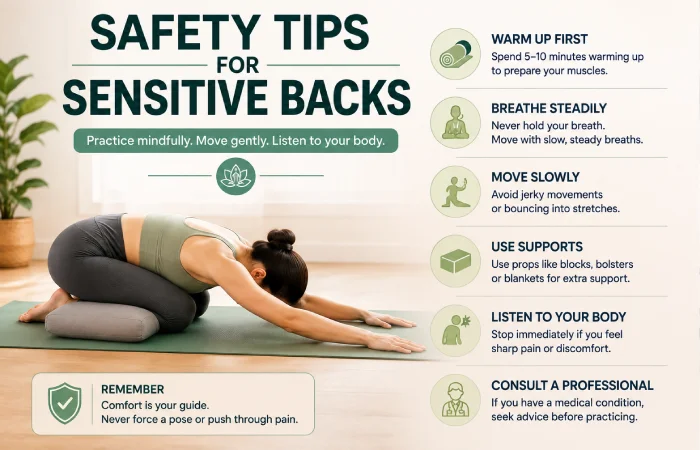
If you have back pain, safety should always come before flexibility.
Follow these best practices:
- Do 5-10 minutes of warm-up to prepare for stretching.
- Don’t bounce into a stretch.
- Move in a slow and even pace, breathing smoothly.
- Support yourself with blocks, bolsters or rolled up blankets.
- Stop immediately if you experience sharp burning or radiation pain.
- Prioritize excellent alignment over gaining access to the full stretch.
The evidence, including guidelines from various health professionals suggests to not engage in poses in which you both twist to an extreme angle and hyperextend the spine in the same action, if you currently live with a condition of the spine.
Product Comparison for Beginners
| Product | Pros | Best For | Cons |
| Yoga Mat (6 mm) | Comfortable and stable | Daily practice | Bulkier than thin mats |
| Cork Yoga Block | Improves balance and reach | Beginners | Slightly heavier |
| Yoga Strap | Assists safe stretching | Limited flexibility | Learning curve |
| Yoga Bolster | Excellent back support | Restorative yoga | Takes up storage space |
When to Avoid Certain Yoga Poses
Yoga is beneficial for most people suffering from mild, non-specific back pain-but not all-as it helps to reduce pain. It is not recommended to practice yoga if the cause of the back pain is fracture, infection, tumor of the spine, bone loss due to severe osteoporosis or if you have undergone surgery. It is better to visit your physician before practicing yoga.
Avoid or Modify These Poses
| Pose | Safer Alternative | Why It May Be Unsafe |
| Full Wheel Pose | Sphinx Pose | Extreme spinal extension |
| Deep Forward Fold | Half Forward Fold with bent knees | Can increase disc pressure |
| Full Cobra | Baby Cobra or Sphinx | May compress the lower back |
| Standing Deep Twists | Supine Spinal Twist | May aggravate disc-related pain |
| Full Boat Pose | Pelvic Tilt or Dead Bug | Can overload weak core muscles |
A balanced yoga routine can include movements performed in different positions. Adding standing yoga poses can bring balance, stability, and strength into your practice alongside back-focused exercises.
Stop Practicing and Contact a Healthcare Professional If You Experience
- Severe or increasing back pain
- Shooting pain down one or both legs
- Numbness or tingling
- Bladder or bowel control loss (medical emergency)
- Pain after fall or accident
- Fever or unexplained weight loss accompany back pain
10-Minute Beginner Yoga Routine
If you’re new to yoga, start with this simple sequence 2–3 times per week.
| Time | Pose |
| 1 minute | Deep Breathing |
| 2 minutes | Cat-Cow Stretch |
| 2 minutes | Child’s Pose |
| 2 minutes | Knee-to-Chest Stretch |
| 1 minute | Thread the Needle |
| 1 minute | Bridge Pose |
| 1 minute | Legs-Up-the-Wall |
It’s a sequence of mobile movements and light stretching exercises for the body and to awaken it without putting any tension on our spine.
If you’re looking for gentler positions, seated movements can provide a stable foundation for controlled stretching and mobility work. Try these seated yoga poses as part of a well-rounded practice.
Frequently Asked Questions (FAQs)
What yoga pose is good for lower back pain?
For yoga beginners with undefined lower back pain these are often suggested poses to get you started on developing some mobility.
- Child pose.
- Cat-Cow.
- Knees-to-Chest pose.
- Sphinx Pose.
This is as they don’t add undue load to the spine. It may vary, however, according to your back pain symptoms.
Can yoga be a cure for back pain permanently?
No. Yoga cannot relieve you of your backpain but few poses practised routinely could relieve pain, improve flexibility, strengthen muscles responsible of support of our back and let you be functional Yoga could offer you a long-lasting cure in conjunction with improvement of lifestyle, sleep, amount of movement and correct postures.
Is it ok to do yoga every day?
Yes. Gentle Yoga poses can be performed everyday unless symptoms worsen with your activity, so beginners should aim at taking 2 – 3 structured classes at week, and light stretching any other days of the week to enhance body mobile functions.
Can yoga worse my back pain?
Yes.
Practice incorrect alignment or forcefully doing extreme stretched can trigger your symptoms and will surely bring about pain, so if you ever experienced sharp unbearable sensation radiating along or down your back please, Stop.
Do I need to use a yoga prop?
Strips for straps and a folded blank or yoga block support is nice to have available when you’re trying some new poses , need assistance in poses requiring assistance, just want added support for a supported pose or find there are parts of your body that have decreased mobility.
Conclusion
Effective back pain yoga pose guidelines focus more on slow, natural transitions and the movement of the body over extreme flexing or painful postures. Instead of deepening your stretch and risking damage you should be creating suppleness throughout the spine to encourage its support through strengthening muscles.
Numerous of those who experience this kind of discomfort can feel benefits by doing basic poses such as Cat Cow poses for yoga, the Child poses for yoga, King Cobra or upward facing dogs pose, knee to chest posing for the back, and alsobridgesposes for back issues.
These poses performed carefully, repeatedly can ease not specific back pain.
Combined practice with posture while sitting and standing, consistent walking and also an core workout strengthen ability of abs and ensure a benefit for life long.
Afiya Jafar is a fitness and wellness writer who focuses on making health, exercise, and healthy lifestyle information simple and practical. Her work covers workouts, fitness motivation, strength training, nutrition, weight management, stress management, mindfulness, and everyday wellness.
Read Full Bio of Afiya Jafar →
Sameena Begum reviews selected health, wellness, fitness, and digital content for clarity, factual presentation, consistency, and reader usefulness. Her review work helps maintain clear and responsible editorial standards across PhysicalFitt content.
Read Full Bio of Sameena Begum →
Dr. Khizrana Begum is a qualified medical professional with MBBS and MD qualifications and 5+ years of experience in the medical field. She works as a General Physician and Dermatologist, with expertise in general medicine, dermatology, preventive healthcare, and skin health.
Read Full Bio of Dr. Khizrana Begum →