
 Afiya Jafar
Fitness & Wellness Writer
Afiya Jafar is a fitness and wellness writer who focuses on making health, exercise, and healthy lifestyle information simple and practical.
Read Full Bio of Author →
Afiya Jafar
Fitness & Wellness Writer
Afiya Jafar is a fitness and wellness writer who focuses on making health, exercise, and healthy lifestyle information simple and practical.
Read Full Bio of Author →
 Sameena Begum
Health, Fitness & Digital Content Reviewer
Sameena reviews selected health, wellness, fitness, and digital content for clarity, factual presentation, and reader usefulness.
Read Full Bio of Reviewer →
Sameena Begum
Health, Fitness & Digital Content Reviewer
Sameena reviews selected health, wellness, fitness, and digital content for clarity, factual presentation, and reader usefulness.
Read Full Bio of Reviewer →
 Dr. Khizrana Begum
General Physician & Dermatologist
Dr. Khizrana Begum is a General Physician and Dermatologist with MBBS and MD qualifications and 5+ years of experience in the medical field.
Read Full Bio of Medical Reviewer →
Dr. Khizrana Begum
General Physician & Dermatologist
Dr. Khizrana Begum is a General Physician and Dermatologist with MBBS and MD qualifications and 5+ years of experience in the medical field.
Read Full Bio of Medical Reviewer →
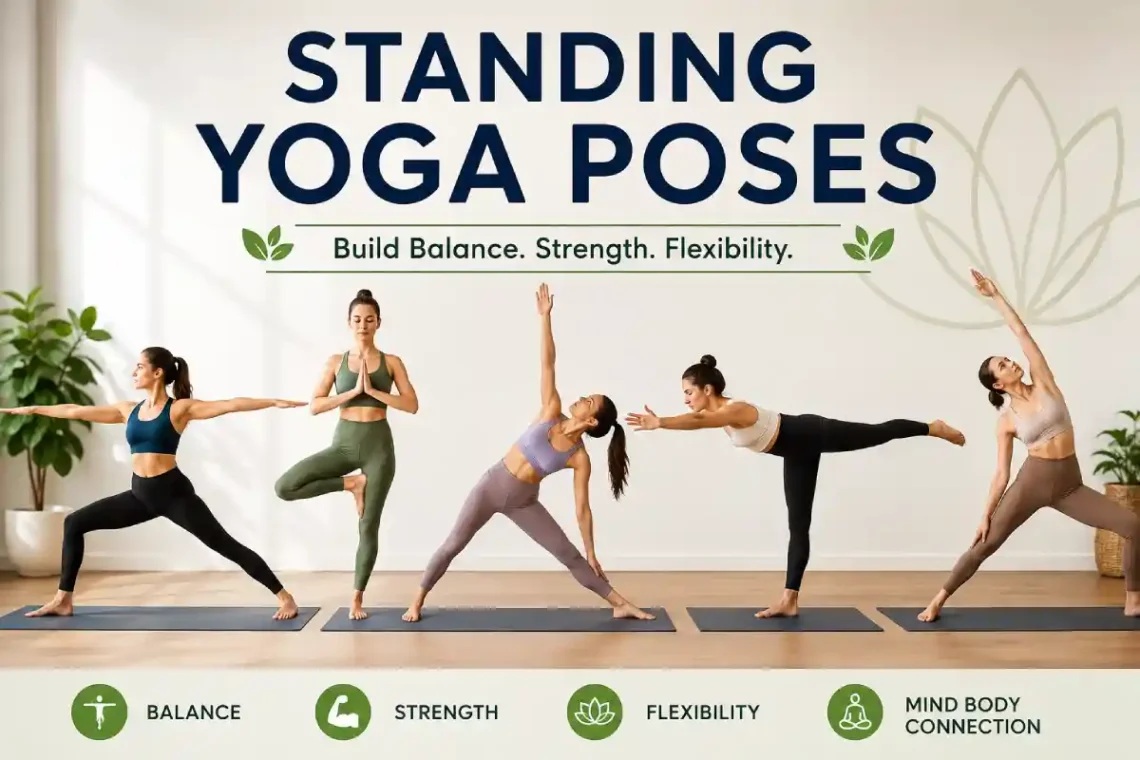
A set of standing yoga poses is a good idea to build balance, strength, mobility, flexibility and body awareness without keeping you on the mat the entire time you’re doing a workout. Some standing poses can include something as easy as standing still, whereas others demand greater stability, such as half moon and warrior 3. If you’re just getting started out, standing asanas can be a good stepping stone toward figuring out how to distribute weight properly, how to secure the feet and ankles, how to get the core going, and how to practice decent posture.
Standing asanas are a corner stone in many types of yoga, and these postures can be easily modified for a fitness range you may have when practicing the postures and the following.
Some poses require a wall, chair or block of yoga so you can practice balance in them rather than straining to remain stable in an unbalanced one. Yoga for balance The existing data on yoga for balance is somewhat conflicting, but it would generally be considered an effective method of balance for a given person, population and program type. A systematic review published in 2025 examines the available 18 randomized controlled studies to conclude that yoga leads to substantial improvements in overall balance; however, due to differences between the studies they gave a low rating of confidence in their findings.
❝
This article is a part of
Yoga Hub
Benefits of Standing Yoga Poses
Standing poses engage your body to oppose gravity. These poses can require participation from your feet, ankles, calves, quadriceps, hamstrings, glutes, hips, abs, shoulders, and back – depending on the shape. This opens up ways to improve.
Standing poses are just one part of a complete yoga practice. If you want to explore different types of movements and routines, browse our full collection of yoga poses.
Improved balance & body awareness
In many of these one-leg standing poses – like Tree Pose and Warrior III – your available base of support shrink significantly, requiring careful attention and the ability to stabilize the whole body from a small point.
This, along with repeated exposure to such poses, will develop your balance and body awareness over time. A 2025 study identified improvements in balance with general yoga practice for healthy adults – though the researchers found that further standardization in future research is required.
Stronger core and legs
Certain poses-like Chair Pose, various Warriors and Goddess Pose – work the legs while also bringing the core in to stabilize the trunk. While standing poses should not serve as your primary form of strength building, they contribute well to a movement lifestyle.
“Regularly engage all major muscle groups in strengthening exercises at least twice per week for adults,” according to the World Health Organization.
Better body awareness
The process of trying to stand in one pose requires you to actively monitor how your feet feel on the ground, where your center of balance lies and whether your knees, hips, shoulders and head stack appropriately. It is an invaluable skill to have when progressing to a more complicated yoga practice, and there is research underway. A 2025 review was published regarding changes in body awareness during yoga programs as an emerging topic of study.
Increased flexibility and range of motion
Triangle Pose, Warrior poses, or Wide-Legged Forward Fold can put stretch and expansion throughout the hamstrings, hips, calves, shoulders and spine. There is no purpose in forcing your stretch and working to create a sensation of pain for a better stretch; rather, it should be a controlled movement where your body begins to move with less tension over time.
If you’re practicing standing poses while dealing with back discomfort, it’s important to choose movements that feel appropriate for your body. You can also explore these yoga poses for back pain for a more targeted routine.
Essential Standing Poses
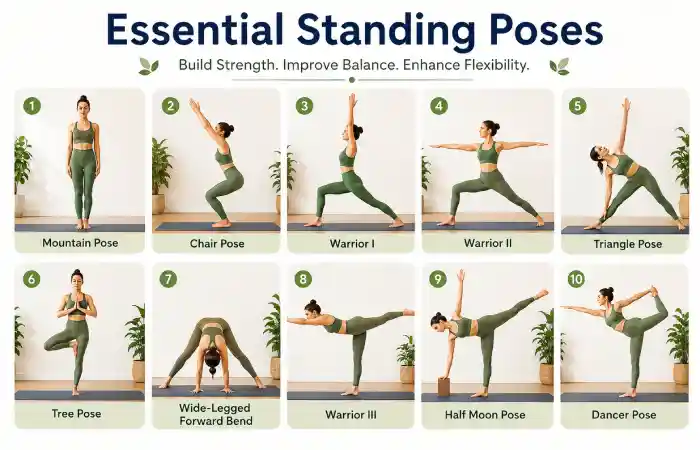
There is no need to remember more than fifty at first. Use basic position, then more complicated position.
Many standing poses require mobility through the hips, legs, and spine. Adding yoga poses for flexibility to your routine can help you work on overall mobility alongside standing movements.
| Standing yoga pose | Level | Beginner modification | Main focus |
| Mountain Pose (Tadasana) | Beginner | Stand with feet slightly apart | Alignment and posture |
| Chair Pose (Utkatasana) | Beginner | Use a wall behind you | Legs and core |
| Warrior I | Beginner | Shorten the stance | Legs, hips and stability |
| Warrior II | Beginner | Reduce knee bend | Legs and hip mobility |
| Triangle Pose | Beginner–Intermediate | Place hand on a block | Hamstrings and side body |
| Tree Pose (Vrksasana) | Beginner | Keep toes on the floor | Balance and concentration |
| Wide-Legged Forward Bend | Beginner–Intermediate | Bend the knees | Hamstrings and hips |
| Warrior III | Intermediate | Keep fingertips on a wall | Balance and posterior-chain strength |
| Half Moon Pose | Intermediate | Use a block underneath the hand | Balance and hip stability |
| Dancer Pose | Intermediate | Hold a wall for support | Balance, mobility and coordination |
Mountain Pose
The Mountain Pose poses are the building block of all standing poses in Yoga. To achieve the Mountain Pose, place your feet comfortably on the floor at a neutral stance, elongate the crown of your head, lower your shoulders, and keep your focus right in front of you.
It will be helpful if you visualize this pose not simply as standing but checking whether you weigh down properly on heels and the ball of your feet.
Chair Pose
With your knees bent, trace the hips back as though you are sinking your bottom into an imaginary chair, from your Mountain Pose (Tadasana) back, without dropping your chest, creating a slight concave in the lower back. Chair Pose is an excellent pose for building lower leg endurance, as well as challenging your core strength to keep you upright. To ease the back and build a bit more confidence, first begin with your back against the wall.
Warrior I and Warrior II
These Warrior I & II are considered starting standing postures that will involve leg strength, hip flexibility, balance, & arm placements. When setting into the Warrior II Pose, generally have the front knee point in the same direction that your front foot points as well. Try not to have the front knee fall in. Make sure that you stance is appropriate so that your breathing is deep and you are not struggling for air.
Triangle Pose
Triangle Pose It’s a blend of standing power and lateral stretch. You’ll “kick the leg open and forward and then extend away from it, with a long spine over the side of the torso,” Adams explains. If your spine and side body will begin to shorten as you round toward the floor, a block will make reaching towards your ankle possible as a stepping stone to lowering your arm toward the ground.
Tree Pose
Perhaps one of the most ubiquitous standing balancing poses, Tree pose can be as simple as resting your sole at the ankle, calf, or inner thigh – never the knee. If balance comes less easily feel free to rest your toes on the earth lightly or hold onto a wall. This is exactly why a site like YogaJala and other beginner practices start with stabilizing and easing into more advanced poses.
Standing yoga can also be combined with mindful breathing and slower movements to create a calming practice. For routines that place greater emphasis on relaxation, explore these yoga poses for stress relief.
Improving Balance and Strength
Balance improves through practice, not by trying to remain perfectly still from the first attempt.
Start with both feet firmly grounded. Once that feels comfortable, move to staggered stances and then single-leg poses. Keep your gaze fixed on one stable point, often called a drishti, when practicing balance poses.
A simple progression could look like this:
Mountain Pose → Warrior II → Tree Pose → Chair Pose → Warrior III
Spend about 3–5 comfortable breaths in each pose at first. The exact duration does not need to be rigid. Quality of movement, steady breathing, and controlled transitions matter more than trying to hold a pose for a specific number of seconds.
A simple beginner standing sequence
- Mountain Pose — 5 breaths
- Chair Pose — 3–5 breaths
- Warrior I — 3–5 breaths per side
- Warrior II — 3–5 breaths per side
- Triangle Pose — 3–5 breaths per side
- Tree Pose — 3–5 breaths per side
- Wide-Legged Forward Bend — 3–5 breaths
- Return to Mountain Pose and breathe normally
This short routine can be useful when you want a standing-only practice or have limited floor space.
After practicing standing movements, you may want to transition into gentler positions that allow you to slow down and focus on breathing and mobility. Try these seated yoga poses as a complementary part of your routine.
Proper Alignment Tips
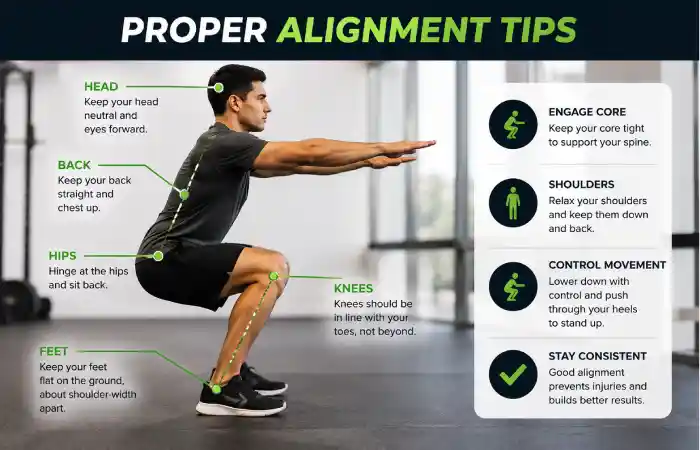
Good alignment isn’t the same as trying to make every single body fit into a mold. The way a pose feels depends on your specific body – the body you inhabit. That depends on your proportions, your level of flexibility, how strong you are, whether you are new to yoga, and how you typically move.
But, there are some fundamental alignment cues that apply generally:
- Ground through the feet, with no more pressure on the outside of your feet than anywhere else.
- Track the knees: in many standing postures, the knees shouldn’t collapse inward.
- Control the tilt of your pelvis: Don’t force your pelvis into what you imagine a specific posture is going to feel based on how you saw someone else do it. Create space through your spine, not a shape you imagine is “right.”
- Find your relaxation: Relax your jaw, your shoulders-whatever muscles are doing more work than is required for you to experience the pose.
- Keep breathing: Holding in your breath often suggests that you may have pushed a little past your comfort boundaries. Take support.
- A wall or chair or a block is a tool: use it to support stability or when the body is struggling with alignments.
This, as well as focusing on the body, keeping the support from the wall or the support from the block in mind, on the knees, hips, shoulders, spine and neck is what “Yoga Basics” emphasis as “doing the pose the right way.”
As your balance, strength, flexibility, and body awareness improve, you may be ready to progress to more challenging movements. Explore these advanced yoga poses when you’re looking to take your practice further.
Common Mistakes
Forcing flexibility
Trying to reach the floor in Triangle Pose or touch your toes in a forward bend can cause you to sacrifice spinal position and control. Use a block or bend your knees instead.
Locking the knees
Standing with the knees aggressively pushed backward can make the posture uncomfortable. Maintain a natural, controlled extension rather than forcing the joints straight.
Looking around during balance poses
Constantly moving your gaze makes balancing harder. Pick a stationary point and keep your eyes relaxed.
Holding your breath
Breathing should remain comfortable. If you cannot breathe normally, reduce the intensity or come out of the pose.
Ignoring support
Using a wall or chair is not a failure. It is a useful progression tool. MyYogaTeacher specifically recommends props and support for beginners who need additional stability.
Copying advanced poses too soon
A complicated pose is not automatically a better pose. Build a foundation with Mountain, Warrior, Chair, Triangle, and Tree before progressing to more demanding balance positions.
FAQs
What are the best standing yoga poses for beginners?
Some excellent starter poses are Mountain pose, Chair pose, warrior I, warrior II, triangle pose and tree pose. They are beginner friendly by increasing body alignment, strength building, increasing the range of motion in joints and improving balance without requiring great amounts of flexibility
Are standing yoga poses helpful for balance?
They can be. The WHO noted a 2025 systematic review of 18 randomized controlled trials showing evidence for an impact of yoga interventions on static balance . However, the reviews showed considerable variation across trials.
Are standing poses good for strength?
Many standing poses work the legs and core like chair pose, Warrior I pose, Warrior II pose and Goddess Pose. If your goal is muscle building then you’ll also need to Incorporate strength training into your routine in an appropriately designed program.
Can you do standing yoga without a mat?
There are many standing poses that can be done without the aid of a yoga mat, as long as the floor you’re standing on provides proper grip. However, a mat does provide additional stability and cushioning.
How long should I hold a standing pose for?
Beginners should hold a standing yoga pose for 3–5 breaths and gradually increase that time based on their ability, comfort level, and controlled body alignment. More important is controlled posture than amount of time.
Is standing yoga good for seniors?
There are modifications to assist, however balance poses need to be approached with extra precaution. Seniors who lack mobitily should attempt an adequate quantity of exercises for their skill level and also would have the most profit from a trained yoga professional. The WHO has recommended that people who are limited in mobility should perform balance-enhancing activities at least three times per week.
The Bottom Line
Standing yoga poses are such a fantastic and varied practice-great for building balance, leg strength, mobility, posture, and body awareness. You don’t have to be flexible, own tons ofprops,or perform super complex movements to benefit. The beginner practice might include poses like Mountain Pose, Chair Pose, Warrior I, Warrior II, Triangle pose and Tree Pose with progress coming as your control develops.
Remember that breath and intelligent alignment are more important than how deep you go, as are practices that lead to and enhance stability-use walls, chairs, and blocks when necessary and integrate standing posing into a more well-rounded practice to create a cohesive workout regimen.
Afiya Jafar is a fitness and wellness writer who focuses on making health, exercise, and healthy lifestyle information simple and practical. Her work covers workouts, fitness motivation, strength training, nutrition, weight management, stress management, mindfulness, and everyday wellness.
Read Full Bio of Afiya Jafar →
Sameena Begum reviews selected health, wellness, fitness, and digital content for clarity, factual presentation, consistency, and reader usefulness. Her review work helps maintain clear and responsible editorial standards across PhysicalFitt content.
Read Full Bio of Sameena Begum →
Dr. Khizrana Begum is a qualified medical professional with MBBS and MD qualifications and 5+ years of experience in the medical field. She works as a General Physician and Dermatologist, with expertise in general medicine, dermatology, preventive healthcare, and skin health.
Read Full Bio of Dr. Khizrana Begum →