
 Afiya Jafar
Fitness & Wellness Writer
Afiya Jafar is a fitness and wellness writer who focuses on making health, exercise, and healthy lifestyle information simple and practical.
Read Full Bio of Author →
Afiya Jafar
Fitness & Wellness Writer
Afiya Jafar is a fitness and wellness writer who focuses on making health, exercise, and healthy lifestyle information simple and practical.
Read Full Bio of Author →
 Sameena Begum
Health, Fitness & Digital Content Reviewer
Sameena reviews selected health, wellness, fitness, and digital content for clarity, factual presentation, and reader usefulness.
Read Full Bio of Reviewer →
Sameena Begum
Health, Fitness & Digital Content Reviewer
Sameena reviews selected health, wellness, fitness, and digital content for clarity, factual presentation, and reader usefulness.
Read Full Bio of Reviewer →
Exercise motivation may inspire you to get moving at the start of a new program, but inspiration is not enough to fuel you through months and years. What works consistently is building around practical goals; enjoyable movement, small, easy habits, recording your progress, taking care of your body, and being in environments where you’re set up for success. You don’t have to feel inspired by working out every day in order to be in good physical condition.
The mindset shift you absolutely must practice in fitness is moving from inspired to focused and from consistent to always doing it anyway.
Current physical-activity recommendations state that adults ought to engage in at least 150 minutes of moderate physical-activity per week or 75 minutes of vigorous physical-activity per week, and muscle strengthening activities two to three times per week. Keep it: a few times a week, and even several small sessions out of the week is fine. You can find what works best within all aspects of what motivates you to move in order to find fitness.
In this guide you will explore why motivation is more fickle than habit, what to know about the fitness motivation and how to exercise sustainability, regardless of the fact if you want to shed excess weight, improve overall health, build muscle, lose stress, or simply improve your physical conditioning.
❝
This article is a part of
Fitness Motivation Tips Hub
What Is Fitness Motivation?
Fitness motivation is comprised of all the reasons, feelings, thoughts, desires, hopes, goals and the situation that make you work out and continue to work out.
It looks very different from one person to the next.
One person’s reason for working out may be to lose weight, another to gain strength, improve athletic ability, relieve stress, improve sleep or to have the physical energy needed to keep up with their kids.
There is no “wrong” reason to work out.
The only question to answer is:
What gives the activity of physical moving its meaning for you?
Motivation is also not static. It follows the pattern of your sleep, your level of stress, work schedule, your social life, your level of energy, how much progress you’re actually seeing in the gym, your surroundings and how much you enjoy the specific workout that you’ve picked.
This is also why motivation based plans are usually so up and down.
A better model to follow is:
Motivation Action Repetition Habit Consistency Progress
The effort is put in over time to rely less on whether you feel like it for working out.
Starting a workout routine is often the hardest part, especially when your motivation is low. Learn practical strategies for finding motivation to exercise and making physical activity a consistent part of your routine.
Why Fitness Motivation Matters
Consistent physical activity is beneficial to cardiovascular health, fitness, brain health and mental well-being, muscle strength and health in general. The present guidelines from the CDC suggest that all adults will benefit from doing more rather than less activity-even if you have not yet met the levels recommended.
However, understanding that exercising is beneficial to you does not necessarily mean that exercising is simple. Harvard Health states that decreased motivation is one of the factors that cause people to have difficulty adhering to an exercise program with some research estimates even suggesting that it is as high as one-half of those who start exercising who will quit within the first six months.
Motivation can help you:
- Start exercising after a long period of inactivity
- Continue exercising when early excitement disappears
- Recover from missed workouts without giving up
- Stay focused on long-term goals
- Handle plateaus and slow progress
- Develop healthier routines
- Find forms of movement you actually enjoy
- Build confidence through measurable improvements
However, motivation should support your routine—not control it.
If your primary goal is losing weight, staying consistent can be more important than feeling motivated every day. Explore our guide to fitness motivation for weight loss to build habits that support long-term progress.
The Science Behind Staying Motivated
Fitness motivation is influenced by several psychological and behavioral factors.
- Your reasons matter
A goal that personally matters to you is generally easier to sustain than a goal chosen only because someone else expects it.
For example:
External goal: “I need to look better because people will judge me.”
Personal goal: “I want to feel stronger and more confident in everyday life.”
The second goal gives you a reason that remains meaningful even when external validation disappears.
- Progress creates feedback
Exercise can feel frustrating when the only measurement is body weight or appearance.
Instead, track multiple forms of progress:
- More repetitions
- Heavier weights
- Longer walks
- Faster running pace
- Better balance
- Improved technique
- Increased mobility
- More workout sessions completed
- Better exercise confidence
Harvard Health recommends focusing on specific goals and measuring progress rather than expecting dramatic changes immediately.
- Enjoyment influences consistency
The CDC specifically suggests you select an action that is agreeable and fitting. You find what appears enjoyable the simplier you’ll stick together with physical activity:
If you have not got the heart operating, do not run.
Try:
- Walking
- Cycling
- Swimming
- Dancing
- Strength training
- Yoga
- Pilates
- Hiking
- Sports
- Home workouts
The best workout is often the one you can realistically repeat.
- Environment reduces decision-making
Every day you’ll have to decide again, whether you want to train when you do it, how you do it, where you do it. That friction kills motivation!
Instead:
- Keep workout clothes ready
- Schedule exercise in your calendar
- Prepare equipment beforehand
- Choose a regular workout time
- Keep your home workout area accessible
- Use a simple training plan
The less effort required to begin, the easier it becomes to start.
Building muscle requires patience and consistent training. If you’re working toward greater strength and muscle development, these motivation for muscle gain strategies can help you stay committed to your training plan.
Intrinsic vs Extrinsic Fitness Motivation
Motivation can broadly be divided into intrinsic and extrinsic forms.
| Motivation type | What drives it? | Fitness example | Long-term potential |
| Intrinsic | Internal satisfaction | “I enjoy feeling strong.” | High |
| Extrinsic | External reward or outcome | “I want to lose 10 kg.” | Moderate |
| Social | Connection and accountability | “My friend and I train together.” | High |
| Identity-based | Becoming a certain type of person | “I am someone who takes care of my body.” | High |
| Performance-based | Improving measurable ability | “I want to squat more weight.” | High |
Extrinsic motivation can be an excellent starting point.
The desired to lose weight, gain muscle, slip on your jeans, get set for that occasion will all spur you into action. Yet intrinsic drive can become even more critical as time wears on, as the activity is rewarding in itself.
For example:
- What comes to mind: “I exercise to lose weight”.
- What’s next on the horizon: “I exercise to build strength.”.
- For the future, you aspire to “I exercise because movement is empowerment.”.
Change that perspective from the “I do this because” to “I feel..”and you might just start enjoying it instead of feeling that it’s “pay back time.
From planning your weekly sessions to overcoming days when you don’t feel like training, the right workout motivation and tips can make it easier to maintain a consistent fitness routine.
Setting Realistic Fitness Goals
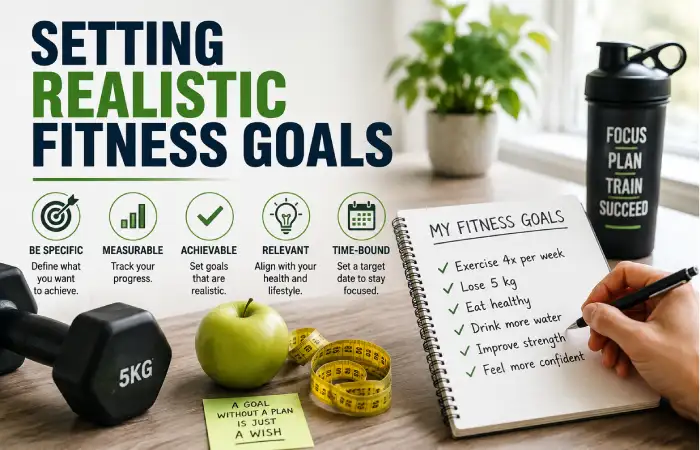
Unrealistic goals are one of the fastest ways to destroy fitness motivation.
If your expectations are:
- Lose a large amount of weight immediately
- Gain significant muscle in a few weeks
- Exercise every day without fail
- Never eat your favorite foods
- Never miss a workout
then normal setbacks can feel like failure.
Instead, use SMART goals:
Specific + Measurable + Attainable + Relevant + Time-bound
Poor goal
“I want to get fit.”
Better goal
“I will complete three 30-minute strength workouts each week for the next four weeks.”
The second goal gives you something you can actually control.
Outcome goals vs process goals
| Goal type | Example | Control |
| Outcome | Lose 10 kg | Lower |
| Outcome | Gain muscle | Moderate |
| Process | Strength train 3 times weekly | High |
| Process | Walk 25 minutes after dinner | High |
| Process | Prepare protein-rich meals 5 days weekly | High |
Prioritize process goals.
The pace of body transformation is beyond your ultimate command, yet the behavior you intend to perform is entirely under your command.
You don’t need a gym to stay active. For people who prefer exercising in their own space, at-home workout motivation can make it easier to establish a routine and stick with it.
How to Build Lasting Motivation
The most useful fitness motivation strategy is to stop treating motivation as something you must constantly “find.”
Instead, build conditions that make action easier.
Step 1: Identify your real reason
Write down:
“I want to become fitter because…”
Then go deeper.
Maybe you want to:
- Feel more energetic
- Improve your health
- Become stronger
- Feel comfortable in your body
- Play with your children
- Improve sports performance
- Reduce stress
- Build confidence
Your “why” should be personal rather than something copied from social media.
Step 2: Start smaller than you think
If you currently do no exercise, beginning with five days of intense training is unnecessary.
Start with a manageable target.
For example:
1: 10–20 minutes, 3 days
2: 20–25 minutes, 3 days
3: 25–30 minutes, 3–4 days
Then gradually build.
Step 3: Make starting easy
Use the five-minute rule:
Tell yourself that you only need to exercise for five minutes.
After five minutes, you can stop if you genuinely need to.
Often, starting removes the mental resistance.
Step 4: Track consistency
A simple calendar can work.
Mark:
✓ Workout completed
✓ Walk completed
✓ Strength session completed
✓ Recovery day followed as planned
You are not trying to create perfection.
You are building evidence that you can keep promises to yourself.
Step 5: Never turn one missed workout into a missed week
Missing a workout is normal.
The mistake is thinking:
“I missed Monday, so I failed.”
Instead:
“I missed Monday. I will continue Tuesday.”
This prevents one imperfect day from becoming an abandoned routine.
Everyone’s fitness journey is different, and women may have specific goals and challenges when it comes to staying consistent. Explore these practical strategies for fitness motivation for women.
Daily Habits That Keep You Motivated
Motivation becomes easier when your daily environment supports your goals.
- Prepare the night before
Put your:
- Shoes
- Workout clothes
- Water bottle
- Training plan
- Resistance bands
- Gym bag
where you can see them.
- Set a consistent workout window
You do not necessarily need the “perfect” workout time.
Choose the time that fits your life.
- Use visual reminders
A calendar, habit tracker, workout log, or fitness app can provide feedback.
- Celebrate small wins
Do not wait until you reach your final goal.
Celebrate:
- First week completed
- First month completed
- First push-up
- First heavier lift
- Improved endurance
- Better exercise technique
- More consistent sleep
- More daily movement
- Protect recovery
Constantly pushing harder can eventually reduce motivation.
Rest days, easier sessions, sleep, nutrition, and stress management are part of the process.
Overcoming Common Fitness Challenges
Fitness motivation usually disappears for predictable reasons.
| Challenge | Why motivation drops | Better solution |
| No visible results | Expectations are too high | Track performance and habits |
| Lack of time | Routine is too complicated | Use shorter sessions |
| Boredom | Repetitive workouts | Add variety |
| Fatigue | Too much training or poor recovery | Reduce intensity and recover |
| Fear of the gym | Lack of confidence | Start at home or use beginner sessions |
| Missed workouts | All-or-nothing thinking | Resume at the next opportunity |
| Plateaus | Progress becomes less obvious | Change the measurement |
| Lack of support | No accountability | Find a partner or community |
Troubleshooting: “I know exercise is important, but I still don’t want to do it.”
Try changing the friction, not your personality.
Ask:
- Is the workout too difficult?
- Is it too long?
- Do I actually enjoy this activity?
- Am I sleeping enough?
- Am I trying to train too frequently?
- Is my goal realistic?
- Would exercising with another person help?
- Could I make the workout shorter?
Sometimes low motivation is not laziness. It is feedback that your current system is poorly designed.
Fitness Motivation for Beginners
Beginners often make one major mistake: starting with an advanced routine.
You do not need six gym sessions per week to begin.
A beginner-friendly starting structure might look like this:
| Day | Activity |
| Monday | 20–30 min full-body workout |
| Tuesday | Easy walk |
| Wednesday | Rest or mobility |
| Thursday | 20–30 min full-body workout |
| Friday | Easy walk |
| Saturday | Optional enjoyable activity |
| Sunday | Rest |
These are reasonable guidelines for getting there sometime over the course of a few years at least 150 minutes of moderate intensity aerobic exercise per week, including muscle building 2 per week, says the CDC. However, there’s no need to sprint straight towards that goal if you’re starting from zero.
Staying Motivated During Weight Loss
Weight loss can create a motivation problem because the scale does not always move in a predictable way.
Your weight can fluctuate because of:
- Water retention
- Food volume
- Sodium intake
- Carbohydrate intake
- Hormonal changes
- Training-related changes
- Digestive contents
Therefore, do not use body weight as your only measurement.
Track:
- Weekly weight trend
- Waist measurement
- Workout performance
- Daily steps
- Strength
- Energy
- Sleep
- Clothing fit
- Workout consistency
Exercise is valuable for health even when the scale changes slowly. CDC guidance notes that physical activity contributes to energy expenditure and can support weight management, while maintaining weight loss requires regular physical activity.
A healthier weight-loss mindset
Instead of:
“I must lose weight to succeed.”
Try:
“I am building behaviors that support a healthier body.”
This makes the process less dependent on a single number.
Staying Motivated to Build Muscle
Muscle-building motivation often suffers because visible changes take time.
Instead of judging your progress only in the mirror, track performance.
Record:
- Exercise
- Sets
- Repetitions
- Weight used
- Technique
- Rest periods
- Training frequency
For example:
Week 1: Squat — 20 kg × 8 reps
Week 6: Squat — 25 kg × 8 reps
That is measurable progress even if your physique has not dramatically changed.
Motivation tip
Do not compare your progress with somebody who has:
- Different genetics
- Different training history
- Different nutrition
- Different recovery
- Different schedule
Your strongest competition is usually your previous version.
Fitness Motivation at Home
Home workouts remove many barriers:
- No commute
- No gym membership
- Flexible timing
- Greater privacy
- Easy access
A basic home setup can be surprisingly effective.
Home fitness equipment comparison
| Equipment | Best for | Space needed | Beginner-friendly | Cost level |
| Exercise mat | Mobility, yoga, bodyweight workouts | Low | Excellent | Low |
| Resistance bands | Strength and mobility | Very low | Excellent | Low |
| Adjustable dumbbells | Strength and muscle building | Low | Excellent | Medium |
| Kettlebell | Strength and conditioning | Low | Good | Medium |
| Bench | Strength training variety | Medium | Good | Medium |
| Treadmill | Walking/running indoors | High | Good | High |
| Exercise bike | Low-impact cardio | Medium | Excellent | Medium–High |
Buying principle: Do not buy equipment because you hope it will magically create motivation.
Buy equipment that removes a real barrier.
If, for example, you don’t enjoy the trip to the gym you could find the use for an adjustable dumbbell. If you already walk but are unable to go outside on a regular basis a treadmill could answer a problem that you already have.
Finding the Right Workout Routine
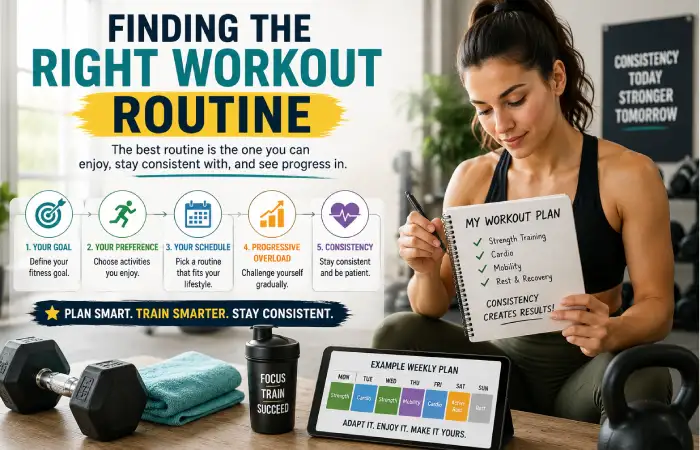
The right workout routine is not necessarily the most advanced routine.
It should fit your:
- Goal
- Fitness level
- Schedule
- Preferences
- Available equipment
- Recovery capacity
- Experience
Goal-based exercise comparison
| Goal | Useful focus |
| General fitness | Cardio + strength + mobility |
| Weight management | Regular movement + strength + aerobic activity |
| Muscle building | Progressive resistance training |
| Strength | Resistance training with progressive overload |
| Endurance | Aerobic training with gradual progression |
| Mobility | Mobility work, stretching, yoga or similar activities |
| Stress management | Enjoyable moderate activity, walking, yoga or recreational exercise |
However, most guidelines on how much to do recommend mixing moderate or vigorous cardio work with at least two days a week of muscle-strengthening exercises, with no exercise being 100% cardio or 100% resistance.
The best routine is sustainable
If a routine requires 2 hours per day and the most you can actually do is 30 min it is not for you. There will be no such thing as an ideal 2 hours. One 30 minutes routine the you do is so much more valuable than an ideal routine you drop.
The Role of Nutrition in Staying Motivated
Nutrition and fitness motivation are connected.
If you don’t eat often enough or intentionally restricted how much and what types of food you ate your workouts could become harder and your recovery time extended.
A sustainable fitness diet should generally emphasize:
- Adequate protein
- Fruits and vegetables
- Whole grains or other carbohydrate sources
- Healthy fats
- Adequate fluids
- Mostly minimally processed foods
- Enough total energy for your needs
Nutrition needs differ depending on body size, activity, goals, preferences, and health circumstances.
Avoid the “perfect diet” trap
A diet does not need to be perfect to support fitness.
If your eating plan is so restrictive that you cannot maintain it, the restriction itself may become a motivation problem.
Mental Health and Fitness Motivation
Movement offers benefits far beyond what you see. That’s because exercise also aids in good emotional health. Some of the benefits listed by Cleveland Clinic include:
- Boost mood
- Increase energy
- Better sleep
- Healthy brains
- Reduce stress
This doesn’t means that every exercise session can treat any particular anxiety or depression.
When a person suffers severe physical, and lasting depression or anxiety symptoms, it can get help from a specialist.
However to help individuals with many health issues, practice of this form of self-care can be good to one’s overall well being.
Try changing your fitness question
Instead of asking:
“Does this workout burn enough calories?”
ask:
“How do I feel after moving?”
You may notice:
- Better mood
- More energy
- Less tension
- Greater confidence
- Better focus
- A sense of accomplishment
Those immediate benefits can help reinforce long-term consistency.
Common Motivation Mistakes to Avoid
Mistake 1: Wait for motivation to show up
Motivation comes in waves. Create the routines for doing activity when motivation is low.
Mistake 2: Take on too much too soon
Extreme soreness, fatigue and burnout occur the week after dramatic new exercise regime starts up.
Mistake 3: Comparing yourself with other
This is how social media would usually picture what the end result is without showing the last 10 or years of consistent working for that goal.
Mistake 4: Only tracking weight
Fitness achievements consist of such things like
- Strength
- Endurance
- Mobility
- Habits
- Confidence
- Health
So you would be surprised to see all of those improve greatly for someone even before their scale moves too much.
Mistake 5: Viewing each skipped workout as failure
This missed workout is a one-time event.
It should never define identity for you.
Mistake 6: Selecting workout’s that they hate
You do not necessarily require doing an activity every single day that they truly detest.
Mistake 7: Building their work plan in excess
More exercises. More dietary products, and increasingly more requirements.
All this has does not indicate the result goes into betterment.
Mistake 8: Neglecting rest
When there is ongoing fatigue. No one can ever sustain this motivation.
Mistake 9: Expecting rapid transformation
Healthiest approach to fitness is a continuous and lifelong journey.
Mistake 10: Utilized exercises to motivation
For eating or eating incorrectly or for failing at an physical criteria of visual performance.
Long-Term Strategies for Fitness Success
The strongest fitness motivation strategy is to build a lifestyle where exercise has a permanent place.
- Create identity-based habits
Instead of:
“I am trying to exercise.”
Think:
“I am a person who takes care of my health.”
The difference may seem small, but identity changes how you interpret setbacks.
- Use minimum and ideal goals
Your ideal goal might be:
“45-minute workout.”
Your minimum goal might be:
“10 minutes of movement.”
On difficult days, complete the minimum.
This protects consistency.
- Build accountability
Accountability options include:
- Workout partner
- Personal trainer
- Group class
- Online community
- Family member
- Fitness app
- Workout log
ACE Fitness similarly emphasizes tracking progress, social networks, rewards, enjoyable music or podcasts, and consistency as useful strategies for maintaining exercise behavior.
- Make workouts enjoyable
Experiment.
Try:
- Strength training
- Walking
- Running
- Cycling
- Swimming
- Dance
- Yoga
- Pilates
- Sports
- Hiking
You are allowed to change your mind.
- Review your progress monthly
Ask:
- What is working?
- What is not working?
- What do I enjoy?
- What feels unnecessarily difficult?
- What has improved?
- What should I change?
This turns fitness into an ongoing process rather than a rigid challenge.
2026 Fitness Motivation Research Snapshot
Sustainability, customization, daily activity and health being central rather than aesthetic is a growing trend within the 2026 fitness landscape.
February 2026 saw an insight which was a useful point: exercise can be incredibly beneficial for health, however exercise solely as a method of fat loss might offer unrealistic perceptions and movement, strength, and health are better priorities than the number on the scale.
Turning to fitness on the tech side, AI in workout programs is not just in 2026. The year also saw a 2026 adaptive fitness pilot study found individuals in the study felt more enthusiastic and engaged with more accomplished but also more bored and bored by a system of adapted fitness compared with standard of care, a smaller controlled trials found. But because of the small sample size of that particular research study – don’t think those results prove that AI for workout programs are definitely the best fit of everyone.
What’s also happening with AI workouts is a 2026 pilot study found that people could increase the quality of personalized self-modelling to attain initial benefits quickly that declined in their effectiveness as time progressed – and that motivational approaches are probably a more helpful complement than a substitute for reasonable objectives.
2026 evidence-informed fitness motivation model
| Principle | What current evidence suggests | Practical takeaway |
| Consistency | Regular activity matters more than occasional extreme workouts | Build a repeatable schedule |
| Health | Fitness benefits extend beyond weight loss | Track health and performance outcomes |
| Enjoyment | Enjoyable activities can improve adherence | Choose exercise you can tolerate or enjoy |
| Personalization | Individual preferences and abilities matter | Adapt your routine |
| Technology | Apps and AI may support engagement | Use technology as a tool, not a replacement for habits |
| Strength | Muscle-strengthening is a core component of adult activity recommendations | Include resistance work at least twice weekly |
| Daily movement | Activity can be accumulated throughout the week | Look for opportunities to move more |
A Simple 4-Week Fitness Motivation Plan
If you are struggling to stay consistent, use this framework.
Week 1: Make exercise easy
Goal: 3 sessions
Keep workouts short.
Focus on showing up rather than intensity.
Week 2: Establish a routine
Goal: 3–4 sessions
Exercise around the same time when possible.
Prepare your clothes and equipment beforehand.
Week 3: Track progress
Record:
- Workout duration
- Exercises
- Repetitions
- Steps
- Energy
- Mood
Look for improvements beyond body weight.
Week 4: Review and adjust
Ask:
- Which workouts did I enjoy?
- What was difficult?
- What caused me to miss sessions?
- What can I simplify?
- What should I continue?
Then build your next four weeks around what you learned.
Fitness Motivation Troubleshooting Guide
“I was motivated for two weeks, then stopped.”
Likely issue: You depended on initial excitement.
Fix: Reduce your routine to something sustainable and schedule it.
“I don’t see results.”
Likely issue: You are measuring too few outcomes.
Fix: Track performance, consistency, measurements, energy, and other meaningful changes.
“I don’t have time.”
Likely issue: Your routine is too long.
Fix: Attempt 10-30 min sessions and total activity throughout the day.
“ I feel awkward at the gym.”
Problem: The atmosphere is not a good fit.
Fix: Try home workouts, walking, a beginner class or a quieter hour in the gym.
” I am not able to workout regularly.”
Problem: All-or-nothing approach.
Fix: Implement the minimum strategy, and go back in at any available moment.
“ I feel like I’m stuck in a rut.”
Problem: Lack of variety.
Fix: Switch up exercises, workout location, music, style or even modality.
“ I am exhausted.”
Problem: The workload might be too high, recovery could be deficient or fuel may be lacking.
Fix: Decrease training stress and allow the body to recover. Persistent/odd exhaustion requires a visit to the doctor.
Frequently Asked Questions About Fitness Motivation
How to get fitness motivation?
Identify a personal reason why you want to exercise, keep the workout to a relatively small amount and attainable, avoid feeling like you need motivation to workout, consistent behavior will take its place.
How to stay motivated to workout?
Choose activities that you enjoy doing, set achievable goals, monitor your progress, schedule in your workouts, reduce your barriers, use accountibility for your workout.according to the CDC you should find activities that you enjoy and can fit into your life style so you are able to continue with them.
Why do I lose motivation when i start working out?
Initial excitement is bound to fade. Many people lack motivation because the plan the have is unrealistic, the workouts are too difficult, progress slows down over time or it’s boring.
Motivation or discipline is more important for fitness?
Both will keep you going, neither one should be the whole plan. A good system that rewards good behavior will reduce the amount of discipline that needs to be involved daily.
How to stay motivated to lose weight?
Focus on process goals, like doing certain activities daily, sticking to habits related to eating, or taking consistent workouts instead of scale metrics.
How to stay motivated to build muscle?
Track your lifts, aim for progress in terms of resistance, reps, technique or consistency. Muscle building and is a slow process, so performance-based short term milestones may help keep things encouraging.
Is it possible to get fit without the gym?
Walking, running, cycling, home workout stations, resistance bands, body weight exercise, sports or many other activity will allow you to continue to live a fit lifestyle without a gym.
What should i do about missing workouts?
Pick them up at the next opportunity, do not try to do an extra long workout to make up for the one you missed.
How many times per week do you need to workout?
It depends on many thing, but for a beginner long term goal of adults is at least 150 minutes of moderate aerobic exercise or 75 minutes of vigorous aerobic exercise per week. It is recommended that you get at least two strength training sessions per week. Beginners are going to want to ease their way into this goal.
Is motivation to exercise important for mental health?
Exercise can help with mood, energy levels, better sleep, more stress management and just overall mental well-being. It should not replace going to therapy if you are experiencing severe symptoms.
What is a good motivation plan for people who are new to exercise?
Don’t overload yourself to much, pick something fun, stick to schedule, consistently do what you have planned. Your first goal should be getting the routine to stick.
Final Takeaway: Build Fitness Motivation, Don’t Chase It
The one thing to remember about fitness motivation is that you absolutely don’t need motivation to be able to make strides in your fitness goals. Motivation can be a big help to kick things off, but actual results comes from the systems you build after it.Set realistic goals.
Choose activities you enjoy.
Start small.
Track progress.
Make workouts convenient.
Build accountability.
Eat in a sustainable way.
Prioritize recovery.
Expect setbacks.
And above all else – stop judging your fitness progress by one terrible workout day.
We aren’t trying to create someone who never skips the gym, the stairs, the walk. We are just trying to become the kind of person who can climb right back on board after missing for a bit.
This whole journey of getting fit wasn’t just born from a burst of inspiration or some 30 day challenge. Fitness really comes from millions of decisions made in the micro (days) over decades (months and years).
Perfection and inspiration are nice and all… but they aren’t necessary. They really aren’t a requirement. All we need is a set of behaviors we are able to come back to.
Afiya Jafar is a fitness and wellness writer who focuses on making health, exercise, and healthy lifestyle information simple and practical. Her work covers workouts, fitness motivation, strength training, nutrition, weight management, stress management, mindfulness, and everyday wellness.
Read full bio of Afiya Jafar
Sameena reviews selected health, wellness, fitness, and digital content for clarity, factual presentation, and reader usefulness.
Read full bio of Sameena Begum