

 Afiya Jafar
Fitness & Wellness Writer
Afiya Jafar is a fitness and wellness writer who focuses on making health, exercise, and healthy lifestyle information simple and practical.
Read Full Bio of Author →
Afiya Jafar
Fitness & Wellness Writer
Afiya Jafar is a fitness and wellness writer who focuses on making health, exercise, and healthy lifestyle information simple and practical.
Read Full Bio of Author →
 Sameena Begum
Health, Fitness & Digital Content Reviewer
Sameena reviews selected health, wellness, fitness, and digital content for clarity, factual presentation, and reader usefulness.
Read Full Bio of Reviewer →
Sameena Begum
Health, Fitness & Digital Content Reviewer
Sameena reviews selected health, wellness, fitness, and digital content for clarity, factual presentation, and reader usefulness.
Read Full Bio of Reviewer →
 Dr. Khizrana Begum
General Physician & Dermatologist
Dr. Khizrana Begum is a General Physician and Dermatologist with MBBS and MD qualifications and 5+ years of experience in the medical field.
Read Full Bio of Medical Reviewer →
Dr. Khizrana Begum
General Physician & Dermatologist
Dr. Khizrana Begum is a General Physician and Dermatologist with MBBS and MD qualifications and 5+ years of experience in the medical field.
Read Full Bio of Medical Reviewer →
The Truth About Building Muscle For Motivation Building muscles, especially visible muscles is a weeks, even month long process of weight training, plenty of food & protein and lots of recovery and improvement. Building muscle is more about habit, so you keep training, not being “pumped up” for each and every workout. You do not need your motivation to be perfect to make progress.
You simply need attainable goals, workout routine to follow up and method to assess results that do not show up in the mirror.
For beginners at least getting more consistent or stronger seems to a be more inspiring goal than watching your body weight or even a photo of your body!
❝
This article is a part of
Fitness Motivation Tips Hub
Staying Motivated While Building Muscle
Since muscular development is an extremely slow process, training can be hard on your motivation. Some days your energy levels and eagerness to lift may be high. On other days, it can be tough to even make it to the gym.
The trick to this is to make your workouts a routine instead of a choice. Pick dedicated training days, lay your workout clothes out the night before and make your training less than you can follow. A consistent routine, such as one designed by a program, can save a lot on decision-making energy. Current 2026 Oklahoma State’s THRIVE guidelines include consistency, proper exercise choices, appropriate training progressiveness, and recover.
Try using these motivation strategies:
- Set a specific muscle-building goal.
- Schedule workouts like appointments.
- Track every workout.
- Celebrate strength improvements.
- Take progress photos every few weeks.
- Avoid comparing your body with experienced lifters.
- Focus on consistency rather than perfect workouts.
A useful mindset is “never miss twice.” Missing one workout is normal. Allowing one missed session to become several weeks away from the gym is what creates a bigger problem.
Building muscle takes time, consistency, and the right mindset. If you want to explore more strategies for staying committed to your fitness goals, check out this complete guide to fitness motivation.
Setting Strength Goals

One of the easiest ways to improve fitness motivation for muscle gain is to stop making size your only goal.
Instead of saying, “I want bigger arms,” create measurable performance goals such as:
| Goal type | Example |
| Strength | Increase squat from 95 to 135 lb |
| Repetitions | Increase pull-ups from 3 to 8 |
| Training consistency | Complete 3 workouts weekly |
| Technique | Perform controlled repetitions with better form |
| Nutrition | Hit your daily protein target consistently |
| Recovery | Maintain a regular sleep schedule |
Fitness motivation can vary depending on your goals, lifestyle, and individual circumstances. Women looking for more targeted strategies can explore this guide to fitness motivation for women.
Strength training provides a measurable feedback loop. When your repetitions, resistance, technique or training consistency improve, you have evidence that your effort is producing results.
Another current recommendation for building muscle is progressive overload-gradually increasing resistance as an exercise gets easier.
A simple 2026 goal framework
Short term: Complete your planned workouts for four weeks.
Medium term: Improve selected exercises over 8–12 weeks.
Long term: Build sustainable strength and muscle over several months.
Do not anticipate extraordinary results right after a few trainings. The strength gains may materialize, but before they even become noticeable, while significant hypertrophy typically necessitates minimum of several weeks of consistent training.
Some days your energy and motivation will be high, while other days it may be difficult to start a workout. Learning how to maintain motivation to exercise can help you turn training into a consistent habit.
Nutrition for Muscle Growth
Motivation is definitely much lower when the body simply doesn’t have enough energy on board. Muscle is built via resistance exercise and it requires energy and protein to adequately recover and promote protein synthesis within the muscles.
A muscle-building diet does not have to be complicated. Build meals around:
- Lean meat, poultry and fish
- Eggs and dairy
- Beans and other legumes
- Whole grains
- Fruits and vegetables
- Nuts and seeds
- Healthy sources of dietary fat
Protein deserves particular attention. Current muscle-building guidance commonly places active individuals’ protein needs above the basic minimum used for sedentary adults, although the appropriate amount varies by body size, training level and individual circumstances.
Muscle-building nutrition snapshot
| Nutrition factor | Why it matters |
| Protein | Provides amino acids needed for muscle repair and growth |
| Carbohydrates | Help fuel demanding resistance workouts |
| Dietary fats | Support energy intake and overall nutrition |
| Calories | Provide energy for training and tissue building |
| Hydration | Supports normal physical performance and recovery |
A 2026 Healthline nutrition guide also emphasizes adequate protein, carbohydrates, fats and nutrient-dense foods as part of a muscle-building eating pattern.
Rather than chasing a perfect diet, focus on eating consistently enough to support your training.
Fitness goals aren’t always limited to gaining muscle. If you’re also working toward reducing body weight while maintaining an active lifestyle, learn more about fitness motivation for weight loss.
Measuring Progress Beyond the Scale
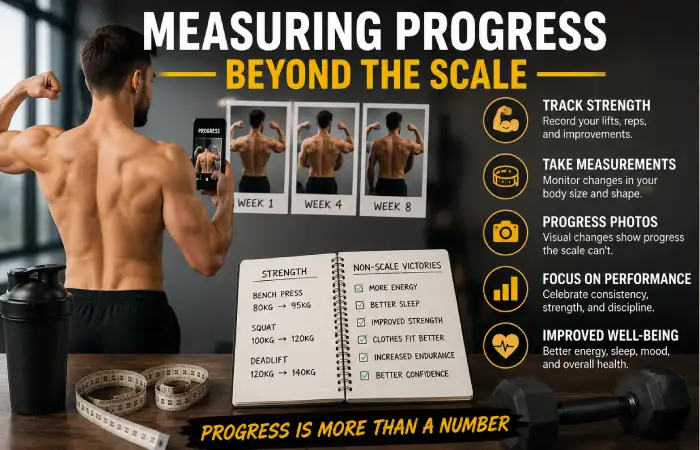
The scale is one of the least useful motivation tools when used alone.
Your body weight can fluctuate because of water, food volume, glycogen and other factors. Muscle gain can therefore happen without dramatic changes in scale weight.
Track several indicators instead:
Workouts performed – Are you able to get a lot more reps in, or is it better weight lifting as a total?
Body measurements – Arms, chest measurement, waist, thighs, and any other physical measurements can be tracked weekly or biweekly.
Progress Pictures – Click pictures, use similar lighting, attire and posture.
Number of Training Sessions Completed – If you can get the workout in, call it what you may, but it can also be counted as a victory.
Sleep, Energy and recovery – Do you get enough rest or have enough energy and enthusiasm to power through your training sessions?
Form/Technique – You might still be using the same weight but is control and form improved?
This can also indicate you are progressing.
2026 progress scoreboard
| Metric | Beginning | Target direction |
| Weekly workouts | Track baseline | More consistent |
| Main lift repetitions | Record baseline | Gradual increase |
| Training resistance | Record baseline | Gradual increase |
| Body measurements | Record baseline | Goal dependent |
| Progress photos | Week 1 | Compare every 4–8 weeks |
| Recovery | Track sleep/energy | More consistent |
The key is to compare yourself with your previous performance rather than someone else’s physique.
A realistic workout routine can make consistency much easier. For additional strategies to stay focused, structure your training, and overcome common obstacles, explore these workout motivation tips.
Long-Term Consistency Tips
The biggest mistake beginners make is expecting motivation to remain high throughout the entire muscle-building journey.
Instead, build a system that still works when motivation is low.
Keep workouts realistic
A workout plan that requires six perfect gym sessions every week may fail if your schedule only allows three. Choose a routine you can realistically maintain.
Make progress gradual
You do not need to add large amounts of weight every session. Progressive overload can involve additional repetitions, improved technique, increased resistance, or other appropriate changes.
Prioritize recovery
Training more is not automatically better. Muscles need recovery time, and current 2026 guidance notes that recovery can require roughly 24–72 hours depending on the muscle group and training demands.
Use accountability
Working out in a gym with workout buddies , having classes to do your training or the assistance of trainers and a physical trainer who works on training a set program or even an app to keep track of your activity, can make the whole process easier. For example a workout class can offer a more motivated setting that forces structure, supervision and accountability in terms of physical workouts for the most parts.
Expect plateaus
Unfortunately progress isn’t linear If you haven’t gained or your measurements are stuck, look at training volume, exercise technique, nutrition, sleep, and recovery prior to declaring program failure.
Don’t chase shortcuts
Sustainable-muscle-gaining relies on resistance exercise, proper fueling and recovering- not punishing routines or ridiculous hype-and to the same extent Cleveland Clinic has the four components for a muscle gaining diet, they list the four main drivers of muscle growth, progressive resistance, training, diet and recovery.
Not everyone has the time or preference to train at a gym. If you prefer to build strength and stay active from your own space, these strategies for motivation to work out at home can help you stay consistent.
FAQs
How do I stay motivated to build muscle?
Try Setting specific small measurable workout goals and keep workout logs to ensure you get workout logs to stay consistent. While a few weeks you’ll be stronger by bettering your form you’ll feel the same motivation over not training every week. Body recom is a much longer goal and it takes time to develop and not short bursts.
How long before seeing muscle growth?
It depends on training experience, genetics, nutrition, and a variety of other factors that come into play. Based off a variety of different studies the consensus to see hypertrophy that is noticeable is several weeks or longer, to make lasting improvements though expect it in months.
What should you track if you wanna get muscle gain?
- Workouts done (reps and weight)
- Body measurments
- Progress photos
- Consistency
You can also record nutrition and recovery patterns if it help you pinpoint factors.
What is more important for building muscle, motivation or program?
The two work hand in hand. Having a decent workout program allows you a road map. You motivate and reinforce habit, to make yourself follow it, however long-term results and progression depend on consistent training no short bursts.
When starting at the gym is it better to build muscle size or strength?
They both can work off one another, to progressively work those muscles over time, making you bigger at the same time. You just gotta make sure that ya following an adequate nutrition plan as well.
Final Thoughts
Weight training is not really about chasing instant success. While Fitness motivation for muscle gain may sometimes come from seeing what your physique can do in the short time, building systems that ensure your regular exercise regimen takes precedence often prove a far greater influence.
You would not be mistaken to pursue training goals, sufficient nutrition that caters to your activities of daily training, progress assessment and good recovery patterns. A training missed session or a sluggish week does not signify a loss of any previous achievement. Reverting back to your regular program in practice leads to advancement in.
The most intense forms of stimulation are almost certainly derived from realizing the abilities which you may get a hold of in the present which have in all probability in all probability not previously occurred earlier in days past months prior.
Prioritize those advancements, pursue consistency as your primary approach, along with the consequences to become inevitable eventually.
Afiya Jafar is a fitness and wellness writer who focuses on making health, exercise, and healthy lifestyle information simple and practical. Her work covers workouts, fitness motivation, strength training, nutrition, weight management, stress management, mindfulness, and everyday wellness.
Read Full Bio of Afiya Jafar →
Sameena Begum reviews selected health, wellness, fitness, and digital content for clarity, factual presentation, consistency, and reader usefulness. Her review work helps maintain clear and responsible editorial standards across PhysicalFitt content.
Read Full Bio of Sameena Begum →
Dr. Khizrana Begum is a qualified medical professional with MBBS and MD qualifications and 5+ years of experience in the medical field. She works as a General Physician and Dermatologist, with expertise in general medicine, dermatology, preventive healthcare, and skin health.
Read Full Bio of Dr. Khizrana Begum →