
 Afiya Jafar
Fitness & Wellness Writer
Afiya Jafar is a fitness and wellness writer who focuses on making health, exercise, and healthy lifestyle information simple and practical.
Read Full Bio of Author →
Afiya Jafar
Fitness & Wellness Writer
Afiya Jafar is a fitness and wellness writer who focuses on making health, exercise, and healthy lifestyle information simple and practical.
Read Full Bio of Author →
 Sameena Begum
Health, Fitness & Digital Content Reviewer
Sameena reviews selected health, wellness, fitness, and digital content for clarity, factual presentation, and reader usefulness.
Read Full Bio of Reviewer →
Sameena Begum
Health, Fitness & Digital Content Reviewer
Sameena reviews selected health, wellness, fitness, and digital content for clarity, factual presentation, and reader usefulness.
Read Full Bio of Reviewer →
 Dr. Khizrana Begum
General Physician & Dermatologist
Dr. Khizrana Begum is a General Physician and Dermatologist with MBBS and MD qualifications and 5+ years of experience in the medical field.
Read Full Bio of Medical Reviewer →
Dr. Khizrana Begum
General Physician & Dermatologist
Dr. Khizrana Begum is a General Physician and Dermatologist with MBBS and MD qualifications and 5+ years of experience in the medical field.
Read Full Bio of Medical Reviewer →
Motivation in home fitness can seem elusive when the siren call of the sofa, smartphone, endless chores, and the demands of your life beckon. Fortunately, you won’t need Herculean discipline or a hefty gym fee to achieve lasting exercise habits. The surer path to an exercise routine lies in setting up an easily executed framework that entails selecting a attainable objective, reserving spots for your workouts, securing a suitable location, keeping track of your achievements, and making exercise readily approachable for the lazy days too.
For adults, guidelines issued by the World Health Organization include 150 to 300 minutes of moderate-aerobic training for adults (or 75-150 minutes of vigorous activity) each week and muscle-strengthening work on at least two days each week.
Above all, any movement is better than nothing.
❝
This article is a part of
Fitness Motivation Tips Hub
Benefits of Home Workouts
At-home workouts bypass many of the traditional barriers to exercise. Home workouts don’t require a trip or a membership and waiting for equipment. They also offer freedom from having to work around commitments to other areas of your life.
Here are some of the advantages to home workouts.
- Convenience: you can start a workout just a few minutes after deciding you are going to, without travel time and the gym setting.
- Cheaper: you do not need much or any equipment when it comes to many strength exercises, including those at home.
- More privacy: it’s easier for beginners to do some basic strength exercises where they cannot feel observers, judging their effort and technique.
- More flexibility in workout length: it’s much easier to find short sessions from ten minutes through to medium sessions or longer.
- Easy consistency: it’s more convenient when a workplace, home gym, or exercise environment is right next to you, not requiring travel.
- There are plenty of workout options available at home: In addition to the workout programs such as Strength training, yoga, Pilate, mobility training, dances and walks that are available for practice, the Cardios exercises are also an efficient alternative.
The Kaiser Permanent has also reiterated in the Kaiser Permanente’s 2026 update, stating that much of the bodyweight workouts should not be an obstacle even while working out in their respective homes since the participant is reminded of good form and proper warm-up movements.
What does a realistic weekly target look like?
| Goal | Example weekly routine |
| Beginner | 3 × 20–30 minute workouts + daily walking |
| General fitness | 4 × 30–40 minute workouts + active movement |
| WHO minimum target | About 150 minutes moderate activity + 2 strength sessions |
| Higher activity target | Gradually work toward 300 minutes moderate activity |
This is just a suggestion in the table, it isn’t like you have to hit 150 mins on the first try if you are starting with no activity levels. Gradually work up to these times if 150 mins seems a bit too much if you are inactive.
Staying consistent with home workouts starts with having a clear goal and creating habits that make exercise easier to maintain. For more strategies to stay committed to your goals, explore our complete guide to fitness motivation.
Creating a Dedicated Workout Space
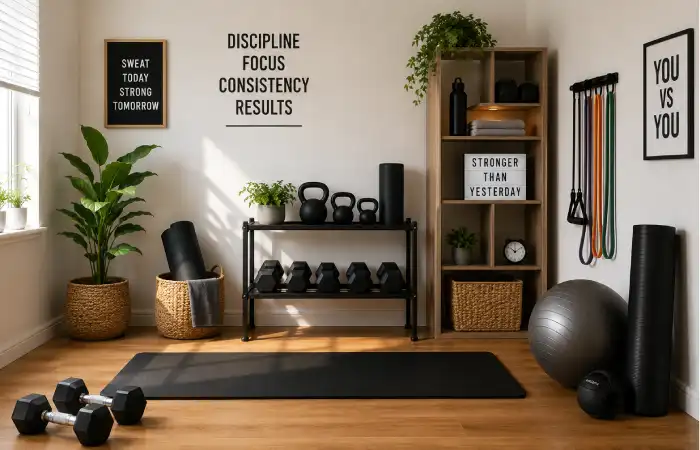
You do not need an entire room to create a home gym.
If you only have access to an area of about 2 metres by 2 metres, that can be perfectly sufficient for many bodyweight exercises, yoga, using resistance bands, or lifting weights with dumbbells.
All that you need isn’t costly equipment – it’s to design the space simply to be practical. That said; storing your yoga mat, workout shoes, resistance bands and dumbbells where they are easily visible can act as a psychological cue to motivate your workouts to occur.
Simple home workout setup
| Setup | Best for | Approximate cost |
| Bodyweight only | Beginners | ₹0 |
| Yoga/exercise mat | Floor exercises, yoga | Low |
| Resistance bands | Strength + mobility | Low |
| Pair of dumbbells | Progressive strength training | Moderate |
| Adjustable dumbbells | Long-term strength training | Higher |
Buying tip: Do not purchase a large home-gym package simply because it looks impressive. Start with equipment that solves an actual problem in your routine.
For example, a resistance band can add resistance without taking much storage space, while adjustable dumbbells can provide more progression as you become stronger.
Current Indian-market examples range from inexpensive resistance bands to adjustable dumbbells, with prices varying substantially by resistance, weight capacity, and design. Prices can change, so compare the current price, warranty, construction, and return policy before purchasing.
Motivation can fluctuate from day to day, so having practical strategies for getting started is important. If you regularly struggle to begin a workout, these tips for motivation to exercise can help you build a more consistent routine.
Staying Motivated Without a Gym
The biggest mistake is treating motivation as something you must constantly feel.
Motivation changes. A better strategy is to build habits that make starting easier.
-
Set a specific goal
Instead of saying:
“I want to get fit.”
Choose something measurable:
“I will complete three 25-minute workouts every week for the next four weeks.”
Exercise adherence research supports interventions (goal-setting and behavior monitoring with feedback), however with differing evidence strength across people and interventions.
-
Use the 10-minute rule
On difficult days, promise yourself just 10 minutes.
Start with:
- Two minutes of easy movement.
- Three minutes of simple exercises.
- Three minutes of your main workout.
- Two minutes of stretching or walking.
If you want to continue, keep going. If not, you have still maintained the habit.
-
Schedule workouts like appointments
Choose specific days and times.
For example:
Monday: Strength
Wednesday: Cardio
Friday: Full-body workout
Saturday: Yoga or mobility
If you’re needing a greater drive to commence working out, consider establishing a pre-game routine, following the same activity every time beforehand, trying out new activities, using positive internal monologues and setting SMART goals, according to UQ’s ‘Do you really hate exercise’ guide.
-
Track small wins
Do not measure progress only through body weight.
Track:
- Workouts completed
- Repetitions
- Workout duration
- Walking time
- Resistance used
- Push-ups completed
- Plank duration
- Energy and consistency
Fitness Journal or Activity Tracker- Can help you see progress and will serve as accountability. Verywell Fit recommends working out and activity logging as one way to become more motivated.
-
Change your workouts
You can have all your progress recorded at a glance for accountability with the help of an activity tracker and the physical evidence with a fitness journal, too. Very Well Fit also recommends activity logging and tracking your workout as some motivational hacks.
Setting a specific and measurable goal can make it easier to stay accountable. If weight loss is one of your primary fitness goals, you can find additional strategies in this guide to fitness motivation for weight loss.
Home Workout Ideas
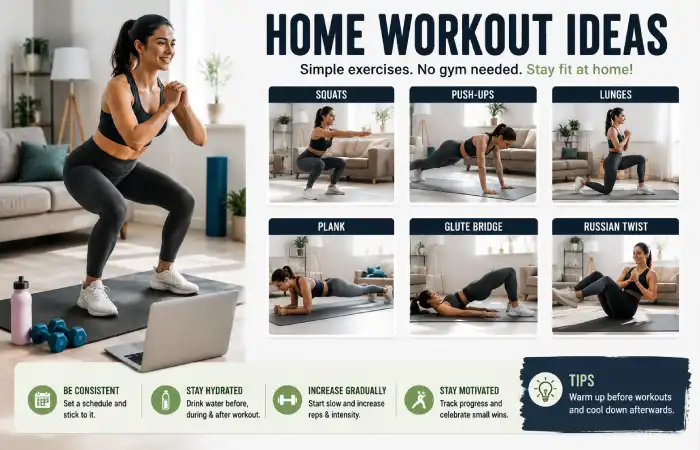
You can build an effective beginner routine without sophisticated equipment.
20-minute beginner home workout
Warm-up — 3 minutes
- March in place
- Arm circles
- Hip rotations
- Easy bodyweight squats
Main workout — 12 minutes
Complete 2–3 rounds:
- 10 squats
- 8 wall or incline push-ups
- 10 alternating reverse lunges
- 12 glute bridges
- 20-second plank
Cool-down — 5 minutes
Use gentle walking and comfortable stretches.
As your fitness improves, increase repetitions, add resistance, reduce rest periods, or move toward more challenging variations.
Do not sacrifice form simply to complete more repetitions.
Home workouts can also support strength and muscle-building goals, especially when you gradually increase resistance or make exercises more challenging. For additional strategies, explore our guide to motivation for building muscle.
Avoiding Distractions
The home environment is convenient—but it can also be your biggest obstacle.
Common distractions include:
- Social media
- Television
- Household chores
- Phone notifications
- Family interruptions
- Work messages
- Pets
- Feeling too comfortable
GymQuip identifies distractions such as television, children, and household tasks as common challenges for home exercisers.
Create a pre-workout ritual
Use the same sequence before each workout:
Change clothes → fill water bottle → put phone on Do Not Disturb → start music → begin warm-up.
Over time, this routine can reduce the amount of decision-making required before exercise.
Another simple trick is to have all your workout gear packed and at the ready in advance. When the exercise effort to start is reduced to a couple of minutes from an amount of fifteen, there’s far less chance you’ll talk yourself into staying home.
When You Lose Motivation
Missing one workout does not mean your plan has failed.
The dangerous thought is:
“I missed Monday, so I might as well restart next week.”
Replace it with:
“I missed one session. My next workout is Wednesday.”
Focus on returning quickly rather than achieving perfection.
Cleveland Clinic similarly recommends expecting setbacks, exercising for appropriate reasons, and giving yourself credit rather than treating a missed workout as failure.
Troubleshooting common motivation problems
Finding a routine that fits your lifestyle can make it easier to stay consistent with exercise. Women looking for additional strategies tailored to their fitness goals can explore this guide to fitness motivation for women.
| Problem | Try this |
| “I don’t have time.” | Do 10–15 minutes instead of skipping |
| “I’m bored.” | Change the workout style |
| “I don’t see results.” | Track strength, repetitions, and consistency |
| “My home is distracting.” | Use a dedicated workout area |
| “I keep skipping workouts.” | Schedule fixed workout times |
| “I feel overwhelmed.” | Follow one simple beginner routine |
| “I have no equipment.” | Start with bodyweight exercises |
| “I missed several days.” | Restart with one short session |
Scheduling workouts, tracking small wins, and changing your routine can all make it easier to stay consistent. You can also explore these practical workout motivation tips for additional ways to keep your training on track.
FAQs
What can i do to encourage myself to work out at home?
Making your workout easily to start It may encourage you to initiate by making workouts more palatable by scheduling when and doing all exercises at one location, establish the exact performance measures, tracking results, and finding activities you enjoy, etc.
Can you be fit, not visiting the gym?
Yes, It would be appropriate by adding the following in your home workout.
A complete workout routine at home consists of cardio aerobic exercise, strength training, range of motion work, and extending work. Begin it utilizing just bodyweight moves, and then integrate resistance bands or weights when you progress.
What is the best home workout for beginners?
Most beneficial home workout program for novicesis one youcan follow safely and regularly.
You could incorporate all the below: The moves like squats, high press-ups incline pushups, buttock raises, lunge, core work, walking, as well as range of motion perform at home effectively start at least.
How many days should I train at home per week?
You could begin doing three planned exercise routine sessions weekly and build this up slowly. Based on WHO for global health the suggested physical movement dose is 150-300 minutes moderate aerobic activity once in a week or muscle-strengthen activities a couple days a week.
What ought to I invest for a home workout?
No items can be found initially, and it depends upon your financial investment plans you could start slowly, as soon as you decide equipment may be essential to buy. You can begin with an yoga mat as well as some resistance bands, then add weights.
Ensure to buy equipment that’s suitable for your goals, room, budget, and in addition your level of fitness in doing the equipment safely.
The Bottom Line
To improve motivation to train at home you can remove the reliance you have on motivation. Create a sustainable system: know your goals, put workouts on the diary, create an easy to setup workout space, eliminate distractions, focus on small wins and only plan for 10 minutes.
It’s consistency over and then a single perfection workout.
And don’t forget, you don’t need an over-night transformation. Create the smallest and easiest habit that you can do and go from there.
Note on injuries: Ensure you check with an appropriately qualified health or exercise professional before making any changes to your exercise regime if you have any existing injury, illness, medical conditions or you are pregnant or in the postpartum period and believe the routine in this plan is inappropriate for you.
Afiya Jafar is a fitness and wellness writer who focuses on making health, exercise, and healthy lifestyle information simple and practical. Her work covers workouts, fitness motivation, strength training, nutrition, weight management, stress management, mindfulness, and everyday wellness.
Read Full Bio of Afiya Jafar →
Sameena Begum reviews selected health, wellness, fitness, and digital content for clarity, factual presentation, consistency, and reader usefulness. Her review work helps maintain clear and responsible editorial standards across PhysicalFitt content.
Read Full Bio of Sameena Begum →
Dr. Khizrana Begum is a qualified medical professional with MBBS and MD qualifications and 5+ years of experience in the medical field. She works as a General Physician and Dermatologist, with expertise in general medicine, dermatology, preventive healthcare, and skin health.
Read Full Bio of Dr. Khizrana Begum →