

 Afiya Jafar
Fitness & Wellness Writer
Afiya Jafar is a fitness and wellness writer who focuses on making health, exercise, and healthy lifestyle information simple and practical.
Read Full Bio of Author →
Afiya Jafar
Fitness & Wellness Writer
Afiya Jafar is a fitness and wellness writer who focuses on making health, exercise, and healthy lifestyle information simple and practical.
Read Full Bio of Author →
 Sameena Begum
Health, Fitness & Digital Content Reviewer
Sameena reviews selected health, wellness, fitness, and digital content for clarity, factual presentation, and reader usefulness.
Read Full Bio of Reviewer →
Sameena Begum
Health, Fitness & Digital Content Reviewer
Sameena reviews selected health, wellness, fitness, and digital content for clarity, factual presentation, and reader usefulness.
Read Full Bio of Reviewer →
 Dr. Khizrana Begum
General Physician & Dermatologist
Dr. Khizrana Begum is a General Physician and Dermatologist with MBBS and MD qualifications and 5+ years of experience in the medical field.
Read Full Bio of Medical Reviewer →
Dr. Khizrana Begum
General Physician & Dermatologist
Dr. Khizrana Begum is a General Physician and Dermatologist with MBBS and MD qualifications and 5+ years of experience in the medical field.
Read Full Bio of Medical Reviewer →
Working out motivation for ladies isn’t about forcing yourself into the fitness center daily or ready to obtain “roused to workout. It’s the practical goals, exercise you genuinely like, and the habit of a fitness routine that has to have the ability to get by means of your busiest weeks, your most tired days, and your unavoidable slipups.
“Many ladies work with (and battle the) expectations from their jobs, household duties, social obligations and also, ultimately, ‘me’ time,” notes Sarah. Scientific research in fact shows that motivation that originates from personal principles, intrinsic interest, as well as the sense of effectiveness tends to motivate a higher, and also extra lasting exercise. A recent 2024 systematic testimonial and also meta-analysis established a positive link between autonomy motivations and also girls sport engagement and also located that the feeling of autonomy, capability, as well as links were vital factors that contribute in ladies physical activity.
The objective, thus, is not to discover motivation one time – it’s to develop an effective workout system for yourself which makes the very first move very easy.
Staying consistent with exercise is easier when you have realistic goals and a routine that fits your lifestyle. For more strategies to build sustainable habits, explore this guide to fitness motivation.
❝
This article is a part of
Fitness Motivation Tips Hub
Women’s Fitness Challenges
Women can encounter many different barriers to regular exercise. These vary by age, lifestyle, work situation and personal circumstances, so there is no single “women’s fitness problem.”
Common challenges include:
- Being short on time due to work or family commitments
- Feeling awkward, embarrassed, or nervous in a gymnasium
- Inexperience with the exercise regimen and a lack of confidence
- Unrealistic ideas regarding expectations of weight or appearance
- Losing motivation when results are slow
- Boredom from repeating the same workouts
- Fatigue or disrupted routines during demanding periods of life
- Comparing progress with influencers or other people online
More than half of women are not exercising as much as they wish, according to global ASICS Move Her Mind research on more than 24,000 women in over 40 countries, which also showed high links between frequent exercise and improved confidence, happiness and energy levels and reduced stress. The crucial mindset change: Exercise needn’t be about punishment for food or to look a certain way. It can be about strength, mobility, mobility, mobility, well-being and overall longevity.
A Better Motivation Mindset
Instead of saying:
“I have to work out because I need to lose weight.”
Try:
“I exercise because I want to become stronger, healthier and more capable.”
This type of intrinsic motivation can be more sustainable than relying entirely on appearance-based goals.
Motivation naturally rises and falls, so learning how to get yourself started is an important part of building a lasting routine. These strategies for motivation to exercise can help you stay active even on low-energy days.
Setting Realistic Goals
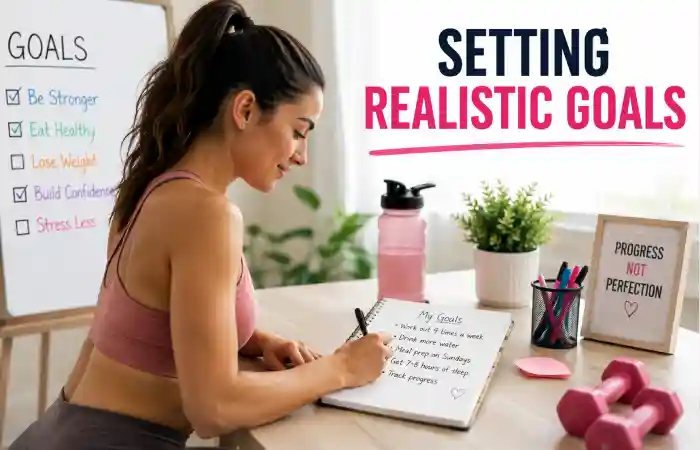
One amazingly fast way to lose all motivation for fitness is to have an unrealistic schedule, that’s it.
Start with a goal that fits your current life.
Try the SMART approach
| Goal | Weak Version | Better Version |
| Frequency | “Exercise more” | “Walk for 30 minutes three days this week” |
| Strength | “Get stronger” | “Complete two full-body strength sessions weekly” |
| Cardio | “Improve fitness” | “Walk or cycle for 25 minutes three times weekly” |
| Consistency | “Never miss a workout” | “Complete at least two planned sessions each week” |
| Progress | “Get fit quickly” | “Track workouts and gradually increase difficulty” |
Adults can stay fit by working 30-300 minutes of moderate Aerobic 20 -200 (or 75-150 minutes of Aerobic with highest high effort), plus the activities which strengths 2 muscles-building exercises at most. Inactive individuals need only minimal activity amounts that can be progressively increased over time.
Use process goals, not only outcome goals
An outcome goal might be:
“I want to lose 5 kg.”
A process goal could be:
“I will complete three planned workouts this week.”
You have much more control over the second goal.
Weight loss can be one of many reasons to exercise, but focusing only on the number on the scale can make motivation harder to maintain. If weight loss is one of your goals, learn more about fitness motivation for weight loss.
Staying Consistent Through Busy Schedules
You do not need a perfect schedule to become fit.
Instead, create a minimum viable workout for busy days.
For example:
10-minute option
- 2 minutes: warm-up
- 3 minutes: squats and lunges
- 3 minutes: push-ups or wall push-ups
- 2 minutes: stretching
20-minute option
- 5 minutes: warm-up
- 10 minutes: strength or cardio circuit
- 5 minutes: cool-down
30–45-minute option
Use your normal workout routine.
This approach removes the “all or nothing” mindset. A short session may not replace every longer workout, but it can help maintain the habit.
Build your routine around existing habits
Try:
- Walking after lunch
- Strength training immediately after work
- Yoga after your morning coffee
- Weekend workouts with a friend
- A short home workout while children are occupied
The best workout schedule is the one you can realistically repeat.
Strength training can help women develop strength and muscle while providing a measurable way to track progress. If building muscle is one of your primary goals, explore these strategies for motivation for building muscle.
Building Confidence Through Exercise
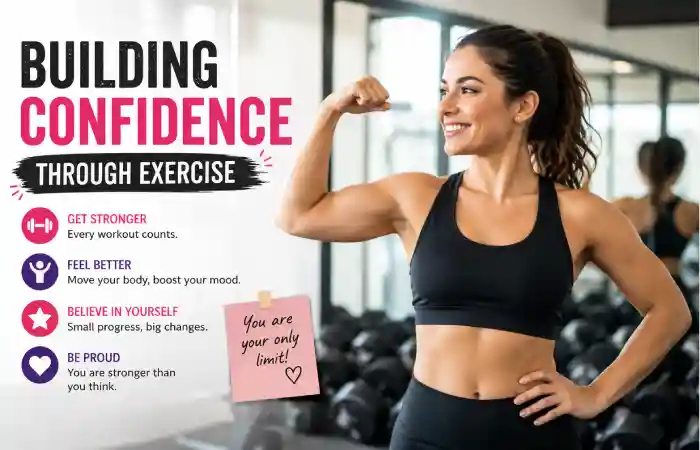
You’re going to want confidence before you’ve even started. Confidence comes through showing up. But don’t be too intimidated. Make the environment more comfortable.
Start with familiar movements
Beginners can start with simple movements such as:
- Bodyweight squats
- Glute bridges
- Wall or incline push-ups
- Resistance-band rows
- Step-ups
- Walking
- Basic mobility exercises
Learn proper technique before adding significant resistance.
Track small wins
Do not measure progress only through body weight.
Track:
- Number of workouts completed
- Walking distance
- Repetitions completed
- Resistance used
- Energy levels
- Sleep quality
- Exercise consistency
- Improvements in everyday activities
Choose exercise you actually enjoy
Running is not mandatory.
You could try:
| Activity | Best For |
| Walking | Beginners and low-impact movement |
| Strength training | Building strength and muscle |
| Yoga | Mobility, balance and mind-body practice |
| Cycling | Cardio and outdoor activity |
| Dancing | Enjoyable cardio |
| Swimming | Low-impact full-body exercise |
| Group classes | Social accountability |
| Home workouts | Convenience and privacy |
The most effective option is often the activity you are willing to keep doing.
Creating a realistic schedule, preparing your workout clothes in advance, and tracking small wins can all make it easier to stay consistent. For more practical ideas, check out these workout motivation tips.
Long-Term Success Tips
Motivation naturally rises and falls. Your system should work even when motivation is low.
- Schedule workouts
Put exercise on your calendar like any other important appointment.
- Prepare the night before
Place your workout clothes, shoes, water bottle or equipment where you can easily see them.
- Make starting easy
Tell yourself you only need to begin with 10 minutes. Once you start, continuing often becomes easier.
- Find accountability
A workout partner, trainer, class or supportive online community can make exercise more enjoyable and create social commitment.
- Change your routine when boredom appears
Try a different walking route, class, workout format or strength routine.
- Plan for missed workouts
Missing one workout is normal.
The problem is turning one missed session into an abandoned routine.
Use this rule:
Miss once → return at the next opportunity.
- Focus on identity
Instead of thinking:
“I am trying to get fit.”
Think:
“I am someone who makes time for movement.”
The findings are consistent with findings that are in line with psychological principles. These studies suggest the relationship between women’s participation and their autonomous motivation and psychological needfor autonomy and competence.
Fitness Motivation Troubleshooting
“I don’t feel motivated.”
Do not wait for motivation. Put on your workout clothes and commit to 10 minutes.
“I don’t have enough time.”
Break exercise into smaller sessions or choose a short home workout. Some activity is better than none, and WHO specifically recommends gradually increasing activity for people who are currently inactive.
“I started but stopped after a few weeks.”
Your routine may be too ambitious. Reduce frequency or workout duration and rebuild consistency.
“I’m not seeing results.”
Let your body adjust. Instead of just one marker, try to measure strength, stamina, energy and consistency.
“I feel uncomfortable at the gym.”
Start with quieter hours, beginner-friendly equipment or home workouts. You can gradually become more comfortable as your experience increases.
“I keep comparing myself with other women.”
Remember that someone’s fitness level reflects their own history, not your starting point. Compare your current performance with your previous performance.
A Simple Weekly Fitness Motivation Plan
| Day | Example Activity | Time |
| Monday | Full-body strength | 25–40 min |
| Tuesday | Walking | 20–30 min |
| Wednesday | Rest or mobility | 10–20 min |
| Thursday | Full-body strength | 25–40 min |
| Friday | Walking/dance/cycling | 20–30 min |
| Saturday | Enjoyable activity | 30–60 min |
| Sunday | Rest + plan next week | — |
This is only an example. Adjust the frequency, duration and intensity according to your fitness level, preferences and circumstances.
Choosing Fitness Products Without Overspending
Commercial fitness products can support consistency, but equipment is not a requirement for becoming active.
| Product | Useful For | Priority |
| Comfortable walking/training shoes | Walking and general workouts | High |
| Resistance bands | Home strength training | Medium |
| Exercise mat | Yoga, mobility and floor exercises | Medium |
| Dumbbells | Progressive strength training | Optional |
| Fitness tracker | Activity tracking | Optional |
| Workout app | Guided sessions | Optional |
Before buying equipment, ask:
- Will I actually use it?
- Does it solve a real problem?
- Can I start without it?
- Is it appropriate for my fitness level?
- Does it fit my available space and budget?
A product should make your routine easier—not become another source of pressure.
A home workout can be a convenient option when time, privacy, or access to a gym is a challenge. If you prefer exercising at home, these strategies for motivation to work out at home can help you stay consistent.
FAQs
What are the best motivators for women?
The best motivation for anyone is your own. Targets tied to strength, energy, health, fun, and body confidence can be far more enduring than goals driven by nothing more than looks and weight loss.
What are effective ways to stay motivated women?
Develop achievable goals, book them into your day, pick activities that are FUN, document small successes, and always have a fallback to days that are packed.
What to do if time is a concern and you need to stay motivated?
Embrace short workouts, combine workouts into other tasks, keep a simple “maintenance” option for especially dire days.
Can I exercise at home as a beginner?
Yes: in home walking, body weight resistance training, resistance band exercise, movement and flexibility work, and beginner yoga programs are fine ways to get started.
How many workouts do women need every week?
WHO advises both adults have 150-300 mins moderate and 75-150 mins vigorous work per week, alongside strength work twice weekly. Small amounts suffice for beginners.
What can I do if I suddenly feel demotivated?
Don’t perceive the motivation dip as defeat. Shrink your workout back into an option to do and remember why you’re exercising to get you through your next workout and put any thoughts for the full month behind you.
Final Takeaway
At the end of the day, motivation for women’s fitness is less about cultivating everlasting motivation and more about developing a manageable, practical routine.
Set realistic and sustainable fitness goals. Start out small. Do activities that you love. Measure progress and motivation in ways other than the number on a scale.
Adjust and adapt exercise during times when you need to cope with business, and find ways to get a success habit through small victories. Remember that consistent doesn’t mean perfection, it means consistent returning to you habit.
Afiya Jafar is a fitness and wellness writer who focuses on making health, exercise, and healthy lifestyle information simple and practical. Her work covers workouts, fitness motivation, strength training, nutrition, weight management, stress management, mindfulness, and everyday wellness.
Read Full Bio of Afiya Jafar →
Sameena Begum reviews selected health, wellness, fitness, and digital content for clarity, factual presentation, consistency, and reader usefulness. Her review work helps maintain clear and responsible editorial standards across PhysicalFitt content.
Read Full Bio of Sameena Begum →
Dr. Khizrana Begum is a qualified medical professional with MBBS and MD qualifications and 5+ years of experience in the medical field. She works as a General Physician and Dermatologist, with expertise in general medicine, dermatology, preventive healthcare, and skin health.
Read Full Bio of Dr. Khizrana Begum →