
 Afiya Jafar
Fitness & Wellness Writer
Afiya Jafar is a fitness and wellness writer who focuses on making health, exercise, and healthy lifestyle information simple and practical.
Read Full Bio of Author →
Afiya Jafar
Fitness & Wellness Writer
Afiya Jafar is a fitness and wellness writer who focuses on making health, exercise, and healthy lifestyle information simple and practical.
Read Full Bio of Author →
 Sameena Begum
Health, Fitness & Digital Content Reviewer
Sameena reviews selected health, wellness, fitness, and digital content for clarity, factual presentation, and reader usefulness.
Read Full Bio of Reviewer →
Sameena Begum
Health, Fitness & Digital Content Reviewer
Sameena reviews selected health, wellness, fitness, and digital content for clarity, factual presentation, and reader usefulness.
Read Full Bio of Reviewer →
 Dr. Khizrana Begum
General Physician & Dermatologist
Dr. Khizrana Begum is a General Physician and Dermatologist with MBBS and MD qualifications and 5+ years of experience in the medical field.
Read Full Bio of Medical Reviewer →
Dr. Khizrana Begum
General Physician & Dermatologist
Dr. Khizrana Begum is a General Physician and Dermatologist with MBBS and MD qualifications and 5+ years of experience in the medical field.
Read Full Bio of Medical Reviewer →
Sleep health goes beyond the amount of sleep you get at night. It encompasses whether your sleep is enough, restorative, occurring at the right time, in a consistent manner, and ultimately beneficial for your physical and mental health. If you are in good health, the benefits of which extend to better concentration and alertness during the day, better mood, better recovery physically, and the better quality of your life as a whole.
Studies are now beginning to recognize sleep as being much more of a health behavior than a simply inert state for recovery, and various dimensions exist to understand what healthy sleep looks like, including sleep satisfaction, sleep timing, sleep duration, sleep efficiency and wake alertness.
Good sleep is an important part of overall wellness, but it works best alongside other healthy lifestyle choices. Explore these practical health tips for more ways to support your everyday health.
❝
This article is a part of
General Health Hub
What Is Sleep Health?
Your sleep health-the general quality and design of your sleep and the extent to which it aids your well-being and functioning during waking hours. This involves not only sleep duration but also when you sleep, regularity, the ease with which you fall and stay asleep and feeling restored during the day.
This is somewhat different than sleep hygiene. The latter involves primarily behavioral habits and environmental recommendations associated with sleep: e.g., maintaining a consistent bedtime, avoiding stimulating activities just prior to sleep, taking regular exercise, maintaining a desirable bedroom environment.
While sleep health is the larger goal to consider, sleep hygiene represents another important tool that one uses to achieve the goal of good sleep health.
Someone can fulfill the criterion of spending eight hours asleep each night, yet poor sleep health would exist due to numerous awakenings, treatingsleep apnea,or having significantinsomnia, or the subjective experience of daytime fatigue.
Why Quality Sleep Matters
During our sleep cycles, the brain and body undergo various important actions associated with memory, learning, physically repairing itself, our metabolism, immunity system and emotional processing. As the National Heart Lung and Blood Institute put it: “When people are denied the amount of sleep their body requires, it affects concentration, decision making, reaction time, learning ability, mood, and overall physical performance”.
Insufficient sleep can have further health problems associated with it and so regularly achieving less sleep than you actually need has long term health implications associated with it including becoming obese or diabetic, having high blood pressure and heart disease and a reduced ability of the immune system, plus being accident prone to name just a few, additionally depression can be suffered in relation to poor quality sleep and long term health impacts the effects of which include chronic conditions to arise over the years.
Sleep quality can be influenced by your daily routine, activity levels, nutrition, and other lifestyle choices. Learn more about healthy lifestyle choices that can support better overall well-being.
Sleep Health at a Glance
| Sleep-health factor | What healthy sleep generally looks like |
| Duration | Enough sleep for your age and individual needs |
| Regularity | Similar sleep and wake times most days |
| Quality | Mostly uninterrupted, restorative sleep |
| Timing | Sleep aligned reasonably well with your daily schedule |
| Daytime function | Good alertness, energy, concentration, and mood |
| Environment | Quiet, dark, comfortable, and sleep-friendly bedroom |
Creating a consistent bedtime routine is one of the simplest ways to develop better sleep patterns. Discover practical healthy habits that can help you build a more consistent approach to wellness.
These factors work together. Increasing sleep duration does not necessarily solve a problem if sleep quality or timing remains poor.
How Much Sleep Do You Need?
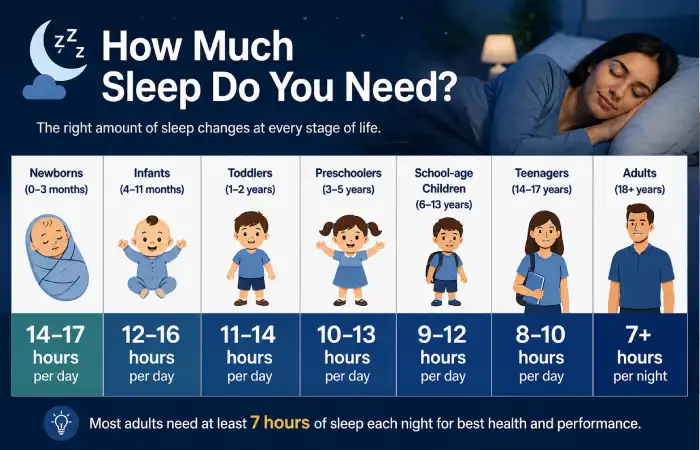
Sleep requirements change throughout life.
| Age group | General recommended sleep |
| Newborns | 14–17 hours |
| Infants | 12–16 hours, including naps |
| Toddlers | 11–14 hours, including naps |
| Preschoolers | 10–13 hours, including naps |
| School-age children | 9–12 hours |
| Teenagers | 8–10 hours |
| Adults | 7 or more hours |
| Older adults | 7–8 hours |
Prioritizing quality sleep can be part of a broader approach to taking care of your health before problems arise. Explore these preventive health tips for more proactive wellness strategies.
Most adults who are generally healthy need seven to eight hours sleep per night. The need for sleep varies between individuals, young people or someone coming out of sleep deprivation may need 8 or 9 hours.
Benefits of a Consistent Sleep Schedule
Maintaining regular sleep/wake times solidifies your body’s internal body clock. In fact, more regular sleep has been shown to lead to better results in many areas – such as heart/metabolic health, cognitive functioning, mental/emotional health and mental readiness/sleep quality – through an expert consensus derived by the National Sleep Foundation. For more information, it’s best to begin with establishing your regular wake up time, then adjusting your sleep onset accordingly.
When it is feasible keep a moderate contrast between your sleep schedule weekdays/weekends.
If your schedule differs significantly on an everyday basis, start out gradually (rather than by several hours of one block.)
How to Improve Sleep Quality
It normally takes some simple and repeated practices for you to sleep better rather than buying an expensive product.
While healthy sleep habits are important, regular healthcare can also help you stay informed about your overall well-being. Learn more about regular health checkups and the role they can play in maintaining your health.
Make your sleeping space dark, quiet, cool and comfortable; and try to keep some relax pre-sleep practices and limit activating stimuli before bed. Morning doses of light are also useful to support your biological clock.
Here are some additional common strategies that might be worth trying:
- Consistent sleep and wake-up schedule
- Prioritise your sleep; see it as the time dedicated for it instead of spare time
- Take care with the intake of caffeine later on the day if you are sensitive to them when you need to sleep
- Avoid heavy food right before bed
- Get regularly exercise
- Take away bright light as well as activated screen use before bed
- Ensure that the bed itself is intended mostly for sleep and avoid its use for protracted work and amusements
- Naps are better short and around midday, if you find they bother your night’s sleep
If you buy products that are for supporting sleep, investigate first for what they are meant before buying the most expensive alternative.
| Sleep-support option | Potential use | Important consideration |
| Blackout curtains | Reducing unwanted light | Particularly useful for bright bedrooms or shift workers |
| White-noise machine | Masking inconsistent background sounds | Choose a comfortable volume |
| Sleep tracker | Monitoring sleep patterns and trends | Estimates are not medical diagnoses |
| Supportive pillow | Improving comfort and positioning | Personal fit matters |
| Mattress | Improving pressure relief and comfort | Firmness preference varies considerably |
Stress can make it harder to maintain a consistent and restful sleep routine. Explore these practical stress management tips to learn ways to manage everyday stress and support better overall wellness.
Sleep trackers can be useful for observing patterns, but they should not be treated as definitive measurements of sleep stages or as substitutes for medical assessment. In people with insomnia, excessive sleep tracking can sometimes increase anxiety about sleep.
Foods and Drinks That Can Affect Sleep
One aspect of diet that may affect sleep specifically in people due to ingesting foods or drinks shortly before trying to go to bed is also examined below.
Perhaps the key dietary consideration in the research with sleep in adults is caffeine. Studies have mostly linked caffeine consumption with both longer sleep onset time and fewer total hours spent asleep. The perceived quality of sleep has also been reported to be worse among caffeine consumers. However, a very wide individual variation is present here.
Alcohol could produce initial feelings of sleepiness but negatively affect sleep over the remainder of the night. Large or hefty meals consumed immediately before attempting to go to sleep may also cause a form of uncomfortable sensations thus compromising sleep.
A balanced diet with plenty of fruit, vegetables, whole grains, legumes, sufficient protein seems to be a reasonable start. The current understanding regarding specific “sleep foods” is still very preliminary so particular food may not be described as a ” cure” for insomnia.
Exercise and Sleep
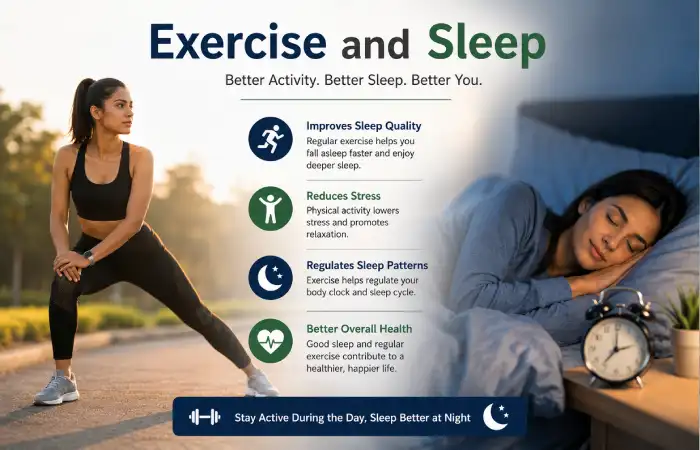
Getting some regular exercise can contribute to better sleep and health. The benefits might include: improved sleep quality; management of stress; improved energy levels throughout the day. Consider the time of day If you are not able to relax and go to sleep after your evening routine and think that strenuous evening exercise is causing it, consider moving this exercise earlier in the day.
If evening exercise relaxes you and does not pose a problem then don’t worry about it.
Most importantly – Be Consistent! An exercise regimen is useless if you work out heavily on the weekend then take next five days off.
Stress and Sleep
In sleep and stress, a cycle can form. In sleep the effects of stress can make falling asleep harder, and lack of sleep can leave your emotions at your mercy, hindering your ability to deal with the events of the day.
If you are having trouble settling your thoughts when you go to bed try the exercise in step 2 by writing down and planning tomorrow’s events before you head to bed. Other methods to try are progressive muscle relaxation, deep breathing, meditation, reading before sleep, or simply a ritual to calm down before bed.
Don’t make falling asleep a task to do correctly. Looking at the clock can lead to feelings of frustration and a worry over the lack of time spent asleep.
If you are anxious, depressed, or have any mental health condition affecting your sleep then you should seek professional help for your anxiety or other condition.
Common Sleep Problems
Many people experience insomnia, sleep apnea, restlessness legs,narcolepsy,circadian rhythms or can fall asleep. Sleep is classified as not being able to fall asleep or stay asleep, or waking up too early;which is known as insomnia. The sleep disorders include sleep apnea, which are causes in which you stop breathing while asleep.
Typical symptoms would include loud snoring and gasping.
In addition, sufferers can have severe daytime sleepiness and headaches. For instance, according to the Cleveland Clinic,sleep disorders are mental or physical conditions that can cause harm both to a person’s mind and body, and they encompass insomnia, restless legs syndrome, narcolepsy, and sleep apnea.
Do not assume that every sleep problem is caused by poor sleep hygiene. Persistent symptoms may have an underlying medical cause.
When to Seek Professional Help for Sleep Problems
If you can not sleep through the night more than three times per week and these bouts are affecting your day and everyday living-such as work, school, the workplace, relationships, and personal security-you should seek medical attention from your healthcare provider. You should also seek medical attention if you:
Find that your snoring is regularly loud and / or if you find yourself gagging or choking when you sleep Make audible gasping sounds while sleeping have been seen with your partner to stop breathing or have a number of gaps in your breathing when you were asleep Are typically very sleepy when you are normally not have a tendency to fall asleep unexpectedly whenever you’re doing everyday actions Can not seem to fall asleep or stay asleep more than three times per week frequently Twitch and jerk your limbs while sleeping
Do not consider sleep supplements, wearable device information or the opinions of online “experts” if any of the symptoms listed indicate that you may actually have a sleep disorder-speak with a health care provider who will decide if more information and maybe even a sleep study would benefit you. (CDC)
The Bottom Line
Sleep Health and HabitsSleep Health, which consists of duration, quality, timing, regularity, and effectiveness, is one aspect of Health that is being studied. Most adults require a minimum of 7 hours of sleep, the optimum of which is individualized.
Where is that we should start?
The beginning is the best.
Stick to a healthy, balanced, regular, and predictable sleep schedule, the correct sleep setting, an exercise, diet with particular regard of caffeine and dinner meal, stress management as well as consult professional and seek medical treatment or advice when concerned about sleep disorder or persistent symptoms. Healthy sleep doesn’t mean you just stay late in bed. Healthy sleep actually mean you organize your lifestyle so you sleep and recovering properly. Persistent sleep concerns or even suspicion of a sleep disorders should warrant medical examination by an appropriately qualified professional.
Afiya Jafar is a fitness and wellness writer who focuses on making health, exercise, and healthy lifestyle information simple and practical. Her work covers workouts, fitness motivation, strength training, nutrition, weight management, stress management, mindfulness, and everyday wellness.
Read Full Bio of Afiya Jafar →
Sameena Begum reviews selected health, wellness, fitness, and digital content for clarity, factual presentation, consistency, and reader usefulness. Her review work helps maintain clear and responsible editorial standards across PhysicalFitt content.
Read Full Bio of Sameena Begum →
Dr. Khizrana Begum is a qualified medical professional with MBBS and MD qualifications and 5+ years of experience in the medical field. She works as a General Physician and Dermatologist, with expertise in general medicine, dermatology, preventive healthcare, and skin health.
Read Full Bio of Dr. Khizrana Begum →