
 Afiya Jafar
Fitness & Wellness Writer
Afiya Jafar is a fitness and wellness writer who focuses on making health, exercise, and healthy lifestyle information simple and practical.
Read Full Bio of Author →
Afiya Jafar
Fitness & Wellness Writer
Afiya Jafar is a fitness and wellness writer who focuses on making health, exercise, and healthy lifestyle information simple and practical.
Read Full Bio of Author →
 Sameena Begum
Health, Fitness & Digital Content Reviewer
Sameena reviews selected health, wellness, fitness, and digital content for clarity, factual presentation, and reader usefulness.
Read Full Bio of Reviewer →
Sameena Begum
Health, Fitness & Digital Content Reviewer
Sameena reviews selected health, wellness, fitness, and digital content for clarity, factual presentation, and reader usefulness.
Read Full Bio of Reviewer →
 Dr. Khizrana Begum
General Physician & Dermatologist
Dr. Khizrana Begum is a General Physician and Dermatologist with MBBS and MD qualifications and 5+ years of experience in the medical field.
Read Full Bio of Medical Reviewer →
Dr. Khizrana Begum
General Physician & Dermatologist
Dr. Khizrana Begum is a General Physician and Dermatologist with MBBS and MD qualifications and 5+ years of experience in the medical field.
Read Full Bio of Medical Reviewer →
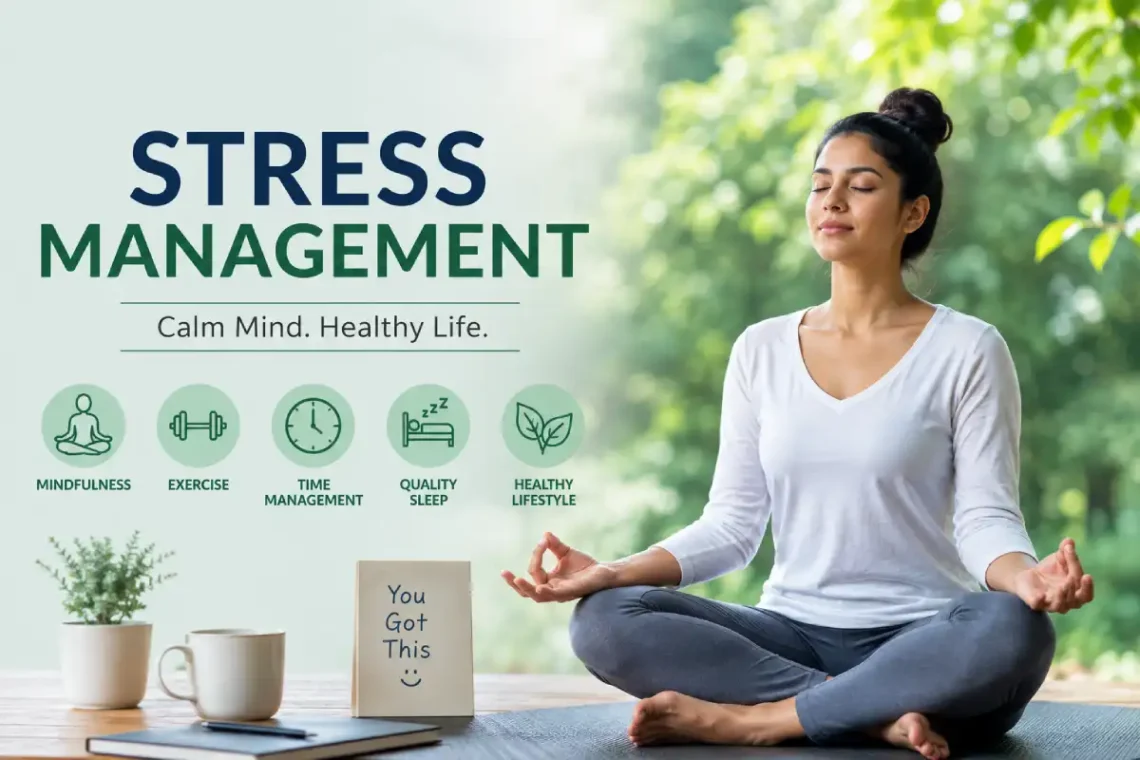
We all experience stress from time to time as we encounter difficulties in our lives. Chronic stress-when unmanaged- can affect your sleep and concentration; your mood and relationships; and your overall health. Stress management teaches you: your stresses recognize triggers you can minimize unnecessary ones take on new challenges and how respond to stressful events, and develop lifestyle habits that enhance your resilience.
According to Mayo Clinic, chronic stress can activate the body’s “fight-or-flight” system but the mental-health benefits of stress-management coping strategies will help your body to accommodate life’s continued demands.
It isn’t to necessarily help you to avoid all stress in your life, rather it’s about responding with relative calm to pressure so as not to chronically impact your physical and/or your mental health.
Managing stress is an important part of maintaining your overall health and well-being. Explore these practical health tips for more ways to build a healthier daily routine.
❝
This article is a part of
General Health Hub
What Is Stress Management?
What techniques can I use to eliminate the feeling of being over stressed, it has been almost 3 years this way the negative thoughts are never going away and the worrieds are gettingbiggerand bigger no one has to tell me anything I always assume the best or the worst. Behavioral, Psychological and Lifestyle measures are what we can consider behavioral, physical and life styles we used to take care of these things when we feel too stressed; Breathing exercise and meditation; Yoga; Exercise;adequate sleeping pattern; Spending time in nature; Meditation with friends/ partners ; Journaling/ diarywriting.
There is not only one technique that can cure it, one has the to combine,short period calmingtechniquewitheffects which can be applied to everyday practices which can minimize and reduce stress in your daily life in a more general way of course it is better to identify what exactly stressors in order to manage.
How Stress Can Affect Your Health
Stress lasting a brief time will boost energy and vigilance. Persistent stress activating this pathway causes problems. The American Psychological Association indicates that sustained stress can have a variety of effects on many body systems, ranging from circulatory and respiratory to the endocrine, digestive and nervous systems. It also impacts the musculoskeletal system.
| Area affected | Possible effects of prolonged stress |
| Mental health | Irritability, anxiety, difficulty concentrating |
| Sleep | Trouble falling or staying asleep |
| Muscles | Tension, aches and headaches |
| Digestive system | Stomach discomfort and digestive symptoms |
| Cardiovascular system | Increased heart rate and blood pressure |
| Behavior | Unhealthy eating, withdrawal or reduced activity |
Your daily lifestyle can have a significant impact on how you handle stress and maintain emotional well-being. Discover these healthy lifestyle tips for practical ways to support a balanced routine.
This does not mean stress automatically causes a particular disease. Rather, persistent stress can interact with existing health risks and unhealthy coping behaviors.
Common Causes of Stress
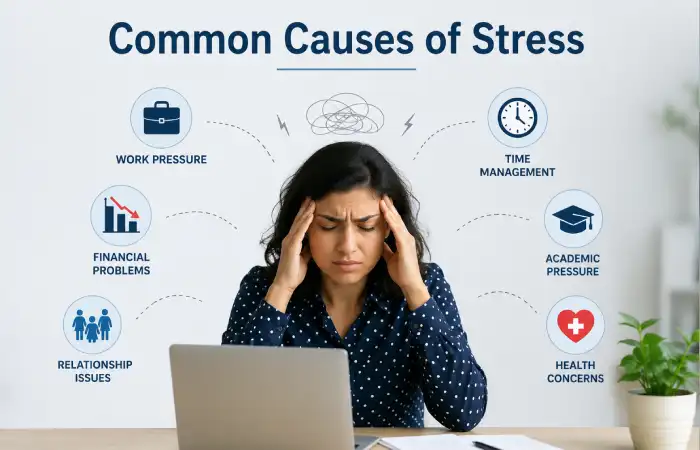
Job or school deadlines, money troubles, difficult relationship problems, a stressful change in your life, taking care of a person or being constantly deprived of sleep may all make you feel down in the dumps. Even though you deal with stressors at one, two or all of them at the same time may not be an overwhelming or taxing situation.
The accumulated small events of life may also pose a challenge as it will wear down to a mild degree of the day stress that would ultimately effect in one too and you won’t get to find out it just not enough space when in fact its part of day to day that would become that to and you are all of sudden shocked.
In order to get some control over them, you can start out writing in a stress journal, which would help you get through many of that because you record down and keep track on what is happening to make your thought process into action by tracing those back.
Breathing Exercises for Stress
Controlled breathing is the simplest technique to use in a stressful, acute event. To control breathing, breathe in slowly to a count of four, hold to a count of four, breathe out to a count of six and continue several times. Alternatively, just slow and control breathing such that exhaling comes easily and without forcing; it is not to get the deepest breath possible.
Simple, consistent routines can make it easier to manage everyday pressure and support better overall wellness. Learn more about building healthy habits that can become part of your daily routine.
The idea is just to break a rapid, shallow breathing pattern with a “break of a few seconds.
A short cut can be as follows: place yourself comfortable with a relaxing posture. Focus breathing so that it slow. In and out is then to be attended to with attention to breath over few breaths.” In the event the controlled breathing has the counter effect of increasing unease or dizziness: simply return to your normal style of breathing
Exercise and Stress Relief
Physical activity is the active part of stress management. Walking, biking, swimming, dancing, weight training and other physical forms of relaxation can all serve to enhance the mood and the health.
You don’t always need a rigorous exercise to combat your stresses. While this will still have a benefit to your health and your stress levels, a quick walk can sometimes get you going to continue from a state of mental exhaustion resulting from hours of sitting. The Cleveland Clinic has in fact suggested physical activity as a part of its daily activities designed to cope with stress.
Mindfulness and Relaxation Techniques
Mindfulness isn’t about thinking without consciously thinking, but is an act of directing attention to the current moment rather than impulsively responding to a stressed induced thought. The easy forms of this would be medatation, progressive muscle relaxation, grounding activities, stretches and simply time alone without any form of technology available. As pointed out by the Mayo Clinic, relaxation exercises can help reduce symptoms of stress and require minimal costs or equipment. If meditating for the first time, attempt it for 5 minutes first instead of a prolonged amount.
Taking a proactive approach to your health can include managing stress before it begins to interfere with your daily life. Explore these preventive health tips for additional ways to support your long-term well-being.
Healthy Sleep and Stress Management
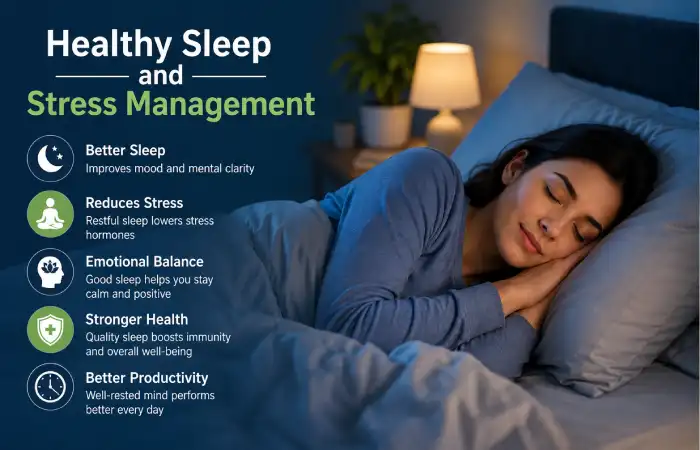
Reinforcing vicious cycle. When stressed the worry can make it impossible to fall asleep. Lack of sleep may not help cope.
Develop a consistent sleep habits Schedule the sleep and wake time at a regular hour Try to be inactive at least one to two hours prior bed Have quiet and comfortable place to go to bed; decrease or eliminate the needless time that the screen is used up at nights.
The American Psychological Association stresses that sufficient sleep can be considered one.
Managing Everyday Stress
The key to managing long-term stress and coping with difficult circumstances is to incorporate helpful strategies into your day-to-day life. The APA also says that emotional support is a buffer when facing hardships as well.A simple daily routine might include:
| Time | Stress-management habit |
| Morning | Brief breathing or mindfulness practice |
| Daytime | Movement breaks and realistic task priorities |
| Evening | Reduce stimulating screen activity |
| Before bed | Relaxation routine and consistent sleep schedule |
If stress becomes persistent or starts affecting your daily life, talking with a healthcare professional can be an important step. Learn more about regular health checkups and staying proactive about your overall health.
2026 Evidence Snapshot
Current authoritative guidance continues to emphasize a combination rather than a single “best” stress-relief method:
Physical activity + adequate sleep + relaxation skills + social support + appropriate professional care
This combination is more defensible than claims that one supplement, device or app can “cure” stress. APA guidance supports exercise, sleep and social support, while Mayo Clinic and HelpGuide emphasize relaxation, lifestyle changes and identifying stress triggers.
Common Stress Management Mistakes
Misconception Stress is going to magically go away When you accept the idea of stress as part of life, the goal is to do the work to be better able to manage it when it shows up-not to eliminate stress completely. Others: drinking alcohol or drugs, overeating, isolation, avoidance, going without sleep or undertaking too many lifestyle changes at once.
“We find when clients come to us, they have unhealed trauma-related stress and we help them not to avoid their trauma, but to manage it much better in the future,” HelpGuide lists on its website, also suggesting substitution of unhealthy behaviors for healthier ones.
Stress and sleep are closely connected, and creating a healthy nighttime routine can be an important part of managing everyday pressure. Explore these practical sleep health tips for ideas to support better rest.
Not Making Time For Relaxation Treating relaxation as an activity for when you are in crisis can lead to these techniques feeling unavailable when they are most needed.
Regular implementation of little practices make them more readily accessible during time.
When to Seek Professional Support
Talk to your doctor or a mental health professional about when to seek care when stress is chronic, persistent and not possible to manage – or beginning to interfere with daily activities. Warning signs may involve a consistent problem sleeping; major shifts in behavior and mood; disruption at school or work; persistent physical symptoms of stress; and increasing use of harmful coping.
MedlinePlus encourages people to call their health doctor if stress and/or depression are disrupting the day-to-day. There is no shame in professional assistance of this type; there is nothing wrong with the management being at risk if stress and/or depression is having such an effect. Psychologists and therapists specialize in helping the identified and the affected people discover their stressors,and then create a viable solution set to make a change.
Bottom line
Managing stress doesn’t require you to shun all challenging events. It is the ability to acknowledge stress as it appears and then resort to healthy coping practices in everyday habits. Physical and psychological well-being are enhanced by daily stress management routine.
Afiya Jafar is a fitness and wellness writer who focuses on making health, exercise, and healthy lifestyle information simple and practical. Her work covers workouts, fitness motivation, strength training, nutrition, weight management, stress management, mindfulness, and everyday wellness.
Read Full Bio of Afiya Jafar →
Sameena Begum reviews selected health, wellness, fitness, and digital content for clarity, factual presentation, consistency, and reader usefulness. Her review work helps maintain clear and responsible editorial standards across PhysicalFitt content.
Read Full Bio of Sameena Begum →
Dr. Khizrana Begum is a qualified medical professional with MBBS and MD qualifications and 5+ years of experience in the medical field. She works as a General Physician and Dermatologist, with expertise in general medicine, dermatology, preventive healthcare, and skin health.
Read Full Bio of Dr. Khizrana Begum →