
 Afiya Jafar
Fitness & Wellness Writer
Afiya Jafar is a fitness and wellness writer who focuses on making health, exercise, and healthy lifestyle information simple and practical.
Read Full Bio of Author →
Afiya Jafar
Fitness & Wellness Writer
Afiya Jafar is a fitness and wellness writer who focuses on making health, exercise, and healthy lifestyle information simple and practical.
Read Full Bio of Author →
 Sameena Begum
Health, Fitness & Digital Content Reviewer
Sameena reviews selected health, wellness, fitness, and digital content for clarity, factual presentation, and reader usefulness.
Read Full Bio of Reviewer →
Sameena Begum
Health, Fitness & Digital Content Reviewer
Sameena reviews selected health, wellness, fitness, and digital content for clarity, factual presentation, and reader usefulness.
Read Full Bio of Reviewer →
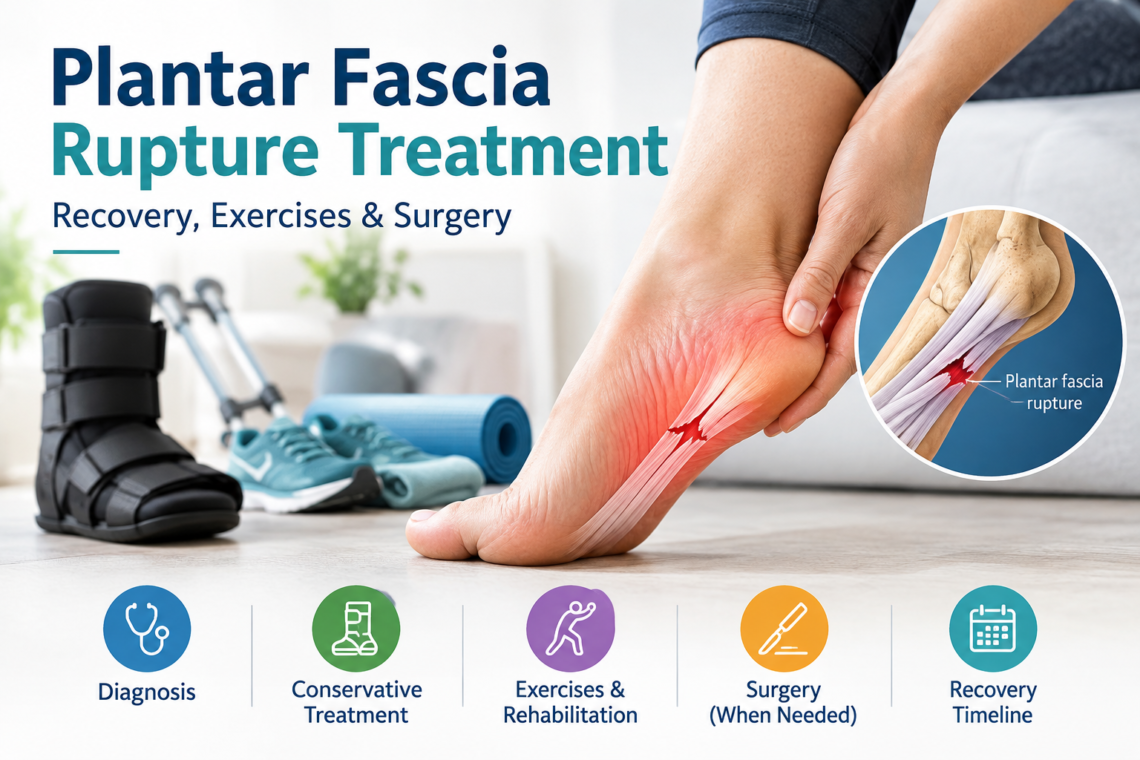
The conservative treatment for a rupture of the plantar fascia should aim to protect the foot, control pain and swelling and eventually return to weight bearing and strengthen. Most published cases have been treated non operatively but the choice of method used would be guided by the severity of disruption of the sheath, location of rupture, severity of symptoms and activity requirements.
A rupture of the plantar fascia is not the same as standard plantar fasciitis. A rupture is a tear in a tissue structure called the plantar fascia the dense sheet of tissue that supports the sole of the foot. Ruptures of this nature can be sudden, during running, jumping, acceleration or other time of stress. Some ruptures occur in patients with prior plantar fasciitis.
Since this injury is not common, any severe plantar pain should be assessed rather than assumed to be just another episode of plantar fasciitis.
What Does a Plantar Fascia Rupture Feel Like?
A rupture often has a noticeably different onset from typical plantar fasciitis.
Common symptoms may include:
- Sudden, sharp pain in the arch or heel
- A popping or tearing sensation
- Swelling
- Bruising along the sole or arch
- Difficulty putting weight on the foot
- Tenderness along the plantar fascia
- Pain that remains significant when walking
In contrast, fascial strain is often “insidious” (come on gradually, without pain in the beginning), for instance with pain in the morning on the first step.
An MRI may show an interruption of the plantar fascia as well as associated tissue swelling. Ultrasound may be helpful to determine the fascia has a break in continuity. An X-ray is not useful in directly seeing the fascia but can be helpful to rule out or identify a fracture.
Plantar Fascia Rupture vs. Plantar Fasciitis
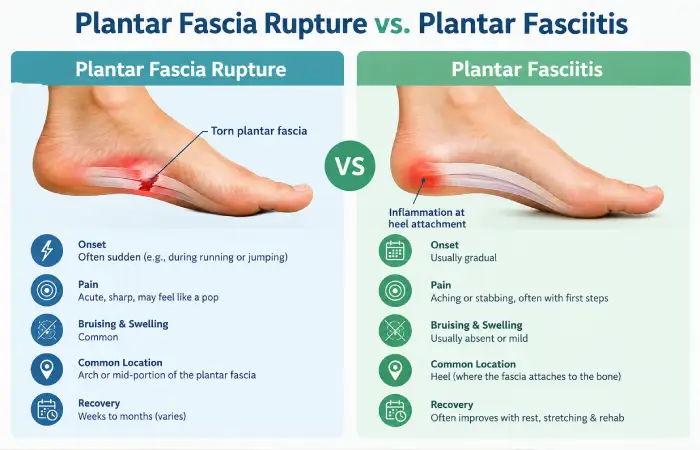
| Feature | Plantar fasciitis | Plantar fascia rupture |
| Onset | Usually gradual | Often sudden |
| Pain | Usually aching or stabbing | Acute and potentially severe |
| Popping sensation | Unusual | May occur |
| Bruising | Usually absent | Can occur |
| Swelling | Usually mild or absent | May be noticeable |
| Location | Commonly near heel attachment | Often arch/plantar fascia |
| Imaging | May show thickening/edema | May show fascial discontinuity |
| Initial approach | Activity modification + stretching/rehab | Protection + gradual rehabilitation |
These are general patterns rather than a way to diagnose yourself.
How Is a Plantar Fascia Rupture Diagnosed?
Diagnosis generally starts with a medical history and physical examination.
Your clinician may ask:
- What were you doing when the pain started?
- Did you feel or hear a pop?
- Did swelling or bruising develop?
- Could you continue walking?
- Have you previously had plantar fasciitis?
- Have you received corticosteroid injections?
- What sports or activities do you normally perform?
MRI can be particularly useful when the diagnosis is uncertain or the clinician needs to determine the location and extent of the tear. Published case reports describe MRI showing interruption of the normal low-signal plantar fascia with surrounding edema.
First-Line Plantar Fascia Rupture Treatment
Most patients are treated non-operatively.
Initial management may include:
Protect the Foot
The use of a walking boot, stiff-soled shoe, cast or crutches is possible according to the severity of injury and the clinical decision.
There is a wide variability of published treatment protocols. A systematic review of treatment protocols found that rigid-walker immobilization averaged 2.6 weeks and newer clinical protocol may use longer periods of protection for select injuries.
Reduce Weight-Bearing Initially
If walking is extremely uncomfortable, your clinician might advise crutches and non-weight-bearing for a while.
Progression of weight-bearing is usually slow rather than abrupt to previous levels of activity as the symptoms are settling.
Control Pain and Swelling
Ice, altitude and activity modification during the acute phase. NSAIDs may be used or advised when indicated, but this will not be suitable for all individuals.
Consult a doctor or pharmacist before using NSAIDs if you have kidney disease, stomach ulcers, are on blood thinning medications, you are pregnant or any other medical problems.
Begin Rehabilitation Gradually
Once the acute injury has settled, rehabilitation can focus on restoring:
- Ankle mobility
- Calf flexibility
- Plantar fascia flexibility
- Intrinsic foot-muscle strength
- Balance
- Walking mechanics
- Gradual load tolerance
A 2024 case report used a phased program progressing from protection and limited weight-bearing to stretching, strengthening, proprioceptive exercises and eventual return to higher loading.
Plantar Fascia Rupture Recovery Timeline
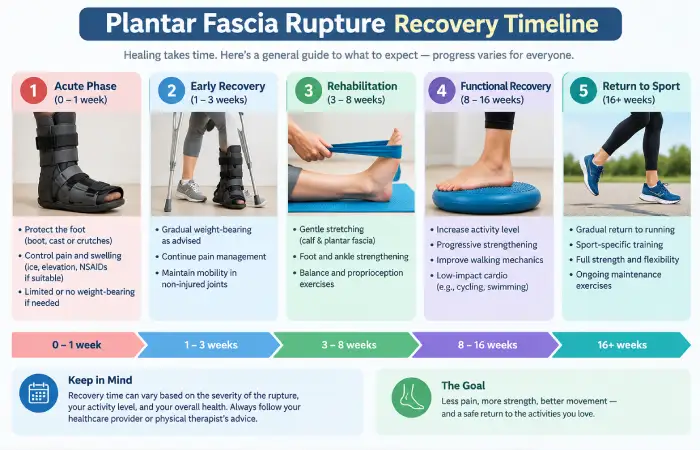
The common recovery time table for each rupture is non-existent.
A single report of 18 athletes indicated return to activity between 2 and 26 weeks (mean of 8.96 weeks). More recent clinical protocols indicate much longer timeframes for high level athletes if the injury is more severe.
A practical framework looks like this:
| Recovery stage | Typical focus |
| Acute phase | Protect foot, control pain/swelling |
| Early recovery | Gradual weight-bearing as advised |
| Rehabilitation | Mobility and strengthening |
| Functional recovery | Balance, walking and progressive loading |
| Return to sport | Jogging → running → sport-specific movements |
Do not use these stages as a substitute for an individualized rehabilitation plan.
Exercises After a Plantar Fascia Rupture
Exercises should be introduced only when the injury is sufficiently healed and your clinician or physical therapist has cleared progression.
Possible rehabilitation exercises include:
- Gentle calf stretching
- Plantar fascia stretching
- Toe curls
- Intrinsic foot strengthening
- Calf raises
- Balance exercises
- Progressive resistance exercises
One case published where doing gentle plantar fascia and Achilles stretching started about 6 weeks and then calf raises and strengthening progressed.
Commencing aggressive stretching, running or jumping too early may apply unnecessary stress to the healing tissue.
Do You Need Surgery for a Ruptured Plantar Fascia?
Usually, surgery is not the first treatment.
Conservative treatment seemed to be the most popular as the systematic review of 124 patients showed that 94.4% of patients had conservative treatment. A systematic review of 155 patients showed there was no randomized controlled studies which again shows how little evidence there is to treat[?]45.
Surgical intervention can be considered in rare circumstances of failure of appropriate conservative treatment or in specific complex injuries.
There are published surgical cases such as one being a reconstruction following an iatrogenic rupture, but these are unusual, irregularities in the norm and not part of the everyday treatment.
Walking Boot vs. Supportive Shoe vs. Orthotic
| Option | When it may be considered | Potential role |
| Walking boot | Acute or more symptomatic injuries | Protects the foot and limits painful loading |
| Stiff-soled shoe | Later recovery | Provides protection while allowing more normal walking |
| Orthotic | Rehabilitation/return to activity | Provides arch support and changes load distribution |
| Crutches | Severe acute pain | Reduces weight-bearing |
The appropriate choice depends on the extent and location of the rupture and should be determined clinically.
Key Takeaway
The current evidence up to 2026 does advocate a conservative-first approach for the majority of plantar fascia ruptures; usually protection, suitable progression of weight bearing and structured rehabilitation. However, the evidence-base is limited, and treatment regimes differ. Where there is a history of a sudden ‘pop’, acute plantar pain, bruising, or severe difficulty with weight-bearing this should be referred to a health professional, and not treated as standard plantar fasciitis.
Afiya Jafar is a fitness and wellness writer who focuses on making health, exercise, and healthy lifestyle information simple and practical. Her work covers workouts, fitness motivation, strength training, nutrition, weight management, stress management, mindfulness, and everyday wellness.
Read full bio of Afiya Jafar
Sameena reviews selected health, wellness, fitness, and digital content for clarity, factual presentation, and reader usefulness.
Read full bio of Sameena Begum