
 Afiya Jafar
Fitness & Wellness Writer
Afiya Jafar is a fitness and wellness writer who focuses on making health, exercise, and healthy lifestyle information simple and practical.
Read Full Bio of Author →
Afiya Jafar
Fitness & Wellness Writer
Afiya Jafar is a fitness and wellness writer who focuses on making health, exercise, and healthy lifestyle information simple and practical.
Read Full Bio of Author →
 Sameena Begum
Health, Fitness & Digital Content Reviewer
Sameena reviews selected health, wellness, fitness, and digital content for clarity, factual presentation, and reader usefulness.
Read Full Bio of Reviewer →
Sameena Begum
Health, Fitness & Digital Content Reviewer
Sameena reviews selected health, wellness, fitness, and digital content for clarity, factual presentation, and reader usefulness.
Read Full Bio of Reviewer →
 Dr. Khizrana Begum
General Physician & Dermatologist
Dr. Khizrana Begum is a General Physician and Dermatologist with MBBS and MD qualifications and 5+ years of experience in the medical field.
Read Full Bio of Medical Reviewer →
Dr. Khizrana Begum
General Physician & Dermatologist
Dr. Khizrana Begum is a General Physician and Dermatologist with MBBS and MD qualifications and 5+ years of experience in the medical field.
Read Full Bio of Medical Reviewer →
Joint pain can make everyday actions that are easy for people without joint problems like walking up the stairs, exercising, cooking or opening a jar, feel almost impossible. To better cope with joint pain, first identify causes and sources, then add the right blend of motion, lifestyle modification, and pain symptom relief and professional health services if indicated.
Most of us suffer from joint pain. 1.71 billion people worldwide struggle with disorders of the musculoskeletal system, as according to the WHO, and in 2019 alone around 528 million had arthritis; with specifically osteoarthritis the figure was closer to 528 million globally.
Joint pain can have many different causes and may require a combination of movement, lifestyle changes, and symptom-management strategies. For a broader overview of these approaches, explore our pain management guide.
However it’s important to note, that the existence of joint pain is not a diagnosis in itself and could also stem from reasons such as arthritis, injury or overuse. Similarly in the case of an infections or gout similar symptoms can be shown to be present, a severe or sustained presentation warrants investigation.
❝
This article is a part of
Pain and Recovery Hub
What Causes Joint Pain?
Pain within the joints occurs for many reasons, and can reveal itself to doctors through its location, length of time the joint has been in pain for, as well as if there are other symptoms present alongside the joint pain.
Causes may include:
- Osteo arthritis, commonly identified by stiffness and gradual pain in a certain joint with restricted mobility.
- Rheumatoid arthritis an auto- immune disease causing stiffness and pain in many joints as well as a feeling of swelling.
- Gout, known for its sudden acute and painful attacks and swelling, usually in the big toe, but any joint in the body can be affected.
- Sprains and strains, most commonly known after an injury, as well as wear and tear through constant/repetitive action or due to sport.
- Inflammation surrounding joints which can appear as bursitis or tendinitis
- Infections – any heat in a swollen joint accompanied by raised temperature requires prompt treatment by the appropriate personnel.
- Lupus and psoriatic arthritis (alongside many others) can lead to arthritis.
The NHS state that when you experience joint pain there is a certain pattern to the disease; such as a relationship between pain and activity or rest.
How Can You Manage Joint Pain?
There isn’t one treatment that works for every type of joint pain. A practical management plan may include:
Joint discomfort is not limited to the arms and legs. Pain and stiffness can also affect the joints and structures around the spine, making back pain management an important part of maintaining comfortable movement.
- Appropriate physical activity
- Strength and mobility exercises
- Weight management when appropriate
- Heat or cold therapy
- Sleep and stress management
- Topical or oral medications when appropriate
- Physical therapy
- Medical treatment for an underlying condition
For relatively mild symptoms of minor trauma after an accident, rest, ice and progressive return to activity might provide temporary benefits; conversely, entirely abandoning all activity could lead to stiffness and decreased function.
For the person with long term Arthritis, the arthritis foundation recommends that:
The knees are among the joints that can be affected by arthritis, injury, repetitive stress, or changes in movement. If knee discomfort is your main concern, our guide to knee pain management provides more specific information.
Joint Pain Relief Options: Quick Comparison
| Approach | Important consideration | Best suited for | Main benefit |
| Gentle exercise | Progress gradually | Long-term joint health | Strength and mobility |
| Stretching | Never force painful movements | Stiffness/reduced mobility | Improves range of motion |
| Heat | Avoid excessive heat | Stiff muscles/stiffness | Relaxation and comfort |
| Cold | Protect skin | Swelling or acute soreness | Temporary pain/swelling relief |
| Topical products | Check active ingredients | Localized superficial pain | Convenient symptom relief |
| Physical therapy | Professional assessment recommended | Persistent or functional problems | Personalized rehabilitation |
Joint pain can sometimes develop after a sprain, strain, fall, sports injury, or other trauma. If your symptoms began following an injury, learn more about pain management after injury and the role of gradual movement during recovery.
Best Exercises for Joint Pain
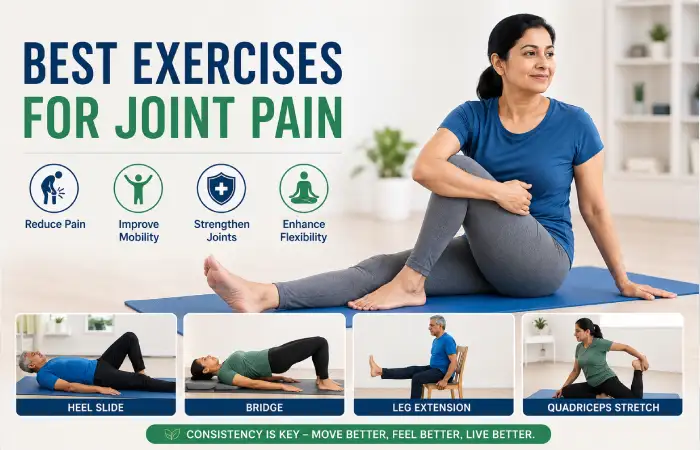
Exercise should generally be gentle, progressive and appropriate for your condition.
Useful options include:
- Walking
- Stationary cycling
- Swimming
- Water aerobics
- Gentle strengthening
- Range-of-motion exercises
- Tai chi
- Modified yoga
A balanced program can combine aerobic activity, strengthening, flexibility and balance work.
Start with a manageable amount rather than trying to compensate for months of inactivity in one workout. If an exercise produces sharp or worsening joint pain, stop and reassess the movement.
Low-Impact Activities for Joint Health
Low-impact exercise reduces the repetitive pounding associated with activities such as running and jumping while still allowing you to stay active.
| Activity | Joint impact | Suitable for beginners |
| Swimming | Very low | ★★★★★ |
| Water aerobics | Very low | ★★★★★ |
| Stationary cycling | Low | ★★★★★ |
| Walking | Low | ★★★★☆ |
| Tai chi | Low | ★★★★★ |
| Jogging | Higher | Depends on condition |
Not all pain around a joint is caused by the joint itself. Burning, tingling, shooting sensations, or numbness may be associated with nerve irritation, so learning about nerve pain management may be helpful when these symptoms occur.
This activity is made useful by the buoyancy provided by water; the resistance will help to exercise your muscles and in conjunction with the support will lessen the effect of gravity on you body.
The most effective exercise however is likely the one you can sustain without increasing your symptoms excessively.
Stretching and Mobility for Joint Pain
Stretching can help maintain mobility, particularly when joints feel stiff after sitting or resting.
Try gentle movements such as:
- Shoulder rolls
- Ankle circles
- Gentle knee bends
- Wrist movements
- Hip range-of-motion exercises
- Gentle calf and hamstring stretches
Perform slowly and do not bounce. Stretching should have a mild stretch sensation, no pain should be felt. For those who are severely restricted with stiffness or have joint problems or diagnosed arthritis a physiotherapist can develop an individualised mobility program.
When joint pain persists for several months or repeatedly interferes with sleep, movement, or everyday activities, a longer-term approach may be needed. In these situations, explore our guide to chronic pain management.
Heat and Cold Therapy for Joint Pain
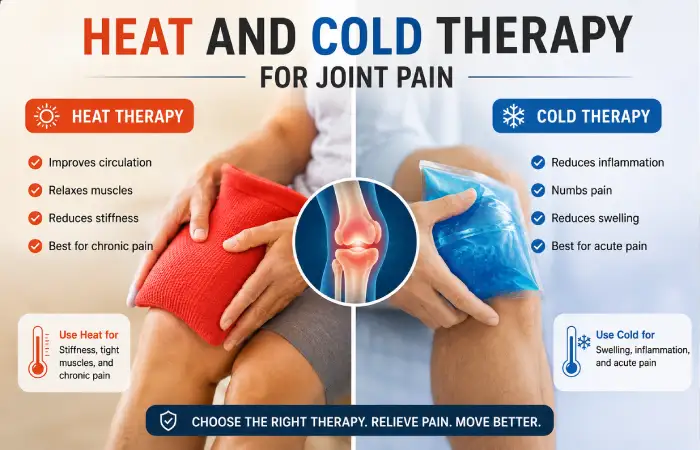
Heat and Cold Therapy for joint pain Heat and cold may reduce symptoms in the short term.
Heat may be beneficial if stiff and tight muscles and may help with improving blood flow to an area and relaxing tense muscles. Cold may be temporarily beneficial for the reduction of pain and swelling after activity or during inflammation. According to the Arthritis Foundation, a hot pack may encourage muscle relaxation while a cold pack may reduce swelling.
Heat vs. Cold
| Situation | Consider |
| Morning stiffness | Heat |
| Tight muscles | Heat |
| Swelling after activity | Cold |
| Acute soreness | Cold |
| Before gentle movement | Heat may help stiffness |
| After exercise with swelling | Cold may help |
Use a towel or protective layer between your skin and an ice pack, and avoid prolonged applications. The NHS recommends an ice pack wrapped in a towel for up to 20 minutes at a time.
Lifestyle Habits for Managing Joint Pain
Daily habits can make joint pain easier—or harder—to manage.
Keep weight manageable-
If the individual is overweight and suffering from disorders of the weight-bearing joints, any subsequent weight reduction would lead to less mechanical forces exerted on the knee, hip, and ankle joints. As stated by the Arthritis Foundation, any 1 lb reduction in body weight is responsible for taking off about 4 lb of pressure on the knee joints.
Maintain adequate physical activity-
The patients should refrain from static posture. Any continuous static posture should be relieved with periodic ambulatory efforts.
Ensure adequate sleep-
Lack of adequate sleep could augment discomfort and impact the patients’ overall ability to participate in activity.
Maintain appropriate stress management techniques-
Stress is often coupled with an increased muscle activity that adds on discomfort to those patients with Chronic Pain. Relaxation technique, diaphragmatic breathing technique and mindful meditation might serve as complementary techniques to the physical therapy modality.
Adequate protection of the joints-
Suitable shoes and orthotics; avoid repetitive weight bearing, etc., and modifying postures/activities when warranted.
When Should Joint Pain Be Evaluated?
Seek medical advice when joint pain:
- Interferes with normal activities or sleep
- Keeps returning or becomes progressively worse
- Has not improved after about two weeks of home care
- Causes prolonged morning stiffness
- Is accompanied by significant swelling
Immediate medical attention should be sought for any hot, swollen joint if the patient also feels hot (has fever) or is generally unwell. For acute injuries an immediate visit to the doctor or hospital are necessary if the patient has pain with any movement, has lost their function, has developed a deformity and if they cannot bear weight on their limb and for injuries in which the joint feels numb.
Diagnosis is also crucial because treatment for diseases like osteoarthritis, gout, RA and infection will be very different from injury.
Joint Pain Management: Simple Daily Routine
For beginners, a simple routine might look like:
Morning:
5–10 minutes of gentle mobility → warm shower → normal daily movement
During the day:
Break up long sitting periods → take short walks → use joint-protection techniques
Exercise:
Choose a low-impact aerobic activity → add gradual strengthening → finish with gentle mobility
Evening:
Relaxation or breathing exercises → comfortable stretching → consistent sleep schedule
Adjust the routine according to your symptoms and medical advice.
Afiya Jafar is a fitness and wellness writer who focuses on making health, exercise, and healthy lifestyle information simple and practical. Her work covers workouts, fitness motivation, strength training, nutrition, weight management, stress management, mindfulness, and everyday wellness.
Read Full Bio of Afiya Jafar →
Sameena Begum reviews selected health, wellness, fitness, and digital content for clarity, factual presentation, consistency, and reader usefulness. Her review work helps maintain clear and responsible editorial standards across PhysicalFitt content.
Read Full Bio of Sameena Begum →
Dr. Khizrana Begum is a qualified medical professional with MBBS and MD qualifications and 5+ years of experience in the medical field. She works as a General Physician and Dermatologist, with expertise in general medicine, dermatology, preventive healthcare, and skin health.
Read Full Bio of Dr. Khizrana Begum →