

 Afiya Jafar
Fitness & Wellness Writer
Afiya Jafar is a fitness and wellness writer who focuses on making health, exercise, and healthy lifestyle information simple and practical.
Read Full Bio of Author →
Afiya Jafar
Fitness & Wellness Writer
Afiya Jafar is a fitness and wellness writer who focuses on making health, exercise, and healthy lifestyle information simple and practical.
Read Full Bio of Author →
 Sameena Begum
Health, Fitness & Digital Content Reviewer
Sameena reviews selected health, wellness, fitness, and digital content for clarity, factual presentation, and reader usefulness.
Read Full Bio of Reviewer →
Sameena Begum
Health, Fitness & Digital Content Reviewer
Sameena reviews selected health, wellness, fitness, and digital content for clarity, factual presentation, and reader usefulness.
Read Full Bio of Reviewer →
The current evidence up to 2026 does advocate a conservative-first approach for the majority of plantar fascia ruptures; usually protection, suitable progression of weight bearing and structured rehabilitation. However, the evidence-base is limited, and treatment regimes differ. Where there is a history of a sudden ‘pop’, acute plantar pain, bruising, or severe difficulty with weight-bearing this should be referred to a health professional, and not treated as standard plantar fasciitis.
What Causes Pain Under the Shoulder Blade?
The shoulder blade, or scapula, is surrounded by muscles, tendons, nerves, ribs and joints. Pain underneath it does not necessarily mean that the shoulder blade itself is injured.
Common causes include:
- Muscle strain or overuse
- Poor sitting or standing posture
- Sleeping in an awkward position
- Repetitive overhead movements
- Heavy lifting
- Neck or upper-back problems
- Rib or thoracic joint irritation
- Nerve irritation
- Shoulder conditions
Less commonly, pain can be referred from the lungs, heart, gallbladder or other internal organs.
Common Causes Compared
| Possible cause | Usually needs evaluation? | Typical clues |
| Muscle strain | If persistent or severe | Pain after exercise, lifting or repetitive activity |
| Poor posture | Usually self-care initially | Worse after desk or phone use |
| Neck-related pain | Yes if persistent | Neck stiffness, tingling or arm symptoms |
| Rib/thoracic irritation | Depends on symptoms | Pain with certain movements or breathing |
| Shoulder problem | If it continues | Pain with shoulder or arm movement |
| Gallbladder problem | Yes | Often right-sided with abdominal symptoms |
| Heart/lung problem | Urgent assessment | Chest symptoms, breathing difficulty or sudden severe pain |
Muscle Strain and Overuse
Muscular strain is one of the typical reasons for pain over or underneath the shoulder blade. The muscles stabilise and move the scapula these include the/ rhomboids, trapezius, levator scapulae and others.
Modest amounts of exercise suddenly exceeded the capacity of these tissues. Lifting a heavy object, repetitive reaching movements or computer work persisted over long periods may bring on pain. This pain may intensify with movement of the arm, turning of the upper body and muscle activity.
Poor Posture
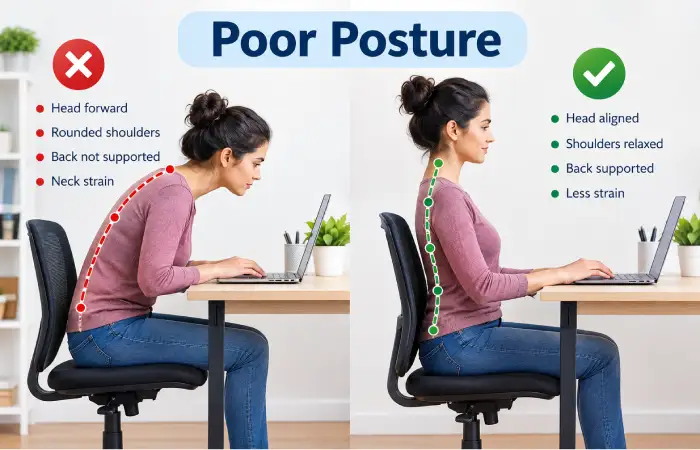
Additional pressure on the muscles supporting the shoulder blades can result from the hours spent bent over a laptop or staring down at a phone.
Postural Pain The pain from bad posture can develop slowly throughout a day and reduce with body motion and position change. Spine-health specifically states that sustained poor posture and positions that load the muscles of the scapula are common causes of pain underneath the scapula.
Helpful habits include:
- Keep your screen near eye level.
- Take movement breaks during prolonged sitting.
- Avoid keeping your shoulders rounded forward for long periods.
- Change positions regularly.
- Strengthen the upper back when appropriate.
Neck or Nerve Problems
Pain under shoulder blade can sometimes be referred from neck rather than from the shoulder.
A cervical disc problem or irritated nerve can cause pain at the shoulder blade along with neck pain, tingling, numbness or weakness through the arm. Healthline also explains that spinal problems that include disc problems and spinal stenosis also cause shoulder-blade-region pain.
Shoulder blade pain and weakness new weakness or significant numbness or ongoing neurological symptoms.
Shoulder or Rib Problems
Moving the arms up and round causes the ‘scapula to slide over the rib cage’. As such any injury to the musculature, joints, tendons or bursae in this area may produce pain that feels as if it is under the scapula.
Occasionally clicking, grinding or a snapping sensation can be felt with shoulder movement. Repetitive overhead activity and trauma may lead to problems affecting movement around the shoulder blade.
Can Internal Organs Cause Pain Under the Shoulder Blade?
Yes. Sometimes pain in the shoulder-blade is referred pain – the pain is originating from somewhere else.
A typical example, Right-sided Pain over the Shoulder blade can be a feature of gall bladder disease, especially in the presence of upper abdominal pain or nausea. Some lung conditions may give pain over the shoulder blade. Heart conditions may also present with referred pain over the shoulder/shoulder blade if other overt signs and symptoms are present.
This does not mean that whenever you have pain over the shoulder-blade, you have an internal-organ problem. Musculoskeletal causes are common, but symptoms that occur together will guide you on the need for further investigation.
When Is Shoulder Blade Pain an Emergency?

Seek urgent medical attention if shoulder-blade pain occurs with symptoms such as:
- Chest pressure or pain
- Shortness of breath
- Fainting or severe lightheadedness
- A rapid or irregular heartbeat
- Coughing up blood
- Sudden severe pain
- New weakness or paralysis
- Significant sweating or feeling acutely unwell
These symptoms can occur with serious heart, lung, neurological or vascular conditions.
How to Relieve Shoulder Blade Pain
Provided the pain is relatively mild and was preceded by an identifiable muscle injury or postural cause it is possible to improve conservatively.
Emergency efforts in the home
Continue to move lightly: Don‘t become completely still unless ordered by a health professional; moving lightly stops the joints seizing up.
Improve your posture: change your work station and don‘t stay in one position for long.
Use a hot or cold pack: Apply heat or cold (whichever is most appropriate or most comfortable for you) as necessary to temporarily help relieve symptoms.
Reduce aggravating activities: Instigate activities which are sensibly shown to exacerbate the pain.
Seek for professional advice: Physical therapy could be effective where weakness, movement difficulty or repetition pain are involved.
The offending agent should be treated rather than just treating the pain. Whether by physiotherapy, drugs or targeted treatment, or by operation in selected cases of a severe diagnosis.
Shoulder Blade Pain Troubleshooting Guide
| What you notice | What it may suggest |
| Started after lifting | Muscle strain or overuse |
| Worse after sitting at a desk | Postural or muscular strain |
| Pain with neck movement | Possible neck-related source |
| Tingling or weakness in the arm | Possible nerve involvement |
| Right shoulder blade + abdominal symptoms | Possible gallbladder involvement |
| Pain + breathing difficulty | Needs prompt medical evaluation |
| Chest pain + shoulder-blade pain | Emergency evaluation may be necessary |
These patterns are clues, not a diagnosis. Persistent or unexplained pain should be assessed by a qualified healthcare professional.
How Is the Cause Diagnosed?
In consultation with a doctor or nurse, the place, length and quality of the pain, what alleviates and aggravates it, any recent injury or activity and other symptoms may be discussed.
The assessment might involve observing the range of movement of the shoulder and neck, muscle weakness, sensation and neurological assessment. In some circumstances, it might be appropriate to order relevant investigations, such as imaging.
Prevention Tips
You can reduce the likelihood of recurring muscular shoulder-blade pain by:
- Taking regular breaks from prolonged sitting.
- Setting up your computer workstation comfortably.
- Gradually increasing exercise intensity.
- Using proper lifting technique.
- Maintaining strength and mobility in the upper back and shoulders.
- Avoiding repetitive activities without adequate recovery.
- Paying attention to pain that repeatedly returns.
Final Takeaway
Pain below the shoulder blade remain frequently associated with muscles, posture, overuse, or neck and upper back issues. But the location itself is not diagnostic. Observing triggers and other symptoms can provide guidance whether to pursue simple self management or seek professional assessment.
Afiya Jafar is a fitness and wellness writer who focuses on making health, exercise, and healthy lifestyle information simple and practical. Her work covers workouts, fitness motivation, strength training, nutrition, weight management, stress management, mindfulness, and everyday wellness.
Read full bio of Afiya Jafar
Sameena reviews selected health, wellness, fitness, and digital content for clarity, factual presentation, and reader usefulness.
Read full bio of Sameena Begum