
 Afiya Jafar
Fitness & Wellness Writer
Afiya Jafar is a fitness and wellness writer who focuses on making health, exercise, and healthy lifestyle information simple and practical.
Read Full Bio of Author →
Afiya Jafar
Fitness & Wellness Writer
Afiya Jafar is a fitness and wellness writer who focuses on making health, exercise, and healthy lifestyle information simple and practical.
Read Full Bio of Author →
 Sameena Begum
Health, Fitness & Digital Content Reviewer
Sameena reviews selected health, wellness, fitness, and digital content for clarity, factual presentation, and reader usefulness.
Read Full Bio of Reviewer →
Sameena Begum
Health, Fitness & Digital Content Reviewer
Sameena reviews selected health, wellness, fitness, and digital content for clarity, factual presentation, and reader usefulness.
Read Full Bio of Reviewer →
 Dr. Khizrana Begum
General Physician & Dermatologist
Dr. Khizrana Begum is a General Physician and Dermatologist with MBBS and MD qualifications and 5+ years of experience in the medical field.
Read Full Bio of Medical Reviewer →
Dr. Khizrana Begum
General Physician & Dermatologist
Dr. Khizrana Begum is a General Physician and Dermatologist with MBBS and MD qualifications and 5+ years of experience in the medical field.
Read Full Bio of Medical Reviewer →
As people get older they want to stay active when they’re in their 60s 70s and even older. Senior and Low Impact Fitness is a way to get stronger move better and feel good. It is safe. It really works. Some workouts can be bad for your joints. Low-impact fitness is easy on them. This means older people can exercise and still get lots of health benefits.
Lots of studies from health groups show that exercising regularly helps people stay independent not fall down and feel happy. Low-impact fitness is good for people who exercise by themselves with their husband or wife or with a friends, at home. It helps people stay active without hurting their body. Senior and Low Impact Fitness is a choice because it is safe and it helps people stay healthy.
Why Low-Impact Fitness Matters for Seniors
Age related muscle loss and loss in quality of muscles, changes in the vestibular system resulting in less balance, reduced flexibility, and joints wearing down and needing replacements are some examples of changes seen in the older adult. Nevertheless, changes like this and others can be delayed through appropriate exercise.
Main advantages:
1. Increased range of movement
2. Improved balance and decreased fall incidence
3. Strong bones and muscles
4. Decreased joint pain
5. Better heart function and endurance
6. Better overall physical independence
7. Enhanced mood and cognitive function
2026 Comparison: Popular Senior Fitness Activities
Older adults looking for a variety of age-appropriate activities can explore these best group exercises at home to stay active and socially engaged.
| Exercise Type | Joint Friendly | Beginner Friendly | Equipment Needed | Group Friendly |
| Walking Groups | Excellent | Excellent | None | Yes |
| Chair Exercises | Excellent | Excellent | Chair | Yes |
| Chair Yoga | Excellent | Excellent | Chair | Yes |
| Resistance Bands | Very Good | Good | Bands | Yes |
| Water Aerobics | Excellent | Good | Pool Access | Yes |
| Traditional Running | Poor | No | Shoes | Limited |
| HIIT Workouts | Moderate | No | Optional | Yes |
Active seniors seeking a greater challenge may consider modified HIIT training workouts that match their abilities and fitness goals.
Data taken from senior fitness resources and physical therapy recommendations.
❝
This article is a part of
Exercises At Home Hub
Low-Impact Group Exercises for Seniors
Group activities make motivation easier and promote exercise persistence.
Seniors who are new to physical activity may feel more comfortable starting with beginner-friendly group workouts that focus on safe and gradual fitness progression.
Suggested activities:
- Walking Circles
A few people can walk in a group indoors or outdoors at an easy pace.
- Seated Strength Sessions
Using chairs and light resistance bands, participants can safely perform:
- Arm curls
- Shoulder presses
- Leg extensions
- Seated marches
- Balance Practice
Balance-focused exercises help reduce fall risk.
Examples include:
- Heel-to-toe walking
- Supported single-leg stands
- Standing marches
Chair Exercises for Groups at Home
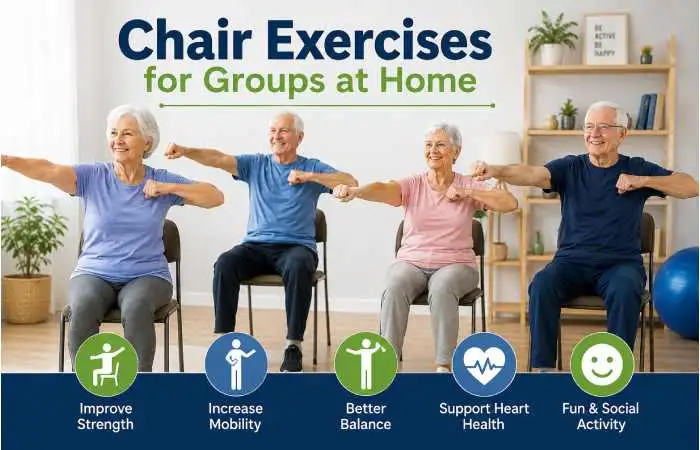
Chair workouts remain among the safest options for older adults.
Sample 15-Minute Group Chair Routine
| Exercise | Duration |
| Seated Marching | 2 minutes |
| Arm Circles | 1 minute |
| Leg Extensions | 2 minutes |
| Seated Twists | 2 minutes |
| Heel Raises | 2 minutes |
| Chair Squats | 3 minutes |
| Cool Down Stretch | 3 minutes |
Safe Group Fitness Routines for Older Adults
Group exercise classes provide older adults with a fun, motivating and predictable form of physical activity. In a group setting older adults can socialise, gain support and accountability as well as increasing physical activity. Older adults exercising must always exercise in a safe way, in particular if older adults are concerned with joint pain, balance problems and other health issues.
When you do a group fitness routine it should have movements that do not hurt your body. The routine should get a little harder as you get stronger. This kind of exercise is called fitness. Functional fitness is, about doing things that help you do tasks like standing up from a chair going up stairs reaching for something high and carrying food from the store. Doing these exercises helps older people stay independent and not fall down much.
Women in older age groups can also benefit from women’s fitness exercises that promote strength, flexibility, and overall well-being.
Components of a Safe Senior Group Workout
A well rounded group fitness class should incorporate these components:
| Workout Component | Benefits | Duration |
| Warm-Up | Increases circulation and prepares muscles | 5–10 minutes |
| Cardiovascular Activity | Improves heart health and endurance | 10–20 minutes |
| Strength Training | Maintains muscle mass and bone strength | 10–15 minutes |
| Balance Exercises | Reduces fall risk | 5–10 minutes |
| Flexibility & Stretching | Enhances mobility and joint function | 5–10 minutes |
| Cool Down | Gradually lowers heart rate | 5 minutes |
Improving heart health and stamina is possible through group cardio workouts that can be adapted to different fitness levels.
Beginner-Friendly Group Fitness Routine
Most active older adults should be able to perform this routine. You can do it at home, in a community room, or during a senior fitness class.
Warm-Up
- Shoulder rolls
- Arm swings
- Gentle marching in place
- Neck stretches
- Ankle circles
Cardio Segment
- Walking in place
- Side-to-side steps
- Low-impact toe taps
- Gentle knee lifts
Strength Segment
- Chair squats
- Wall push-ups
- Seated leg extensions
- Resistance band rows
- Bicep curls with light weights
Maintaining a healthy weight becomes easier when combining regular activity with weight loss workout routines designed to support long-term wellness.
Balance Segment
- Heel-to-toe walking
- Single-leg stands with support
- Standing side leg raises
- Controlled weight shifts
Cool Down
- Deep breathing exercises
- Hamstring stretch
- Calf stretch
- Upper body stretch
Safety Guidelines for Group Exercise Sessions
In order to ensure a safe environment for all to work in:
- Exercise on flat surfaces that are clear of obstructions
- For seated exercises, use non rolling stable chairs
- Participants should be in comfortable clothing, with appropriate footwear for exercise
- Water source readily available to participants
- Work at your own pace- encourage this!
- Smooth, not jerky movements
- Ensure ample time for movement between exercises
- Watch out for participants becoming lightheaded, having chest pain, or appearing overly tired
It should also be stressed that group exercise is not a competition. The priority is to ensure safe increases in health and mobility rather than the extremes.
Many older adults prefer no-equipment group exercises because they can be performed safely at home without specialized fitness gear.
Benefits of Exercising in a Group
Group exercise has a set of benefits unique to that type of fitness:
- Motivating and increases accountability
- Encourages mental health
- Decreases feelings of loneliness and isolation
- Greater exercise consistency
- Enhanced confidence in movement
- Opportunities to build friendships and community connections
Grandparents who enjoy spending active time with younger family members may appreciate family and kids fitness activities that encourage movement across generations.
Others appreciate the social element that working out with other seniors provides; as workouts are seen as less of a task and more as an enjoyable activity.
Modifications for Different Fitness Levels
Not all participants will have the same mobility or fitness abilities. A successful group workout should provide modifications for everyone.
To maintain motivation and encourage regular participation, many groups organize group workout challenges that create accountability and make exercise more enjoyable.
| Fitness Level | Recommended Modifications |
| Beginner | Seated exercises and shorter workout durations |
| Intermediate | Standing exercises with support |
| Advanced | Added resistance bands or light dumbbells |
| Limited Mobility | Fully chair-based routines |
| Balance Concerns | Exercises performed near a wall or chair |
Preserving muscle strength and independence often involves participating in group strength training exercises that support functional movement.
Having variations of the exercises allows each individual to perform the movement in a way that will be effective for them and not at risk of any potential harm.
Creating a Consistent Weekly Routine
For best results, older adults should aim for a regular fitness schedule.
Sample Weekly Plan
- Monday: Group walking and stretching
- Tuesday: Chair strength training
- Wednesday: Balancing and mobility.
- Thursday: A low impact cardio workout.
- Friday: Band resistance work.
- Saturday: A gentle yoga class or flexibility class.
- Sunday: An active recovery and light walk.
Safe group fitness exercises build strength, endurance and increase flexibility and maintain range of motion without over-exerting seniors and risking injury. As time goes on, safe group fitness exercise can really enhance the health and independence and well-being in older age.
Gentle Home Exercises for Small Groups
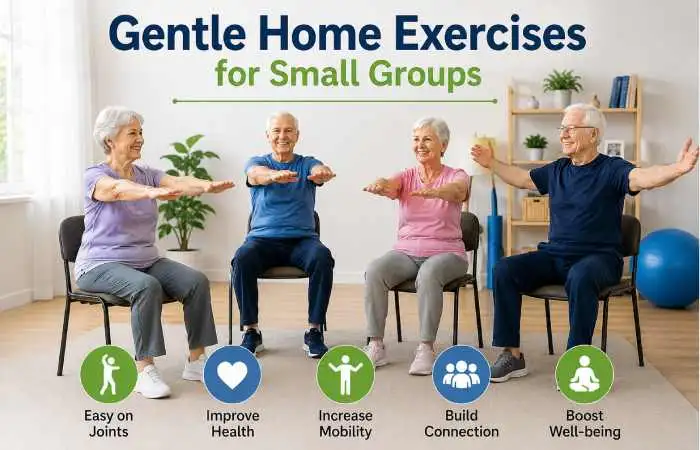
These routines require little or no equipment.
Mobility Circuit
- Neck rotations
- Shoulder rolls
- Seated side bends
- Ankle circles
- Standing calf raises
Strength Circuit
- Chair sit-to-stands
- Wall push-ups
- Resistance band rows
- Seated knee lifts
These help supplement all the normal, daily activities we all do, and help the elderly stay independent.
Senior-Friendly Indoor Workout Ideas
Poor weather is no excuse to suspend your training program.
Indoor Fitness Options
Chair Yoga
Chair Yoga poses build flexibility and coordination and relieve stress in people of almost all fitness levels.
Indoor Walking
A simple routine of walking in a home or community center aids cardio.
Virtual Group Classes
Working out as part of a group with seniors working out online may be the way for more elderly people to continue exercising. Studies have proven that virtual group exercises enhance adherence rates and social connection in the elderly population.
Common Mistakes Seniors Should Avoid
| Mistake | Better Alternative |
| Exercising through pain | Stop and assess discomfort |
| Skipping warm-ups | Perform 5-minute mobility work |
| Poor posture | Use mirrors or instructor feedback |
| Doing too much too soon | Gradually increase intensity |
| Ignoring recovery | Schedule rest days |
Troubleshooting Guide
“My knees hurt during exercise.”
Choose chair-based exercises and avoid jumping movements.
“I struggle with balance.”
Perform exercises near a wall or stable support.
“I get tired quickly.”
Reduce workout duration and gradually increase over time.
“I lack motivation.”
Join a group fitness challenge or schedule workouts with friends.
Conclusion
Senior & Low Impact Fitness-it isn’t necessarily working out harder, it’s about working out smarter. Chair workouts, walking programs, light weight training, group fitness-it’s all a means for older individuals to increase the quality of their health and stay mobile and independent for as long as possible. This blend of proper, safe movement along with social interaction and repetitive practice will help seniors remain strong, confident, andmobilewell into the future.
Afiya Jafar is a fitness and wellness writer who focuses on making health, exercise, and healthy lifestyle information simple and practical. Her work covers workouts, fitness motivation, strength training, nutrition, weight management, stress management, mindfulness, and everyday wellness.
Read Full Bio of Afiya Jafar →
Sameena Begum reviews selected health, wellness, fitness, and digital content for clarity, factual presentation, consistency, and reader usefulness. Her review work helps maintain clear and responsible editorial standards across PhysicalFitt content.
Read Full Bio of Sameena Begum →
Dr. Khizrana Begum is a qualified medical professional with MBBS and MD qualifications and 5+ years of experience in the medical field. She works as a General Physician and Dermatologist, with expertise in general medicine, dermatology, preventive healthcare, and skin health.
Read Full Bio of Dr. Khizrana Begum →