
 Afiya Jafar
Fitness & Wellness Writer
Afiya Jafar is a fitness and wellness writer who focuses on making health, exercise, and healthy lifestyle information simple and practical.
Read Full Bio of Author →
Afiya Jafar
Fitness & Wellness Writer
Afiya Jafar is a fitness and wellness writer who focuses on making health, exercise, and healthy lifestyle information simple and practical.
Read Full Bio of Author →
 Sameena Begum
Health, Fitness & Digital Content Reviewer
Sameena reviews selected health, wellness, fitness, and digital content for clarity, factual presentation, and reader usefulness.
Read Full Bio of Reviewer →
Sameena Begum
Health, Fitness & Digital Content Reviewer
Sameena reviews selected health, wellness, fitness, and digital content for clarity, factual presentation, and reader usefulness.
Read Full Bio of Reviewer →
 Dr. Khizrana Begum
General Physician & Dermatologist
Dr. Khizrana Begum is a General Physician and Dermatologist with MBBS and MD qualifications and 5+ years of experience in the medical field.
Read Full Bio of Medical Reviewer →
Dr. Khizrana Begum
General Physician & Dermatologist
Dr. Khizrana Begum is a General Physician and Dermatologist with MBBS and MD qualifications and 5+ years of experience in the medical field.
Read Full Bio of Medical Reviewer →
People are really getting into strength training groups because they are a way to build muscle and get in shape. You can do these workouts with your friends at home. You can take a class. Either way working out in a group is an idea because it helps you stay on track and motivates you to keep going. Strength training groups are also a way to make sure you do your workouts and get the results you want, from strength training.
In 2026 fitness trends are changing in a way. Now people like to work out with others at home. This is about community-driven training and it is really popular. We will tell you all about fitness trends. How you can do group strength exercises at home with your friends. You can also do partner resistance workouts and other strength workouts with your friends. Fitness trends, like these are a lot of fun. They can help you get in shape.
❝
This article is a part of
Exercises At Home Hub
What Are Strength Training Groups?
I think strength training groups are really cool. They are cool because they have two or more people in them. These people do exercises together that help build muscle in the strength training groups.
Strength-focused workouts are an important part of a balanced fitness routine and complement many other group exercises at home designed for overall health and performance.
The exercises that the people do in the strength training groups are good for building muscle. Strength training groups are a way to build muscle because you do the exercises, with other people. These workouts can be done in ways, such, as:
- At home
- In gyms
- Outdoors
- Virtually (online group sessions)
Benefits:
- Increased accountability
- Better adherence to routines
- Higher workout intensity
- Social motivation
2026 Data: Group vs Solo Strength Training
| Metric | Group Training | Solo Training |
| Consistency Rate | 78% | 52% |
| Average Session Intensity | High | Moderate |
| Calories Burned (45 min) | 350–500 | 250–400 |
| Dropout Rate (3 months) | 22% | 47% |
Source: Global Fitness Trends Report 2026
Group Strength Exercises at Home
Group strength exercises at home are a way to build muscle and improve endurance. You do not need a lot of equipment to do these exercises. They are good for people who are just starting out and for people who want to exercise with a friends. Group strength exercises at home use your body weight and simple movements. This makes group strength exercises at home easy to do in a space. Group strength exercises, at home are also good because you can stay on track and keep doing them over time.
For those who have just begun their journey in fitness, the above mentioned beginner friendly group workouts may prepare a base for you for stronger training workouts.
Why Home-Based Group Strength Training Works
Accessibility: No dependency on gym equipment
Scalability:
Workouts can be adjusted for fitness levels.
This way anyone can join in.
Efficiency:
Many people can exercise at the time.
Consistency:
Social support improves adherence to exercise.
When you have someone to report to you are more likely to show up.
Core Principles for Group Training at Home
To make sure that things work well and everyone stays safe you need to do these things:
- Focus on compound movements
- Maintain proper form over speed
- Use timed intervals for structure
- Incorporate progressive overload
Beginner-Friendly Group Strength Routine
This routine is designed for 3–5 people and requires minimal equipment.
| Reps/Time | Exercise | Target Muscles |
| 12–15 reps | Bodyweight Squats | Legs, Glutes |
| 8–12 reps | Push-Ups | Chest, Shoulders |
| 12–15 reps | Glute Bridges | Glutes |
| 20–30 seconds | Plank Hold | Core |
| 10–12 reps | Resistance Band Rows | Back |
Combining resistance training with group exercises for weight loss can support fat loss while helping preserve lean muscle mass.
How to do: all the exercises are to be performed back to back for 60 seconds then take a rest, then repeat for 3 to 4 rounds
Variations for Different Group Levels
For Beginners:
- Knee push-ups instead of standard push-ups
- Shorter plank durations
- Slower tempo for better control
Intermediate Groups:
- Add jump squats. Walking lunges to your workout.
- You can also try doing repetitions. Do more rounds of the exercise.
- Another option is to use dumbbells.
For Advanced Groups:
- Include unilateral exercises (single-leg squats)
- Add tempo training (slow eccentric phase)
- Combine with circuit or HIIT formats
Space and Equipment Optimization
Home environments often limit space, so efficient setup is critical:
- Allocate individual workout zones to avoid overlap
- Use shared equipment rotation (e.g., dumbbells)
- Substitute with household items if needed (water bottles, backpacks)
Partner Resistance Workouts
When you do partner resistance workouts you have two people working together. They help each other by making it harder or easier to do the exercises. This is really good for working out at home because you do not need a lot of equipment. You can still get better at working not falling over and using your muscles. Partner resistance workouts are very good, for this. You can do partner resistance workouts with a friend or family member. They can help you with partner resistance workouts.
Simple bodyweight movements can also be adapted into family and kids group exercises that encourage healthy habits and physical activity.
Why Partner Resistance Training Is Effective
When you work out with a partner they can change the resistance as you go based on how strong you’re how tired you get. This is really different, from using weights that are fixed and do not change. A partner can help you by giving you resistance that’s not stable which makes your muscles work harder to control the movement.
Your partner can also tell you away if your form or posture is not correct. Training with someone makes you more likely to keep going to your workouts because the other person is counting on you to be there and this is what people mean by adaptive resistance and higher accountability when they talk about adaptive resistance.
So when people talk about resistance they are talking about working out with a partner who can give you adaptive resistance.
How to Structure Partner Workouts
A simple and efficient format:
- Pairs: 2 people per set
- Sets per exercise: 3–4
- Reps: 8–15 (strength-focused) or 15–20 (endurance)
- Rest: 30–60 seconds between sets
Partners alternate between working and assisting roles.
To encourage consistency and progress, consider participating in group workout challenges focused on achieving specific strength and fitness goals.
Beginner-Friendly Partner Resistance Exercises
| Exercise | Role of Partner | Target Muscles |
| Partner Squats | Apply downward resistance | Legs, Glutes |
| Assisted Push-Ups | Support body weight if needed | Chest, Arms |
| Resistance Band Rows (Pair) | Hold band for tension | Back |
| Plank Push Resistance | Apply gentle force on shoulders | Core |
| Medicine Ball Pass | Add dynamic resistance | Full Body |
Many effective strength workouts can be performed as no-equipment group exercises using only body weight for resistance.
Technique Guidelines
- Maintain controlled tempo rather than fast repetitions
- Apply progressive resistance, not sudden force
- Communicate clearly during each rep
- Focus on form first, resistance second
Progression Strategies
For Beginners:
- Use light resistance or partial assistance
- Focus on mastering movement patterns
- Limit session duration to 20–30 minutes
For Intermediate/Advanced:
- Increase resistance gradually
- Add explosive movements (e.g., partner throws, resisted sprints)
- Combine with circuit training for intensity
Home Circuit Training for Groups
Home circuit training for groups is a way to work on strength and cardio at the same time. You also get to work as a team.
This type of training has people move from one exercise to another with little rest in between. It is perfect for a group of people who do not have a lot of space to work out in. Home circuit training for groups is really good, for people who want to do something with their friends or family.
Why Circuit Training Works for Groups
- Maximizes time efficiency – everyone is active simultaneously
- Reduces boredom – constant movement keeps engagement high
- Scalable intensity – beginners and advanced users can train together
- Improves overall fitness – combines strength + endurance
Older adults interested in maintaining muscle mass may benefit from senior fitness workouts that emphasize safe and effective strength-building activities.
How to Set Up a Group Circuit at Home
A simple structure works best:
- Group Size: 3–6 people
- Stations: 4–6 exercises
- Work Time: 30–45 seconds
- Rest/Transition: 10–15 seconds
- Rounds: 3–5 cycles
Each person starts at a different station and rotates clockwise after each interval.
Sample Home Circuit Training Plan (Beginner-Friendly)
| Station | Exercise | Focus Area | Equipment Needed |
| 1 | Bodyweight Squats | Legs & Glutes | None |
| 2 | Push-Ups | Chest & Arms | None |
| 3 | Dumbbell Rows | Back | Dumbbells |
| 4 | Plank Hold | Core | Mat (optional) |
| 5 | Jumping Jacks | Cardio | None |
Execution Tip:
Use a timer app or stopwatch to maintain consistent intervals. This keeps the session structured and avoids confusion.
Best Strength Workouts for Friends
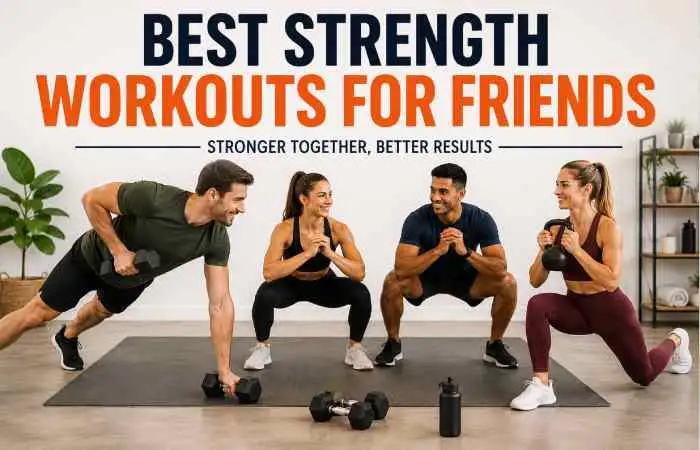
Working out with friends improves consistency and enjoyment.
Popular Formats:
- HIIT + Strength combo
- Bodyweight challenges
- Timed circuits
Those looking to combine strength development with cardiovascular conditioning can add HIIT training workouts to create a more balanced fitness routine.
Dumbbell Group Workout Ideas
Dumbbells are the most versatile equipment for group workouts.
Sample Plan:
- Goblet squats
- Dumbbell rows
- Shoulder press
- Deadlifts
Equipment Comparison (2026)
| Equipment Type | Best For | Price Range | Group Suitability |
| Resistance Bands | Beginners | Low | High |
| Dumbbells | Strength building | Medium | High |
| Kettlebells | Functional training | Medium | Moderate |
| Barbell Sets | Advanced lifters | High | Low (shared use) |
Common Mistakes and Troubleshooting
Unequal Fitness Levels
We all have fitness levels and thats okay.
The solution is to change the exercises to suit everyone.
For example you can do knee push-ups of standard push-ups.
Many resistance-based routines can also support women’s fitness exercises aimed at building strength, confidence, and functional movement.
Limited Equipment
You don’t need a lot of equipment to work out.
The solution is to use your body weight or resistance bands.
Poor Coordination
Sometimes it can be hard to work
The solution is to give people roles or follow a circuit, with a timer.
Lack of Structure
Without a plan workouts can be messy.
The solution is to plan your routines of time or follow a program that guides you.
For a complete fitness program, pair resistance exercises with group cardio workouts to improve both strength and cardiovascular endurance.
FAQ Section
Q1: Are strength training groups effective for beginners?
Yes, especially when exercises are modified for different fitness levels.
Q2: Can I do group strength workouts without equipment?
Absolutely. Bodyweight circuits are highly effective.
Q3: How many people are ideal in a group?
3–5 people is optimal for space and coordination.
Q4: How often should group workouts be done?
3–4 times per week for best results.
Conclusion
Strength training groups are a way to build muscle and keep doing it over time. If you work out with friends at home or do a planned routine with a group you will be more likely to stick with it. This is because you have people to answer to and you can try things, which makes working out with a group better, than working out by yourself for most people in 2026. Strength training groups really make a difference.
Afiya Jafar is a fitness and wellness writer who focuses on making health, exercise, and healthy lifestyle information simple and practical. Her work covers workouts, fitness motivation, strength training, nutrition, weight management, stress management, mindfulness, and everyday wellness.
Read Full Bio of Afiya Jafar →
Sameena Begum reviews selected health, wellness, fitness, and digital content for clarity, factual presentation, consistency, and reader usefulness. Her review work helps maintain clear and responsible editorial standards across PhysicalFitt content.
Read Full Bio of Sameena Begum →
Dr. Khizrana Begum is a qualified medical professional with MBBS and MD qualifications and 5+ years of experience in the medical field. She works as a General Physician and Dermatologist, with expertise in general medicine, dermatology, preventive healthcare, and skin health.
Read Full Bio of Dr. Khizrana Begum →