
 Afiya Jafar
Fitness & Wellness Writer
Afiya Jafar is a fitness and wellness writer who focuses on making health, exercise, and healthy lifestyle information simple and practical.
Read Full Bio of Author →
Afiya Jafar
Fitness & Wellness Writer
Afiya Jafar is a fitness and wellness writer who focuses on making health, exercise, and healthy lifestyle information simple and practical.
Read Full Bio of Author →
 Sameena Begum
Health, Fitness & Digital Content Reviewer
Sameena reviews selected health, wellness, fitness, and digital content for clarity, factual presentation, and reader usefulness.
Read Full Bio of Reviewer →
Sameena Begum
Health, Fitness & Digital Content Reviewer
Sameena reviews selected health, wellness, fitness, and digital content for clarity, factual presentation, and reader usefulness.
Read Full Bio of Reviewer →
The Top Fitness Motivation for Seniors: Not Forcing Yourself to Work Out Sometimes When You Need It the Most The best exercise motivation for seniors involves asking why they should want to move in the first place, selecting exercise routines that are appropriate, and doing so in a simple way.
For many, pain, fatigue, fall concerns, lack of motivation, fatigue, boredom and confidence could all be influencing factors. The good news is – you don’t need to be motivated all of the time! Consistent routine, connectedness and achievable goals could certainly make getting moving every day easier.
Why Is Fitness Motivation Important for Seniors?
Moving your body can promote physical health, mobility, independence, strength, balance, sleep and overall wellness as you get older. Physical activity has short-term benefits, according to the National Institute on Aging, like helping you to sleep better and improving mood and pain, and long-term benefits such as lowering the risk of dying early, reduces the risk of heart disease, stroke, and cognitive decline, and can help control your weight.
Current CDC guidance for adults age 65 and older recommends 150 minutes of moderate-intensity aerobic activity and muscle strengthening activity on two or more days that work all muscle groups and includes working on your balance. However, the CDC also notes that being active is great – even if it’s just a little.
2026 Senior Fitness Research Snapshot
| Finding | What it means for seniors |
| 150 minutes of moderate aerobic activity weekly | A useful long-term target, not a requirement to accomplish immediately |
| Strength training at least 2 days weekly | Supports muscle function and everyday activities |
| Balance activities | Particularly important for stability and fall prevention |
| 2026 study of 225 exercising older adults | Higher weekly exercise duration was associated with greater motivation, while social and perceived barriers were associated with adherence challenges |
| Research on older adults | Motivation is individual and can benefit from personalized exercise programs |
In 2026, 225 older adults were studied. In this study, the amount of exercise per week was the strongest predictor of motivation, and social and belief barriers correlated with adherence. Since this was a cross-sectional study, the results demonstrated correlations rather than that more exercise directly affects motivation.
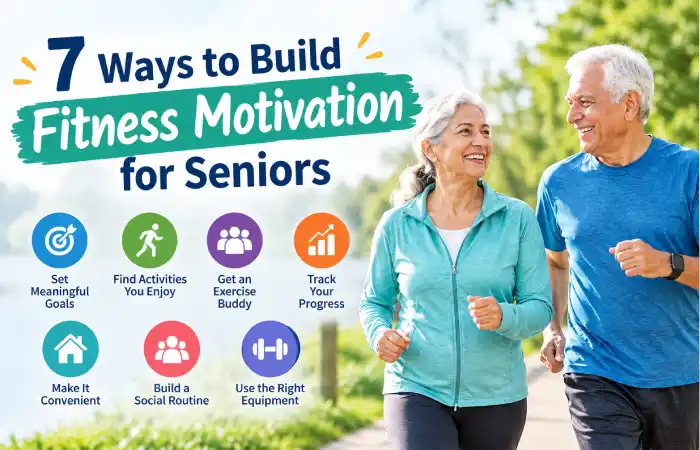
7 Ways to Build Fitness Motivation for Seniors
-
Start With a Meaningful Goal
“Get fit” is too vague to be motivating.
Instead, connect exercise to something you genuinely want to do.
Your goal could be:
- Walk around the neighborhood without getting tired
- Play with your grandchildren
- Climb stairs more comfortably
- Improve balance
- Travel with greater confidence
- Get stronger for everyday tasks
- Stay independent for longer
Specific and realistic goals are easier to track. The NIA recommends setting goals that are specific, realistic and personally important.
-
Choose Exercise You Actually Enjoy
You are more likely to continue an activity when it feels enjoyable rather than like a punishment.
Try:
- Walking
- Dancing
- Swimming or water aerobics
- Cycling
- Gardening
- Chair exercises
- Yoga
- Tai chi
- Resistance-band exercises
- Group fitness classes
The NIA also suggests the addition of aerobics, strength and balance exercises, and new activities to enhance fun. Motivation idea: If you’re not a gym fan, don’t make it the only activity center you have to choose from. A walk in your neighborhood, a workout at home or a class at the community center can be added to your active routine.
-
Use the “Small Start” Strategy
One of the biggest mistakes beginners make is trying to do too much too soon.
Instead of promising yourself an hour-long workout every day, begin with something manageable.
For example:
Week 1: 10-minute walk, 4 days
Week 2: 15-minute walk, 4 days
Week 3: 20-minute walk, 5 days
Week 4: Gradually increase duration or add strength and balance work
Short periods of movement can add up. Current CDC guidance emphasizes that older adults who cannot immediately meet the recommended amount should be as active as their abilities and conditions allow.
-
Find an Exercise Buddy
Accountability can turn exercise from something you “should” do into something you look forward to.
Ask a:
- Spouse
- Friend
- Neighbor
- Sibling
- Family member
to walk or exercise with you.
According to Harvard Health, having a partner to exercise with can keep you committed and motivated. And a 2024 study discussed by Harvard found that older adults who discussed exercise with friends were able to increase and maintain physical activity better than those who didn’t have a partner.
-
Track Progress Instead of Perfection
Motivation becomes easier when you can see evidence that you are improving.
Keep a simple weekly record:
| Track | Example |
| Walking | 20 minutes, 4 days |
| Strength | 2 sessions |
| Balance | 5 minutes, 3 days |
| Energy | Better after walks |
| Goal | Completed weekly target |
Do not focus only on weight or appearance. Being able to walk farther, stand from a chair more easily, carry groceries or feel steadier can be meaningful progress.
NIA guidance also recommends tracking activity and celebrating achievements.
-
Make Exercise Convenient
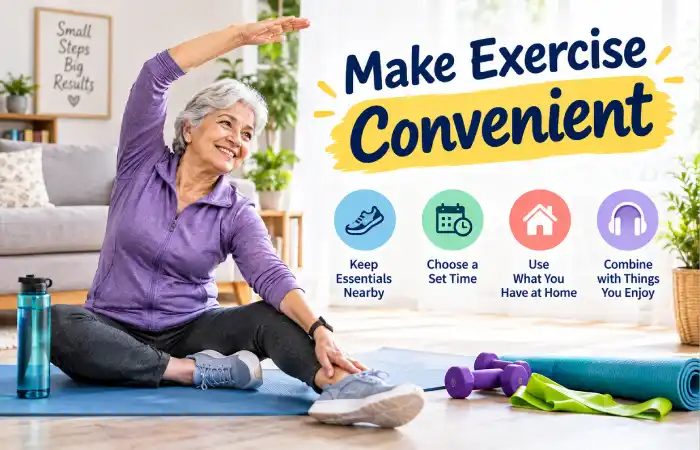
The simpler something is to get into, the less you’ll need motivation.
1. Keep your walking shoes by the door.
2. Put a resistance band where you’ll see it.
3. Exercise at the same time each day.
You might consider activities such as listening to an audio book while walking or doing house work or exercising while watching your favorite tv show.
The research-backed motivation tip sheet from AARP in 2026 describes rewards and “temptation bundling” — pairing a pleasurable activity with exercise — as approaches to make activity more desirable.
Build a Social Routine
Exercise does not have to be solitary.
Look for:
- Senior centers
- Walking groups
- Community recreation programs
- Water-aerobics classes
- Tai chi groups
- Local fitness classes
- Family walking routines
Social connection can provide structure, encouragement and accountability. Community-based exercise is also highlighted by NIA and AARP as a useful way to maintain motivation.
Final Takeaway
The most powerful fitness motivation for seniors isn’t about doing more, it’s about doing what matters. All it takes is starting with a little bit. Find a way to make it fun.
Make it relevant.
Find a supportive accountability buddy. And recognize that new results and experiences don’t always have to include the scale.
Because the goal isn’t to do your workout perfectly. The goal is to move in a way that enables you to live the way you want.
Medical note: This article is meant to provide general knowledge only and is not a substitute for a medical doctor’s advice. Patients with health problems, limited mobility, injury or those who have a concern about starting an exercise program should consult the appropriate health care professional before making significant changes to their level of activity.
Afiya Jafar is a fitness and wellness writer who focuses on making health, exercise, and healthy lifestyle information simple and practical. Her work covers workouts, fitness motivation, strength training, nutrition, weight management, stress management, mindfulness, and everyday wellness.
Read full bio of Afiya Jafar
Sameena reviews selected health, wellness, fitness, and digital content for clarity, factual presentation, and reader usefulness.
Read full bio of Sameena Begum