
 Afiya Jafar
Fitness & Wellness Writer
Afiya Jafar is a fitness and wellness writer who focuses on making health, exercise, and healthy lifestyle information simple and practical.
Read Full Bio of Author →
Afiya Jafar
Fitness & Wellness Writer
Afiya Jafar is a fitness and wellness writer who focuses on making health, exercise, and healthy lifestyle information simple and practical.
Read Full Bio of Author →
 Sameena Begum
Health, Fitness & Digital Content Reviewer
Sameena reviews selected health, wellness, fitness, and digital content for clarity, factual presentation, and reader usefulness.
Read Full Bio of Reviewer →
Sameena Begum
Health, Fitness & Digital Content Reviewer
Sameena reviews selected health, wellness, fitness, and digital content for clarity, factual presentation, and reader usefulness.
Read Full Bio of Reviewer →
 Dr. Khizrana Begum
General Physician & Dermatologist
Dr. Khizrana Begum is a General Physician and Dermatologist with MBBS and MD qualifications and 5+ years of experience in the medical field.
Read Full Bio of Medical Reviewer →
Dr. Khizrana Begum
General Physician & Dermatologist
Dr. Khizrana Begum is a General Physician and Dermatologist with MBBS and MD qualifications and 5+ years of experience in the medical field.
Read Full Bio of Medical Reviewer →
Healthcare can be considered a variety of health professions and health care organizations which, when delivered, result in medical treatment to a patients who seek services. Healthcare can also be used to support life processes so that they don’t stop or fail. The definition above covers services, health professionals, health facilities, healthcare technologies and health care delivery system that would contribute towards health status. Apart from being considered in the hospital/doctor terms, healthcare services encompasses general practitioners, specialists, nursing services, pharmacy services, nursing/midwifery homes, mental health care, rehabilitative care, community health, digital healthcare or e-health and palliative care.
For beginners to a system of care this can appear daunting as every system is funded or organized differently in individual countries. However they all have similar basic goals, which are to promote and sustain people in the enjoyment of best possible health whilst ensuring appropriate care is delivered in the safest and most effective way and at reasonable cost.
Healthcare covers a wide range of services designed to support prevention, diagnosis, treatment, and long-term well-being. For a strong foundation, learn more about primary healthcare and how it supports routine care, prevention, and referrals.
The following outlines the function of healthcare, the main types of care, healthcare professionals and institutions, the effects of technology in the future health delivery system, barriers in accessing and paying for services and safety in healthcare delivery.
❝
This article is a part of
Health Care Hub
What Is Healthcare?
Healthcare describes ordered services and processes which seek to maintain, promote, recover or restore people’s health. These processes can cover as wide a spectrum as a normal medical examination or vaccine to emergency surgery, treatment for cancer, physiotherapy, support of people with mental health issues or end-of-life care. Healthcare, therefore has preventive and curative qualities: it not only helps to recover from illness, but helps to avoid them and promotes peoples’ wellness. There are number of interconnected health related services we can breakdown into groups to try and conceptualise healthcare.
Staying healthy also depends on preventive healthcare, including regular screenings, checkups, vaccinations, and early detection of potential health problems.
Health promotion- enabling people to increase control over, and improve, their health.
Prevention- increasing resistance to disease or injury.
Diagnosis- detection of illness, injury or other diseases.
Treatment- management or cures for disease and injury.
Rehabilitation- helping restore function and independence.
Palliative care- increasing comfort and quality of life in serious diseases.
Public health- preserving and improving health for groups.
Long term care- help and assistance where people require prolonged support.
WHO’s approach is, by far more holistic in approach than simply a number of hospitals- ” A health system includes all the organizations, people and actions whose principal purpose is to promote, restore and maintain health. This includes providing access to treatment and palliative care as well as contributing to governance, financing and information about health services”
How Does the Healthcare System Work?
Health systems represent the linkages between a country’s health professionals, institutions, medicines and technologies, money and health information.
While all health systems vary considerable from country to country, they generally consist of some key elements.
- Patients and communities
The focus of healthcare is, and always will be, upon the people who use its services; they are the ones demanding it, making choices that have treatment and information related consequences and the owners of the information that underpins it. Modern healthcare is more and more adopting a patient-centred approach, thus including patient preferences, needs and values in it.
- Healthcare professionals
The healthcare services are carried out by doctors, nurses, pharmacists, therapist, technicians, dentists, psychologist, community health workers and many others.
When medical attention is needed, understanding different healthcare providers can help people choose appropriate professionals and better understand their treatment options.
- Healthcare facilities
Care can be provided in:
- Primary health centers
- Clinics
- Doctor’s offices
- Hospitals
- Diagnostic laboratories
- Pharmacies
- Rehabilitation centers
- Mental health facilities
- Nursing and long-term care facilities
- Community health centers
- Home-care settings
MedlinePlus describes healthcare facilities as places that provide healthcare, including hospitals, clinics, outpatient centers and specialized facilities.
- Financing
Healthcare must be paid for somehow. Depending on the country, funding can come from:
- Government budgets
- Public insurance
- Private insurance
- Employer-sponsored insurance
- Patient payments
- Community financing
- Charitable organizations
- A combination of these approaches
- Regulation and governance
There are also governments and regulators that establish and implement standards, monitoring all health entities, regulating drugs and medical devices and developing policies on health aimed to protect patients. WHO also characterizes ‘governance’ as a key function for health systems that will facilitate it as accessible, equable, efficient, affordable and high quality.
- Health information
Healthcare depends increasingly on reliable information, including:
- Medical histories
- Laboratory results
- Imaging reports
- Prescriptions
- Vaccination records
- Electronic health records
- Population-health data
- Public-health surveillance
Types of Healthcare
The quality and availability of care can also depend on the healthcare facilities where services are provided, including clinics, hospitals, diagnostic centers, and other medical facilities.
Healthcare can be classified in several ways. One of the most useful approaches is to look at the level of care a person needs.
| Example | Type of care | Typical purpose |
| Routine checkup | Primary care | First-contact and ongoing care |
| Cardiologist consultation | Secondary care | Specialist services |
| Major surgery | Tertiary care | Complex specialist treatment |
| Vaccination or screening | Preventive care | Prevent illness or detect it early |
| Physiotherapy | Rehabilitative care | Restore function |
| Serious-illness support | Palliative care | Comfort and quality of life |
| Emergency department | Emergency care | Immediate treatment |
| Chronic disability care | Long-term care | Ongoing support |
Technology is also transforming modern medicine. Explore digital healthcare to learn more about telemedicine, electronic health records, remote care, and other digital health solutions.
The boundaries between these groups may not be clearly defined. Similarly, one episode of healthcare for an individual with diabetes may include primary care, preventive care, laboratory tests, specialist care, pharmacy and nutrition.
Primary Healthcare
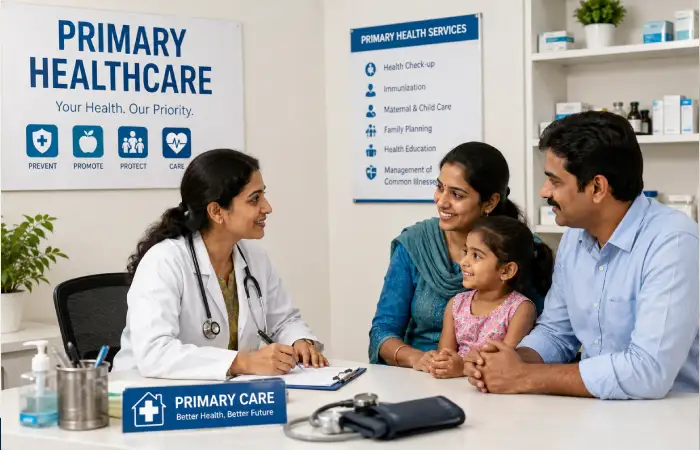
Primary healthcare is usually considered the foundation of an effective health system.
Care commonly includes:
- Routine medical consultations
- Health assessments
- Vaccinations
- Screening
- Treatment of common illnesses
- Chronic disease management
- Basic mental healthcare
- Maternal and child health services
- Health education
- Referrals to specialists
WHO identifies five important characteristics of strong primary care:
- First-contact accessibility
- Continuity
- Coordination
- Comprehensiveness
- People-centeredness
Preventive Healthcare
Finally, healthcare access plays an important role in making sure people can obtain appropriate and affordable medical services when they need them.
Preventive healthcare focuses on reducing the risk of illness or identifying problems before they become more serious.
Examples include:
- Vaccination
- Blood-pressure checks
- Diabetes screening
- Cancer screening when appropriate
- Dental checkups
- Eye examinations
- Prenatal care
- Lifestyle counseling
- Nutrition support
- Smoking cessation
- Health-risk assessments
Preventive care will not promise that a person will always remain in a state of wellness. Its aim, rather, is to cut down on the amount of avoidable risk involved, and to catch diseases in early stages.
For instance, through screening a condition could be detected prior to the manifestation of any obvious symptoms, and a physician would be able to suggest proper follow-up steps to be taken
Healthcare Services
Healthcare services encompass a wide range of activities.
Diagnostic services
Diagnostics help healthcare professionals understand what may be causing symptoms or identify disease.
Examples include:
- Blood tests
- Urine tests
- Imaging
- X-rays
- Ultrasound
- CT scans
- MRI
- ECG testing
- Pathology
- Genetic testing in appropriate circumstances
Medical treatment
Treatment may involve:
- Medicines
- Surgery
- Medical procedures
- Physical therapy
- Behavioral interventions
- Radiation therapy
- Infusion therapy
- Other evidence-based interventions
Mental healthcare
Mental healthcare includes services addressing emotional, psychological and behavioral health.
Depending on individual needs, this may include counseling, psychotherapy, psychiatric care, crisis services, medication management and community-based support.
Dental healthcare
Dental healthcare focuses on oral health, including prevention, diagnosis and treatment of dental and gum conditions.
Rehabilitation
Rehabilitation helps people recover or adapt following illness, injury, surgery or disability.
Common examples include:
- Physiotherapy
- Occupational therapy
- Speech therapy
- Cardiac rehabilitation
- Neurological rehabilitation
Home healthcare
Some healthcare services can be provided at home, particularly for people who have mobility limitations, chronic conditions or ongoing care needs.
Healthcare Providers and Professionals
Healthcare is delivered by multidisciplinary teams rather than by doctors alone.
| Common role | Professional |
| General medical assessment and ongoing care | Primary care physician |
| Focused care for a particular field | Specialist physician |
| Direct care, monitoring, education and coordination | Nurse |
| Medication-related care and counseling | Pharmacist |
| Oral healthcare | Dentist |
| Movement and physical rehabilitation | Physiotherapist |
| Functional independence and daily activities | Occupational therapist |
| Psychological assessment and therapy | Psychologist |
| Medical assessment and treatment of mental disorders | Psychiatrist |
| Nutrition assessment and counseling | Dietitian |
| Imaging and diagnostic support | Radiographer/technologist |
| Diagnostic testing | Laboratory professional |
| Community-based health support | Community health worker |
According to MedlinePlus, primary and specialty care can include physicians and nurse practitioners, physician assistants, and a variety of other health care professionals.
Healthcare Facilities
Which health care facility to choose relies heavily on your medical needs.
Clinics and general practitioners centers (GPs)
GPs centers and clinics are very commonly appropriate when: you are sick, for preventive care, or in case of a common health problem that do not require the full skills of a hospital professional.
Hospitals
Hospitals deliver a range of service from common disease treatment, intensive and specialized care, to the provision of surgical care.
Diagnostic centers
Labs and radiology centers perform medical tests that are crucial for both diagnosis and monitoring of various conditions.
Pharmacies
Pharmacies dispense prescribed and non-prescribed drugs, but they may also offer services such as: medication counseling, immunization, blood pressure monitoring and health screenings according to regulations governing such practice.
Rehabilitation facilities
These facilities support recovery and functional improvement.
Mental health facilities
These may provide outpatient, inpatient, community or specialized mental healthcare.
How to choose a healthcare facility
When comparing facilities, consider:
- Whether the facility provides the service you need
- Qualifications and experience of relevant professionals
- Emergency capabilities where appropriate
- Infection-prevention practices
- Accessibility and location
- Appointment availability
- Costs and insurance coverage
- Patient communication
- Quality indicators where available
- Accreditation or licensing
- Availability of follow-up care
Location is important but shouldn’t always be the main deciding factor. MedlinePlus advises taking a look at location, insurance coverage, availability of the providers and quality of the facility.
Healthcare Technology
Technology is changing almost every part of healthcare.
Healthcare technology includes:
- Diagnostic equipment
- Electronic health records
- Telemedicine
- Wearable devices
- Remote monitoring
- Artificial intelligence
- Medical imaging
- Robotic systems
- Digital therapeutics
- Health information exchanges
- Decision-support tools
Health technology, according to the WHO, encompasses a wide range of products, knowledge, systems and procedures, including medicines, drugs and appliances developed through science and technology, which provide the inputs to care through the management and application of this knowledge through apparatus, devices and equipment used for disease prevention, diagnosis, treatment, surveillance, rehabilitation, and also for the delivery of services
How technology can improve healthcare
Technology can potentially:
- Improve access
- Reduce administrative work
- Support earlier diagnosis
- Connect patients with specialists
- Improve information sharing
- Help monitor chronic diseases
- Reduce paperwork
- Support public-health surveillance
- Improve care coordination
However, technology is not automatically beneficial.
Healthcare organizations must consider:
- Accuracy
- Privacy
- Cybersecurity
- Interoperability
- Cost
- Accessibility
- Digital literacy
- Clinical validation
- Human oversight
The WHO emphasizes that digital health should support equitable access to quality services, while also recognizing that implementation challenges remain.
Healthcare and Digital Health
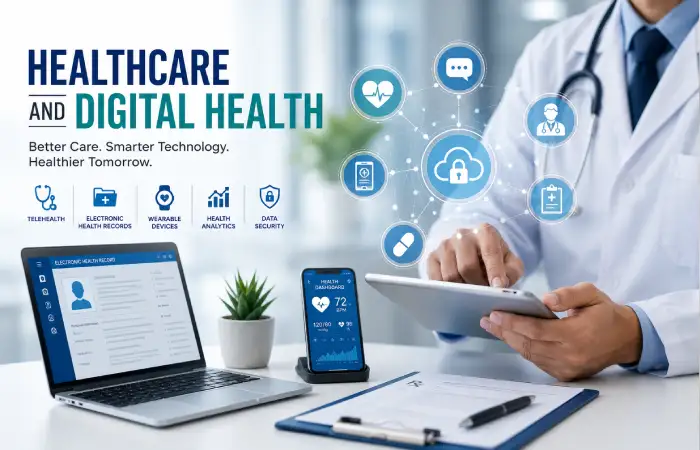
Digital health is broader than telemedicine.
It includes technologies such as:
| Digital health technology | Example use |
| Telemedicine | Remote consultation |
| Electronic health records | Digital medical records |
| Wearables | Activity or physiological monitoring |
| Mobile health apps | Health tracking and education |
| Remote monitoring | Monitoring patients outside facilities |
| AI | Decision support, analysis and workflow assistance |
| Digital registries | Connecting providers and health information |
| Health information exchange | Sharing records between systems |
Digital healthcare in India
India has made particularly rapid progress in building digital health infrastructure.
The Ayushman Bharat Digital Mission (ABDM) has created a national digital ecosystem connecting health identities, facilities, professionals and health records.
As of 12 August 2026, government data reported:
- 96.43 crore ABHA health identity numbers
- More than 110 crore health records linked with ABHA
- More than 5.47 lakh registered health facilities
- More than 10.50 lakh registered healthcare professionals
ABDM also crossed 25 crore OPD registrations through its Scan & Register service in August 2026, with the service operational across more than 30,800 healthcare facilities.
These figures illustrate how digital infrastructure is moving from an experimental concept toward a significant part of healthcare delivery.
Artificial Intelligence in Healthcare
Artificial intelligence is one of the most closely watched developments in modern healthcare.
Potential applications include:
- Medical image analysis
- Risk prediction
- Clinical decision support
- Administrative automation
- Drug discovery
- Patient monitoring
- Public-health surveillance
- Research
- Personalized health information
But AI should not be treated as a replacement for qualified healthcare professionals.
Healthcare Access and Affordability
Having healthcare services available does not necessarily mean people can use them.
Access can be affected by:
- Income
- Location
- Transportation
- Waiting times
- Availability of professionals
- Language
- Disability
- Digital access
- Insurance
- Out-of-pocket costs
- Awareness and health literacy
WHO defines universal health coverage as ensuring people can obtain the health services they need without financial hardship.
Healthcare access in India
Though India is increasing its public health infrastructure and financial protection schemes, the issues of accessibility and affordability are still paramount.
In a report presented by a Parliamentary Standing Committee in 2026 on health spending, it stated that government health expenditure constituted around 1.4 percent of GDP which is much lower than the targeted 2.5 percent, mentioned in the National Health Policy 2017 and hence called for and urgent road-map for increasing public health spending.
This highlights an important healthcare principle:
Access is not simply about building more facilities. It also depends on financing, workforce, quality, medicines, technology and the ability of people to reach and use services.
Healthcare Costs: What Determines the Price?
Healthcare costs can vary enormously.
Factors include:
- Type of service
- Complexity of treatment
- Location
- Facility type
- Professional fees
- Medicines
- Diagnostic testing
- Length of hospital stay
- Insurance coverage
- Government subsidies
- Follow-up requirements
Comparing healthcare payment options
| Payment approach | Advantages | Potential limitation |
| Government-funded care | Can reduce direct patient costs | Capacity and waiting times may vary |
| Public insurance | Financial protection | Eligibility and covered services vary |
| Private insurance | Wider financial protection depending on policy | Premiums, exclusions and limits |
| Self-pay | Simple for uncovered services | Can create financial hardship |
| Employer coverage | Employer contribution may reduce cost | Coverage can depend on employment |
| Mixed systems | Multiple routes to care | Can be complicated to navigate |
Before choosing a healthcare service or insurance product, consumers should check exactly what is covered, exclusions, waiting periods, provider networks, deductibles or co-payments, and claim procedures.
Healthcare Quality and Safety
Access alone is not enough.
A person can receive healthcare but still have a poor outcome if the service is delayed, inappropriate, unsafe or poorly coordinated.
WHO describes high-quality healthcare as care that is effective, safe, people-centered, timely, equitable, integrated and efficient.
The seven dimensions of healthcare quality
- Effective
Care should be based on appropriate evidence and should produce the intended health benefits. - Safe
Healthcare should minimize preventable harm. - People-centered
Patients’ needs, preferences and values should be respected. - Timely
Unnecessary delays should be minimized. - Equitable
Quality should not depend unfairly on a person’s background or location. - Integrated
Different providers and levels of care should work together. - Efficient
Resources should be used responsibly and unnecessary waste reduced.
WHO estimates that 5.7–8.4 million deaths each year are attributable to poor-quality care in low- and middle-income countries, demonstrating why quality is as important as access.
How can patients evaluate healthcare quality?
Depending on what information is available in a country, patients can look for:
- Professional licensing
- Facility accreditation
- Infection-control standards
- Patient-safety information
- Treatment outcomes
- Readmission measures
- Patient experience
- Waiting times
- Emergency capabilities
- Quality reporting
- Transparent pricing
A rating alone should not determine where someone receives care. Quality information needs to be considered alongside clinical suitability, accessibility and individual circumstances.
Healthcare Quality vs. Healthcare Access
These concepts are related but different.
| Healthcare access | Healthcare quality |
| Can the patient obtain care? | Is the care effective and safe? |
| Focuses on availability | Focuses on performance |
| Includes affordability | Includes clinical effectiveness |
| Includes geographic access | Includes patient-centeredness |
| Includes waiting times | Includes safety and outcomes |
A strong healthcare system needs both.
Simply more low-quality care doesn’t work, and also high-quality care that most people cannot access doesn’t serve a population.
The Role of Public Health in Healthcare
Healthcare and public health are closely connected but operate at different levels.
Healthcare often focuses on individual patients.
Public health focuses on populations and communities.
Public-health activities include:
- Vaccination programs
- Disease surveillance
- Outbreak response
- Health education
- Environmental health
- Food safety
- Maternal and child health
- Screening programs
- Tobacco-control measures
- Health policy
The two areas increasingly overlap.
The Future of Healthcare
Healthcare is moving toward a model that is more:
- Preventive
- Personalized
- Connected
- Data-driven
- Community-based
- Digitally enabled
- Patient-centered
Several developments are likely to influence healthcare over the coming decade.
More preventive care: Healthcare services are shifting their focus towards ensuring people get healthier by focusing onpreventing illnessesrather than dealing with chronic disease or disease that is very advanced.
More use of digital health: Telemedicine, electronic health records, monitoring at a distance and broader digital health infrastructure are likely to be found in standard care.
Responsible AI: The use of AI is expected to grow in research, diagnostics, administration and supporting decision-making however validation, governance and clinical supervision are crucial.
More care outside hospitals: Routine health monitoring and follow-up treatments will begin to shift into homes and the community setting and even into primary care settings as well.
Focus on more interoperability: Healthcare data becomes much more useful when there is safe and seamless flow of data between systems.
A focus on health equity: Technology should only provide a healthcare that is valuable for users with a smartphone, quality internet access and a solid health literacy or sufficient personal means.
The WHO has reported thatwhile digital health offers a promising path toward expanded accessibility, it may also widen the divides with regard to access, the affordability and comprehensibility of digital interventions, as well as the health-related skills and resources possessed by an individual.
Workforce development: There needs to be enough properly-trained healthcare professionals, along with technology, in order to serve the needs of the growing population. It is currently projected by WHO that by 2030 there will be a deficit of 11 million health professionals around the world, and the health work deficit is most dire in the low- and lower-middle-income countries.
Frequently Asked Questions About Healthcare
What is healthcare, simply put?
Healthcare refers to the entire set of services and practitioners who assist individuals in health maintenance, illness prevention, diagnostics, treatment, recovery from an illness/injury and ongoing management of their health.
What are the primary types of healthcare?
The most common categories are primary, secondary and tertiary care, although other types include preventative, emergent, rehabilitation, palliative and long-term care.
Why is primary healthcare significant?
Primary healthcare encompasses ongoing contact and is first access to services. It can coordinate services across the entire system. The WHO sees primary care as a bedrock of universal health coverage.
What is preventative healthcare?
Preventative care involves preventing disease, minimizing threats to health or earlier diagnosis. Vaccinations, cancer screenings, health evaluations and counselling are all preventative health strategies.
How is primary different from secondary healthcare?
Normally the first contact is with a primary health provider regarding their typical health issues. Secondary care usually relates to specialist care and frequently involves referral by primary care services.
What is tertiary care?
Tertiary care services address difficult and specialized needs. These includes many types of complex surgical procedures, cutting-edge cancer therapies, intensive specialist treatments etc.
What does ‘digital health’ mean?
Digital health applies technological processes to many health tasks. This involves telemedicine, the application of remote monitoring, and many other digital health features such as mobile health applications, AI supported systems, electronic health records etc.
Final Takeaway
Healthcare is not simply about seeing a medical practitioner when ill. It is an integrated delivery system composed of prevention, primary care, detection and diagnosis, treatment, rehabilitation, public health, practitioners, institutions and infrastructure, and financing, technology and policy. The ideal health systems not only ensure access to care, but also guarantee safe, efficient, affordable, equitable and people-centered care.
Technologies will indeed be fundamental to the future of healthcare, but their impacts will not, and indeed can not, solely define the health systems of the future: professional workforce, primary care capacity, infrastructure, responsible governance, science and evidence base and public trust will continue to be integral to quality health care.
For patients, an informed stance on their part is perhaps the best. That should start by being aware of the range of options available; by verifying health professionals’ credentials; by questioning and inquiring the benefits and risks associated with different interventions; by considering both the accessibility and the affordability of the proposed medical interventions and protecting one’s health data. And, above all, it should be centered on seeking competent professional advice whenever appropriate for addressing personal care issues.
Afiya Jafar is a fitness and wellness writer who focuses on making health, exercise, and healthy lifestyle information simple and practical. Her work covers workouts, fitness motivation, strength training, nutrition, weight management, stress management, mindfulness, and everyday wellness.
Read Full Bio of Afiya Jafar →
Sameena Begum reviews selected health, wellness, fitness, and digital content for clarity, factual presentation, consistency, and reader usefulness. Her review work helps maintain clear and responsible editorial standards across PhysicalFitt content.
Read Full Bio of Sameena Begum →
Dr. Khizrana Begum is a qualified medical professional with MBBS and MD qualifications and 5+ years of experience in the medical field. She works as a General Physician and Dermatologist, with expertise in general medicine, dermatology, preventive healthcare, and skin health.
Read Full Bio of Dr. Khizrana Begum →