

Last Updated: August 6, 2026
The ability to have great mental strength to a sportsmen is the one the of most significant differentiations we see between great sportsman and superb sportsman. However when people want to train for a particular sport they are typically focused on the physical, improving on Speed, Strength, Endurances in place of anything that will allow them to be stress free when the pressure is on, to be strong in their will to bounce back if something did not go to plan, or in ability to execute the highest standards of performance no matter when needed.
There is, according to various studies cited throughout sports psychology literature consistently clear evidence of how the benefits of mental skills training help athletes to increased confidence, manage emotions, focus attention, and ultimately the ability to compete.
By 2026, it is expected that numerous sports teams will pay the same amount of attention to Mental Preparedness as physical training. In both cases, beginner or weekend player to a wannabe champion-level performer mental strengths can benefit your performances across a multitude of sporting contexts.
❝
This article is a part of
Mental Strength Hub
What Is Mental Toughness?
Mental toughness is the ability to:
- Stay confident under pressure
- Control emotions
- Maintain focus
- Recover quickly from mistakes
- Perform consistently despite challenges
It doesn’t mean ignoring emotions—it means managing them effectively.
Strong athletic performance starts with mental toughness, which helps athletes stay focused, disciplined, and composed when facing pressure.
Athletes with strong mental toughness can:
- Bounce back after losses
- Stay composed in championship moments
- Train consistently
- Handle criticism positively
- Adapt to unexpected situations
Why Athletes Need Mental Strength
Physical ability alone rarely guarantees success.
Two athletes with identical fitness levels often produce different results because of their mindset.
Mental strength helps athletes:
- Perform consistently
- Reduce performance anxiety
- Stay motivated during long seasons
- Improve decision-making
- Trust their training
- Avoid giving up after setbacks
Benefits of Mental Toughness
| Physical Skills | Mental Skills |
| Strength | Confidence |
| Speed | Focus |
| Endurance | Emotional control |
| Technique | Decision making |
| Agility | Resilience |
Elite performance requires both. (APA)
Understanding mental toughness vs. resilience can help athletes recognize the difference between performing under pressure and adapting after adversity.
Athletes can strengthen these skills through practical mental toughness exercises designed to improve focus, confidence, emotional control, and perseverance.
2026 Comparison: Mental Skills and Athletic Performance
| Mental Skill | Performance Impact | Evidence from Sports Psychology |
| Focus Training | Higher consistency | High |
| Visualization | Better skill execution | High |
| Positive Self-Talk | Increased confidence | High |
| Goal Setting | Better motivation | High |
| Controlled Breathing | Reduced anxiety | High |
| Reflection Journaling | Faster learning | Moderate |
Handling Pressure During Competition
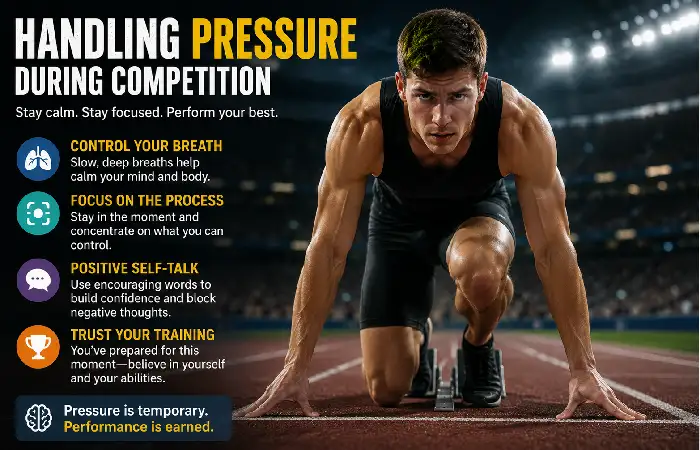
Competition pressure affects nearly every athlete.
Symptoms include:
- Racing heart
- Sweaty hands
- Negative thoughts
- Muscle tension
- Poor concentration
Instead of try to escape pressures, high performance individuals practice managing stress.
Practical Strategies
- Control Your Breathing
Try box breathing:
- Inhale 4 seconds
- Hold 4 seconds
- Exhale 4 seconds
- Hold 4 seconds
Repeat 5 cycles.
- Focus on Process Goals
Instead of:
“I must win.”
Think:
“Stay balanced.”
“Keep good technique.”
“Finish every play.”
Process goals reduce anxiety.
- Develop a Reset Routine
After mistakes:
- Deep breath
- Positive cue word
- Reset posture
- Focus on next action
Many elite athletes use this exact routine.
A consistent mental toughness training routine can help athletes develop the psychological skills needed to perform consistently in demanding situations.
Improving Focus
Distractions exist everywhere:
- Crowd noise
- Opponents
- Coaches
- Social media
- Internal doubts
Focus is trainable.
Daily Focus Exercises
Visualization
Spend 5 minutes imagining:
- Perfect technique
- Successful competition
- Calm reactions
- Strong finishes
Visualization triggers many of the neural pathways that are at work when people physically perform.
Developing the habits of mentally strong people can help athletes maintain discipline, recover from setbacks, and stay committed to long-term goals.
Mindfulness Training
Practice:
- 10 minutes of breathing
- Body awareness
- Present-moment attention
Benefits include:
- Better concentration
- Reduced stress
- Faster recovery from distractions
Attention Cue Words
Examples:
- “Explode”
- “Calm”
- “Drive”
- “Finish”
One word can quickly refocus attention.
Comparison: Distracted vs. Focused Athlete
| Distracted Athlete | Focused Athlete |
| Thinks about winning or losing | Concentrates on the next action |
| Dwells on mistakes | Learns and moves on quickly |
| Reacts emotionally to setbacks | Responds calmly under pressure |
| Notices every distraction | Maintains attention on performance |
| Loses confidence easily | Trusts preparation and training |
Daily Focus Training Plan
| Exercise | Benefit | Duration |
| Mindfulness meditation | Improves concentration | 5–10 minutes |
| Visualization | Builds confidence and mental rehearsal | 5 minutes |
| Deep breathing | Reduces stress and anxiety | 3–5 minutes |
| Reaction drills | Sharpens attention and decision-making | 10 minutes |
| Performance journal | Identifies distractions and tracks progress | 5 minutes |
Key Takeaway
The idea isn’t to avoid distractions-it’s to retrain your ability to re-center your attention whenever it wanders, as it’s bound to do. By building visualization skills, practicing mental mindfulness techniques, engaging in breathing techniques, and solidifying their pre-competition rituals, individuals can enhance their ability to remain focused and confidently play at their peak when the spotlight is on. Your ability to concentrate just gets better with practice – and with conscious and intentional practice.
Athletes who want to improve their mindset can learn how to build mental toughness through deliberate practice, consistent habits, and challenging experiences.
Recovering From Defeat
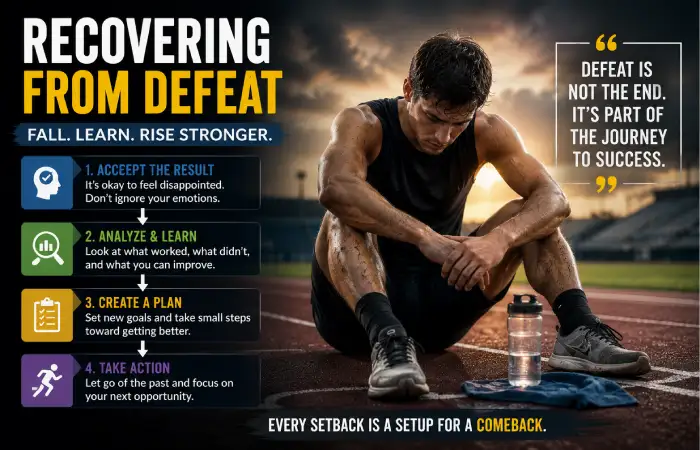
Every athlete loses.
The difference lies in the response.
Mentally tough athletes view defeat as feedback instead of failure.
Recovery Framework
Step 1
Accept the result.
Don’t deny mistakes.
Step 2
Analyze objectively.
Ask:
- What worked?
- What didn’t?
- What can improve?
Step 3
Create an improvement plan.
Example:
Instead of:
“I failed.”
Think:
“My endurance dropped after 30 minutes. I’ll improve conditioning.”
Step 4
Return to training quickly.
Avoid dwelling on losses.
Consistency builds confidence.
Healthy Reflection Questions
- What did I learn?
- What will I improve?
- What can I control?
- What should I repeat?
Pre-Competition Mindset
Your mindset before competition influences performance.
Successful athletes avoid last-minute panic.
Instead, they follow routines.
Sample Pre-Competition Routine
| Time | Activity |
| Night before | Prepare equipment |
| Morning | Balanced breakfast |
| 60 minutes before | Dynamic warm-up |
| 20 minutes before | Visualization |
| 10 minutes before | Controlled breathing |
| Competition | Focus on process |
Consistency creates confidence.
2026 Mental Preparation Checklist
✔ Sleep 7–9 hours
✔ Hydrate well
✔ Review strategy
✔ Use positive self-talk
✔ Visualize success
✔ Control breathing
✔ Trust your training
Troubleshooting Common Mental Challenges
| Challenge | Possible Cause | Solution |
| Performance anxiety | Fear of failure | Breathing + visualization |
| Losing confidence | Negative self-talk | Replace with constructive cues |
| Difficulty focusing | External distractions | Mindfulness practice |
| Fear after defeat | Dwelling on mistakes | Reflection and action plan |
| Inconsistent motivation | Unclear goals | Set SMART goals and track progress |
Products That Can Support Mental Training
While no product replaces consistent practice, some tools can complement mental training:
| Tool Type | Best For | Considerations |
| Guided meditation apps | Mindfulness and relaxation | Look for athlete-specific sessions |
| Sports psychology books | Learning mental skills | Choose evidence-based authors |
| Performance journals | Goal tracking and reflection | Use daily for best results |
| Heart-rate monitors | Breathing and recovery training | Helpful for biofeedback practice |
Frequently Asked Questions
How can a sports performer gain mental toughness?
Train the mental muscles through consistent mental training utilizing visualization, positive affirmation, mindfullness, goalsetting and error analysis you will begin to get closer to mental toughness. Training can strengthen this mental muscle too similar to how you physically train.
Is mental toughness learnable?
Yes, in sports psychology it has been found that mental skills development, and not be a pure gift but to be gained with training and coaching.
What is the best exercise for mental toughness?
Visualization along with breathing control and is often seen as one of the most effective exercises, as it trains both the brain for the stress of performance while giving it more control of the emotions it produces.
Is confidence mental toughness?
No, not entirely. It can be argued confidence is one part of mental toughness but true mental toughness also includes being resilient, focused, disciplined and have control over the emotions that have been produced.
How often should athletes practice their mental training?
Experts suggest athletes should dedicate 10-20 mins of every day to mental training for practice of things like visualisation, breathing exercises, journaling or mindfulness along side their physical training.
Conclusion
However, when we factor in this work on mental conditioning, you’ll get a winning approach; not too slow, not too fast. Sport psychologists call it: “ mental conditioning ”. It can be built it’s the kind of thing you must practise, you aren’t just born ready for this”. The work that athletes are doing on improving concentration, learning from failure, dealing with pressure, and building a solid pregame routine helps make better athletes and it builds their confidence to.