
 Afiya Jafar
Fitness & Wellness Writer
Afiya Jafar is a fitness and wellness writer who focuses on making health, exercise, and healthy lifestyle information simple and practical.
Read Full Bio of Author →
Afiya Jafar
Fitness & Wellness Writer
Afiya Jafar is a fitness and wellness writer who focuses on making health, exercise, and healthy lifestyle information simple and practical.
Read Full Bio of Author →
 Sameena Begum
Health, Fitness & Digital Content Reviewer
Sameena reviews selected health, wellness, fitness, and digital content for clarity, factual presentation, and reader usefulness.
Read Full Bio of Reviewer →
Sameena Begum
Health, Fitness & Digital Content Reviewer
Sameena reviews selected health, wellness, fitness, and digital content for clarity, factual presentation, and reader usefulness.
Read Full Bio of Reviewer →
 Dr. Khizrana Begum
General Physician & Dermatologist
Dr. Khizrana Begum is a General Physician and Dermatologist with MBBS and MD qualifications and 5+ years of experience in the medical field.
Read Full Bio of Medical Reviewer →
Dr. Khizrana Begum
General Physician & Dermatologist
Dr. Khizrana Begum is a General Physician and Dermatologist with MBBS and MD qualifications and 5+ years of experience in the medical field.
Read Full Bio of Medical Reviewer →
The practical difficulties that often accompany chronic pain management can affect more than just your physical well-being. Ongoing pain can lead to problems with sleep, employment, activity, relationships and even your emotional state, with the term ‘chronic pain’ usually implying pain which lasts three months or more (though precise definitions can differ depending on clinical settings).
Fortunately managing chronic pain doesn’t necessarily mean you must be completely pain free. Modern day chronic pain management practices can provide ways to maximize your function, sleep and movement while optimizing your sense of confidence and your quality of life; the primary cause will be treated where one has been identified.
A systematic review and meta-analysis of pain completed in 2026 reported the global prevalence of chronic pain to be around 27% across 52 included studies (n of 290,000).
Managing persistent symptoms often requires a combination of exercise, lifestyle changes, professional care, and other appropriate treatments. For a broader overview of these approaches, explore our pain management guide.
❝
This article is a part of
Pain and Recovery Hub
What Is Chronic Pain?
Chronic pain is a pain which has lasted at least three months or has lasted longer than the normal healing period.
This may:
- Vary between being constant and intermittent.
- It may throb or ache, burn, sting or stab and can be generalized or localized.
- This may or may not have a clear underlying cause.
It can be broadly divided into three major types of pain: Musculoskeletal pain, Neuropathic pain and Nociplastic pain which all have different biological mechanisms occurring within the body and nervous system.
It is different from acute pain, because while acute pain is a signal that damage has recently occurred it can still last once the tissue damage itself has occurred.
Common Causes of Chronic Pain
It is possible to develop pain as a result of an injury, a disease process, following surgery or of changes to the nervous system. In some instances there will not be any underlying factor.
Chronic pain may sometimes be associated with ongoing problems affecting the spine or surrounding tissues. If persistent back or neck discomfort is your main concern, learn more about back pain management.
Common underlying factors will include conditions such as:
* arthritis and other joints conditions
* chronic back/neck pain
* previous injury or surgery
* nerve damage (neuropathy)
* migraine and headache disorders
* Fibromyalgia
* pain from cancer
* various musculoskeletal disorders
How Is Chronic Pain Managed?
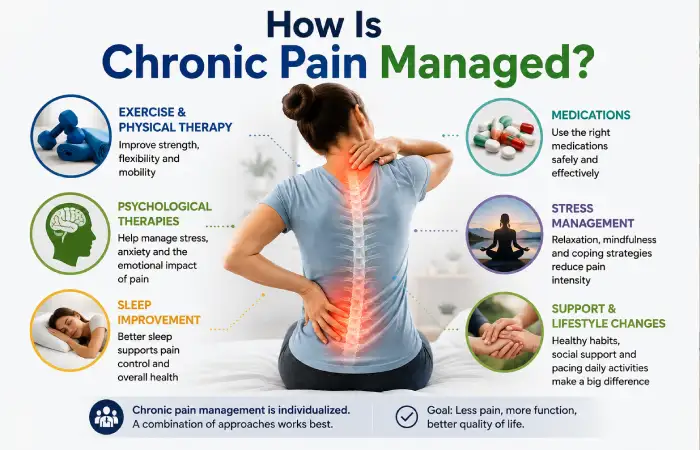
There is no universal treatment that works for everyone. Effective chronic pain management is usually individualized and may combine several approaches.
Arthritis and other joint conditions are common contributors to persistent pain and may affect mobility and everyday activities. For more specific strategies, see our guide to joint pain management.
| Approach | Typical role | Main purpose |
| Exercise/physical therapy | Often foundational | Improve strength and movement |
| Psychological therapy | Especially useful when pain affects mood/function | Develop coping and self-management skills |
| Sleep improvement | Important lifestyle target | Support recovery and pain regulation |
| Stress management | Daily self-management | Reduce factors that amplify pain |
| Medicines | Depends on diagnosis and risks | Reduce specific pain mechanisms |
| Complementary approaches | May complement conventional care | Support symptom management |
| Procedures/devices | Used when clinically appropriate | Target selected pain conditions |
Persistent pain can also affect weight-bearing joints such as the knees, particularly when arthritis, previous injury, or movement problems are involved. If knee symptoms are affecting your mobility, explore our guide to knee pain management.
CDC recommend optimal non-pharmacologic and non-opioid treatments for chronic pain, with the choice depending upon specific disorder and the individuals concerned.
Medication may still play an appropriate part, with drug choice based upon therapeutic value, side effects, Drug-Drug interactions, and individual risk factors.
A useful order to consider treatment could be:-
Diagnosis movement/rehab lifestyle psychological support medication where necessary procedures or sub-speciality intervention where relevant
However this order should not be viewed as a rigid one all patients do not need to progress through all the steps in this sequence.
Exercise and Chronic Pain
While it’s understandable you will want to avoid all activity when experiencing pain, lack of exercise will encourage weaknes, stiffness, and a decrease in function.
Your program should take your specific condition, activity level and objectives into consideration and can include, for example:
* Walking
* Swimming or ‘water’ exercises
* Cycling
* Light strength training
* Range of motion or’ mobility’ exercises
* Yoga or Tai Chi
The guidelines from CDC include as non-pharmacological exercises for chronic pain the use of aerobic exercise, aquatic exercise, and resistance exercise. They are keen to point this out:
In cases where adults suffer with chronic primary pain NICE are also recommending “supervised exercise programmes…whilst promoting sustained physical activity as is appropriate and possible for individual needs and capability”. It should never be seen as some way of measuring your pain threshold but should be approached gradually with guidance and support.
Previous injuries or surgery can sometimes contribute to pain that continues beyond the normal healing period. If your persistent symptoms began after an injury, our guide to pain management after injury provides additional information about recovery and rehabilitation.
Sleep and Chronic Pain
Pain and bad sleep can be a tricky cycle – pain can disturb your sleep, and bad sleep might make it feel more severe. One study of over 116,000 people revealed that difficulty sleeping is related to a greater risk for developing chronic musculoskeletal pain. Another systematic review found that quality of sleep and daily pain share a reciprocal relationship, with the quality of night time sleep being most robustly related to day time intensity of pain.
What can you do?
Establish regular sleep times
Try to limit activities that will energize you before bed
Optimize your sleep surroundings
Treat severe insomnia with your doctor
Keep a sleep diary to log your sleep and pain
Stress Management and Chronic Pain
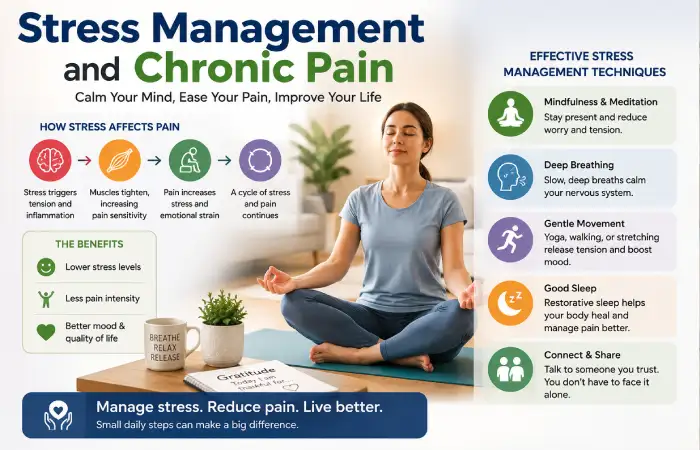
Stress does not mean that pain is “all in your head.” Instead, pain, stress, mood and nervous-system responses can influence one another.
Useful techniques may include:
- Slow breathing
- Mindfulness
- Meditation
- Relaxation exercises
- Cognitive behavioral therapy (CBT)
- Acceptance and commitment therapy (ACT)
- Regular enjoyable activities
NICE recommends considering CBT or ACT for adults with chronic primary pain when delivered by appropriately trained healthcare professionals.
Persistent pain may also result from nerve damage or changes in the nervous system. When symptoms include burning, tingling, shooting pain, or numbness, learn more about nerve pain management.
The goal is not to ignore pain. It is to develop skills that make pain less disruptive to everyday life.
Daily Habits for Living With Chronic Pain
Small, repeatable habits are often more sustainable than trying to completely change your lifestyle overnight.
Try a simple daily framework:
Morning: Gentle mobility + planned activity
Daytime: Alternate activity with appropriate rest and avoid doing too much on “good” days
Evening: Relaxation routine + consistent bedtime
Weekly: Review pain, sleep, activity and functional goals
Keep a simple record of:
- Pain intensity
- Sleep quality
- Physical activity
- Medication use
- Stress levels
- Activities you were able to complete
This can help you and your healthcare professional identify patterns and adjust your plan.
When Should You Seek Professional Support?
Consider speaking with a healthcare professional if pain:
- Has lasted three months or longer
- Is getting progressively worse
- Interferes with sleep or everyday activities
- Prevents you from working or exercising normally
- Requires frequent pain medication
- Is accompanied by significant weakness, numbness or other concerning symptoms
If the pain is severe, rapidly progressive or you have any new significant weakness, Loss of Bladder/Bowel control, Major Chest pain, Difficulty breathing, or MAJOR trauma or any other warning of emergency you will need to attend A+E urgently.
Additional management strategies from pain specialists, physiotherapists, rehab consultants or the multidiscipilary pain team may be considered if routine management is not providing sufficient benefit. Multidisciplinary care is at the core of modern management for chronic pain.
Key Takeaway
Effective chronic pain management needs to be individualized and focus on a “whole person” approach instead of a hunt for the “magic cure”. It is about assessing why things are occurring in the first place, working on improving range of movement, improving sleep quality and improving coping strategies for managing stress, as well as achieving a reduction in pain which will have an affect in all the above. If these things do not yield results then medication can be introduced where necessary as well as seeing health professionals.
The purpose is not just reduced pain score. The purpose is to allow you to sleep more, to be more mobile, and to engage in whatever is important in your life.
Afiya Jafar is a fitness and wellness writer who focuses on making health, exercise, and healthy lifestyle information simple and practical. Her work covers workouts, fitness motivation, strength training, nutrition, weight management, stress management, mindfulness, and everyday wellness.
Read Full Bio of Afiya Jafar →
Sameena Begum reviews selected health, wellness, fitness, and digital content for clarity, factual presentation, consistency, and reader usefulness. Her review work helps maintain clear and responsible editorial standards across PhysicalFitt content.
Read Full Bio of Sameena Begum →
Dr. Khizrana Begum is a qualified medical professional with MBBS and MD qualifications and 5+ years of experience in the medical field. She works as a General Physician and Dermatologist, with expertise in general medicine, dermatology, preventive healthcare, and skin health.
Read Full Bio of Dr. Khizrana Begum →