
 Afiya Jafar
Fitness & Wellness Writer
Afiya Jafar is a fitness and wellness writer who focuses on making health, exercise, and healthy lifestyle information simple and practical.
Read Full Bio of Author →
Afiya Jafar
Fitness & Wellness Writer
Afiya Jafar is a fitness and wellness writer who focuses on making health, exercise, and healthy lifestyle information simple and practical.
Read Full Bio of Author →
 Sameena Begum
Health, Fitness & Digital Content Reviewer
Sameena reviews selected health, wellness, fitness, and digital content for clarity, factual presentation, and reader usefulness.
Read Full Bio of Reviewer →
Sameena Begum
Health, Fitness & Digital Content Reviewer
Sameena reviews selected health, wellness, fitness, and digital content for clarity, factual presentation, and reader usefulness.
Read Full Bio of Reviewer →
 Dr. Khizrana Begum
General Physician & Dermatologist
Dr. Khizrana Begum is a General Physician and Dermatologist with MBBS and MD qualifications and 5+ years of experience in the medical field.
Read Full Bio of Medical Reviewer →
Dr. Khizrana Begum
General Physician & Dermatologist
Dr. Khizrana Begum is a General Physician and Dermatologist with MBBS and MD qualifications and 5+ years of experience in the medical field.
Read Full Bio of Medical Reviewer →
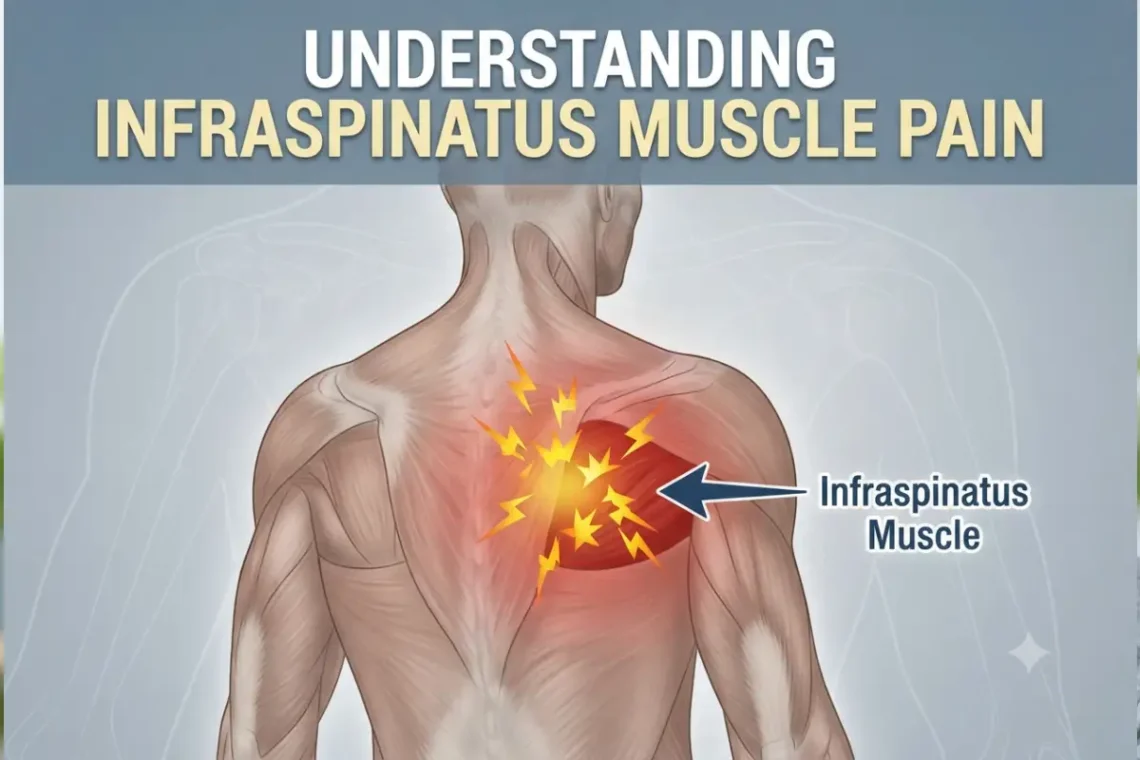
Pain in the infraspinatus muscle presents as aching, tender, weak or sore behind the shoulder and shoulder blade, The infraspinatus is part of the rotator cuff and id irritated or inflammation of the tendon thus makes any movements such as stretching or turning around, putting on a coat or side sleeping.
The good news is that shoulder problems are often treatable early on with activity modification and rehab. The bad news is that if pain persists or is associated with weakness or triggered by an injury, evaluation by a professional is indicated.
What Is the Infraspinatus Muscle?
The Infraspinatus muscle is one of the 4 muscles of the rotator cuff muscle. It is situated on the posterior part of scapula and helps in external rotation of the humerus and stabilization of the shoulder-joint.
The four rotator-cuff muscles are:
- Supraspinatus
- Infraspinatus
- Teres minor
- Subscapularis
The infraspinatus works during activities such as throwing, swimming, lifting, reaching and rotating the arm. Repeated or excessive loading can irritate the muscle or its tendon.
Infraspinatus Pain: Common Patterns
| Possible problem | What may help | Typical features |
| Muscle strain/overuse | Relative rest and gradual return to movement | Local aching or tenderness after increased activity |
| Tendinopathy | Progressive rehabilitation | Pain with shoulder use, weakness or stiffness |
| Rotator-cuff tear | Professional assessment | Pain plus noticeable weakness, sometimes after injury |
| Trigger-point pain | Individualized physical therapy | Tender spot with possible referred shoulder/arm pain |
| Nerve involvement | Medical evaluation | Pain with weakness, numbness or altered sensation |
These patterns can overlap, so symptoms alone cannot confirm the exact cause.
What Causes Infraspinatus Muscle Pain?
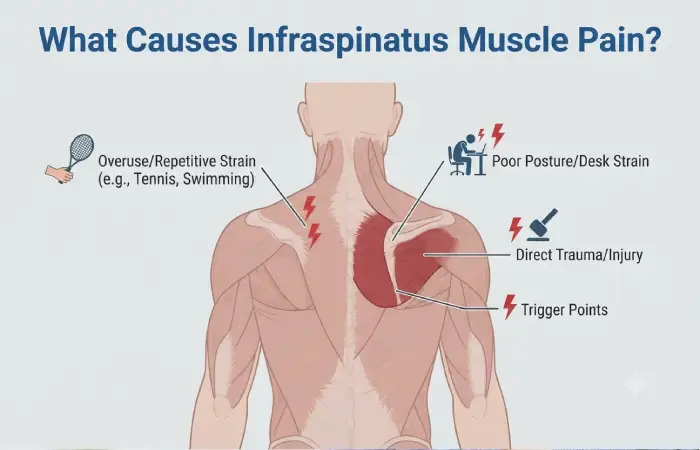
A variety of conditions may lead to pain at or near the infraspinatus:
Overuse and Repetitive Movement
The following activities can overload your rotator cuff with some examples. Throws, swimming, tennis, lifting or lifting here as a general term for any exertion involving the shoulder.
Sudden increases in training volume or jumping back into exercising after a long layoff can also overload the muscle.
Infraspinatus Tendinopathy
Tendinopathy is defined as a deterioration of a tendon resulting in pain at the site of the lesion due to changes in biochemistry and structure. It can also be a slow process with the result of pain on motion and stiffness with weakness.
Rotator Cuff Tear
The infraspinatus tendon can be torn either partially or completely. Tears may be traumatic but may also be as a result of degenerative changes.
Any new onset of pain with immediate weakness following a fall or traumatic event should be urgently evaluated.
Trigger Points and Myofascial Pain
Myofascial trigger points can produce pain around the shoulder blade and referred pain into the upper arm. Research involving people with infraspinatus trigger points found the scapular region was a common area of complaint, while referred pain frequently extended toward the front or outer portion of the upper arm.
Nerve Problems
The suprascapular nerve supplies the infraspinatus. Nerve compression or injury can contribute to shoulder pain and weakness and may sometimes cause muscle wasting.
What Does Infraspinatus Muscle Pain Feel Like?
Symptoms vary depending on the underlying problem, but common complaints include:
- Pain behind the shoulder
- Tenderness around the shoulder blade
- Aching or deep shoulder pain
- Pain when rotating the arm outward
- Shoulder weakness
- Reduced range of motion
- Pain when reaching overhead or behind the back
- Discomfort when sleeping on the affected side
- Clicking, catching or grinding sensations
Pain can also be referred away from the exact location of the muscle, which can make the source difficult to identify.
How Is Infraspinatus Pain Diagnosed?
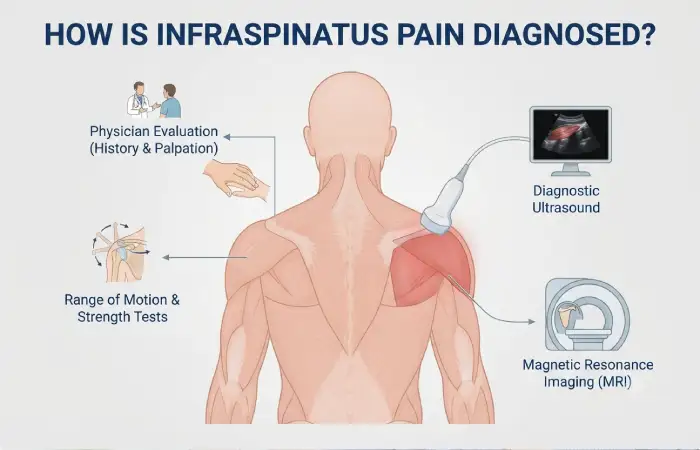
Your doctor will normally take your history and exam you. In taking your history they will enquire if injuries, when the pain started, activities which aggravate the pain, the sports or work you participate in.
The examination may assess:
- Shoulder range of motion
- External-rotation strength
- Pain during resisted movements
- Tenderness
- Shoulder stability
- Neck and nerve-related symptoms
Imaging is not always necessary. Depending on the suspected condition, an X-ray, ultrasound or MRI may be considered.
An examination of the shoulder would enable you to differentiate among an infraspinatus pathology and other shoulder pain.
How to Relieve Infraspinatus Muscle Pain
Treatment will vary according to the cause and severity.
Temporarily Modify Painful Activities
Decrease or alter movements that are obviously provoking of your pain, such as high repetition overhead activity or lifting heavy weights. This does not mean immobolize.
Use Cold or Heat Appropriately
Cold can be used if pain is experienced shortly after an aggravating activity, and soft heat if comfort in the area is required prior to movement work.
Protect your skin and do not apply too hot or too cold.
Begin Gentle Movement
Do not immobilize the shoulder in a highly restrictive sling for extended time without medical advice.
The use of gentle, comfortable movement may help to maintain mobility.
Progressive Exercise
In existing clinical practice directions for rotator-cuff tendinopathy, active management may involve motor-control and/or resistance exercises. Loading should be modified according to pain, strength and aims.
Common rehabilitation exercises may include:
- Pendulum movements
- Gentle external rotation
- Scapular-control exercises
- Progressive rotator-cuff strengthening
Exercises should be performed within an appropriate level of discomfort rather than forcing painful movements.
Pain Medication
Some people may experience short term pain relief from OTC pain medicines such as topical, acetaminophen or NSAIDS. These should not be taken by everyone, and should be used as indicated on the packaging. Before use, check with a doctor or pharmacist if you have other health conditions or are taking other medication.
When Should You See a Healthcare Professional?
Consult a healthcare professional if the pain continues, worsens, recurs over and over, or prevents normal activity and sleeping.
Obtain a prompt assessment following injury if you suddenly develop severe pain or instantaneous weakness.
Urgent assessment should be obtained if you are unable to move the arm, there is marked swelling or deformity of the shoulder, numbness persists and the sensation is lost, or if you feel unwell with the shoulder pain.
Infraspinatus Muscle Pain vs. Other Shoulder Pain
Since several shoulder problems can have similar symptoms, it would be wrong to presume that pain behind the shoulder is necessarily a result of an infraspinatus injury.
It may be that pain extends towards the shoulder for instance in neck problems. Similarly, other rotator-cuff pathologies, bursitis, arthritis and labral problems may have common symptomatology.
A thorough assessment is crucial under the following conditions; particularly if weakness is pronounced, or symptoms started immediately after injury.
Key Takeaway
Infraspinatus pain could be due to overuse, tendinitis, rotator-cuff tear, myofascial pain or nerve related. The site of pain cannot alone determine the cause of pain.
For many of the non-traumatic rotator-cuff problems, advice and activity modification and remedial exercises are an important part of management. Pain which remains, marked weakness or symptoms following injury should be investigated by a trained health professional.
Afiya Jafar is a fitness and wellness writer who focuses on making health, exercise, and healthy lifestyle information simple and practical. Her work covers workouts, fitness motivation, strength training, nutrition, weight management, stress management, mindfulness, and everyday wellness.
Read Full Bio of Afiya Jafar →
Sameena Begum reviews selected health, wellness, fitness, and digital content for clarity, factual presentation, consistency, and reader usefulness. Her review work helps maintain clear and responsible editorial standards across PhysicalFitt content.
Read Full Bio of Sameena Begum →
Dr. Khizrana Begum is a qualified medical professional with MBBS and MD qualifications and 5+ years of experience in the medical field. She works as a General Physician and Dermatologist, with expertise in general medicine, dermatology, preventive healthcare, and skin health.
Read Full Bio of Dr. Khizrana Begum →