
 Afiya Jafar
Fitness & Wellness Writer
Afiya Jafar is a fitness and wellness writer who focuses on making health, exercise, and healthy lifestyle information simple and practical.
Read Full Bio of Author →
Afiya Jafar
Fitness & Wellness Writer
Afiya Jafar is a fitness and wellness writer who focuses on making health, exercise, and healthy lifestyle information simple and practical.
Read Full Bio of Author →
 Sameena Begum
Health, Fitness & Digital Content Reviewer
Sameena reviews selected health, wellness, fitness, and digital content for clarity, factual presentation, and reader usefulness.
Read Full Bio of Reviewer →
Sameena Begum
Health, Fitness & Digital Content Reviewer
Sameena reviews selected health, wellness, fitness, and digital content for clarity, factual presentation, and reader usefulness.
Read Full Bio of Reviewer →
 Dr. Khizrana Begum
General Physician & Dermatologist
Dr. Khizrana Begum is a General Physician and Dermatologist with MBBS and MD qualifications and 5+ years of experience in the medical field.
Read Full Bio of Medical Reviewer →
Dr. Khizrana Begum
General Physician & Dermatologist
Dr. Khizrana Begum is a General Physician and Dermatologist with MBBS and MD qualifications and 5+ years of experience in the medical field.
Read Full Bio of Medical Reviewer →
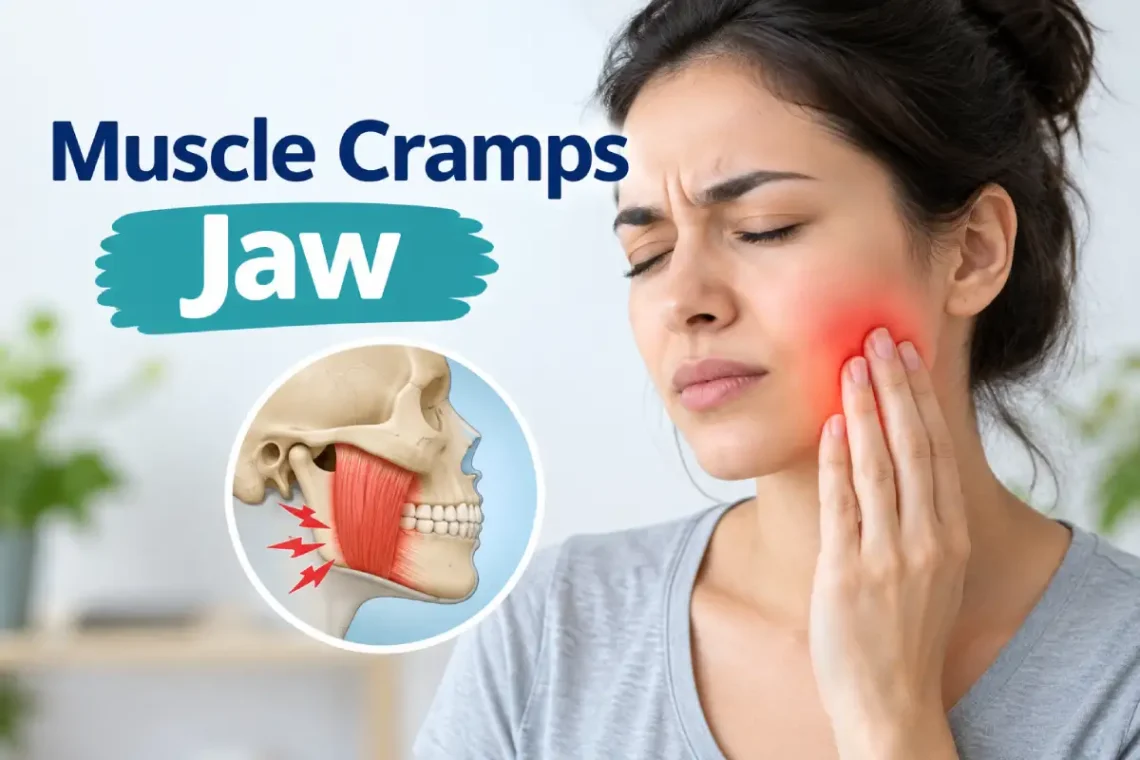
Jaw muscle cramps can be experienced as the sudden tightness or hardening, twitching or painful contraction of the muscles around the cheeks, temples or just below the lower jaw. Muscle cramps involving the jaw tend to be of a transient nature and are sometimes associated with muscle overuse, clenching, stress, dehydration or jaw-joint disorders. Persistent and severe cramping may be associated with an underlying medical or dental disorder.
Other muscles in the jaw that are used for chewing and speech are the masseter and temporalis muscles. If these muscles contract involuntarily and should not, and are unable to relax to a normal tone, you may experience a spasm or cramp.
Medical term for a tight jaw that does not allow the mouth to open easily is trismus.
What Does a Jaw Muscle Cramp Feel Like?
A jaw cramp can vary from mild tightness to a painful contraction.
Common symptoms include:
- Sudden tightening of the jaw
- Pain or aching in the cheek muscles
- Difficulty opening the mouth normally
- A feeling that the jaw is “stuck”
- Muscle twitching around the cheek or temple
- Pain when chewing
- Jaw stiffness
- Tenderness around the temporomandibular joint
- Pain that spreads toward the ear, temple, face, or neck
Trismus can cause jaw muscles to become tight enough to restrict mouth opening. Cleveland Clinic notes that a typical mouth opening is roughly 40–60 mm, while trismus can substantially reduce this range.
Common Causes of Muscle Cramps in the Jaw
There is no one single cause. What triggers the cramp can depend on whether the cramp is post chewing, under stress, with other associated symptoms or recurring in the absence of any triggers.
Jaw Clenching and Teeth Grinding
Regularly grinding your teeth can cause fatigue of the muscles which move the jaw.
Certain individuals have their jaw tight during the day without notice while others grind their teeth at night. Gradually over time this can cause muscle fatigue and tenderness and spasms.
NIDCR encourages patient to minimize habits of jaw clenching, gum chewing and nail biting while taking care to use tissues to prevent streaking.
Excessive Chewing

Prolonged bouts of gum chewing, eating hard foods, or consuming significantly larger quantities of food than usual can fatigue the masseter and other muscles of mastication.
If you experience cramping in the jaw after eating or prolonged chewing, you might be experiencing transient muscular fatigue.
Stress and Muscle Tension
Stress may cause unconscious jaw clenching. This can cause the muscles involved with chewing to remain slightly contracted for long periods of time.
A helpful tip is if the tight feeling in your jaw becomes worse whenever you are under stress, and then gets better when you try consciously to relax your face.
Dehydration and Electrolyte Imbalance
Muscle cramps all over the body can be caused by being dehydrated and having a deficiency of electrolytes, such as calcium, magnesium or potassium.
The dehydration itself could further be used as a causative factor of cramps as well.
But don‘t believe all jaw cramps mean you need a magnesium supplement. Ongoing or unexplained cramping should be investigated rather than masked with supplements.
Temporomandibular Disorders
Temporomandibular disorders, or TMD, affect the jaw joints and/or the muscles responsible for jaw movement.
Possible symptoms include:
- Jaw-muscle pain
- Stiffness
- Limited movement
- Jaw locking
- Pain while chewing
- Pain spreading into the face or neck
NIDCR notes that TMD includes more than 30 conditions involving the jaw joints and chewing muscles.
Dental Problems or Infection
Infection of the teeth or around the mouth, recent dental treatment or inflammation around the mouth can constrict the mouth opening or make it painful to open. Trismus can follow dental treatment or be associated with certain infection.
If you experience any tooth pain, swelling, fever, pus, or trouble swallowing along with the cramping, make an appointment with a dentist or doctor instead of just at-home remedies.
Low Calcium or Other Medical Conditions
Severe deficiency of calcium may lead to cramps and, in severe deficiency, spasms or tetany. The following may be present : numbness around the lips or fingers.
Some medications and medical conditions are thought to cause muscle cramps.
Jaw Cramp Causes at a Glance
| Possible cause | What may help | Typical clues |
| Jaw clenching | Relaxation and reducing clenching | Worse during stress or concentration |
| Teeth grinding | Dental assessment | Morning jaw soreness |
| Excessive chewing | Rest and softer foods | Starts after prolonged chewing |
| Dehydration | Fluids and electrolyte replacement when appropriate | Thirst, dark urine, other cramps |
| TMD | Conservative dental/medical care | Jaw pain, clicking, stiffness or limited movement |
| Dental infection | Prompt dental treatment | Tooth pain, swelling or fever |
| Low calcium/electrolytes | Medical evaluation | Cramping elsewhere, tingling or spasms |
| Trismus | Evaluation of the underlying cause | Significant difficulty opening mouth |
| Tetanus | Urgent medical treatment | Jaw stiffness plus progressive muscle spasms |
This table summarizes recognized associations rather than diagnosing the cause of an individual’s symptoms.
How to Relieve a Jaw Muscle Cramp
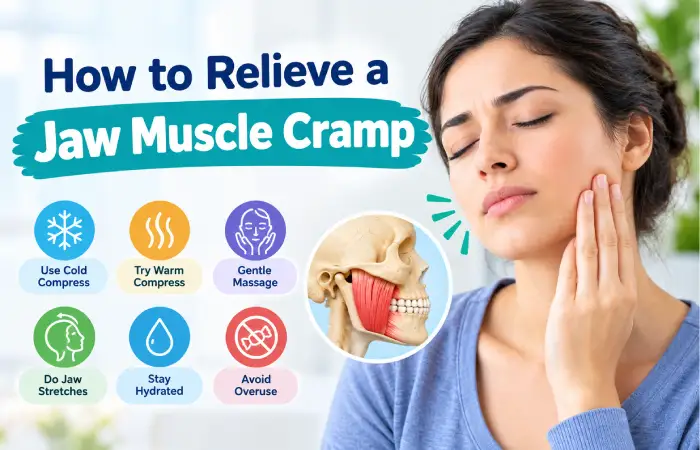
If the cramp is mild and there is no suspicious symptoms, stretching (opening the jaws) is the aim to ease the muscles, not stretching forcibly into opening of jaws.
Follow these steps:
- Cease chewing.
- Rest those jaw muscles.
- Softer jaw.
- Keep your teeth slightly apart instead of clenched.
- Utilize moderate warmth.
Cover the jaw with a moist towel that has been warmed to a comfortably warm temperature; application to the jaw relaxes tightened muscles. Cleveland Clinic favors moist heat for trismus as a home care option.
Switch to softer foods for the time being.
If consuming food is painful, sticking to softer foods that lessen jaw movement could lessen the discomfort.
Keep well in liquids.
If dehydration was the cause then fluids might do the trick.
Nausea occurs not only when the site of injection is painful, but sometimes also when the patients have eaten.) Avoid gum and hard foods.
Can increase the working load of already irritated chewing muscles.
No strenuous stretching of the locked jaw.
Aggressive stretching can aggravate injury and pain. Follow appropriate illustrated exercises as directed by a trained health professional.
The NIDCR also recommended application of conservative technique such as soft diet, heat/cold with exercises, reduction of clenching and increased gum chewing.
When Is Jaw Cramping an Emergency?
Most brief jaw cramps are not caused by life-threatening conditions. But certain patterns should not be ignored.
Seek urgent medical attention if jaw cramping occurs with:
- Difficulty breathing
- Difficulty swallowing
- Severe facial or neck swelling
- A serious facial or jaw injury
- Seizures or widespread muscle spasms
- Rapidly worsening stiffness
- Severe weakness or confusion
- Chest pressure or pain, especially if it spreads to the jaw
Jaw discomfort accompanied by chest pressure, shortness of breath, sweating, nausea or other possible heart-attack symptoms requires emergency evaluation.
What about tetanus?
Tetanus less common but very serious. Lockjaw (spasms of the muscles of the jaw) may be an initial presenting feature, then dysphagia, generalized stiffness of muscles and painful spasms.
If you acquire new jaw stiffness following a potentially contaminated wound and your tetanus inoculation status is either not current or unknown, and go to healthcare_PROVIDER.
Muscle Cramps Jaw vs. TMD vs. Trismus
These terms can overlap, but they aren’t interchangeable.
| Feature | TMD | Jaw muscle cramp | Trismus |
| What it describes | Group of jaw-joint/muscle disorders | Sudden muscle contraction | Restricted mouth opening |
| May be temporary? | Yes | Yes | Depends on cause |
| Pain possible? | Common | Yes | Common |
| Difficulty opening mouth | Possible | Sometimes | Characteristic |
| Can have multiple causes? | Yes | Yes | Yes |
| Requires diagnosis? | Often if persistent | Not always | Usually when significant |
NIDCR defines TMD as a group of conditions affecting the jaw joints and/or chewing muscles, while trismus refers to restricted mouth opening associated with tight or spasming jaw muscles.
Bottom Line
Cramping of the muscles of the jaw may result from overuse of the muscles, clenched muscles, stress, dehydration and muscle disorder, but there are a number of causes for this complaint. Simple episodes of mild cramping will usually resolve in time with rest, fluid intake and warm compresses; persistent or severe hot compresses.
The single most important point is not to think every jaw spasm is “lockjaw”. Trismus is a clinical sign that may be caused by various diseases. Tetanus is a specific, serious infective disease. Tetanus spasms are often associated with progressive rigidity and other distant muscle spasms, all of which need urgent treatment.
Afiya Jafar is a fitness and wellness writer who focuses on making health, exercise, and healthy lifestyle information simple and practical. Her work covers workouts, fitness motivation, strength training, nutrition, weight management, stress management, mindfulness, and everyday wellness.
Read Full Bio of Afiya Jafar →
Sameena Begum reviews selected health, wellness, fitness, and digital content for clarity, factual presentation, consistency, and reader usefulness. Her review work helps maintain clear and responsible editorial standards across PhysicalFitt content.
Read Full Bio of Sameena Begum →
Dr. Khizrana Begum is a qualified medical professional with MBBS and MD qualifications and 5+ years of experience in the medical field. She works as a General Physician and Dermatologist, with expertise in general medicine, dermatology, preventive healthcare, and skin health.
Read Full Bio of Dr. Khizrana Begum →